Note 10 — Chapter XXII · IRON, COBALT, AND NICKEL
George Kamensky translation
This direct process of separating the carbon from cast iron is termed puddling. It is conducted in reverberatory furnaces. The cast iron is placed on the bed of the furnace and melted; through a special aperture, the puddler stirs up the oxidising mass of cast iron, pressing the oxides into the molten iron. This resembles kneading dough, and the process introduced in England became known as puddling. It is evident that the puddled mass, or bloom, is a heterogeneous substance obtained by mixing, and hence one part of the mass will still be rich in carbon, another will be poor, some parts will contain oxide not reduced, &c. The further treatment of the puddled mass consists in hammering and drawing it out into flat pieces, which on being hammered become more homogeneous, and when several pieces are welded together and again hammered out a still more homogeneous mass is obtained. The quality of the steel and iron thus formed depends principally on their uniformity. The want of uniformity depends on the oxides remaining inside the mass, and on the variable distribution of the carbon throughout the mass. In order to obtain a more homogeneous metal for manufacturing articles out of steel, it is drawn into thin rods, which are tied together in bundles and then again hammered out. As an example of what may be attained in this direction, imitation Damascus steel may be cited; it consists of twisted and plaited wire, which is then hammered into a dense mass. (Real damascened wootz steel may be made by melting a mixture of the best iron with graphite (1⁄12) and iron rust; the article is then corroded with acid, and the carbon remains in the form of a pattern.)
Steel and wrought iron are manufactured from cast iron by puddling. They are, however, obtained not only by this method but also by the bloomery process, which is carried out in a fire similar to a blacksmith's forge, fed with charcoal and provided with a blast; a pig of cast iron is gradually pushed into the fire, and portions of it melt and fall to the bottom of the hearth, coming into contact with an air blast, and are thus oxidised. The bloom thus formed is then squeezed and hammered. It is evident that this process is only available when the charcoal used in the fire does not contain any foreign matter which might injure the quality of the iron or steel—for instance, sulphur or phosphorus—and therefore only wood charcoal may be used with impunity, from which it follows that this process can only be carried on where the manufacture of iron can be conducted with this fuel. Coal and coke contain the above-mentioned impurities, and would therefore produce iron of a brittle nature, and thus it would be necessary to have recourse to puddling, where the fuel is burnt on a special hearth, separate from the cast iron, whereby the impurities of the fuel do not come into contact with it. The manufacture of steel from cast iron may also be conducted in fires; but, in addition to this, it is also now prepared by many other methods. One of the long-known processes is called cementation, by which steel is prepared from wrought iron but not from cast iron. For this process strips of iron are heated red-hot for a considerable time whilst immersed in powdered charcoal; during this operation the iron at the surface combines with the charcoal, which however does not penetrate; after this the iron strips are re-forged, drawn out again, and cemented anew, repeating this process until a steel of the desired quality is formed—that is, containing the requisite proportion of carbon. The Bessemer process occupies the front rank among the newer methods (since 1856); it is so called from the name of its inventor. This process consists in running melted cast iron into converters (holding about 6 tons of cast iron)—that is, egg-shaped receivers, fig. 94, capable of revolving on trunnions (in order to charge in the cast iron and discharge the steel), and forcing a stream of air through small apertures at a considerable pressure. Combustion of the iron and carbon at an elevated temperature then takes place, resulting from the bubbles of oxygen thus penetrating the mass of the cast iron. The carbon, however, burns to a greater extent than the iron, and therefore a mass is obtained which is much poorer in carbon than cast iron. As the combustion proceeds very rapidly in the mass of metal, the temperature rises to such an extent that even the wrought iron which may be formed remains in a molten condition, whilst the steel, being more fusible than the wrought iron, remains very liquid. In half an hour the mass is ready. The purest possible cast iron is used in the Bessemer process, because sulphur and phosphorus do not burn out like carbon, silicon, and manganese.
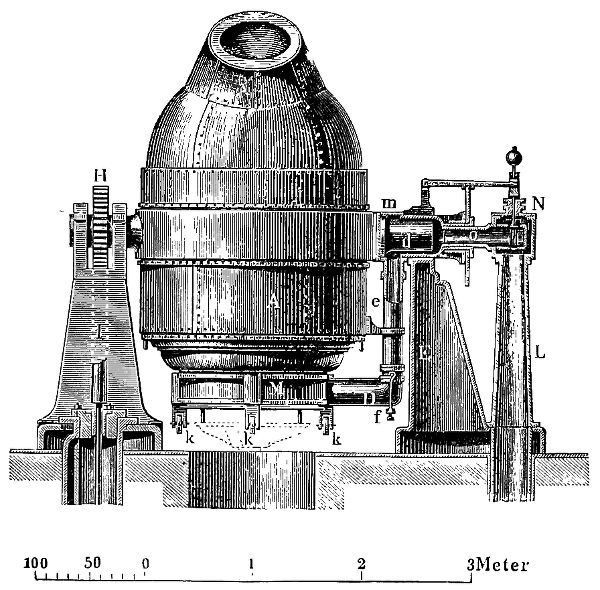
Fig. 94.—Bessemer converter, constructed of iron plate and lined with ganister. The air is carried by the tubes, L, O, D to the bottom, M, from which it passes by a number of holes into the converter. The converter is rotated on the trunnion d by means of the rack and pinion H, when it is required either to receive molten cast iron from the melting furnaces or to pour out the steel.
The presence of manganese enables the sulphur to be removed with the slag, and the presence of lime or magnesia, which are introduced into the lining of the converter, facilitates the removal of the phosphorus. This basic Bessemer process, or Thomas Gilchrist process, introduced about 1880, enables ores containing a considerable amount of phosphorus, which had hitherto only been used for cast iron, to be used for making wrought iron and steel. Naturally the greatest uniformity will be obtained by re-melting the metal. Steel is re-melted in small wind furnaces, in masses not exceeding 30 kilos; a liquid metal is formed, which may be cast in moulds. A mixture of wrought and cast iron is often used for making cast steel (the addition of a small amount of metallic Al improves the homogeneity of the castings, by facilitating the passage of the impurities into slag). Large steel castings are made by simultaneous fusion in several furnaces and crucibles; in this way, castings up to 80 tons or more, such as large ordnance, may be made. This molten, and therefore homogeneous, steel is called cast steel. Of late years the Martin's process for the manufacture of steel has come largely into use; it was invented in France about 1860, and with the use of regenerative furnaces it enables large quantities of cast steel to be made at a time. It is based on the melting of cast iron with iron oxides and iron itself—for instance, pure ores, scrap, &c. There the carbon of the cast iron and the oxygen of the oxide form carbonic oxide, and the carbon therefore burns out, and thus cast steel is obtained from cast iron, providing, naturally, that there is a requisite proportion and corresponding degree of heat. The advantage of this process is that not only do the carbon, silicon, and manganese, but also a great part of the sulphur and phosphorus of the cast iron burn out at the expense of the oxygen of the iron oxides. During the last decade the manufacture of steel and its application for rails, armour plate, guns, boilers, &c., has developed to an enormous extent, thanks to the invention of cheap processes for the manufacture of large masses of homogeneous cast steel. Wrought iron may also be melted, but the heat of a blast furnace is insufficient for this. It easily melts in the oxyhydrogen flame. It may be obtained in a molten state directly from cast iron, if the latter be melted with nitre and sufficiently stirred up. Considerable oxidation then takes place inside the mass of cast iron, and the temperature rises to such an extent that the wrought iron formed remains liquid. A method is also known for obtaining wrought iron directly from rich iron ores by the action of carbonic oxide: the wrought iron is then formed as a spongy mass (which forms an excellent filter for purifying water), and may be worked up into wrought iron or steel either by forging or by dissolving in molten cast iron.
Everybody is more or less familiar with the difference in the properties of steel and wrought iron. Iron is remarkable for its softness, pliability, and small elasticity, whilst steel may be characterised by its capability of attaining elasticity and hardness if it be cooled suddenly after having been heated to a definite temperature, or, as it is termed, tempered. But if tempered steel be re-heated and slowly cooled, it becomes as soft as wrought iron, and can then be cut with the file and forged, and in general can be made to assume any shape, like wrought iron. In this soft condition it is called annealed steel. The transition from tempered to annealed steel thus takes place in a similar way to the transition from white to grey cast iron. Steel, when homogeneous, has considerable lustre, and such a fine granular structure that it takes a very high polish. Its fracture clearly shows the granular nature of its structure. The possibility of tempering steel enables it to be used for making all kinds of cutting instruments, because annealed steel can be forged, turned, drawn (under rollers, for instance, for making rails, bars, &c.), filed, &c., and it may then be tempered, ground and polished. The method and temperature of tempering and annealing steel determine its hardness and other qualities. Steel is generally tempered to the required degree of hardness in the following manner: It is first strongly heated (for instance, up to 600°), and then plunged into water—that is, hardened by rapid cooling (it then becomes as brittle as glass). It is then heated until the surface assumes a definite colour, and finally cooled either quickly or slowly. When steel is heated up to 220°, its surface acquires a yellow colour (surgical instruments); it first of all becomes straw-coloured (razors, &c.), and then gold-coloured; then at a temperature of 250° it becomes brown (scissors), then red, then light blue at 285° (springs), then indigo at 300° (files), and finally sea-green at about 340°. These colours are only the tints of thin films, like the hues of soap bubbles, and appear on the steel because a thin layer of oxides is formed over its surface. Steel rusts more slowly than wrought iron, and is more soluble in acids than cast iron, but less so than wrought iron. Its specific gravity is about 7·6 to 7·9.
As regards the formation of steel, it was a long time before the process of cementation was thoroughly understood, because in this case infusible charcoal permeates unfused wrought iron. Caron showed that this permeation depends on the fact that the charcoal used in the process contains alkalis, which, in the presence of the nitrogen of the air, form metallic cyanides; these being volatile and fusible, permeate the iron, and, giving up their carbon to it, serve as the material for the formation of steel. This explanation is confirmed by the fact that charcoal without alkalis or without nitrogen will not cement iron. The charcoal used for cementation acts badly when used over again, as it has lost alkali. The very volatile ammonium cyanide easily conduces to the formation of steel. Although steel is also formed by the action of cyanogen compounds, nevertheless it does not contain more nitrogen than cast or wrought iron (0·01 p.c.), and these latter contain it because their ores contain titanium, which combines directly with nitrogen. Hence the part played by nitrogen in steel is but an insignificant one. It may be useful here to add some information taken from Caron's treatise concerning the influence of foreign matter on the quality of steel. The principal properties of steel are those of tempering and annealing. The compounds of iron with silicon and boron have not these properties. They are more stable than the carbon compound, and this latter is capable of changing its properties; because the carbon in it either enters into combination or else is disengaged, which determines the condition of hardness or softness of steel, as in white and grey cast iron. When slowly cooled, steel splits up into a mixture of soft and carburetted iron; but, nevertheless, the carbon does not separate from the iron. If such steel be again heated, it forms a uniform compound, and hardens when rapidly cooled. If the same steel as before be taken and heated a long time, then, after being slowly cooled, it becomes much more soluble in acid, and leaves a residue of pure carbon. This shows that the combination between the carbon and iron in steel becomes destroyed when subjected to heat, and the steel becomes iron mixed with carbon. Such burnt steel cannot be tempered, but may be corrected by continued forging in a heated condition, which has the effect of redistributing the carbon equally throughout the whole mass. After the forging, if the iron is pure and the carbon has not been burnt out, steel is again formed, which may be tempered. If steel be repeatedly or strongly heated, it becomes burnt through and cannot be tempered or annealed; the carbon separates from the iron, and this is effected more easily if the steel contains other impurities which are capable of forming stable combinations with iron, such as silicon, sulphur, or phosphorus. If there be much silicon, it occupies the place of the carbon, and then continued forging will not induce the carbon once separated to re-enter into combination. Such steel is easily burnt through and cannot be corrected; when burnt through, it is hard and cannot be annealed—this is tough steel, an inferior kind. Iron which contains sulphur and phosphorus cements badly, combines but little with carbon, and steel of this kind is brittle, both hot and cold. Iron in combination with the above-mentioned substances cannot be annealed by slow cooling, showing that these compounds are more stable than those of carbon and iron, and therefore they prevent the formation of the latter. Such metals as tin and zinc combine with iron, but not with carbon, and form a brittle mass which cannot be annealed and is deleterious to steel. Manganese and tungsten, on the contrary, are capable of combining with charcoal; they do not hinder the formation of steel, but even remove the injurious effects of other admixtures (by transforming these admixed substances into new compounds and slags), and are therefore ranked with the substances which act beneficially on steel; but, nevertheless, the best steel, which is capable of renewing most often its primitive qualities after burning or hot forging, is the purest. The addition of Ni, Cr, W, and certain other metals to steel renders it very suitable for certain special purposes, and is therefore frequently made use of.
It is worthy of attention that steel, besides temper, possesses many variable properties, a review of which may be made in the classification of the sorts of steel (1878, Cockerell). (1) Very mild steel contains from 0·05 to 0·20 p.c. of carbon, breaks with a weight of 40 to 50 kilos per square millimetre, and has an extension of 20 to 30 p.c.; it may be welded, like wrought iron, but cannot be tempered; is used in sheets for boilers, armour plate and bridges, nails, rivets, &c., as a substitute for wrought iron; (2) mild steel, from 0·20 to 0·35 p.c. of carbon, resistance to tension 50 to 60 kilos, extension 15 to 20 p.c., not easily welded, and tempers badly, used for axles, rails, and railway tyres, for cannons and guns, and for parts of machines destined to resist bending and torsion; (3) hard steel, carbon 0·35 to 0·50 p.c., breaking weight 60 to 70 kilos per square millimetre, extension 10 to 15 p.c., cannot be welded, takes a temper; used for rails, all kinds of springs, swords, parts of machinery in motion subjected to friction, spindles of looms, hammers, spades, hoes, &c.; (4) very hard steel, carbon 0·5 to 0·65 p.c., tensile breaking weight 70 to 80 kilos, extension 5 to 10 p.c., does not weld, but tempers easily; used for small springs, saws, files, knives and similar instruments.
The properties of ordinary wrought iron are well known. The best iron is the most tenacious—that is to say, that which does not break up when struck with the hammer or bent, and yet at the same time is sufficiently hard. There is, however, a distinction between hard and soft iron. Generally the softest iron is the most tenacious, and can best be welded, drawn into wire, sheets, &c. Hard, especially tough, iron is often characterised by its breaking when bent, and is therefore very difficult to work, and objects made from it are less serviceable in many respects. Soft iron is most adapted for making wire and sheet iron and such small objects as nails. Soft iron is characterised by its attaining a fibrous fracture after forging, whilst tough iron preserves its granular structure after this operation. Certain sorts of iron, although fairly soft at the ordinary temperature, become brittle when heated and are difficult to weld. These sorts are less suitable for being worked up into small objects. The variety of the properties of iron depends on the impurities which it contains. In general, the iron used in the arts still contains carbon and always a certain quantity of silicon, manganese, sulphur, phosphorus, &c. A variety in the proportion of these component parts changes the quality of the iron. In addition to this the change which soft wrought iron, having a fibrous structure, undergoes when subjected to repeated blows and vibrations is considerable; it then becomes granular and brittle. This to a certain degree explains the want of stability of some iron objects—such as truck axles, which must be renewed after a certain term of service, otherwise they become brittle. It is evident that there are innumerable intermediate transitions from wrought iron to steel and cast iron.
At the present day the greater part of the cast iron manufactured is converted into steel, generally cast steel (Bessemer's and Martin's). I may add the Urals, Donetz district, and other parts of Russia offer the greatest advantages for the development of an iron industry, because these localities not only contain vast supplies of excellent iron ore, but also coal, which is necessary for smelting it.