Note 8 — Chapter XXII · IRON, COBALT, AND NICKEL
George Kamensky translation
The section of a blast furnace is represented by two truncated cones joined at their bases, the upper cone being longer than the lower one; the lower cone is terminated by the hearth, or almost cylindrical cavity in which the cast iron and slag collect, one side being provided with apertures for drawing off the iron and slag. The air is blown into the blast furnace through special pipes, situated over the hearth, as shown in the section. The air previously passes through a series of cast-iron pipes, heated by the combustion of the carbonic oxide obtained from the upper parts of the furnace, where it is formed as in a ‘gas-producer.’ The blast furnace acts continuously until it is worn out; the iron is tapped off twice a day, and the furnace is allowed to cool a little from time to time so as not to be spoilt by the increasing heat, and to enable it to withstand long usage.
Blast furnaces worked with charcoal fuel are not so high, and in general give a smaller yield than those using coke, because the latter are worked with heavier charges than those in which charcoal is employed. Coke furnaces yield 20,000 tons and over of pig iron a year. In the United States there are blast furnaces 30 metres high, and upwards of 600 cubic metres capacity, yielding as much as 130,000 tons of pig iron, requiring a blast of about 750 cubic metres of air per minute, heated to 600°, and consuming about 0·85 part of coke per 1 part of pig iron produced. At the present time the world produces as much as 30 million tons of pig iron a year, about 9/10 of which is converted into wrought iron and steel. The chief producers are the United States (about 10 million tons a year) and England (about 9 million tons a year); Russia yields about 1⅕ million tons a year. The world's production has doubled during the last 20 years, and in this respect the United States have outrun all other countries. The reason of this increase of production must be looked for in the increased demand for iron and steel for railway purposes, for structures (especially ship-building), and in the fact that: (a) the cost of pig iron has fallen, thanks to the erection of large furnaces and a fuller study of the processes taking place in them, and (b) that every kind of iron ore (even sulphurous and phosphoritic) can now be converted into a homogeneous steel.
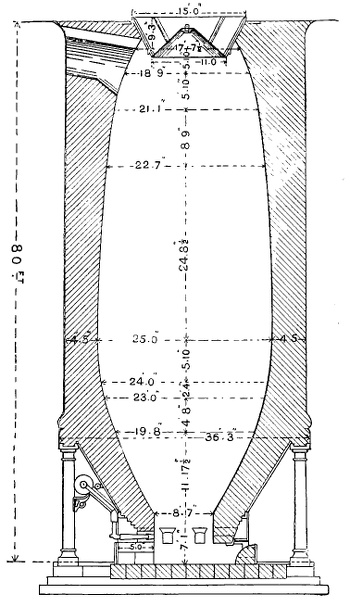
Fig. 93.—Vertical section of a modern Cleveland blast furnace capable of producing 300 to 1,000 tons of pig iron weekly. The outer casing is of riveted iron plates, the furnace being lined with refractory fire-brick. It is closed at the top by a ‘cap and cone’ arrangement, by means of which the charge can be fed into the furnace at suitable intervals by lowering the moveable cone.
In order to more thoroughly grasp the chemical process which takes place in blast furnaces, it is necessary to follow the course of the material charged in at the top and of the air passing through the furnace. From 50 to 200 parts of carbon are expended on 100 parts of iron. The ore, flux, and coke are charged into the top of the furnace, in layers, as the cast iron is formed in the lower parts and flowing down to the bottom causes the whole contents of the furnace to subside, thus forming an empty space at the top, which is again filled up with the afore-mentioned mixture. During its downward course this mixture is subjected to increasing heat. This rise of temperature first drives off the moisture of the ore mixture, and then leads to the formation of the products of the dry distillation of coal or charcoal. Little by little the subsiding mass attains a temperature at which the heated carbon reacts with the carbonic anhydride passing upwards through the furnace and transforms it into carbonic oxide. This is the reason why carbonic anhydride is not evolved from the furnace, but only carbonic oxide. As regards the ore itself, on being heated to about 600° to 800° it is reduced at the expense of the carbonic oxide ascending the furnace, and formed by the contact of the carbonic anhydride with the incandescent charcoal, so that the reduction in the blast furnace is without doubt brought about by the formation and decomposition of carbonic oxide and not by carbon itself—thus, Fe2O3 + 3CO = Fe2 + 3CO2. The reduced iron, on further subsidence and contact with carbon, forms cast iron, which flows to the bottom of the furnace. In these lower layers, where the temperature is highest (about 1,300°), the foreign matter of the ore finally forms slag, which also is fusible, with the aid of fluxes. The air blown in from below, through the so-called tuyeres, encounters carbon in the lower layers of the furnace, and burns it, converting it into carbonic anhydride. It is evident that this develops the highest temperature in these lower layers of the furnace, because here the combustion of the carbon is effected by heated and compressed air. This is very essential, for it is by virtue of this high temperature that the process of forming the slag and of forming and fusing the cast iron are effected simultaneously in these lower portions of the furnace. The carbonic acid formed in these parts rises higher, encounters incandescent carbon, and forms with it carbonic oxide. This heated carbonic oxide acts as a reducing agent on the iron ore, and is reconverted by it into carbonic anhydride; this gas meets with more carbon, and again forms carbonic oxide, which again acts as a reducing agent. The final transformation of the carbonic anhydride into carbonic oxide is effected in those parts of the furnace where the reduction of the oxides of iron does not take place, but where the temperature is still high enough to reduce the carbonic anhydride. The ascending mixture of carbonic oxide and nitrogen, CO2, &c., is then withdrawn through special lateral apertures formed in the upper cold parts of the furnace walls, and is conducted through pipes to those stoves which are used for heating the air, and also sometimes into other furnaces used for the further processes of iron manufacture. The fuel of blast furnaces consists of wood charcoal (this is the most expensive material, but the pig iron produced is the purest, because charcoal does not contain any sulphur, while coke does), anthracite (for instance, in Pennsylvania, and in Russia at Pastouhoff's works in the Don district), coke, coal, and even wood and peat. It must be borne in mind that the utilisation of naphtha and naphtha refuse would probably give very profitable results in metallurgical processes.
The process just described is accompanied by a series of other processes. Thus, for instance, in the blast furnace a considerable quantity of cyanogen compounds are formed. This takes place because the nitrogen of the air blast comes into contact with incandescent carbon and various alkaline matters contained in the foreign matter of the ores. A considerable quantity of potassium cyanide is formed when wood charcoal is employed for iron smelting, as its ash is rich in potash.