Note 4 — Chapter XVII · BORON, ALUMINIUM, AND THE ANALOGOUS METALS OF THE THIRD GROUP
George Kamensky translation
How it is that these vapours containing boric acid are formed in the interior of the earth is at present unknown. Dumas supposes that it depends on the presence of boron sulphide, B2S3 (others think boron nitride), at a certain depth in the earth. This substance may be artificially prepared by heating a mixture of boric acid and charcoal in a stream of carbon bisulphide vapour, and by the direct combination of boron and the vapour of sulphur at a white heat. The almost non-crystalline compound B2S3, sp. gr. 1·55, thus obtained is somewhat volatile, has an unpleasant smell, and is very easily decomposed by water, forming boric acid and hydrogen sulphide, B2S3 + 3H2O = B2O3 + 3H2S. It is supposed that a bed of boron sulphide lying at a certain depth below the surface of the earth comes into contact with sea water which has percolated through the upper strata, becomes very hot, and gives steam, hydrogen sulphide, and boric acid. This also explains the presence of ammonia in the vapours, because the sea water certainly passes through crevices containing a certain amount of animal matter, which is decomposed by the action of heat and evolves ammonia. There are several other hypotheses for explaining the presence of the vapours of boric acid, but owing to the want of other known localities the comparison of these hypotheses is at present hardly possible. The amount of boric anhydride in the vapours which escape from the Tuscan fumerolles and suffioni is very inconsiderable, less than one-tenth per cent., and therefore the direct extraction of the acid would be very uneconomical, hence the heat contained in the discharged vapours is made use of for evaporating the water. This is done in the following manner. Reservoirs are constructed over the crevices evolving the vapours, and the water of some neighbouring spring is passed into them. The vapours are caused to pass through these reservoirs, and in so doing they give up all their boric acid to the water and heat it, so that after about twenty-four hours it even boils; still this water only forms a very weak solution of boric acid. This solution is then passed into lower basins and again saturated by the vapours discharged from the earth, by which means a certain amount of the water is evaporated and a fresh quantity of boric acid absorbed; the same process is repeated in another reservoir, and so on until the water has collected a somewhat considerable amount of boric acid. The solution is drawn from the last reservoir A into settling vessels B D, and then into a series of vessels a, b, c. In these vessels, which are made of lead, the solution is also evaporated by the vapours escaping from the earth, and attains a density of 10° to 11° Baumé. It is allowed to settle in the vessel C, in which it cools and crystallises, yielding (not quite pure) crystalline boric acid. At temperatures above 100°, for instance, with superheated steam, boric acid volatilises with steam very easily.
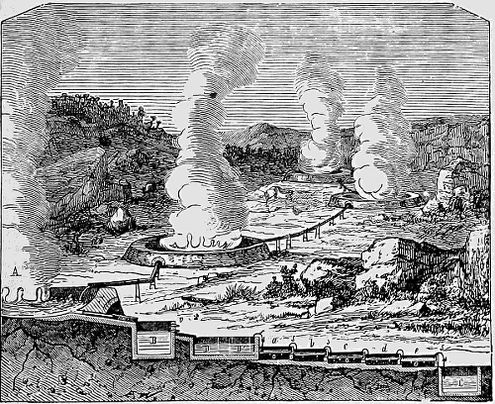
Fig. 81.—Extraction of boric acid in Tuscany.