Note 19 — PRINCIPLES OF CHEMISTRY CHAPTER XV THE GROUPING OF THE ELEMENTS AND THE PERIODIC LAW
George Kamensky translation
Carnelley found a similar dependence in comparing the melting-points of the metallic chlorides, many of which he re-determined for this purpose. The melting-points (and boiling-points, in brackets) of the following chlorides are known, and a certain regularity is seen to exist in them, although the number (and degree of accuracy) of the data is insufficient for a generalisation:—
LiCl 598° BeCl2 600° BCl3 -20°
NaCl 772° MgCl2 708° AlCl3 187°
KCl 734° CaCl2 719° ScCl2 ?
CuCl 434° ZnCl2 262° GaCl3 76°
(993°) (680°) (217°)
AgCl 451° CdCl2 541° InCl3 ?
TlCl 427° PbCl2 498° BiCl3 227°
(713°) (908°)
We will also enumerate the following data given by Carnelley, which are interesting for comparison: HCl -112° (-102°); RbCl 710°, SrCl2 825°, CsCl 631°, BaCl2 860°, SbCl3 73° (223°), TeCl2 209° (327°), ICl 27°, HgCl2 276° (303°), FeCl3 306°, NbCl5 194° (240°), TaCl3 211° (242°), WCl6 190°. The melting-points of the bromides and iodides are higher or lower than those of the corresponding chlorides, according to the atomic weight of the element and number of atoms of the halogen, as is seen from the following examples:—1. KCl 734°, KBr 699°, KI 634°; 2. AgCl 454°, AgBr 427° AgI 527°; 3. PbCl2 498° (900°), PbBr2 499° (861°), PbI2 383° (906°); 4. SnCl4 below -20° (114°), SnBr2 30° (201°), SnI4 146° (295°) (see Chapter II. Note 27, and Chapter XI. Note 47bis, &c.)
Laurie (1882) also observed a periodicity in the quantity of heat developed in the formation of the chlorides, bromides, and iodides (fig. 79), as is seen from the following figures, where the heat developed is expressed in thousands of calories, and referred to a molecule of chlorine, Cl2, so that the heat of formation of KCl is doubled, and that of SnCl4 halved, &c.: Na 195 (Ag 59, Au 12), Mg 151 (Zn 97, Cd 93, Hg 63), Al 117, Si 79 (Sn 64), K 211 (Li 187), Ca 170 (Sr 185, Ba 194), whence it is seen that the greatest amount of heat is evolved by the metals of the alkalis, and that in each period it falls from them to the halogens, which evolve very little heat in combining together. Richardson, by comparing the heats of formation of the fluorides also came to the conclusion that they are in periodic dependence upon the atomic weights of the combined elements.
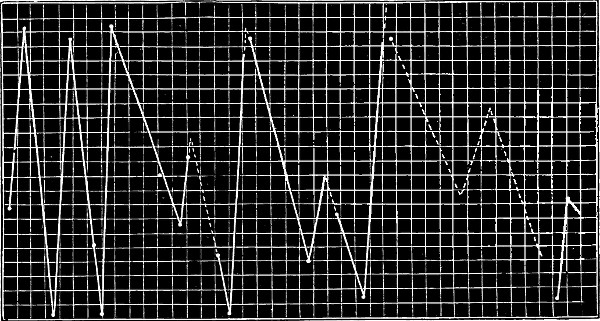
Fig. 79.—Laurie's diagram for expressing the periodic variation of the heat of formation of the chlorides. The abscissæ give the atomic weights from 0 to 210, and the ordinates the amounts of heat from 0 to 220 thousand calories evolved in the combination with Cl2, (i.e. with 71 parts of chlorine). The apices of the curve correspond to Li, Na, K, Rb, Cs, and the lower extremities to F, Cl, Br, and I.
In this respect it may not be superfluous to remark (1) that Thomsen, whose results I have employed above, observed a correlation in the calorific equivalents of analogous elements, although he did not remark their periodic variation; (2) that the uniformity of many thermochemical deductions must gain considerably by the application of the periodic law, which evidently repeats itself in calorimetric data; and if these data frequently lead to true forecasts, this is due to the periodicity of the thermal as well as of many other properties, as Laurie remarked; and (3) that the heat of formation of the oxides is also subject to a periodic dependence which differs from that of the heat of formation of the chlorides, in that the greatest quantity corresponds with the bivalent metals of the alkaline earths (magnesium, calcium, strontium, barium), and not with the univalent metals of the alkalis, as is the case with chlorine, bromine, and iodine. This circumstance is probably connected with the fact that chlorine, bromine, and iodine are univalent elements, and oxygen bivalent (compare, for instance, Chapter XI., Note 13, Chapter XXII., Note 40, Chapter XXIV., Note 28bis, &c.)
Keyser (1892), in investigating the spectra of the alkali metals and metals of the alkaline earths, came to the conclusion that in this respect also there is a regularity of a periodic character in dependence upon the atomic weights. Probably a closer and systematic study of many of the properties of the elements and of complex and simple bodies formed by them will more and more frequently lead to similar conclusions, and to extending the range of application of the periodic law.