Note 28 — Chapter I · ON WATER AND ITS COMPOUNDS
George Kamensky translation
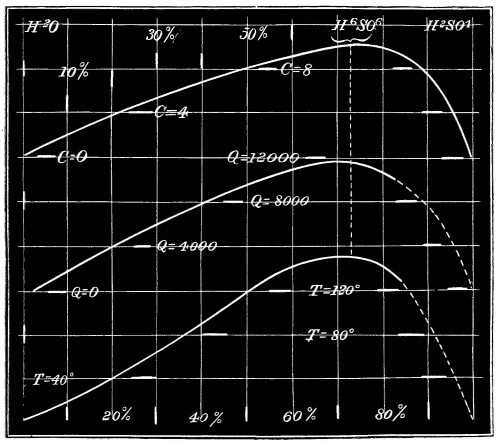
Fig. 17.—Curves expressing the contraction, quantity of heat, and rises of temperature produced by mixing sulphuric acid with water. Percentage of H2SO4 is given along the axis of abscissae.
The temperatures obtained by mixing monohydrated sulphuric acid, H2SO4, with different quantities of water, are shown on the lowest curve in fig. 17, the relative proportions of both substances being expressed in percentages by weight along the horizontal axis. The greatest rise of temperature is 149°. It corresponds with the greatest evolution of heat (given on the middle curve) corresponding with a definite volume (100 c.c.) of the solution produced. The top curve expresses the degree of contraction, which also corresponds with 100 volumes of the solution produced. The greatest contraction, as also the greatest rise of temperature, corresponds with the formation of a trihydrate, H2SO4,2H2O (= 73·1 p.c. H2SO4), which very likely repeats itself in a similar form in other solutions, although all the phenomena (of contraction, evolution of heat, and rise of temperature) are very complex and are dependent on many circumstances. One would think, however, judging from the above examples, that all other influences are feebler in their action than chemical attraction, especially when it is so considerable as between sulphuric acid and water.