Note 5 — A TREATISE ON PNEUMATICS.
Joseph George Greenwood translation
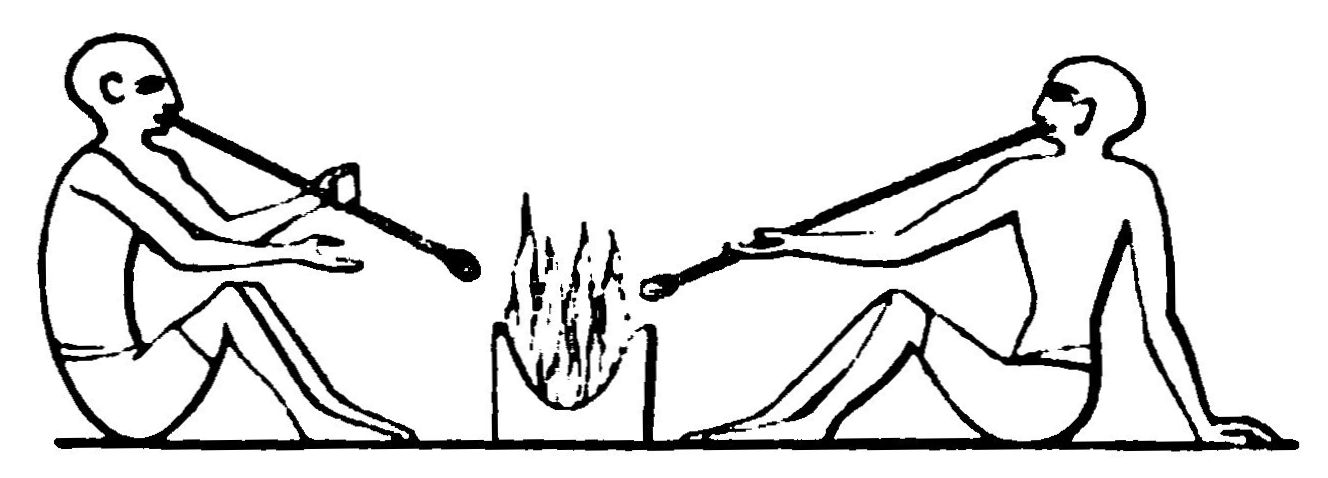
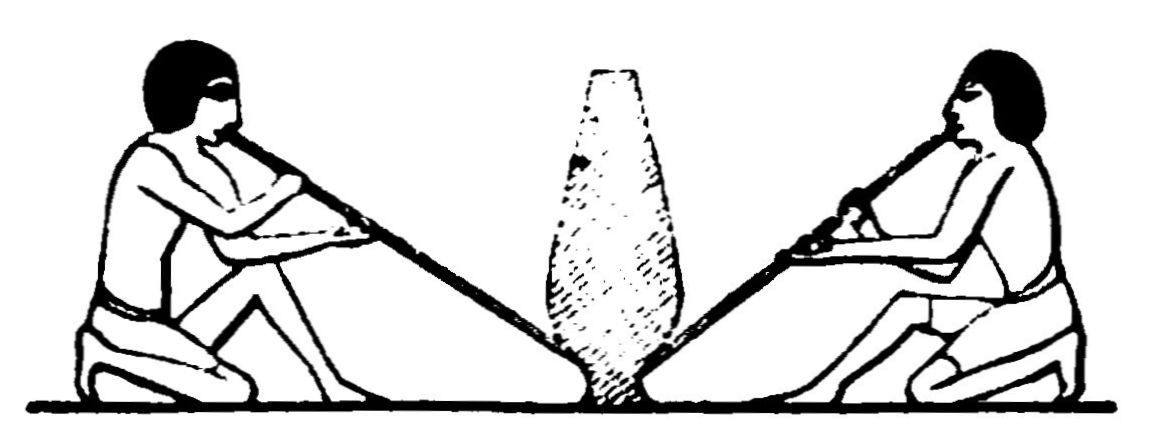
“Glass working was practised by the ancient Egyptians at a very early period of their national existence. Sir J. G. Wilkinson, in his able work on the Manners and Customs of the ancient Egyptians, has adduced three distinct proofs that the art of Glass working was practised in Egypt before the Exodus of the children of Israel from that land, three thousand five hundred years ago. At Beni Hassan are two paintings representing Glass blowers at work, and from the hieroglyphics accompanying them they are shown to have been executed in the reign of the first Osirtasen at the early date above mentioned. Such was the skill of the Egyptians in glass making, that they successively counterfeited the Amethyst and other precious stones worn as ornaments for the person. Winckelmann, a high authority, is of opinion that glass was employed more frequently in ancient than in modern times; it was used by the Egyptians even for coffins; (within the year 1847 a process was patented in England for making Coffins of Glass) they also employed it not only for drinking vessels but for Mosaic work, the figures of deities, and sacred emblems, in which they attained excellent workmanship, and surprising brilliancy of colour.
“It is certain that the glass houses of Alexandria were celebrated among the ancients for the skill and ingenuity of their workmen; and from thence the Romans, who did not acquire a knowledge of the art till a later period, procured all their Glass ware.
“Most of the large cinerary vases in the British Museum, found in Roman barrows which contained bones and bone-ashes, are, probably, the production of extensive Egyptian or Roman works: they are large, and of excellent form and workmanship: but the Glass is somewhat impure, of a greenish tint, has numerous globules and striæ, and is not unlike the modern common crown or sheet glass in quality.
“We have incidentally mentioned the discovery of Glass at Pompeii. Glass vessels have also been found among the ruins of Herculaneum: and it appears that Glass was used for admitting light to dwellings in Pompeii.
“Mr. Auldjo, of Noel house, Kensington, who resided several years at Naples, states, that he has seen glass in the window-frames of some of the houses of Pompeii.
“Mr. Roach Smith has a specimen of ancient flat Glass such as he believes to have been used by the Romans, or their predecessors for windows.”—Curiosities of Glass making by Apsley Pellat, London, 1849.
Mr. Layard in his interesting work on Nineveh, 1849, London, in Vol. I, page 342, says: “I took the instrument, and, working cautiously myself, was rewarded by the discovery of two small vases, one in alabaster, the other in glass (both in the most perfect preservation) of elegant shape, and admirable workmanship. Each bore the name and title of the Khorsabad King, written in two different ways, as in the inscriptions of Khorsabad.”