Note 68 — SECTION IV. (continued 2)
Thomas Taylor translation
Proclus was born in the year of Christ 412, on the 6th of the Ides of February. But, for the sake of the astrologers, I have subjoined the following figure from the Prolegomena of Fabricius to this life: and though I am not skilled in the art myself, I am persuaded, from the arguments of Plotinus, that it contains many general truths; but when made subservient to particulars, is liable to great inaccuracy and error. In short, its evidence is wholly of a physiognomic nature; for such is the admirable order and connection of things, that throughout the universe, one thing is signified by another, and wholes are after a manner contained in their parts. So that the language of the obscure and profound Heraclitus is perfectly just, when he says, “You must connect the perfect and the imperfect, the agreeing and the disagreeing, the consonant and the dissonant, and out of one all things, and out of all things one.”
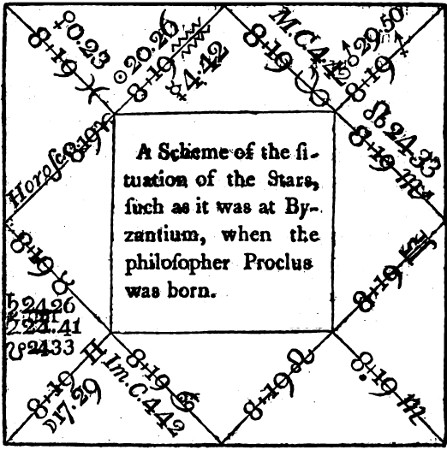
A Scheme of the situation of the Stars, such as it was at Byzantium, when the philosopher Proclus was born.