Note 24 — SECTION II.[22]
Thomas Taylor translation
We are informed by Simplicius, in his Commentary on Aristotle’s third Category of Relation, “that though the quadrature of the circle seems to have been unknown to Aristotle, yet, according to Jamblichus, it was known to the Pythagoreans, as appears from the sayings and demonstrations of Sextus Pythagoricus, who received (says he) by succession, the art of demonstration; and after him Archimedes succeeded, who invented the quadrature by a line, which is called the line of Nicomedes. Likewise, Nicomedes attempted to square the circle by a line, which is properly called τεταρτημόριον, or the quadrature. And Apollonius, by a certain line, which he calls the sister of the curve line, similar to a cockle, or tortoise, and which is the same with the quadratix of Nicomedes. Also Carpus wished to square the circle, by a certain line, which he calls simply formed from a twofold motion. And many others, according to Jamblichus, have accomplished this undertaking in various ways.” Thus far Simplicius. In like manner, Boethius, in his Commentary on the same part of Aristotle’s Categories (p. 166.) observes, that the quadrature of the circle was not discovered in Aristotle’s time, but was found out afterwards; the demonstration of which (says he) because it is long, must be omitted in this place. From hence it seems very probable, that the ancient mathematicians applied themselves solely to squaring the circle geometrically, without attempting to accomplish this by an arithmetical calculation. Indeed, nothing can be more ungeometrical than to expect, that if ever the circle be squared, the square to which it is equal must be commensurable with other known rectilineal spaces; for those who are skilled in geometry know that many lines and spaces may be exhibited with the greatest accuracy, geometrically, though they are incapable of being expressed arithmetically, without an infinite series. Agreeable to this, Tacquet well observes (in lib. ii. Geom. Pract. p. 87.) “Denique admonendi hic sunt, qui geometriæ, non satis periti, sibi persuadent ad quadraturam necessarium esse, ut ratio lineæ circularis ad rectam, aut circuli ad quadratum in numeris exhibeatur. Is sane error valde crassus est, et indignus geometrâ, quamvis enim irrationalis esset ea proportio, modo in rectis lineis exhibeatur, reperta erat quadratura.” And that this quadrature is possible geometrically, was not only the opinion of the above mentioned learned and acute geometrician, but likewise of Wallis and Barrow; as may be seen in the Mechanics of the former, p. 517 and in the Mathematical Lectures of the latter, p. 194. But the following discovery will, I hope, convince the liberal geometrical reader, that the quadrature of the circle may be obtained by means of a circle and right-line only, which we have no method of accomplishing by any invention of the ancients or moderns. At least this method, if known to the ancients, is now lost, and though it has been attempted by many of the moderns, it has not been attended with success.
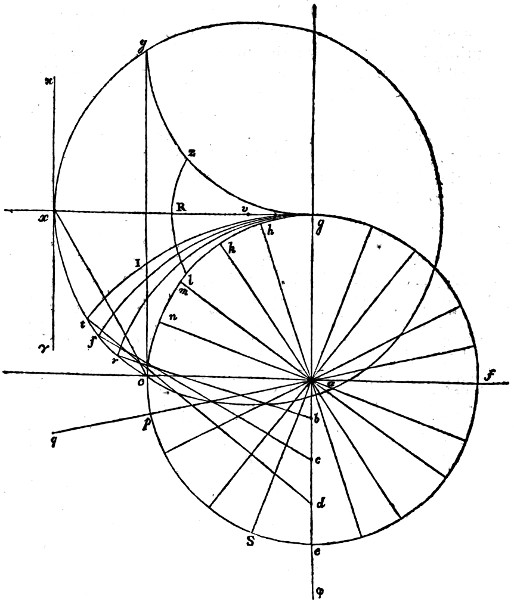
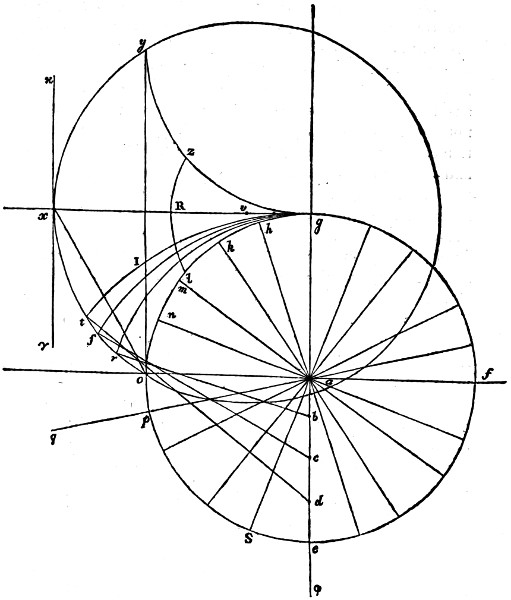
In the circle g o e f, let g o be the quadrantal arch, and the right-line g x its tangent. Then conceive that the central point a flows uniformly along the radius a e, infinitely produced; and that it is endued with an uniform impulsive power. Let it likewise be supposed, that during its flux, radii emanate from it on all sides, which enlarge themselves in proportion to the distance of the point a from its first situation. This being admitted, conceive that the point a by its impulsive power, through the radii a n, a m, &c. acting every where equally on the arch g o, impells it into its equal tangent arch g r. And when, by its uniform motion along the infinite line a φ, it has at the same time arrived at b, the centre of the arch g r, let it impel in a similar manner the arch g r, into its equal tangent arch g s, by acting every where equally through radii equal to b r. Now, if this be conceived to take place infinitely (since a circular line is capable of infinite remission) the arch g o will at length be unbent into its equal, the tangent line g x; and the extreme point o, will describe by such a motion of unbending a circular line o x. For since the same cause, acting every where similarly and equally, produces every where similar and equal effects; and the arch g o, is every where equally remitted or unbent, it will describe a line similar in every part. Now, on account of the simplicity of the impulsive motion, such a line must either be straight or circular; for there are only three lines every where similar, i. e. the right and circular line, and the cylindric helix; but this last, as Proclus well observes in his following Commentary on the fourth definition, is not a simple line, because it is generated by two simple motions, the rectilineal and circular. But the line which bounds more than two equal tangent arches cannot be a right line, as is well known to all geometricians; it is therefore a circular line. It is likewise evident, that this arch o x is concave towards the point g: for if not, it would pass beyond the chord o x, which is absurd. And again, no arch greater than the quadrant can be unbent by this motion: for any one of the radii, as a p beyond g o, has a tendency from, and not to the tangent g x, which last is necessary to our hypothesis. Now if we conceive another quadrantal arch of the circle g o e f, that is g y, touching the former in g to be unbent in the same manner, the arch x y shall be a continuation of the arch x o; for if γ x κ be drawn perpendicular to x g, as in the figure, it shall be a tangent in x to the equal arches y x, x o; because it cannot fall within either, without making the sine of some one of the equal arches, equal to the right-line x g, which would be absurd. And hence we may easily infer, that the centre of the arch y x o, is in the tangent line x g. Hence too, we have an easy method of finding a tangent right-line equal to a quadrantal arch: for having the points y, o given, it is easy to find a third point, as s; and then the circle passing through the three points o, s, y, shall cut off the tangent x g, equal to the quadrantal arch g o. And the point s may be speedily obtained, by describing the arch g s with a radius, having to the radius a g the proportion of 6 to 4; for then g s is the sixth part of its whole circle, and is equal to the arch g o. And thus, from this hypothesis, which, I presume, may be as readily admitted as the increments and decrements of lines in fluxions, the quadrature of the circle may be geometrically obtained; for this is easily found, when a right-line is discovered equal to the periphery of a circle. I am well aware the algebraists will consider it as useless, because it cannot be accommodated to the farrago of an arithmetical calculation; but I hope the lovers of the ancient geometry will deem it deserving an accurate investigation; and if they can find no paralogism in the reasoning, will consider it as a legitimate demonstration.