Note 186 — CHAP. IX. (continued 2)
Thomas Taylor translation
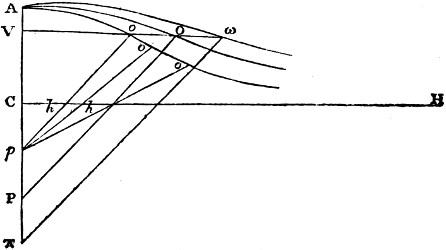
As the conchoid is a curve but little known, I have subjoined the following account of its generation and principal property. In any given right line A P, call P the pole, A the vertex, and any intermediate point C the centre of the conchoid: likewise, conceive an infinite right line C H, which is called a rule, perpendicular to A P. Then, if the right line A p continued at p as much as is necessary, is conceived to be so turned about the abiding pole p, that the point C may perpetually remain in the right line C H, the point A will describe the curve A o, which the ancients called a conchoid.
In this curve it is manifest (on account of the right line P O, cutting the rule in H that the point o will never arrive at rule C H; but because h O is perpetually equal to C A, and the angle of section is continually more acute, the distance of the point O from C H will at length be less than any given distance, and consequently the right line C H will be an asymptote to the curve A O.
When the pole is at P, so that P C is equal to C A, the conchoid A O described by the revolution of P A, is called a primary conchoid, and those described from the poles p, and π, or the curves A o, A ω, secondary conchoids; and these are either contracted or protracted, as the eccentricity P C, is greater or less than the generative radius C A, which is called the altitude of the curve.
Now, from the nature of the conchoid, it may be easily inferred, that not only the exterior conchoid A ω will never coincide with the right line C H, but this is likewise true of the conchoids A O, A o; and by infinitely extending the right-line A π, an infinite number of conchoids may be described between the exterior conchoid A ω, and the line C H, no one of which shall ever coincide with the asymptote C H. And this paradoxical property of the conchoid which has not been observed by any mathematician, is a legitimate consequence of the infinite divisibility of quantity. Not, indeed, that quantity admits of an actual division in infinitum, for this is absurd and impossible; but it is endued with an unwearied capacity of division, and a power of being diffused into multitude, which can never be exhausted. And this infinite capacity which it possesses arises from its participation of the indefinite duad; the source of boundless diffusion, and innumerable multitude.
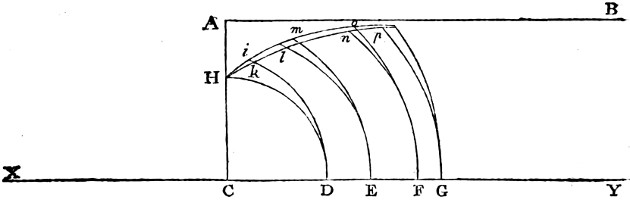
But this singular property is not confined to the conchoid, but is found in the following curve. Conceive that the right line A C which is perpendicular to the indefinite line X Y, is equal to the quadrantal arch H D, described from the centre C, with the radius C D: then from the same centre C, with the several distances C E, C F, C G, describe the arches E l, F n, G p, each of which must be conceived equal to the first arch H D, and so on infinitely. Now, if the points H, k, l, n, p, be joined, they will form a curve line, approaching continually nearer to the right-line A B (parallel to C Y) but never effecting a perfect coincidence. This will be evident from considering that each of the sines of the arches H D, l E, n F, &c. being less than its respective arch, must also be less than the right-line A C, and consequently can never coincide with the right-line A B.
But if other arches D i, E m, F o, &c. each of them equal to the right-line A C, and described from one centre, tangents to the former arches H D, l E, n F, &c. be supposed; it is evident that the points H, i, m, o, &c. being joined, will form a curve line, which shall pass beyond the former curve, and converge still nearer to the line A B, without a possibility of ever becoming coincident: for since the arches D i, E m, F o, &c. have less curvature than the former arches, but are equal to them in length, it is evident that they will be subtended by longer lines, and yet can never touch the right-line A B. In like manner, if other tangent arches be drawn to the former, and so on infinitely, with the same conditions, an infinite number of curve-lines will be formed, each of them passing between H p and A B, and continually diverging from the latter, without a possibility of ever coinciding with the former. This curve, which I invented some years since, I suspect to be a parabola; but I have not yet had opportunity to determine it with certainty.