Note 110 — CHAP. IV.
Thomas Taylor translation
The quadrature of the Lunula is as follows.
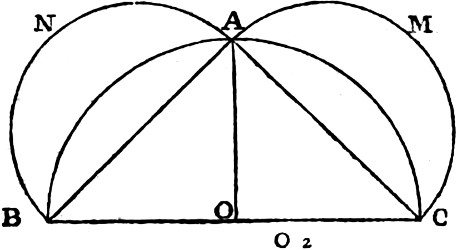
Let A B C be a right-angled triangle, and B A C a semi-circle on the diameter B C: B N A a semi-circle described on the diameter A B; A M C a semi-circle described on the diameter A C. Then the semi-circle B A C is equal to the semi-circle B N A, and A M C together: (because circles are to each other as the squares of their diameters, 31, 6.) If, therefore, you take away the two spaces B A, A C common on both sides, there will remain the two lunulas B N A, A M C, bounded on both sides with circular lines, equal to the right-angled triangle B A C. And if the line B A, be equal to the line A C, and you let fall a perpendicular to the hypotenuse B C, the triangle B A O will be equal to the lunular space B N A, and the triangle C O A will be equal to the lunula C M A. Those who are curious, may see a long account of an attempt of Hippocrates to square the circle, by the invention of the lunulas, in Simplicius on Aristotle’s Physics, lib. i.