Note 1 — INTRODUCTION
Reading edition
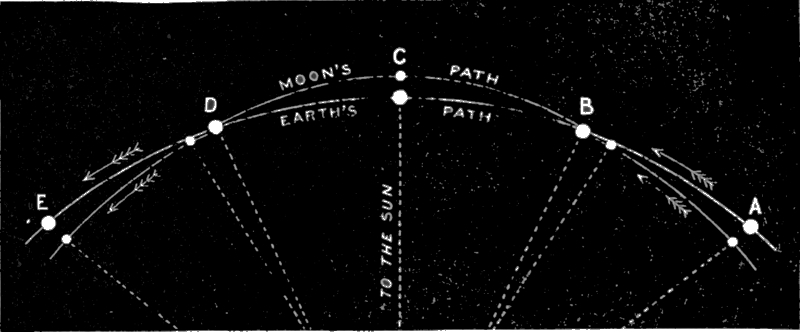
The Moon’s Path with Respect to the Sun and the Earth.
It may be well to add to what is said in the text about the orbit of the moon, that, while the moon does perform a revolution around the earth once a month, yet her orbit is drawn out, by the common motion of both earth and moon around the sun, into a long curve, whose radius is continually changing, but which is always concave toward the sun. This is illustrated in the accompanying diagram. Suppose we start with the earth at A. The moon is then between the sun and the earth, or in the phase of New Moon. The earth’s orbit at this point is more curved than the moon’s, and the earth is moving relatively faster than the moon. At B (First Quarter) the earth is directly ahead of the moon. But now the moon’s orbit becomes more curved than the earth’s and it begins to overtake the earth. At C (Full Moon) the moon has come up even with the earth, but on the opposite side from the sun. From that point to D (Last Quarter) the moon gains upon the earth until she is directly ahead of it. Then, from D to E (New Moon, once more) the earth gains until the two bodies are in the same relative positions which they occupied at A. Throughout the entire lunation, however, notwithstanding the changes which the shape of the moon’s orbit undergoes, the latter is constantly concave toward the sun. This shows that the sun’s attraction is really the governing force, and that the attraction of the earth simply serves to vary the form of the moon’s path, and cause it to move in a virtual ellipse with the earth for its focus.