Note 152 — Chapter VIII
Henry Edward Krehbiel translation
Though there is no authority for doing so it seems impossible not to associate the following three-part canon, which may be found in the B. and H. Complete Edition, with this amusing anecdote:
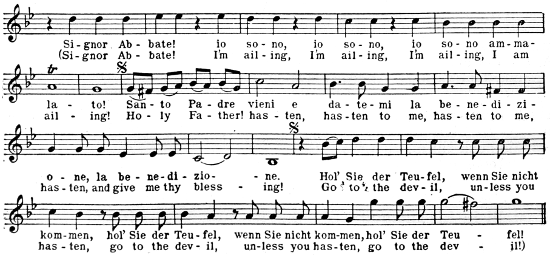
Signor Abbate! io sono, io sono, io sono ammalato! (Signor Abbate! I’m ailing, I’m ailing, I’m ailing, I am ailing! Santo Padre vieni e datemi la benedizione, la benedizione. Holy Father! hasten, hasten to me, hasten to me, hasten, and give me thy blessing! Hol’ Sie der Teufel, wenn Sie nicht kommen, hol’ Sie der Teufel, wenn Sie nicht kommen, hol’ Sie der Teufel! Go to the devil, unless you hasten, go to the devil, unless you hasten, go to the devil!)
[153] “The name is something like the breaking of an axletree,” wrote Beethoven to Haslinger in October.
[154] The description is based on that made by Thayer when he visited Gneixendorf in 1860.
[155] The romancing biographers who copy Schindler and Gerhard von Breuning in their accusations that Johann van Beethoven was prompted only by the meanest motives of self-interest in all his dealings with his great brother will have a difficult task to explain away the evidence to the contrary afforded by the Conversation Books. The proposition that the two make a common home in Vienna had come from Ludwig and been urged by him. After Johann had acquired the estate at Gneixendorf he made repeated efforts to persuade his brother to spend his summer vacation there. In 1823 Beethoven wrote: “He always wants me to come to his people—non possibile per me.” The obstacle was Johann’s wife, who had become one of “his people” because of the composer’s interference with Johann’s private affairs at Linz. Urged on by Ludwig, Johann had taken action against the woman and made himself master of his household. In a Conversation Book of 1824 may be read in Johann’s hand: “My wife has surrendered her marriage contract and entered into an obligation permitting me to drive her away without notice at the first new acquaintance which she makes.” Beethoven seems to have asked, “Why do you not do it!” for Johann continues: “I cannot do that. I cannot know but that some misfortune might befall me.” Then Karl takes the pencil: “Your brother proposes that you spend the four months at his place. You would have 4 or 5 rooms, very beautiful, high and large. Everything is well arranged; you will find fowls, oxen, cows, hares, etc. Moreover, as regards the wife, she is looked upon as a housekeeper only and will not disturb you. The scenery is glorious and it will not cost you a penny. There is a housekeeper; water containing iron, an individual bathroom, etc. If you do not take it he will give up five rooms and announce the fact in the newspapers.” Beethoven, obviously, brings forward his objection to Johann’s wife, for Karl writes: “That matter has come to an end. You will scarcely see the woman. She looks after the housekeeping and works. All the more since she is completely tamed. Besides, she has promised to conduct herself properly.” Other matters are discussed and then Johann writes: “It looks to me as if you did not want to come because it will not cost you anything. Who will look after our household affairs? Who will endure our humors?” In another book Karl writes that Johann had often said that his brother could have everything for nothing at Gneixendorf.
[156] Page 77 et seq. The article was based largely on information gathered by Mr. Thayer at Gneixendorf in 1860 and had been submitted to him for revision.
[157] Third class is what is talked about in the Conversation Books.
[158] Holz told Jahn that Schlesinger had bought it for 80 ducats and sent 360 florins in payment; whereupon Beethoven had said “If a Jew sends circumcised ducats he shall have a circumcised Quartet. That’s the reason it is so short.”
[159] Beethoven’s letters to his nephew are presented in the original in Vol. V of Thayer’s biography as completed by Dr. Deiters and revised by Dr. Riemann. Also copious extracts from the Conversation Books. These books, in Thayer’s transcript, have been consulted anew by the present writer in his presentation of the case which he believes to be in the spirit of Thayer, as he tried also to make the account of the legal controversy over the guardianship. Nevertheless, the editor believes it only right to assume full responsibility for his utterances. The letters may be found in translation in Vol. II of Mr. Shedlock’s edition of the Kalischer collection.
[160] It was Herbert Spencer who remarked to a young man who had beaten him at billiards that while to be able to play well was a praiseworthy accomplishment, such playing as he had just witnessed betokened an ill-spent life.
[161] The date was obtained by Thayer from the records of the hospital on September 22, 1862. F. Helm, then Director of the hospital, certified to the facts of reception, treatment and discharge, but stated that no history of the case could be found in the records.
[162] He did not live to see this wish fulfilled; but it was in the end. Therese van Beethoven, Johann’s wife, died on November 20, 1828, at Wasserhof; Johann died in Vienna on January 12, 1848, and though one of Beethoven’s sensation-mongering biographers at one time printed the monstrous falsehood that he had married his wife’s illegitimate daughter in order to keep the family possessions in his hands, and at another that he had invested his money so that he might use it up during his life and leave nothing to his heirs, the fact is that Johann made Karl his sole heir and that under the will, after paying the costs of probate and administration and a legacy to his housekeeper, over 42,000 florins passed into his nephew’s hands.
[163] Wawruch was a native of Nemtschütz in Moravia. At Olmütz he was a student of theology, but before consecration to the priesthood he came to Vienna as tutor and there decided to abandon the church for medicine. In the course of time he became assistant and also son-in-law to Professor Hildebrand, the director of the General Hospital. Thence he went to Prague as professor of general pathology and pharmacology and, returning to Vienna, became professor of special pathology and medical clinics in the surgical department of the Hospital. He died in 1842. He was accused of adhering to old-fashioned theories in his practice and of having been antagonistic to the determinations of pathological anatomy, and the criticisms of von Breuning and others have pursued him through all the books devoted to Beethoven’s life; yet the scientific determinations of to-day offer justification of his diagnosis and treatment of Beethoven’s case so far as it is possible to judge at this late day.
[164] Holz’s statement on this point has already been given in an earlier chapter. To Otto Jahn Dr. Bertolini said: “Beethoven liked to drink a glass of wine, but he was never a drinker or a gourmand.”
[165] “Better from my belly than from my pen,” is another remark credited to him by Seyfried.
[166] The Royal Library acquired the autograph manuscripts of the instrumental movements of the Symphony from Schindler, and the choral part from the Artaria Collection of Vienna when it was dispersed by sale in 1901. The autograph is not intact, however, the coda of the Scherzo, consisting of four pages, having been given to Moscheles by Schindler on September 14, 1827. Moscheles in turn gave the relic to Henry Phillips. In July, 1907, it was purchased at a public sale by Mr. Edward Speyer, its owner at the present writing. The autograph of the Finale, too, had been mutilated, a page containing the five measures immediately preceding the Allegro energico, 6-4 time, with the words “Über Sternen muss er wohnen,” having been removed. It was sold by an autograph dealer of Berlin to Charles Malherbe, of Paris, who on his death bequeathed it to the Conservatoire. As published, the Allegro non tanto contains eight measures which Beethoven did not write in the autograph, but are, no doubt, an addition made by him in a revision. It would be a beautiful act of piety to assemble the autograph score and publish it in facsimile.
[167] Mr. Thayer, who has given expression in these pages to his belief that Schindler was honest, in transcribing this page of the Conversation Book writes these words: “It is to be noted, first, that the writing (‘The Old Woman,’ etc.) does not correspond with the rest, and secondly, that Die Alte was no longer in Beethoven’s service. It is evident on inspection and from the talk in these last books about Thekla and other servants that Schindler inserted these words long afterwards. The ‘Es muss sein’ can only refer here to Beethoven’s receipt for the ring.” Whether or not Thayer suspected what may have been Schindler’s purpose in making the interlineation does not appear.
[168] Schindler, impeaching Dr. Wawruch’s accuracy here, denies that Beethoven worked on oratorio of “Saul and David” during his last illness. Thayer in a note directs attention to the fact that Beethoven was confessedly deeply absorbed in Handel’s scores, which he had received only a short time before, and that before the end of December Kiesewetter sent a request through Holz for a return of the pianoforte score of “Saul” as no longer necessary, now that the scores were come.
[169] Dr. von Breuning should have said “third.”
[170] Thayer procured a copy of this letter in London along with the other Stumpff papers already mentioned. Only a fragment of the letter has been printed hitherto in the collections of Beethoven’s letters and that, in great probability, from the draft preserved by Schindler. The newspaper article referred to was printed in the “Modezeitung.”
[171] “Documents, Letters etc., relating to the Bust of Ludwig van Beethoven, presented to the Philharmonic Society of London, by Frau Fanny Linzbauer (née Ponsing). Translated and Arranged for the Society by Doyne C. Bell, London: Published for the Philharmonic Society by Lamborn Cock and Co., 63 New Bond Street, W. 1871.”
[172] Schindler had accompanied Beethoven’s application to Moscheles for relief with a personal letter in which he advised that the Philharmonic Society, in case it should accede to his request, explain to Beethoven that the amount would be sent to a responsible person in Vienna from whom it might be drawn by degrees according to his requirements; and that this precautionary step was taken “because, as they well knew, some of his relations who are with him do not act quite uprightly towards him”—a fling, of course, at the composer’s brother whom he so cordially hated; the nephew was not in Vienna.
[173] Among Mr. Thayer’s papers.
[174] The third operation was performed on February 2, not January 28, as Schindler says.
[175] Wolfmayer had commissioned him years before to write a “Requiem,” and paid him for it.
[176] Letter among Mr. Thayer’s papers.
[177] Neue Folge, 1871, p. 169 et seq.
[178] “Rabelais being very sick, Cardinal du Bellay sent his page to him to have an account of his condition; his answer was, ‘Tell my Lord in what circumstances thou findest me; I am going to leap into the dark. He is up in the cockloft, bid him keep where he is. As for thee, thou’lt always be a fool: let down the curtain, the farce is done.’” ... An author (Thov. His. de Jean Clopinel) who styles Rabelais a man of excellent learning, writes, that he being importuned by some to sign a will whereby they had made him bestow on them legacies that exceeded his ability, he, to be no more disturbed, complied at last with their desires; but when they came to ask him where they should find a fund answerable to what he gave; ‘as for that,’ replied he, ‘you must do like the spaniel, look about and search’; then, adds that author, having said, ‘Draw the curtain, the farce is over,’ he died. Likewise a monk (P. de St. Romuald, Rel. Feuillant) not only tells us that he ended his life with that jest, but that he left a paper sealed up wherein were found three articles as his last will: ‘I owe much, I have nothing, I give the rest to the poor.’ The last story or that before it must undoubtedly be false; and perhaps both are so as well as the message by the page; though Fregius (Comment. in Orat. Cic., tom. I) relates also that Rabelais said when he was dying, ‘Draw the curtain,’ etc. But if he said so, many great men have said much the same. Thus Augustus (Nunquid vitæ mimum commode peregisset) near his death, asked his friends whether he had not very well acted the farce of life? And Demonax, one of the best philosophers, when he saw that he could not, by reason of his great age, live any longer, without being a burden to others, as well as to himself, said to those who were near him what the herald used to say when the public games were ended, ‘You may withdraw, the show is over,’ and refusing to eat, kept his usual gaiety to the last, and set himself at ease. (Lucian)—From Peter Motteux’s Life of Rabelais prefaced to the English translation made by himself and Sir Thomas Urquhart.
[179] In a letter to Mr. Thayer which was found among Hüttenbrenner’s posthumous papers and printed in the “Gratzer Tagespost” of October 23rd, 1868.
[180] “Aus dem Schwarzspanierhause,” p. 108.
[181] Mr. Thayer visited Hüttenbrenner in Gratz in June, 1860. His transcript of what Hüttenbrenner told him is reprinted in “Music and Manners in the Classical Period,” by Henry Edward Krehbiel (New York, 1898). The account in the body of the text is that contained in a letter to Mr. Thayer.
[182] The transcript in Mr. Thayer’s note-book of Hüttenbrenner’s oral recital is more sententious and dramatic: “At this startling, awful, peal of thunder, the dying man suddenly raised his head from Hüttenbrenner’s arm, stretched out his own right arm majestically—‘like a general giving orders to an army’. This was but for an instant; the arm sunk back; he fell back; Beethoven was dead.”
[183] The revised edition of Grove’s “Dictionary of Music and Musicians,” 1904, says: “The cold had developed into an inflammation of the lungs, and on this dropsy supervened.” Dr. Wawruch was unquestionably correct in his diagnosis not only in regard to the inflammation of the lungs but also in regard to the diseased condition of the liver.
[184] Preserved amongst Thayer’s papers.
[185] The attested inventory of the sale of Beethoven’s effects, which, preserved by Fischoff, passed through the hands of Otto Jahn into those of Mr. Thayer, showed that his estate amounted to 9,885 florins, 13 kreutzer, silver, and 600 florins, paper (Vienna standard). The market value of the bank-shares, including an unpaid coupon attached to each, was 1,063 florins on the day of Beethoven’s death. In the item of cash is included the £100 received from the London Philharmonic Society, which, as has been stated, was found intact. The official summary was set forth as follows:
Cash1215 fl. (C. M.) 600 fl. (W. W.)
Bank-shares7441 fl.
Debts receivable (annuity)144 fl. 33 k.
Jewels and silverware314 fl. 30 k.
Clothing37 fl.
Furniture and household goods156 fl.
Instruments78 fl.
Music and manuscripts480 fl. 30 k.
Books18 fl. 20 k.
9885 fl. 13 k. 600 fl. (W. W.)
According to a statement by Aloys Fuchs to Jahn the sum realized from the sale of the musical compositions, autographic and otherwise, sketch-books, etc., was 1063 florins. In view of the difference in purchasing power of money in 1827 and 1913 it may be said that Beethoven’s estate amounted to the equivalent of £3,000, or about $15,000.
[186] See “Aus dem Schwarzspanierhause,” p. 113; Hiller’s “Aus dem Tonleben, etc.” p. 177 et seq.; “Der Sammler,” April 14, 1827; Seyfried’s “Beethoven-Studien,” appendix, p. 50 et seq.
[187] The Miserere sung in the court of the Schwarzspanierhaus and its complement, Amplius lava me, were arrangements for male chorus made by Seyfried of the Equale for Trombones composed by Beethoven in Linz in 1812 at the request of Glöggl for use on All Souls’ Day. They may be found in Seyfried’s “Studien.”