Note Note 23 — § 5 EINSTEIN'S THEORY OF GRAVITATION
Henry L. (Henry Leopold) Brose translation
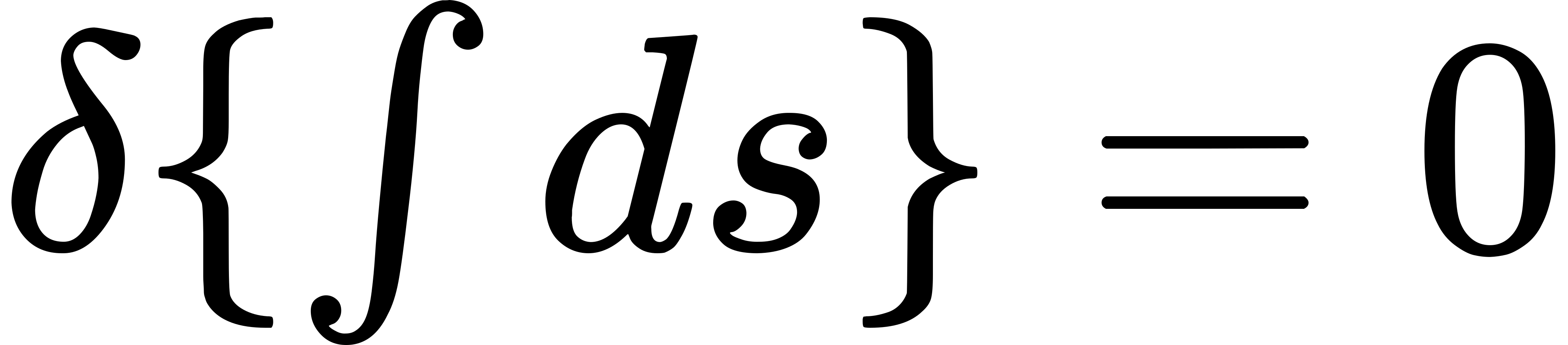
(p. 46). The equation asserts that the variation in the length of path between two sufficiently near points of the path vanishes for the path actually traversed; i.e. the path actually chosen between two such points is the shortest of all possible ones. If we retain the view of classical mechanics for a moment, the following example will give us the sense of the principle clearly: In the case of the motion of a point-mass, free to move about in space, the straight line is always the shortest connecting line between two points in space: and the point-mass will move from the one point to the other along this straight line, provided no other disturbing influences come into play (Law of inertia). If the point-mass is constrained to move over any curved surface, it will pass from one point to another along a geodetic line to the surface, since the geodetic lines represent the shortest connecting lines between points on the surface. In Einstein's theory there is a fully corresponding principle, but of a much more general form. Under the influence of inertia and gravitation every point-mass passes along the geodetic lines of the space-time-manifold. The fact of these lines not, in general, being straight lines, is due to the gravitational field, in a certain sense, putting the point-mass under a sort of constraint, similar to that imposed upon the freedom of motion of the point-mass by a curved surface. A principle in every way corresponding had already been installed in mechanics as a fundamental principle for all motions by Heinrich Hertz.