Note 30 — THE PROGRESS OF DEGRADATION. ITS HISTORY.
Reading edition
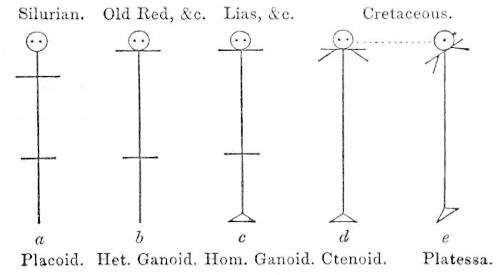
In the following diagram a few simple lines serve to exhibit the progress of degradation. Fig. a represents the symmetrical Placoids of the Silurian period, consisting of head, neck, body, tail, fore limbs and hinder limbs; fig. b represents those heterocercal Ganoids of the Old Red Sandstone, Coal Measures, and Permian System, in which the neck is extinguished, and the fore limbs stuck on to the occiput; fig. c, those homocercal Ganoids of the Trias Lias, Oolite, and Wealden, whose tails spread out into broad terminal processes, without homologue in the higher animals; fig. d, those Acanthopterygii of the Chalk that, in addition to the non-homological processes, have both fore limbs and hinder limbs stuck round the head; while fig. e represents the asymmetrical Platessa, of the same period, with one of its eyes in the middle of its head, and the other thrust out to the side.