Note 17 — CEREBRAL DEVELOPMENT OF THE EARLIER VERTEBRATA. ITS APPARENT PRINCIPLE.
Reading edition
In all probability it is likewise the principle of the placoid skull. The numerous osseous points by which the latter is encrusted, each capable of increase at the edges, seem the minute bricks of an ample dome. It is possible, however, that new points may be formed in the interstices between the first formed ones, as what anatomists term the triquetra or Wormiana form between the serrated edges of the lambdoidal suture in the human skull; and that the osseous surface of the cerebral dome may thus extend, as the dome itself increases in size, not through the growth of the previously existing pieces,—the minute bricks of my illustration,—but through the addition of new ones. Equally, in either case, however, that essential difference between the placoid skull and the placoid vertebra, to which I have referred, appears to hinge on the circumstance, that while the osseous nucleus of each vertebral centrum could form, in even its most complicated shape, from a single point, the osseous walls of the cranium had to be formed from hundreds. The accompanying diagram serves to show after what manner the vertebral centrum in the Ray enlarges with the growth of the animal, by addition of bony matter external to the point in the middle, at which ossification first begins. The horizontal lines indicate the lines of increment in the two internal cones which each centrum comprises, and the vertical ones the lines of increment in the lateral pillars.
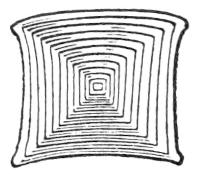
Fig. 23.
SECTION OF VERTEBRAL CENTRUM OF THORNBACK.