Note 194 — THE TRANSITION STYLE
Reading edition
There are scanty, but distinct, traces of two churches on St. Abb’s Head, about three miles north from Coldingham. They are situated about half a mile apart, one to the west of the promontory and the other to the south-east, and both stand on high cliffs overlooking the sea.
The one to the south-east, called St. Abb’s Chapel, (1) is situated in the centre of a churchyard, all the remaining tombstones of which were thrown into the sea during some law proceedings regarding the right of access by the public to St. Abb’s Head. At the time Carr wrote his History of Coldingham Priory (published 1836), the walls of the church were standing to a height of some three or four feet; now only the grass-covered foundations remain. These indicate a chancelled building, the outside dimensions of which are:—length of chancel from east to west about 21 feet, width
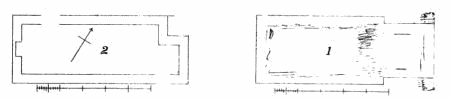
about 24 feet; length of nave 56 feet by 30 feet in width. The chancel is full of rubbish, especially at the place where the arch is usually situated; but it is not unlikely that by digging here some remains might be found sufficient to indicate the style and period of the building. From Carr’s description it appears to have been a Norman building, as he speaks of a “small Saxon arch” (the term frequently used by writers about the beginning of the century for a Norman arch) as visible in his time (p. 243).
The other chapel at St. Abb’s Head (2) is in very much the same state as the one just described, except that more of the masonry is visible. It measures, on the inside, about 69 feet long by 22 feet wide, with walls about 4 feet thick. In the centre of the west wall there is a recess, about 6 feet long by 2 feet 6 inches wide; and at the north-east corner there is a notch about 9 feet square, cut out of the chapel, as it were, forming, to all appearance, a chancel, narrower than the nave on one side instead of in the centre. The remains are very scanty.