Chapter XX · —THE MAGIC-LANTERN, AND ALL ABOUT IT. (continued 2)
Reading edition
Fasten these two wires together by passing a cord round both and tying the ends together. Sometimes the weight of the screen will cause the roller it is hung on to ‘sag’ or drop in the middle. But by tightening the cord underneath, the lower ends of the uprights will be brought towards each other, and will raise the middle of the screen roller.
To make the screen you must get some linen. This can be bought ten feet wide. Get three and a half yards of it, and have it hemmed at the top and bottom.
The top hem must be large enough for the roller to pass tightly through. The screen will get more or less creased in packing, but will come all right on being wetted and hung on the roller.
This frame is calculated for a ten-foot screen, which will be found large enough for most rooms. But it can be made for a larger one by adding one or more rods to each of the sets. The linen for a larger screen must be joined, as it is not made more than ten feet wide. In joining linen for this purpose do not let the seam come across the middle, but add an equal piece at the top and bottom, which will leave the middle of the picture clear, and the line of the join will come among the dark features of the foreground, and will not be seen so much. The tin tubes had better be varnished over with Brunswick black, as they will look better and not be liable to rust. Varnish the iron wires also.
In packing up, the screen must not be rolled on the rods, but had better be folded up by itself in paper and placed in the bottom of the box, and then the rods put in afterwards. Otherwise the screen might have some patches of Brunswick black in the middle of it.
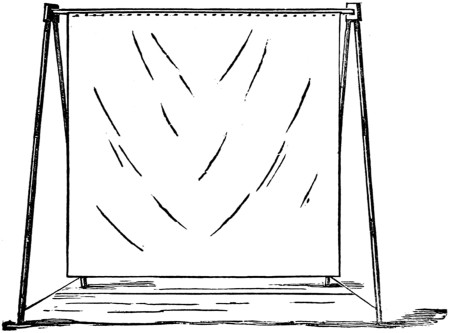
Fig. 4.
Fig. 4 is a view of the screen and frame when put together.
VI. Magic-Lantern for Opaque Slides. By W. J. Gordon.
A lantern to exhibit opaque slides or ordinary pictures on paper or cardboard is, if anything, easier to make than one of the usual type. It is nothing but a photographer’s camera with the action reversed. In the camera the large well-lighted object is focussed down by the lens into the miniature copy in the darkened box; in the lantern the miniature in the well-lighted box is focussed up into the enlarged copy in the darkened room.
The essentials are, a good lens, a good light, and a well-focussed, well-illuminated picture. Any ordinary box will do. Its shape and size are of little moment, but the box must be blacked inside and have the top replaced by or covered with tin or sheet-iron. Let it be, as we have to make one, say eighteen inches long and two feet high. The depth of the lantern depends on the focal length of the lens you have chosen for it. This lens can be either a plain magnifying-glass, such as is used in cheap lanterns of the common build, or it may be compound, of the sort used in portrait cameras. The compound lens will give the best results. Suppose we are dealing with a three-inch lens having a focal length of ten inches, our box should then be ten inches deep. Very much smaller boxes with less powerful lenses can of course be made, and they will act just as satisfactorily.
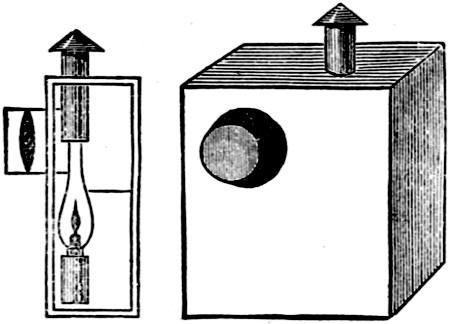
Fig. 1.
The top, as we have said, should be covered with tin, to prevent its catching fire, and it should be fitted with a chimney made by bending a sheet of tin and soldering its edges together. In order that a circle of light may not be thrown on to the ceiling, a cap must be fitted over the top so as to leave ample space for the passage of the heated air. In the front of the box a tube must be fitted, just large enough to hold another tube, in which the lens is held, and by this contrivance perfect adjustment of the focus is assured.
Arrange the interior as shown in the sketches, which are so numerous and self-explanatory that lengthened description is not required. The only peculiarity is in the back, which is so made to prevent a flood of light being thrown out behind each time a picture is changed. There are two doors to it, one being just a quarter the size of the other, and having a piece of wood of the same size fixed on at right angles of it, on the same principle as is seen in many mahogany birdcages where the inside flap of the seed or water-carrier just fills the hole made for the real door when the real door is open. The slide-carrier is marked A, and when the door is shut the marked side of the shade (B) fits close up against the side of the box. The lamp is placed as shown, and should be just far enough from the lens to thoroughly light up the picture without permitting itself to be seen. A paraffin lamp is the best, and it should if possible have a round argand wick; but a flat one will do fairly well. The round shape of the wick is suggested as giving in the majority of instances the most equable light. The bottom of the door should be cut away slightly or perforated, as in the sketch, so as to allow air to enter freely, as no lamp will burn without a draught.
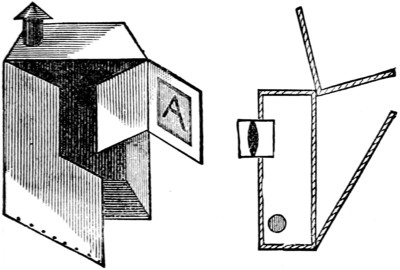
Fig. 2.
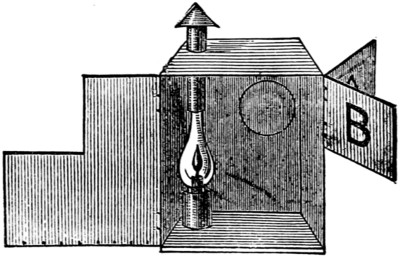
Fig. 3.
It is a good plan to try the chimney on the top before the top is fixed on, and then if the top is left a little larger all round than will be required it can be shifted about until the proper position of the lamp with regard to the lens and slides can be found by experiment, and all risk of failure avoided. When the correct distance is found the top should be screwed down and trimmed to shape. Inside the box, below the chimney, a ring or stop should be screwed to prevent the lamp slipping about in the event of the lantern receiving a sudden knock.
In another form of this lantern the back is in one piece, and the slides are introduced through a slit at the side, a plan, however, having a few disadvantages. The principle of the opaque-slide lantern is apparent at a glance, and once that is understood no difficulty should arise in devising many patterns of the instrument and utilising old materials for the purpose. Any pictures can be shown, coloured or uncoloured; even our own designs in this book can be thrown on the screen with good effect.