Note 42 — Chapter XV · YORKTOWN
Reading edition
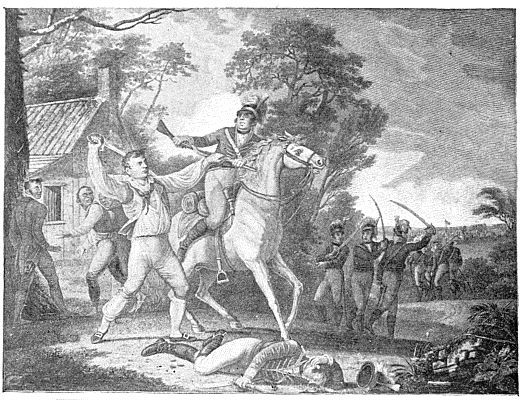
FRANCISCO’S SKIRMISH WITH TARLETON’S DRAGOONS
Just after the fight at Green Spring Tarleton made a raid through Amelia county and as far as Bedford, a hundred miles west of Petersburg. One of the incidents of this raid was made the subject of an engraving that was published in 1814 and soon became a familiar sight on the walls of public coffee-rooms and private parlours. Peter Francisco was a Portuguese waif, an indentured servant of Anthony Winston. As he grew to manhood his strength was such that he could lift upon his shoulder a cannon weighing half a ton, and his agility was equally remarkable. He entered the Continental service in 1777, in his seventeenth year, and fought at Brandywine, Germantown, Fort Mifflin, Monmouth, Stony Point, Camden, Cowpens, and Guilford, where he was wounded and left for dead. Plenty of life remained in him, however. On a July day, somewhere in Amelia county, alone and unarmed, he fell in with nine of Tarleton’s dragoons, one of whom demanded his shoe-buckles. “Take them off yourself,” said the quick-witted fellow-countryman of Magellan. As the man stooped to do the unbuckling, the young giant snatched away his sword and crushed in his skull with a single blow. Then quickly turning he slew two others, one of whom sat on horseback snapping a musket at him. At this moment Tarleton’s troop of 400 men appeared in the distance, whereupon the astute Francisco shouted in tremendous voice some words of command as if to an approaching party of his own. The six unhurt dragoons, who happened to be dismounted, were dazed with the sudden fury of Francisco’s attack, and at his deafening yell they fled in a panic, leaving their horses. These things all happened in the twinkling of an eye. Then Francisco vaulted into the saddle of one of the horses, seized the others by their bridles, and made off through the woods to Prince Edward Court House, where he sold all the horses save one noble charger which he named Tarleton and kept as his pet for many years. See Winston’s Peter Francisco, Soldier of the Revolution, Richmond, 1893.
The above incidents are epitomized in the picture without much regard to accuracy.