Editorial note — Directions for the order of carving Fowl.
Reading edition
The printed book combined two systems of page numbering. Throughout the book, the first four recto (odd, right-hand) pages of each 16-page signature are labeled as A, A2, A3... These are shown in the right margin. The left margin shows continuous page numbers, beginning with signature C (p. 1) and continuing through the end of the recipes (p. 461). In signature T, all page numbers were offset by 4 (261-276 for 257-272). The printed number is shown in (parentheses) followed by the corrected number in italics. Where there are no page numbers, folio numbers added by the transcriber are shown in [brackets].
Many compound words occur in up to three forms: with hyphen; as two separate words; and as a single unhyphenated word. Hyphens at line break were retained unless the word was consistently hyphenless elsewhere. Missing spaces between words were supplied when unambiguous.
beatten; Dear (for Deer); galon; oatmel; somtimes
These spellings are rare but each occurs at least once.
Boyled
The spelling with “y” occurs only in the header for Section I. Both “boil’d” and “boiled” are used in the body text.
lay a lay of ...
The word “layer” also occurs, but “lay” is more common.
Rabit
Note that the word is consistently spelled with one “b” except in the Index.
Snite
Probably a variant of “Snipe”, but in some books it is understood as a different bird.
roast, toast
Both words can be applied to meats.
give it a walm
The word “walm” is always used in this construction. It appears to mean “bring to a boil”. Some occurrences of “warm” may be errors for “walm”.
In several places, text at the beginning of a page was corrected from the catchword on the previous page:
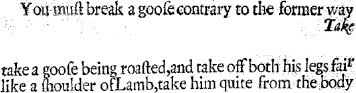
A. You must break a goose contrary to the former way. Take a goose being roasted...
Text as printed at page break: