II. ETHNOLOGY. (continued 3)
Reading edition
Κύπρον Φοινίκην τε καὶ Αἰγυπτίους ἐπαληθεῖς[394].
The pseudo-Ulysses sails from Crete to Egypt[395], and returns thence to Phœnicia, in one tale, and afterwards starts for Libya by Crete; in another legend, he is given over from Egypt to Cyprus; and Antinous[396], in the Seventeenth Odyssey, replying to the supposed beggar-man, says, Get out of the way,
μὴ τάχα πικρὴν Αἴγυπτον καὶ Κύπρον ἵκηαι.
We already know the connection of Crete with Greece from the Iliad: and thus it appears as on the high road from Greece to Phœnicia, and by Phœnicia to Egypt. The unexampled populousness of that island would, as a matter of course, beget migration; and, of all the tracts lying to the west of the Ægean, the Thessalian plain would, from its extent, offer perhaps the greatest encouragement to agricultural settlers. The traditions reported by Herodotus from Dodona connect that place closely with Egypt and the East, and the route now supposed by Crete establishes that connection in what is probably the simplest and most obvious line.
The continental country from Thessaly to the north and east was held as it would appear to a great extent by a martial and highland race Θρῇκες and Θρηίκιοι. It is not likely that the Pelasgians had much in common with that people, or could make their way to Greece either with or in despite of them. Perhaps the coast where we find Cicones and Pæones apart from the Thracians, may have afforded a route, and we must remember the traditional traces of them both on the coast of the Hellespont and in the islands[397].
This may be the place most convenient for observing, that there can be little hesitation in regarding the northern route as that by which the Hellic tribes came into Greece. They, a highland people, came along a mountain country. They left their name upon the Hellespont, the sea of Helle, which means not the mere strait so called in later times, but the whole northern Ægean[398]; and upon the river Selleeis, which discharges itself into the sea of Marmora. We first hear of them in Homer at the extreme north of Thessaly: then we find them giving their name, Hellas, to that country, or to some part of it. The people of Hellas, when their connection with their sires of the mountain had become faint in comparison with their relation to the territory they occupied, called themselves Hellenes, from the region they inhabited; and lost sight, as it were, of the ruder parent tribe. In the meantime, they had struck out offshoots through Greece, and the name Hellas had, as will be seen[399], probably come, even in the time of Homer, to be applied in a secondary and comprehensive sense to the whole northern and central parts of it.
Peloponnesus the seat of power.
It is remarkable and undeniable, with reference both to Pelasgic and to Hellenic times, that in whatever part of the country ruling tribes or families might first make their appearance, the permanent seat of power for Greece was uniformly in the Peloponnesus. Every movement of political importance appears to direct itself thither, and there to rest in equilibrium. The old tradition of Pelasgus, the dynasties of Danaids, Perseids, and Pelopids, the great Heraclid and Doric invasion, evidently aiming at laying hold on the centre of dominion, and yet more, that Spartan primacy (ἡγεμονία), which endured for so many centuries, all tell the same tale; finally the train of evidence is crowned by the strong local sympathies of Juno. It was only in the fifth century before the Christian era that Athens acquired the lead: nor did she keep it long. Her sway, after an interval, was followed by another shortlived ascendancy, that of Thebes, in the fourth century. But Greece ended as she had begun: and the last splendours of her national sentiment and military courage were flung from its pristine seats in Peloponnesus: from Lacedæmon, and Achaia. The old Amphictyonic Union alone remained, throughout the historic times of Greece, to bear witness to the fact that it was in the north of the Isthmus, and above all in Thessaly, that the Hellic tribes first organised themselves as distinct political integers, united in substance, if not in form, in respect of their common religious worship, and their common blood.
It was probably greater security, which gave this advantage, in early times, to Southern over Northern and Midland Greece. Only one narrow neck of land led into the Peloponnesus, and that passage was so circuitous, or dangerous, or both, that it was not the highway of immigrant tribes, who seem usually to have crossed the Corinthian gulf into Elis. This tract of land had not indeed the whole, but it had much, of the advantage enjoyed by England. It was not quite, but it was almost,
A precious stone, set in the silver sea, Which serves it in the office of a wall, Or as a moat defensive to a house[400].
When reached, it was the highway to nothing. The fat lands of Bœotia were a road onwards for all who came from Thessaly: there was here a choice between barrenness and poverty, on the one hand, like those of Attica in early times, and insecurity of tenure in the rich soils, which were the object of desire to each tribe as it went upon its march. The Peloponnesus was richer than the one, far more secure than the other: it throve accordingly; and in the Trojan war this small territory supplied four hundred and thirty ships, probably including the greatest number of large vessels, while the other two divisions of continental Greece together gave no more than five hundred and thirty. And it seems to have had altogether a more vigorous and concentrated political organisation; for while the five hundred and thirty were in fifteen divisions, under twenty-six leaders, the Peloponnesian force was in six divisions, under nine leaders only, and of the six three at least, namely, those of Mycenæ, Lacedæmon, and Arcadia, were virtually under the direct command of Agamemnon.
Derivation of the Pelasgian name.
Various derivations have been suggested for the name of the Pelasgi. Some will have it to come from Peleg, mentioned in the tenth chapter of Genesis, whose name, said to mean division, is taken to allude to the partition of the earth’s surface among the various tribes of the human race. Marsh well observes, that this amounts to no more than possibility: that the meaning of the word will not serve to attach it to the Pelasgi in particular, as in the early ages of the world migration, with partition and repartition, was a continuous process: and that, even if true, it tells us nothing of them antecedent to their European settlement[401]: nothing, that is to say, of a material kind, except what we know independently of it, viz. their being, in common with all other races, of eastern origin. Clinton gives other reasons for rejecting this etymology[402], while he sees force in the reference of the names of Iapetus and Ion to Japheth and Javan respectively. It seems plain that we could not safely build upon even a complete similarity of name, in a case where the interval of time that separates Peleg and Pelasgi, the terms we are to compare, is so vast and so obscure.
So also the name πελαργοὶ, meaning storks, has been taken to be the foundation of Πελασγοί; and the explanation has been given, that the stork is a migratory bird, and that the Pelasgi were called after it on account of their wanderings.
This explanation, which seems worse than the former, rests in part upon a statement of Herodotus misconstrued. He calls the Dorians ἔθνος πουλυπλάνητον κάρτα[403], and this has been erroneously applied to the Pelasgians, of whom, on the contrary, he says, οὐδαμῆ κω ἐξεχώρησε. This statement from a writer of the age of Herodotus, fully neutralises the statement of Dionysius, who describes them as itinerant, and never securely settled[404]. He may, indeed, mean no more than Thucydides means, when he says (i. 2), that the occupants of good soils were the most liable to dispossession. But does this idea of itinerancy correspond with the migrations of the stork, which seem to have reference to the steady periodical variations of climate, and to be as far as possible from the idea implied in ‘much-roving?’
It appears to have been the understood characteristic of that bird, to draw to and dwell about the settled habitations of men. It seems highly improbable, and without precedent, that a widely spread nation should take its name from a bird: but may not the bird have taken its name from the nation? If it were a nation emphatically of settlers, as opposed to pirates, robbers, nomads, and rovers of all kinds, dwelling with comfort in fixed abodes, as opposed to the ἀνιπτόποδες χαμαίευναι[405], might not birds, which seemed to share these settlements, be reasonably named after the people?
It by no means appears as if Aristophanes, in the passage where he uses the term, intended a mere pun. It is in the comedy of the Birds[406], and is an allusion to that law of the Athenians, evidently here signified under the name of storks, which required children to provide for their parents[407]. The passage is clearly a testimony to the Pelasgic origin of the Athenians: and it may be based upon the belief, that the storks took their name from the Pelasgi, and that the similarity lay in their habit of settling on the roofs of houses and the like, almost as if inhabitants, in the villages of which the Pelasgi were the first Greek founders. It also gives room for the conjecture that Πελαργοὶ may have been the old form of the name. The stork, it may be remembered, was one of the sacred birds of the Egyptians.
Again, the word πέλαγος has been suggested as supplying the true derivation of the Pelasgian name. Marsh[408] rejects it, because he conceives it is founded upon the hypothesis that the Pelasgi came across the Ægean, which he thinks improbable. But the evidence appears to be in favour of their having come principally by the islands, if not at once across the Ægean. It may also be questioned, whether the etymology must rest on this hypothesis exclusively. For, in the first place, the more natural construction would be, not that they came by sea, but that they came from beyond sea, an idea which might very well attach to any people of Asiatic origin. So it was that the too famous Pelagius, who is known to have been a Welshman, came by his classical name; a name bearing that very signification[409]. But is it not also possible, that πέλαγος may at one time have had the meaning of a plain? It properly signifies a wide open level surface, corresponding with the Latin æquor, and with our main. Hence Homer never attaches to the word πέλαγος any of his usual epithets for the sea, such as οἴνοψ, ἠχηεὶς, μεγακήτης, ἀτρύγετος, πολύφλοισβος; but only μέγα, great: and he uses the phrase ἅλος ἐν πελάγεσσι[410], which would be mere tautology, if πέλαγος properly and directly meant the sea. So Pindar has πόντιον πέλαγος, Æschylus ἃλς πελαγία, and Apollonius Rhodius πέλαγος θαλάσσης[411]. There were in Macedonia, as we learn from Strabo, a people called Pelagones[412], and in Homer we find the names Πελάγων and Πηλέγων. Again, we have in Hesychius, among the meanings of πελαγίζειν, ψεύδεσθαι μεγάλα, and for πέλαγος he gives μέγεθος, πλῆθος, βύθος; as well as πλάτος θαλάσσης. It seems not impossible that the Pelasgi may owe their name to the word πέλαγος, in its primary sense of plain and open surface: as the word Θρῇξ, in this view its exact counterpart, was derived from τρῆχυς, and at one time meant simply the inhabitant of a rough and rocky place, a mountaineer or highlander.
There is, however, another mode in which Πελασγοὶ may bear the sense of inhabitants of the plain, or rather (for it is in this that the word will most comprehensively apply to them, and most closely keep to its proper meaning), of the cultivable country, which would include valleys as well as plains properly so called: and indeed this derivation, suggested by K. O. Müller, is the simplest possible, if only we can clear the first step, which assumes the identity of Πελασγοὶ and Πελαργοί. He says it is compounded of πέλω and ἄργος. The first meaning of πέλω seems to imply motion with repetition or custom. Afterwards it is to be, and especially to be wont to be. Thus it will, while yet very near its fountain, have the sense, to frequent or inhabit. To the same origin he refers πόλις, πολέω; and also the πελώρια, the harvest feast of Thessaly, taken as the feast of inhabitation[413] or settlement.
The subject of this name will again come into view, when the later name of Ἀργεῖοι is examined. In the mean time, let it be observed, that if the Pelasgi were thus called from being, or if only they in fact were, inhabitants of the plains, we find in this some further explanation of the tradition, which can hardly have been an unmixed error, of their vagrant character. For the plains contained the most fertile soils: and, especially as they were of limited extent, their inhabitants could not but rapidly increase, so as to require more space for the support of their population. Further, these rich tracts offered a prize to all the tribes who were in want of settlements; according to the just observation of Thucydides[414], already quoted, that the most fertile parts of Greece, namely, Bœotia, Thessaly, and much of Peloponnesus, most frequently changed hands. This would be more and more applicable to a given people, in proportion as it might be more addicted to peaceful pursuits. Manifestly, it is as inhabitants of the plains, or the cultivable country, that Homer especially marks the Pelasgi: both by calling the great plain of Thessaly Pelasgic, and by the epithet ἐριβώλαξ which he applies (Il. ii. 841, and xvii. 301), to their Larissa, on the only two occasions when he mentions it. And the etymological inquiry seems, upon the whole, to direct us, although the particular path be somewhat uncertain, towards a similar conclusion.
SECT. IV. On the Phœnicians, and the Outer Geography of the Odyssey.
The Phœnicians.
The text of Homer appears to afford presumptions, if not of close affinity between the Phœnician and Hellenic races, yet of close congeniality, and of great capacity for amalgamation; although the former were of Semitic origin.
The Phœnician name, as may be seen from Strabo, was widely spread through Greece: even in Homer we find the word Φοίνιξ already used, (1) for a Phœnician, (2) for a Greek proper name, (3) for purple, and (4) for the palm tree (Od. v. 163).
We find the ancient family of Cadmus established as a dynasty in Bœotia, about the same time, according to the common opinion, with the earliest appearances of the Hellenic race in the Greek peninsula. We have no reason to suppose that they were themselves of Hellic extraction: but we find them invested with the same marks of political superiority as the Hellenic families, and figuring among the Greek sovereigns in successive generations. They must have ejected previous occupants: for Amphion and Zethus first settled and fortified Thebes, and they were the sons of Jupiter and Antiope[415].
Ino Leucothee, the daughter of Cadmus, was already a deity in the time of Homer. She appears in that capacity to Ulysses, when he is tossed upon the waters between Ogygia and Phæacia; that is to say, when he was still beyond the limits of the Greek or Homeric world, and within the circle of those traditions, lying in the unknown distance, which the Greeks could only derive from the most experienced and daring navigators of the time; namely, the Phœnicians. This appears to mark Ino herself, and therefore her father Cadmus, as of Phœnician birth. And accordingly we may set down the position of this family in Greece, as the earliest token of relations between Phœnicia and Greece.
It is followed by one more significant still, and more clearly attested in Homer. Minos, a Phœnician, appears in Crete and founds an empire: he marries his daughter Ariadne to the Athenian hero Theseus; and so quickly does this empire assume the national character, that in the time of the Troica, Hellenic races are established in the island, the Cretan troops are numbered without distinction among the followers of Agamemnon; and Idomeneus, only the grandson of Minos, appears to be as Grecian as any of the other chiefs of the army. The grandfather himself is appointed to act as judge over the shades of Greeks in the nether world[416]: and his brother Rhadamanthus has a post of great dignity, if of inferior responsibility, in being intrusted with the police of Elysium[417].
Nowhere is Homer’s precision more remarkable, than in the numerous passages where he appears before us as a real geographer or topographer. Indeed, by virtue of this accuracy, he enables us to define with considerable confidence the sphere of his knowledge and experience; by which I mean not only the countries and places he had visited, but those with respect to which he had habitual information from his countrymen, and unrestricted opportunities of correcting error. In the direction of the west, it seems plain that he knew nothing except the coast of Greece and the coastward islands. Phæacia hangs doubtfully upon his horizon, and it is probable that he had only a very general and vague idea of its position. Towards the north, there is nothing to imply, that his experimental knowledge reached beyond the Thracian coast and, at the farthest, the Sea of Marmora. He speaks of Ida, as if its roots and spurs comprised the whole district, of which in that quarter he could speak with confidence[418]. To the east, he probably knew no region beyond Lycia on the coast of Asia Minor, and to the south Crete was probably his boundary: though he was aware, by name at least, of the leading geographical points of a maritime passage, not wholly unfrequented, to the almost unknown regions of Cyprus, Phœnicia, and Egypt. The apparent inconsistency however of his statements[419] respecting the voyage to Egypt, affords proof that it lay beyond the geographical circle, within which we are to consider that his familiar knowledge and that of his nation lay.
While he is within that circle, he is studious alike of the distances between places, the forms of country, and the physical character of different districts: but, when he passes beyond it, he emancipates himself from the laws of space. The points touched in the voyage of Ulysses are wholly irreconcilable with actual geography, though national partialities have endeavoured to identify them with a view to particular appropriation. Some of them, indeed, we may conceive that he mentally associated with places that had been described to him: nay, he may have intended it in all: but the dislocated knowledge, which alone even the navigators of the age would possess, has suffered, by intent or accident, such further derangement in its transfer to the mind of Homer, that it is hopeless to adjust his geography otherwise than by a free and large infusion of fictitious drawing. This outer sphere is, however, peopled with imagery of deep interest. For the purposes of the poem, the whole wanderings both of Menelaus and Ulysses lie within it, and beyond the limits of ordinary Greek experience. And throughout these wanderings the language of Homer is that of a poet who, as to facts, was at the mercy of unsifted information; of information which he must either receive from a source not liable to check or scrutiny, or else not receive at all: and who wisely availed himself of that character of the marvellous with which the whole was overspread, to work it up into pictures of the imagination, which were to fill both his contemporaries and all succeeding generations with emotions of interest and wonder.
Limits of Greek navigation.
In Homer we find that Greek navigation already extends, yet it is very slightly, beyond the limits of Greek settlement. The Pseudo-Ulysses of the Fourteenth Odyssey made nine voyages[420], ἀνδρὰς ἐς ἀλλοδάπους; and at length, inspired as he says by a wild impulse from on high, he planned and executed a voyage to Egypt. But he is represented as a Cretan, and the early fame of Crete in navigation is probably due to its connection through Minos with Phœnicia. Here too the representation is, that he is a Cretan of the highest class, the colleague of Idomeneus in his command[421], and thus, according to the law of poetical likelihood, to be understood as probably of a family belonging to the Phœnician train of Minos. The Thesprotian ship of the Fourteenth Odyssey trades for corn to Dulichium only. The Taphians, indeed, who from the xenial relation of their lord, Mentes[422], to Ulysses, must in all likelihood have lived in the neighbourhood of Ithaca, are represented as making voyages not only to an unknown Temese, which was in foreign parts (ἐπ’ ἀλλοθρόους ἀνθρώπους[423]), but likewise to Phœnicia; the latter voyage, however, is only mentioned in connection with the purpose of piracy[424]. But these Taphians appear to have formed an insignificant exception to the general rule: we do not hear any thing of them in the great armament of the Iliad. Speaking generally, we may say that the Achæans had no foreign navigation: it was in the hands of the Phœnicians.
The Outer Geography Phœnician.
It is to that people that we must look as the established merchants, hardiest navigators, and furthest explorers, of those days. To them alone as a body, in the whole Homeric world of flesh and blood, does Homer give the distinctive epithet of ναυσικλυτοὶ ἄνδρες[425]. He accords it indeed to the airy Phæacians, but in all probability that element of their character is borrowed from the Phœnicians[426], and if so, the reason of the derivation can only be, that the Phœnicians were for that age the type of a nautical people. To them only does he assign the epithets, which belong to the knavery of trade, namely, πολυπαίπαλοι and τρωκταί. When we hear of their ships in Egypt or in Greece, the circumstance is mentioned as if their coming was in the usual course of their commercial operations. Some force also, in respect to national history, may be assigned to the general tradition, which almost makes the Mediterranean of the heroic age ‘a Phœnician lake:’ to their settlements in Spain, and the strong hold they took upon that country; and to the indirect Homeric testimony, as well as the judgment of Thucydides, respecting the maritime character of the Minoan empire.
Again, Homer knew of a class of merchants whom he calls πρηκτῆρες in the Eighth Odyssey (v. 152). But where Eumæus enumerates the δημιόεργοι, or ‘trades and professions’ of a Greek community, there are no πρηκτῆρες among them[427]. Again, as the poet knew of the existence of this class on earth, so he introduced them into his Olympian heaven, where gain and increase had their representative in Mercury. From whence could the prototype have been derived, except from intercourse with the Phœnicians?
But the imaginative geography of the Odyssey goes far beyond the points, with which Homer has so much at least of substantive acquaintance, as to associate them historically with the commerce or politics of the age. The habitations of the Cyclops, the Læstrygones, the Lotophagi, of Æolus, the Sirens, Calypso, and Circe, may have had no ‘whereabout,’ no actual site, outside the fancy of Homer; still they must have been imagined as repositories in which to lodge traditions which had reached him, and which, however fabulously given, purported to be local. Again, with respect to the tradition of Atlas, it is scarcely possible to refuse to it a local character. He knows the depths of every sea, and he holds or keeps the pillars that hold heaven and earth apart. This must not be confounded with the later representations of Atlas carrying the globe, or with his more purely geographical character, as representing the mountain ranges of Northern Africa. Here he appears[428] as the keeper of the great gate of the outer waters, namely, of the Straits of Gibraltar: that great gate being probably the point of connection with the ocean, and that outer sea being frequented exclusively by the Phœnicians, who in all likelihood obtained from Cornwall the tin used in making the Shield of Agamemnon, or in any of the metal manufactures of the period. Rocks rising on each side of a channel at the extreme point of the world, as it was known to Greek experience, or painted in maritime narrative, could not be represented more naturally than as the pillars which hold up the sky. This figure follows the analogy of the pillars and walls of a house, supporting the roof, and placed at the extremities of the interior of its great apartment[429]. With equal propriety, those who are believed alone to have reached this remote quarter, and to frequent it, would be said to hold those pillars[430].
Even in a less imaginative age than that of Homer, the love of the marvellous, both by the givers and by the receivers of information, would act powerfully in colouring all narratives, of which the scene was laid in tracts unknown except to the narrator. But a more powerful motive might be found in that spirit of monopoly, which is so highly characteristic of the earlier stages, in particular, of the development of commerce[431]. To clothe their relations in mystery and awe, by the aid both of natural and supernatural wonders, would be, for a people possessed of an exclusive navigation, a powerful means of deterring competitors, and of maintaining secure hold upon profits either legitimate or piratical.
We have before us these facts in evidence: on the one hand, a people who in maritime enterprise had far surpassed all others, and had a virtual monopoly of the knowledge of the waters and countries lying beyond a certain narrow circle. Then, on the other hand, we have a multitude of adventures laid by Homer in this outer sphere, and associated wholly with the persons and places that belong to it. Upon these grounds it seems hardly possible to avoid the conclusion, that the Phœnicians must have been the people from whom Homer drew, whether directly or mediately, his information respecting the outer circle of the geography of the Odyssey. Such is the judgment of Strabo. He says τοὺς δὲ Φοίνικας λέγω μηνυτάς; he considers that even before the time of Homer they were masters of the choice parts of Spain and Africa: and it appears that the traces of their colonization remained until his day[432].
Traditions of the Outer Geography.
But further; the traditions themselves bear other unequivocal marks, besides their lying in parts known to Phœnicians only, of a Phœnician character; and whether these marks were attached by Homer, or came ready made into his hands, has no bearing upon the present argument.
I have spoken of the tradition of Atlas; and of the likelihood that the Phœnicians would cast a veil over the regions of which they knew the profitable secrets. In conformity with these ideas, the island of Ogygia is the island of Calypso, the Concealer: and this Calypso is the daughter of Atlas.
Phæacia is, in the Odyssey, the geographical middle term between the discovered and the undiscovered world; Ogygia is the stage beyond it, and the stage on this side of it is Ithaca. I do not understand the Phæacians to be a portrait of the Phœnicians[433]: but the very resemblance of name is enough to show that Homer had this people in his eye when he endowed his ethereal islanders with the double gift, first, of unrivalled nautical excellence, and, secondly, of forming the medium of communication between the interior space bounded by the Greek horizon, and the parts which lay beyond it.
Minos the ὀλοόφρων.
But in many instances we find Homer’s peculiar and characteristic use of epithets the surest guide to his meaning. Now in Minos we have, according to Homer, a firmly grounded point of contact with Phœnicia. Of Minos, as the friend of Jupiter, and the Judge of the defunct, we must from the poems form a favourable impression. Yet is Ariadne Μίνωος θυγάτηρ ὀλοόφρονος. What is the meaning of the word ὀλοόφρων? I think an examination of the use of kindred words will show, that in the mind of Homer it does not mean anything actually wicked or criminal, but hard, rigid, inexorable; or astute, formidable to cope with, one who takes merciless advantage, who holds those with whom he deals to the letter of the bond; and, in consequence, often entails on them heavy detriment.
In this view, it would be an epithet natural and appropriate for a people, who represented commerce at a time when it so frequently partook of the characters of unscrupulous adventure, war, and plunder; and an epithet which might pass to Minos as one of the great figures in their history, or as a conqueror. Again, it is worth while to review Homer’s use of the adjective ὀλοός. This epithet is applied by him to the lion, the boar, and the water-snake[434]. Achilles, when complaining of Apollo for having drawn him away from the Trojan wall, calls him θεῶν ὀλοώτατε πάντων[435]. Menelaus, combating with Paris, when his sword breaks in his hand, complains of Jupiter that no god is ὀλοώτερος[436]. Philætius, in the Twentieth Odyssey, astonished that Jupiter does not take better care of good men, uses the same words[437]. And Menelaus applies the same epithet to Antilochus, who has stolen an advantage over him in the chariot-race[438]. In the positive degree, it is applied to old age, fire, fate, night, battle, to Charybdis (Od. xii. 113), and even to the hostile intentions of a god, such as the ὀλοὰ φρονέων of Apollo (Il. xvi. 701), and in θεῶν ὀλοὰς διὰ βουλὰς (Od. xi. 275).
But the characteristic force of the epithet applied to Minos becomes most clear, and its effect in stamping a Phœnician character upon certain traditions undeniable, when we examine the remaining instances of its use; and likewise that of the cognate, indeed nearly synonymous, phrase ὀλοφώïα εἰδώς.
Only two persons besides Minos receive in Homer the epithet ὀλοόφρων[439]. One of them is Atlas, the father of Calypso: the other is Æetes, the brother of Circe. Again, the phrase ὀλοφώïα εἰδὼς is applied to Proteus[440]; and it is used nowhere else except by Melanthius, where he means to describe Eumæus as a person dangerous and to be suspected[441]. Again, the ὀλοφώïα of Proteus are his tricks[442]: and moreover we have the ὀλοφώïα δήνεα of Circe[443]. Thus it would appear that Homer virtually confines these epithets within one particular circle of traditions; for Proteus, Æetes, Circe, Atlas, all belong to the Outer Geography of the Odyssey[444]: and the use of one of them for Minos, with his already presumable Phœnician extraction[445], leads us, in concurrence with many other signs, to conclude that the epithet is strictly characteristic, and the circle of traditions Phœnician. One of the slightest, is also perhaps one of the most curious and satisfactory signs of the Phœnicianism of the whole scheme. Tiresias is employed in the Eleventh Odyssey to predict to Ulysses his coming fortunes: and in doing it he uses many of the very lines, which are afterwards prophetically spoken by Circe. Now why is Tiresias made the informant of Ulysses? He is nowhere else mentioned in the poems; yet he is introduced here, in possession of the only gift of prophecy permitted in the nether world. Why have we not rather Amphiaraus, or Polupheides, those Seers at the top of all mortal renown[446]? Surely there can be but one reason; namely, that Tiresias was a Theban, a native of the only Greek State, except Crete, where he could have been the subject of a Phœnician dynasty[447]. It was doubtless this Phœnician connection, which qualified him to speak of regions, of which a Greek Seer would, in right of his nation, have possessed no knowledge.
Nor is it only upon the epithets that we may rely; but upon the characters, too, of those to whom they are appropriated. They are full of the elements of cunning and deception. Proteus, Circe, Calypso, the Sirens, the Læstrygones, the Cyclopes, all partake of this element, while in some it is joined with violence, and in others with refinement or sensuality. In all of these we recognise so many variations of the one Phœnician type.
It has been observed, that Virgil seems to recognise Proteus as an eastern counterpart of Atlas, in the lines
Atrides Protei Menelaus ad usque columnas, &c.
This is a recognition by Virgil of the Phœnician character of the tradition: but I see no evidence that Homer meant to place Proteus and Atlas in relations to one another as representing the East and West of the Mediterranean, though this theory is adopted by Nägelsbach[448] and others.
The office of the god Mercury, and his relationship to Calypso, will be found to confirm these conclusions[449].
Commercial aptitude of modern Greeks.
The moral signs of the Greek character, though not identical with those of the Phœnician, yet establish a resemblance between them; in so far that both possessed vigour, hardihood, and daring, and that the intelligence, which directed and sustained these great qualities, was susceptible of alliance with craft. In the censure upon the πρηκτῆρες, which Homer has conveyed through the mouth of Euryalus, we may read a genuine effusion of his own nature: but the gifts of Mercury to Autolycus appear to show, that the Phœnician character easily amalgamated with the Greek by its cunning, as well as by its strength. And certainly we may well marvel at the tenacity of tissue, with which these characters were formed, when we find that still, after the lapse of three thousand years, one race is distinguished beyond all others for aptitude and energy in prosecuting the pursuits of honourable commerce; that in England, now the centre of the trade of the whole world, the Greeks of the present day alike excel all other foreigners who frequent her great emporia, and the children of her own energetic and persevering people; themselves perhaps the offspring of the Thesprotians, who went for corn to Dulichium; of the Taphians, who carried swarthy iron to Temese; of the Cretans, who made much money in Egypt; and of the Lemnians, who obtained metals, hides, captives, and even oxen, in return for their wine, from the jovial Greeks of the army before Troy.
The more we attempt an examination of the geography of the Odyssey, the more we find that, impossible as it is to reconcile with the actual distribution of earth and sea, it has marks of being derived from the nation, who navigated in the remote waters where its scenes are laid. The fundamental article of the whole is the circumscription of the known seas by the great river Ocean, which, alike in the Iliad and the Odyssey, flows round and round the earth, returning upon itself, ἀψόρροος[450], like what is called an endless rope. And the two keys, as I believe, to the comprehension of it are to be found in the double hypothesis,
(1) That Homer placed to the northward of Thrace, Epirus, and the Italian peninsula, an expanse, not of land, but of sea, communicating with the Euxine. Or, to express myself in other words, that he greatly extended the Euxine westwards, perhaps also shortening it towards the east; and that he made it communicate, by the Gulfs of Genoa and Venice, with the southern Mediterranean.
(2) That he compounded into one two sets of Phœnician traditions respecting the Ocean-mouth, and fixed the site of them in the North East.
It would carry us too far from the line of ethnological inquiry, were I now to examine the extensive question with which these propositions are connected. I will only observe in this place, that all the features of this outer geography, when viewed at large, are of such a nature as to favour, or perhaps rather to compel, the supposition, that it was founded on foreign, that is to say, on Phœnician information. Its extended range, its reach, by the routes of Menelaus on the one side, and of Ulysses on the other, over all the points of the compass, its vague, indeterminate, and ungeographical character as to distances and directions, and yet its frequent, though inconsistent and confused, resemblances at almost every point to some actual prototype, of which the poet may have had possibly or probably a vision in his eye;—all this agrees with the belief, that it represents a highly manufactured work, made up from Phœnician materials, and can scarcely agree with any thing else.
Reserving this much agitated subject for a fuller separate discussion, I will here only proceed to consider that limited portion of it which bears upon ethnology; I mean the evidence afforded us by Homer in the Odyssey, and particularly in connection with the Wanderings, as to the site and character (1) of the Siceli and of Sicania: (2) of the Thesprotians and Epirus: and (3) with respect to the family of Cadmus, which general tradition connects immediately with Phœnicia in the person of its founder, and which Homer, by indirect testimony, I think, justifies us in considering as derived from that source.
The Siceli and Sicania.
The Siceli and Sicania.
Notwithstanding his use of the name Thrinacie, the poet appears to have had no geographical knowledge of Sicily, at least beyond its shape; for I think it may be shown that he places the site of the island in the immediate neighbourhood of the Bosphorus. But he might still have heard of the eastern coast of Italy immediately adjoining, afterwards the country of the Bruttii, which forms the sole of the foot rudely described by the configuration of southern Italy. For this coast is much nearer to Greece; it probably would be taken by mariners on their way from Greece to Sicily, and might be visited by them before they had pushed their explorations to the more distant point. The Athenian fleet in the Peloponnesian war touched first at the Iapygian promontory, and then coasted all the way[451]. This possibility grows nearly into a certainty, when we find that Homer speaks of a race, evidently as transmarine, which from history would appear probably to have inhabited that region at some early period.
I venture to argue that this Bruttian coast, the sole of the Italian foot, reaching from the gulf of Tarentum down to Rhegium, is the country which appears to us in the Odyssey under the name of Sicania.
In the fabulous account which Ulysses gives of himself to his father Laertes before the Recognition, he speaks as follows:
εἶμι μὲν ἐξ Ἀλύβαντος, ὅθι κλυτὰ δώματα ναίω, υἷος Ἀφείδαντος Πολυπημονίδαο ἄνακτος· αὐτὰρ ἐμοί γ’ ὄνομ’ ἐστὶν Ἐπήριτος· ἀλλά με δαίμων πλάγξ’ ἀπὸ Σικανίης δεῦρ’ ἐλθέμεν οὐκ ἐθέλοντα· νηὺς δέ μοι ἥδ’ ἕστηκεν ἐπ’ ἀγροῦ νόσφι πόληος[452].
In this passage Ulysses represents himself as a mariner, driven by some cross wind out of his course into Ithaca. Now this implies that his point of departure should be one from which by a single change of wind he could easily be driven upon Ithaca. Again, Sicania must have been a region known to the Ithacans, or else, instead of merely naming it, he would have described it to Laertes, as he describes Crete to Penelope[453].
Now, to fulfil these conditions, no other country than the one I have named is available. It has only an open sea between it and Greece, and a passage of some two hundred or two hundred and fifty miles, so that a wind driving him from his course might readily carry him across. And there is no other tract on the western side of the Adriatic, which is so likely to have been intended by Homer. Iapygia, beyond the Tarentine gulf, lies northward even of Scheria; and, like Scheria, so Iapygia was, we may be assured, in the Outer or unknown sphere of geography for Homer.
On the other hand, the Bruttian coast might well be known in Greece, though by dim rumour, yet better than Sicily: first, because it was nearer; and secondly, inasmuch as it did not in the same manner present the appearance of an island, its bearings would be more easily determined, and therefore its site was less likely to be mistaken. Lastly, history assures us that the Sicanian name prevailed in Italy, before it passed over into Sicily. Therefore the country of the Bruttii is in all likelihood the Homeric Sicania.
But again, we hear in Homer of Σικελοὶ, though not of a Σικελία. The Suitors advise Telemachus to send his guests to the Σικελοὶ[454] for sale: adding that a good price, a renumerating price (ἄξιον), would thus be obtained for them. On the other hand, a Sicelian female slave is the wife of Dolios, and looks after Laertes in his old age[455].
From these passages we may infer,
1. That the country of the Σικελοὶ was within the remoter knowledge of Ithacan seamen.
2. That they were a rich people; since they were able to pay a good price for slaves.
The first point, as we have seen, would make the Σικελοὶ suitable inhabitants of Sicania.
But likewise as to the second, Homer has given us some indications of their wealth: (a) in the name Ἀφείδας (the open-handed) ascribed by Ulysses to his father; (b) in that of Ἐπήριτος (object of contention) assumed for himself; (c) perhaps also in the name Ἀλύβας, akin to that of Ἀλύβη[456], where there was silver, and to that of Ἀρύβας a rich Sidonian[457]. This name probably indicates the possession of metallic mines, which for that period we may consider as a special sign of advancement and opulence.
Then if we turn for a moment to the historic period, it is in this very country that we find planted the great and luxurious cities of Sybaris and Crotona[458].
Now as the people called Siceli, and the country called Sicania, are thus placed in relations of proximity by Homer, so they continue throughout all antiquity. The reports collected by Thucydides represent the Sicanians as giving their name to Sicily, and displacing the former name Trinacria, which is identical with the Homeric Thrinacie. At a later time, the Sicilians passed from Italy into Sicily, and, as was said, upon rafts; that is to say, across the strait, and consequently from the country which, as I contend, is the Homeric Sicania. These Siceli were rumoured to have overcome the Sicani, and to have again changed the name of the island to Sicily. It is yet more material to note, that Thucydides says there were still Siceli in Italy when he himself lived: and he adds the tradition that Italus, a king of theirs, gave his name to the Peninsula[459].
To these reports, which form a part of the account given by Thucydides, we may add the statement of Dionysius, that the Σικελοὶ were the oldest inhabitants of Latium, and were displaced by the Pelasgi[460]. This implies their movement southward, and makes it probable that we should meet them in Bruttium, on their way to Sicily, perhaps pressing, in that region, upon the Sicani.
Such an hypothesis would be in entire agreement with Homer, who evidently represents the Sicanian as older than the Sicelian name: for the first had become territorial, when the latter was only tribal or national. And all this is in agreement with Thucydides in the essential point, that he makes the Sicanians precede the Siceli: while, though the tradition he reports brings the Sicani from Spain under pressure from the Ligures[461], he need not mean to exclude the supposition, that they may have come by land down the Italian peninsula. Though it is probably wrong to confound the Siceli with the Sicani[462], it would thus on all hands appear, that they were but successive waves of the tide of immigration advancing southward.
There is a further evidence that Homer meant to place Sicania within the Greek maritime world, and not beyond it. It is this. In his fabulous narrative to Laertes, Ulysses apprises the old man, that he had seen his son five years before in Sicania, hopeful of reaching his home[463]. Now this is a proof that the place was in the Inner or known sphere of geography: for in the outer circle, as for instance at Æolia, he never has any knowledge or reckoning of his own as to the power of reaching home: it was Æolus who gave him the Zephyr to take him home, not he who knew that if he got a Zephyr he would reach home. And in like manner he is supplied with express directions by Calypso: while Menelaus, not being absolutely beyond the known world, has no instructions for his voyage from Proteus, who plays for him the part of divine informant.
Thus then it appears, that Homer knew something of that part of the Italian continent, which we may term the sole of the foot. Again, if we look onward to the heel, Iapygia or Apulia, and observe its proximity to Corcyra or Scheria, we shall perceive that mariners in the time of Homer might take the route, which was afterwards pursued by the Athenian fleet under Nicias and his colleagues. But this is conjectural; and as Scheria was so faintly known, we must suppose Apulia to have been still more faintly conceived. Beyond Apulia Homer gives no sign of any acquaintance whatever with Italy. It therefore at once appears possible that he had no idea of the junction by land between the Greek and Italian peninsulas, and that he had imaged to the northward only an expanse of sea. I postpone, however, the further discussion of this subject.
Epirus and the Thesproti.
Epirus in Homer.
The Ithacan Suitors threaten to send Irus (Od. xviii. 84, 115), and again Ulysses (Od. xxi. 307), to a certain lawless and cruel king named Echetus; and in the two first passages we have the additional indication ἤπειρόνδε. This expression used in Ithaca can refer to no other mainland than that of the Greek Peninsula: of which even the nearer parts[464] pass by that name.
As on the one hand Echetus is savage, and evidently foreign (for we never find a Greek sold by Greeks as a slave to a Greek), he must be beyond the Greek limit: doubtless beyond the Thesproti, who were allies (ἄρθμιοι, Od. xvi. 427) of Ithaca. On the other hand, he could not be remote, or the Suitors would not have spoken so glibly of sending persons there. Hence we can hardly doubt, that this Echetus was a sovereign in the region of Epirus, between Scheria and the Thesproti: and the territorial name Ἤπειρος may thus be at least as ancient as the Poet.
In like manner we find in the Sixth Odyssey a female slave named Eurymedusa, in the household of Alcinous, the old nurse of Nausicaa. She was brought by sea Ἀπείρηθεν, and is described as γρηῢς Ἀπειραίη[465]. This is probably meant to indicate some part of the same region.
Thus Epirus would appear to form, along with Scheria and Sicania, Homer’s line of vanishing points, or extreme limits of actual geography, towards the north-west and west of Greece. To trace these vanishing points all round the circuit of his horizon, whenever it can be done, is most useful towards establishing the fundamental distinction between his Inner and Outer, his practical and poetical geography. In order to mark that distinction more forcibly, I would, if I might venture it, even call the former of these alone Geography, and the latter his territorial Skiagraphy.
More nearly within the circle of every day intercourse with Greece than the barbarous Echetus and his Epirus, and yet hovering near the verge of it, are the Thesprotians of the Odyssey.
Ulysses, in the Fourteenth Book, in the course of his fabulous narrative to Eumæus, relates that, when he was on his way from Crete to Libya, the ship in which he was sailing foundered, but that, by the favour of Jupiter, he floated on the mast for nine days, and, on the tenth, reached the land of the Thesprotians.
Thesproti in Homer.
This statement suffices to fix that people to the north of the gulf of Ambracia (Arta). For had they lain to the south of that gulf, this would not have been the first land for him to make, as it would have been covered by the islands.
The narrative which follows is very curious. The Thesprotian king Pheidon, according to the tale of Ulysses, took good care of him without making him a slave (ἐκομίσσατο ἀπριάτην); which, as he was cast helpless on the shore, common usage would apparently have justified, and even suggested. The king’s son, who found him in his destitute condition, had his share in this great kindness; for he took him home, like Nausicaa, and clothed him. Here, says the tale, he heard news of Ulysses, who had proceeded from thence to Dodona to inquire about his fate, and had left much valuable property in trust with these hospitable and worthy people. But he goes on to relate, still in the assumed character, that, instead of keeping him to wait for Ulysses, the Thesprotian king took advantage of the opportunity afforded by a Thesprotian ship about to sail to Dulichium for corn, and dispatched him by it as a passenger to his home. The crew, however, infected with the kidnapping propensities of navigators, maltreated and bound him, with the intention of selling him for a slave: but, when they landed on the Ithacan beach to make a meal, he took advantage of the opportunity, and made his escape[466].
This ingenious fable is referred to, and in part repeated in subsequent passages of the poem[467], with no material addition, except that the country is called (πίων δῆμος xix. 271) a rich one.
But another passage[468], quite independent of all the former, adds a highly characteristic incident. Antinous, the insolent leader of the Suitors, is sharply rebuked by Penelope, and is reminded that his father Eupeithes had come to the palace as a fugitive from the Ithacan people, dependent on Ulysses for deliverance from their wrath. The reason of their exasperation was, that Eupeithes had joined the buccaneering Taphians in a piratical expedition against the Thesprotians, who were allies of Ithaca.
We have here a very remarkable assemblage of characteristics, which all tend to prove, and I think very sufficiently prove, the Pelasgianism of the Thesprotians. The humane and genial reception of the stranded sea-farer is in exact accordance with the behaviour of the Egyptian king[469], and his people to him on a previous occasion. The fact that he was not enslaved, suggests it as most probable, that there were no slaves in the Thesprotian country: which would entirely accord with the position of the Pelasgians, as themselves not the conquerors of a race that had preceded them, but the first inhabitants of the spots they occupied in the Greek peninsula. The richness of their country is further in harmony with the account of Egypt, and with their addiction to agricultural pursuits. The feigned deposit by Ulysses of his metallic stores with them proves, that they were not a predatory, and therefore proves, for that period, that they were not a poor people. The name Pheidon, or thrifty, given to the king, agrees with the character which, as we shall elsewhere find, attaches in a marked manner to Pelasgian proper names. And lastly, they were the subject of attack by Taphian buccaneers; which tends to show their unoffending and unaggressive character.
On the other side, we find them trading by sea to Dulichium: and we find the crew of the trader attempting to kidnap Ulysses. But as the Pelasgians were not in general navigators, it may very well have happened that the trade of the country had fallen into the hands of some distinct, possibly some Lelegian, or even some Hellenic race, which may have settled there for the purpose of carrying on a congenial employment, and which, like other traders of the time, would be ready upon occasion to do a turn in the way of piracy. It is to be remembered that there was a Thesprotian[470] Ephyre; which proves, as I believe, an early infusion of some race connected with the Hellenic stem.
I conclude, therefore, from Homer, that the Thesprotians were Pelasgian. And this conclusion is strongly sustained by the extra-Homeric tradition. Herodotus states, that they were the parent stock from whence descended the Thessalians[471], a report which I only follow to the extent of its signifying an affinity between the early settlers on the two sides of Mount Pindus. And Dionysius[472] appears to imply the opinion, that they were Thesprotian Pelasgians who settled in Italy.
I have already stated, that I can hardly think Homer points out to us more than one Dodona in the Iliad and Odyssey respectively. At the same time, if the supposition of two Dodonas be admissible, the circumstances suggested by him would help to account for it. For the Dodona of the Iliad is described as Pelasgic and also Hellic: that is, as we must I think suppose, having been Pelasgic, it had become Hellic. The Dodona of the Odyssey (on this supposition) is Thesprotian, that is to say Pelasgic, only. The solution would then be, that the Pelasgians of the original Dodona, when displaced, claimed to have carried their oracle along with them, while the Hellic intruders in like manner set up a counter-claim to have retained it in its original seat. The history of Christendom supplies us with cases bearing no remote analogy to this, in connection with the removal of a great seat of ecclesiastical power.
Cadmeans.
Cadmeans in Homer.
We have seen that the name of Ino Leucothee is sufficiently identified with a circle of Phœnician and outer-world traditions. And, as her name and position give us directly, or by suggestion, the principal testimony borne by Homer to Cadmus her father, this will be the most convenient place for considering his connection with Greece.
We are justified, I think, in at once assuming, first, from his relation to Ino, that he was Phœnician; secondly, from the deification of his daughter, that he was a ruler or prince. And thirdly, Ino appears to Ulysses in his distress as a protecting deity. Now as, when mortal, she had been Phœnician by extraction, and as she thus shows her sympathies with the Hellenic race, we must assume a link between these two facts. They would be associated in an appropriate manner, if the family of Cadmus her father had become naturalized in the possession of a Greek sovereignty.
Diodorus Siculus has handed down a tradition respecting Cadmus[473], which is important from its combination with circumstantial evidence; and which is in harmony with Homer, as it appears to represent the Phœnician immigrant at a well known and natural resting-place on his way towards Greece. It is to the effect, that Cadmus put into Rhodes, built there a temple of Neptune (and here we should remember the worship, and, as some think, the temple of Neptune[474] in Scheria), established a line of hereditary priests, and deposited offerings to Minerva of Lindos. Among these, there remained in after-times a finely wrought kettle or caldron, executed in an antique style of art, and bearing an inscription in the Phœnician character.
In connection with the name of Cadmus, we have the Homeric designations of Καδμεῖοι and Καδμείωνες. They appear to be synonymous: but the patronymical form of the latter corroborates the opinion that there was an individual Cadmus from whom the names proceeded, that they were properly dynastic, and not names taken from a nation or extended race.
We have next to inquire as to the period within which this race of Cadmeans held sway in Bœotia, the district where alone we hear of them. When did they begin, and when did they close?
The extra-Homeric tradition would throw Cadmus back to one of the very earliest periods, which would appear to be included within Homer’s knowledge upwards. The generations are arranged as follows:
1. Cadmus. 2. Polydorus. 3. Labdacus. 4. Laius. 5. Œdipus. 6. Eteocles and Polynices.
The last-named brothers are contemporaries of Tydeus. It follows that Cadmus is placed seven generations before the Trojan war; he is made contemporary with Dardanus, and he appears in Greece about three and a half generations before Minos came to Crete.
Now this is not the presumption, to which the Homeric text would give rise. For it does not seem likely that, if a family of an active race like the Phœnicians made their way into Greece, and managed to establish a sovereignty within it seven generations before the Troica, upwards of a century should elapse before any other adventurer was found to repeat so advantageous a process.
Further, the Cadmeans were in Thebes. But Cadmus was not its founder. It was founded, as we are told in the Eleventh Odyssey[475], by Zethus and Amphion, sons of Jupiter and of Antiope, daughter of Asopus: two persons who have thus, on both sides of their parentage, the signs of being the first known of their own race in the country. From the appearance of Antiope in the Νεκυΐα, where none but Hellenic and naturalized Shades are admitted, we may infer that Amphion and Zethus were not Pelasgian but Hellene. Again, as they first founded and fortified Thebes, they must have preceded Cadmus there. What then was their probable date?
In the Νεκυΐα, so far as regards the women, Homer gives some appearance of meaning to introduce the persons and groups in chronological order.
The first of them all is Tyro[476], who seems to have been of the family of Æolus, and to have lived about four generations before the Troica.
The next is Antiope, mother of Amphion and Zethus.
After her come (1) Alcmene, mother of Hercules,
(2) Epicaste, mother of Œdipus, and
(3) Chloris, mother of Nestor.
All of whom belong to a period three generations before the war.
After these follow Leda and Ariadne, with others whose epoch the text of Homer does not enable us to fix. But Ariadne, the bride of Theseus, and aunt of Idomeneus (the μεσαιπόλιος), stands at about one generation and a half before the war: and Leda, as the mother of Castor and Pollux who were dead, and of Helen whose marriageable age dated from so many years before the action of the Iliad, as well as of Clytemnestra, belongs to about the same date.
On the whole therefore it would appear, from the signs of chronological order, that Antiope can hardly have been older than Tyro, and therefore can only have been about four, and her sons about three generations before the War. We have no vestiges of their race in Homeric history, except that, in the Nineteenth Odyssey[477], there is recorded the death of Itylus, the son of Zethus, in his boyhood. The Amphion Iasides of Od. xi. 283, must be another person. But, if this reasoning be sound, Cadmus, who succeeds to them in Thebes, was probably much more recent than the later tradition makes him, and may have come into Greece only a short time before Minos.
His name appears to have been given as a dynastic name to his subjects, or the ruling class of them, and to have continued such under his descendants. For not only does it appear to have begun with him, but with the fall of the family it at once disappears.
In five different places of the poems, Homer has occasion to refer to occurrences, which took place at Thebes under the Cadmean dynasty, in the time of Œdipus and of his sons: and in these five passages he employs the names Καδμεῖοι and Καδμείωνες no less than eight times for the people, while he never calls them by any other name[478].
But when we come down to the time of the war, this dynasty has disappeared with Eteocles and Polynices: the country of Bœotia, which it had once governed, seems to have lost its cohesion, and its troops are led by a body of no less than five chiefs. And now, whenever Homer has occasion to refer to the inhabitants of the country, they are never Καδμεῖοι or Καδμείωνες, but they are Βοιωτοί. The words Βοιωτὸς and Βοιώτιος are found nine times in the Iliad.
Nations called by a name which is derived from a national source, are likely to retain it longer than those which are designated dynastically from the head of a ruling family: as they must change their dynasties more frequently than they can receive new infusions of race and blood, powerful enough to acquire a predominance over the old.
Strabo indeed says[479], that Homer calls the Cadmeans of the Troic war by the name of Minyæ. But no Minyæ are named in Homer at all, although he speaks of the Ὀρχόμενος Μινυήïος, and of the ποταμὸς Μινυήïος in Peloponnesus, and though there was perhaps there also a Minyan Orchomenos. Even if Minyæ were named in Homer as a race, it would be strange that Homer should without a reason alter, for the period of the war, that use of the Cadmean name, to which he adheres elsewhere so strictly, as to show that he is acting on a rule. Whereas the transition to Βοιωτοὶ is not only intelligible, but politically descriptive.
Upon the foregoing facts we may found several observations:
1. The Cadmean name would seem to be strictly dynastic: as it makes its first appearance on the spot where Cadmus has reigned, and disappears at the same point, along with the extinction of his family.
2. The use of the Cadmean name by Homer, compared with his departure from it, each having appropriate reference to the circumstances of different epochs, appears to be a marked example of a careful and historic manner of handling local names with reference to the exact circumstances of place, time, and persons, and not in the loose manner of later poetry.
3. Our whole view of Cadmus and the Cadmeans from Homer has been attained by circuitous inference: and, presuming it to be a just one, we have here a very singular example of the poet’s reticence with respect to all infusion of foreign blood and influence into his country.
SECT. V. On the Catalogue.
The Catalogue in the Second Book belongs more properly to the Geography, than to the Ethnology of the poems. But I advert to it here on account both of the historic matter it contains, and of the manner in which it illustrates the general historic designs of the Poet.
It is perhaps, in its own way, nearly as characteristic and remarkable a performance, as any among the loftier parts of the poem. Considered as a portion of the Iliad, it would be more justly termed the Array than the Catalogue; for it is a review, and not a mere enumeration. Considered with respect to history, its value can scarcely be overrated: it contains the highest title-deeds of whatever ancient honour the several States might claim, and is in truth the Doomsday Book of Greece.
We may consider the Greek Catalogue in three parts:
First, the Invocation or Preface.
Secondly, the Catalogue Proper.
Thirdly, the Postscript, so to call it, 761-779.
Before and after, he has graced the work with splendid similes. When all is concluded and, as it were, marked off, he proceeds to append to it the Trojan Catalogue; a work of less extent and difficulty, as also of less penetrating interest to his hearers, but yet constructed with much of care, and with various descriptive embellishments.
The Preface contains the most formal invocation of the Muses among the few which are to be found in the poems. The others are,
Il. i. 1. Introduction to the Iliad: addressed to Θεά.
Il. ii. 761. In the Postscript to the Catalogue.
Il. xi. 218. Before the recital of the persons who were slain by Agamemnon.
Il. xiv. 508. Before the recital of the Greek chiefs, who, on the turn of the battle, slew various Trojans.
Il. xvi. 112. Before proceeding to relate, how the Trojans hurled the firebrands at the Grecian ships.
Od. i. 1. Introduction to the Odyssey: addressed to Μοῦσα.
In the cases of the Eleventh and Fourteenth Books, the invocation of the Muse stands in connection with a particular effort of memory; for the recitals prefaced by it consist of names not connected by any natural tie one with the other. But it is here that the Poet’s appeal to the Muse most deserves attention.
If Homer was composing a written poem, the invocation is ill-timed and unmeaning. He has already, by a series of fine similes, elevated the subject to a proper level. Considered as a mere written Catalogue, it does not deserve or account for the prayer for aid: in this point of view, it was of necessity among the sermoni propiora, and was one of the easiest parts of the poem to compose. But if we consider the poem as a recitation, then the Catalogue was very difficult; because of the great multitude of details which are included in it, and which are not in themselves connected together by any natural or obvious link.
It is true that he begs the Muses to inform him, because they were omnipresent and omniscient, whereas he is dependent on report only (κλέος) for information. Now this was equally true of the whole material of the poem: but the reason why he introduces the statement of this truth in so marked a manner, must be from the arduous nature of the task he was beginning; nor could it be arduous in any other way, than as an effort of memory.
The invocation contains another proof that the poems were composed for recitation in the words (vv. 489, 90)
οὐδ’ εἴ μοι δέκα μὲν γλῶσσαι, δέκα δὲ στόματ’ εἶεν φωνὴ δ’ ἄρρηκτος, χαλκέον δέ μοι ἦτορ ἐνείη.
Nothing can be more proper than to refer to the insufficient ability of the bodily organs of recitation, if he were about to recite: but nothing less proper, if he were engaged on a written poem. It has been a fashion however with poets to copy Homer in this passage, although the reason and circumstances on which it is founded had become wholly inapplicable: and their abusive imitation has blinded us to the significance of the passage as it stands in the Iliad.
Now as regards the list itself.
The Greek Array.
In this Catalogue, he had to go through the different States of Greece, furnishing twenty-nine contingents of various strengths, all indicated by the number of ships, to the army. These contingents are under forty-five leaders, many of them with genealogies, and coming from one hundred and seventy-one Greek towns. The proper names of the Greek Catalogue, strictly so called, are three hundred and ninety-six, and those of the Trojan one hundred and five, making in all five hundred and one. These must have been a selection from a larger number, for there were Greek towns (for example Φηραὶ of the Peloponnesus, Od. iii. 488, and the various towns named Ἐφύρη) not named in the Catalogue; and this again increased the difficulty of keeping by memory to the list throughout. Again, it was difficult to adopt any arrangement that should not be wholly arbitrary, in displaying to us the parts of an army which comprised so many divisions, and which was drawn from sources so numerous, and dispersed over a territory of such extremely irregular formation.
The principle of arrangement.
Homer has however with great ingenuity adopted a geographical arrangement in the Greek Catalogue, which, so far as the various divisions were concerned, has enabled him to combine them into a kind of whole.
The territory, which supplied the army, consisted partly of continent, and partly of islands: and the islands again were partly such as, lying about the coast of the mainland, might be most conveniently remembered in conjunction with it, partly such as formed a group of themselves.
If we take the continent and islands together, we shall find that they form part of a curvilinear figure, not indeed circular, but elliptical, and more nearly approaching a circle than that group of islands in the Ægean, which afterwards obtained the name of Cyclades. This name, taken from the rude approximation to a geometrical figure, may possibly have been at first suggested to the Greeks by Homer’s geometrical arrangement in the Catalogue. I speak of Homer’s arrangement as geometrical, because the principle he has adopted is that of mental figure drawing: it is of course of the rudest kind, and he perhaps did not even know the correct mode of constructing a circle.
The proportion of the figure formed by the mainland and islands is about two-thirds of a complete circumference: the ends of the curve being Thessaly to the north, and Calydnæ, with the other small islands, in the south-east.
Let us now proceed to notice, firstly, the primary division of the Catalogue into principal parts, and secondly, the subdivision in each of those parts.
It is worth while to remark, that the Poet has not adopted the mode of enumeration which might have been thought most obvious: namely, to begin at one of the extremities of this semicircle (so to call it), and then proceed towards the other. If the territorial subdivisions had been regular, this would have been convenient: but from their utter irregularity it would in this case have been wholly useless.
Again, he might have begun with Agamemnon, his immediate forces and dominion; and might then proceed through the States according to the political importance of their respective contingents. But to this course there were two objections. First, their order could not on this principle have been easily decided, especially after passing a few of the most considerable. But, secondly, he appears to have avoided, with a fixed purpose and with an extraordinary skill, both here and elsewhere, whatever could have excited feelings of jealousy as between the several States of Greece. Of course I do not refer to the admitted supremacy of Agamemnon: but if he had attempted to place the forces of Nestor, Diomed, Menelaus, of the Athenians, the Arcadians, the Phthians, in an order thus regulated, it would have been at variance with obvious prudence, and with his uniform rule of action. Perhaps, however, we may rightly consider, that if Homer had been writing his poems, he could not have failed to give Agamemnon the first place in this description. He has not then followed the general form of the territory, nor has he begun with the chief political member of the armament. Nor, lastly, has he even treated the Peloponnesus as a separate division of Greece: but he has introduced it, though it was the most important part of the country, between the eastern parts (Bœotia, with six other States) and the western parts (Ætolia, with two other States) of Middle Greece.
There are therefore various modes of arrangement, which either politically or geographically might be termed obvious, but which the Poet has passed by. Why has he passed them by? and why has he begun the Catalogue with the Bœotians? who were neither powerful, nor ancient, nor distinguished in a remarkable degree; nor did they lie at any one of the geographical extremities of the country.
Again, it might be asked, why has he not either divided all the islands from Continental Greece, or none? Instead of that, he reckons Eubœa, Cephallenia, Zacynthus, and Ithaca, in the same division with Continental Greece, but begins a new division with Crete.
Let us now carefully note what he has done, and see whether it does not suggest the reasons.
The three principal divisions of the Catalogue would appear to lie as follows:
I. Continental Greece south of mount Œta, including the Middle and the Southern division, with the islands immediately adjacent. This section furnishes sixteen contingents. (Il. ii. 494-644.)
II. Insular Greece, from Crete to Calydnæ: these islands furnish four contingents. (645-680.)
III. Thessalian Greece, from Œta and Othrys in the south, to Olympus in the north: which furnishes nine contingents. (681-759.)
These three divisions completely sever the line of the semicircular curve. It follows that in recitation he would be able to dispose of each part severally, as each forms a compact figure of itself: and this he could not have done, had he followed the seemingly more natural division into continent and islands. At the interval between the first and the second, he makes a spring from Ætolia to Crete: and another between the second and the third, from the Calydnæ to Thessaly.
The desideratum obviously was, to assist memory by such a geographical disposition, that the different parts might be made by association each to suggest that which was immediately to follow. So distributed, they would supply a kind of memoria technica.
We see how he prepares for this operation by his distribution in chief, which gives him the three sections of Greece, as they succeed one another on the line of the (completed) figure.
And, though we may not yet have in view a reason for his beginning with the Bœotians, we seem now at least to have a reason before us for his beginning with the middle section instead of one of the extremes; namely, that it was the principal one, as it not only supplied the largest number of ships and men, and nearly all the greater commanders, but also as it contains the seat of sovereignty, and supplied the forces of the Chief of the army.
Having the three sections before us, let us now observe the manner in which he manages the sub-distribution, so as to make each district of territory lead him on to the next.
And here he seems evidently to proceed upon these two rules: first, never to pass over an intervening territory, though he may cross a strait or gulf.
And secondly, to throw the several States into rude circles or other figures, round the arc or along the line of which his recollection moves from point to point.
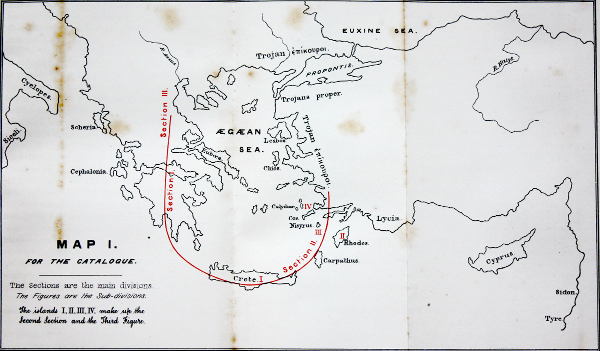
MAP I.
FOR THE CATALOGUE.
The Sections are the main divisions.
The Figures are the Sub-divisions.
The islands I, II, III, IV, make up the Second Section and the Third Figure.
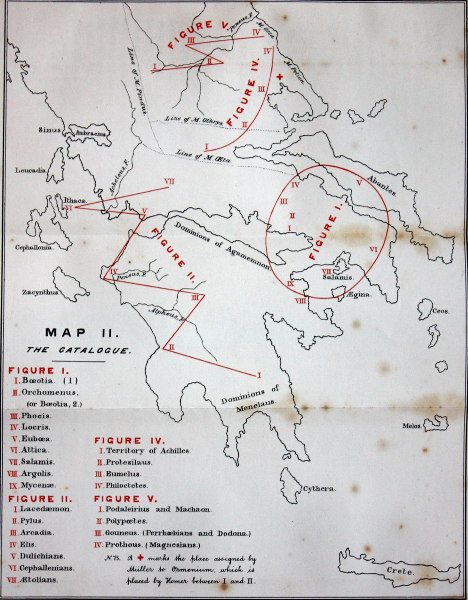
MAP II.
THE CATALOGUE.
FIGURE I.
I. Bœotia. (1)
II. Orchomenus, (or Bœotia, 2.)
III. Phocis.
IV. Locris.
V. Eubœa.
VI. Attica.
VII. Salamis.
VIII. Argolis.
IX. Mycenæ.
FIGURE II.
I. Lacedæmon.
II. Pylus.
III. Arcadia.
IV. Elis.
V. Dulichians.
VI. Cephallenians.
VII. Ætolians.
FIGURE IV.
I. Territory of Achilles.
II. Protesilaus.
III. Eumelus.
IV. Philoctetes.
FIGURE V.
I. Podaleirius and Machaon.
II. Polypœtes.
III. Gouneus. (Perrhœbians and Dodona.)
IV. Prothous. (Magnesians.)
N.B. A ✚ marks the place assigned by Müller to Ormenium, which is placed by Homer between I and II.
His first figure may be called a circle, being elliptical[480]; and it includes nine contingents.
1. Bœotia. 2. Minyeian Orchomenus. 3. Phocis. 4. Locris. 5. Eubœa. 6. Attica. 7. Salamis. 8. Argolis. 9. Mycenæ.
His second is a zigzag, and includes seven contingents[481].
1. Lacedæmon. 2. Pylus. 3. Arcadia. 4. Elis. 5. The Dulichians. 6. The Cephallenians. 7. Ætolia.
We now part with the first section.
His third figure embraces the second section, or insular division of the Catalogue, and is again part of a rude circle or ellipse[482].
1. Crete.
2. Rhodes.
3. Syme.
4. Cos and other islands. Carpathus is included, which lay between Crete and Rhodes; being apparently in political union with Cos and the Calydnæ, and contributing to the same contingent, it could not but stand with them. Strabo observes that this principle of political division, according to what he terms δυνάστειαι[483], has been adopted by the Poet in his account of the Thessalian contingents.
By reference to the rude maps annexed, which mark the several contingents by figures, the nature of this contrivance will be clearly seen.
The order for Thessaly.
It is more difficult to trace Homer’s method of proceeding with respect to Thessaly.
This country furnishes nine contingents, which may best be described by the names of their leaders. There is no difficulty as to the first four, except that some of the boundaries are indeterminate. They form, like the last or insular group, an incomplete circle[484]. The leaders are;
I. Achilles (681-94).
II. Protesilaus (695-710).
III. Eumelus (711-15).
IV. Philoctetes (716-28).
There is more difficulty in describing the arrangement of the remainder. Strabo, who has followed the Catalogue in Thessaly with great minuteness, seems to have noticed the circular arrangement: at least he speaks of the κύκλος τῆς Θετταλίας, and the περιόδεια τῆς χώρας[485]. But when he comes to the sixth division, that of Eurypylus, he appears to find it impossible to fix with any confidence the site of Ormenium: and says, καὶ ἄλλα δ’ ἐστὶν ἃ λέγοι τις ἂν, ἀλλ’ οὖν ὀκνῶ διατρίβειν ἐπὶ πλέον[486]. And further on he observes, that the displacements and changes of cities, and mixtures of races, have confounded the names and tribes[487], so as to make them in part unintelligible to men of his day: where we are anew reminded of the passage of Thucydides, in which he tells us, that the most fertile tracts underwent the most frequent changes of population[488].
The δυναστεία of Eurypylus is in our maps commonly placed on the sea coast, but as it appears, with little authority of any kind: while, after all the proof we have seen of continuous arrangement, it seems incredible that, in this instance alone, Homer could have followed an order such that the δυναστεία should not march either with that which precedes, or that which follows, but should be severed from them by a line of territories intervening, which he has already disposed of.
To judge from analogy with the otherwise uniform rule of the Catalogue, the dominions of Eurypylus must have been somewhere conterminous both with those of the Asclepiads, and with those of Polypœtes. Waiving however any effort to fix positively their site, we find the other four remaining contingents connected by a zigzag line[489], like that which was used in southern Greece. The leaders are as follows:
I. Podaleirius and Machaon (729-33). (Eurypylus 734-7, omitted.)
II. Polypœtes (738-47).
III. Gouneus (Enienes, Perrhæbi, and Dodona, 748-55).
IV. Prothous (the Magnesians, 756-9).
In this view Homer appears to subdivide Thessaly into two figures, as he had done Southern Greece: and in both cases one of them is curvilinear, in which the eastern parts are arranged: the other a zigzag, which includes the western portions.
I have described this geometrical arrangement, as of great interest in connection with the question, whether the poems were written or recited; and also as it seems to be in itself highly ingenious.
It seems to distribute in rude but real symmetry before the eye of the mind, an assemblage of objects between which it would at first sight appear almost impossible to frame any link of connection.
But in Homer, though there is much that is ingenious, there is nothing that is far-fetched: and the order he has followed might well, as to many parts at least of Greece, have been that of his own itinerancy as a minstrel. And, though complex in other respects, yet if it reduces a complex physical arrangement to the form, in which it becomes practically more manageable than in any other way for his purposes, it is evidently the one which may best be justified on the principles of common sense.
Fresh proofs of historical intention.
The Greek Catalogue is also full of proofs of the historical intention of Homer.
In the first place, such proof is afforded by the immense amount of its details, which are prima facie a load upon his verse, and which Homer seems to have so regarded, from the care he has taken to relieve the subject by the cluster of similes at the beginning. He must have had a purpose in facing this disadvantage. It is quite at variance with his own spirit, and the spirit of his age, to suppose that this purpose was merely to flatter the vanity of hearers by wholesale fiction.
The use of supernatural machinery is agreeable to the genius of the poet and his age, but not so the vulgar falsification of plain terrestrial facts. If the supposition of wholesale fiction cannot be maintained, there is no other alternative but that of an historical purpose.
Viewed at large, the Catalogue is an answer to that normal question, which expresses the anxiety of every Greek to make the acquaintance of a man first of all through what are colloquially termed his ‘belongings.’
Τίς; πόθεν εἶς ἀνδρῶν; πόθι τοι πόλις; ἠδὲ τοκῆες[490];
The chief indication of departure from this purpose is in the case of Nireus[491]. This paltry leader is almost the only person of legitimate birth, both of whose parents are named: and while he is evidently introduced for his beauty only, it is most suspicious that his father should be named Χάροψ, and likewise his mother Ἀγλαΐη. This savours of the names Δημόδοκος and Τερπιάδης, which Homer has given to his Bards in the Odyssey. And again of his Phronius, son of Noemon, whom he introduces to play the part of a considerate and serviceable Ithacan citizen[492]. With the insignificant island of Syme Homer might, for a special object, well take this liberty. And we may observe here, as elsewhere, that what is probably a departure from literal truth, may also be in a higher view historical: for doubtless his object is to commemorate impressively the wonderful beauty of Nireus, and this he does by inventing appropriate accessories.
Again, though an accurate geography would not of itself have proved the personal parts of the narrative to be historical, it is scarcely conceivable that he would have adopted one so minute and elaborate, as well as exact, if he had meant to combine with it a string of merely fictitious personalities.
Genealogies of the Catalogue.
Thirdly, besides many simple patronymics, there are found thirteen minor genealogies in the Catalogue, ten of them Greek, and three foreign. They are of three generations only in every case, with the single exception of the Orchomenian leaders, who have four: and in every case they attach to secondary heroes, who are thus treated in a mass, while provision is made in other parts of the poem for making known to us the descent (with the exception of Ajax) of all the greater heroes, as occasion serves to state it for each of them singly. Now it is inconceivable, even on general grounds, that the poet should have invented this mass of names; for they could surely have excited no sort of interest among his hearers, except upon one ground. They must have been true genealogical records of persons, who had played a part in the great national drama; one not perhaps of high importance, yet sufficient to be the basis of such traditions, as are justly deemed worthy of local record among a people eminently strong in their municipal, as well as their general patriotism. Over and above this, many points of these minor genealogies coincide with, and illustrate other historical notices in other parts of the poem.
Again, there are in all eight cases in the Catalogue, where the name of a mother is mentioned. These are,
1. Astyoche, mother of Ascalaphus and Ialmenus, Mars being the father, v. 513.
2. Aroura mother of Erechtheus, no father being mentioned, v. 548.
3. Astyochea mother of Tlepolemus, Hercules being the father, v. 658.
4. Aglaie mother of Nireus, Charops the father, v. 672.
5. Alcestis mother of Eumelus, Admetus the father, v. 715.
6. Rhene mother of Medon, Oileus the father, v. 728.
7. Hippodamia mother of Polypœtes, Pirithous the father, v. 742.
8. Venus is mentioned as the mother of Æneas, Anchises being the father, v. 820.
The second of these cases, if we are to regard the passage containing it as Homeric, must not be considered as an account of parentage, but simply as a mode of asserting autochthonism. Again, the parents of Nireus, whether true persons or not, are evidently named with reference to the consideration of beauty only, which is the key to the whole passage.
And the parentage of Æneas may also perhaps be named for the sole purpose of embellishment.
Described by the words θεὰ βροτῷ εὐνηθεῖσα, it does not appear to stand in the same class, or to be susceptible of the same explanations, as those Greek cases where Greek chieftains born out of wedlock have gods for their fathers; nor is there any case, among the Greeks, of illegitimate birth from a goddess. Of the five other cases three (1, 3, and 6), are obviously illegitimate births, one at least of them with a fabulous father. This raises the presumption that the name of the mother was mentioned as the only remaining means of recording the descent: inasmuch as the persons would otherwise have been οὐτίδανοι. It may reasonably be conjectured, that all these births were out of wedlock.
The epithets of the Catalogue are so accurately descriptive of the country, that they have always been used as tests of the traditions respecting the situations of the places to which they refer. They are not less exactly in harmony with the descriptions in other parts of the poem, and this in minor cases, where purposed fiction can hardly be supposed, not less than in the greater ones. For instance, the Arcadians of Il. vii. 134, are ἐγχεσίμωροι: those of the Catalogue are ἀγχιμάχηται (604), and ἐπιστάμενοι πολεμίζειν (611). The Pelasgi of Il. x. 429 are δῖοι, those of the Catalogue (840) are ἐγχεσίμωροι. The Cephallenians of the Catalogue are μεγάθυμοι (631), those of Il. iv. 330 are στίχες οὐκ ἀλαπαδναί. The Crete of the Odyssey (xix. 174) has ἐννήκοντα πόληες, the Crete of the Catalogue (v. 649) is ἑκατόμπολις[493].
Single commands are in every instance assigned to those who in the rest of the poem appear as chiefs of the first order. In the case of Idomeneus alone is this in any way obscured; as the passage (645-51) runs: ‘Idomeneus led the Cretans.... Idomeneus led them, with Meriones.’ But it is very remarkable that Meriones holds just this sort of ambiguous relation to Idomeneus in the poem at large: sometimes he is called his θεράπων (xxiii. 113 et alibi), and his ὀπάων (x. 58 et alibi), while he stands among the nine first warriors of the army, who (vii. 161), volunteer for single combat with Hector; and when Idomeneus leads the van, he manages the rear (iv. 251-4). Again, though the opportunities afforded by the Catalogue are of necessity narrow, yet Homer has contrived within its limits to mark distinctly the character and position of nearly every great chieftain: certainly of Agamemnon, Achilles, Menelaus, Telamonian Ajax (v. 668), and Ulysses.
The Epilogue.
The third portion, or epilogue, appears to be ascribable chiefly to the genial love of Homer for the horse. His arrangement of the army according to the number of ships, which conveyed each division, had shut out the mention of the chariots and the coursers who drew them, and he appears to have devised this closing invocation for the purpose of supplying the defect. It was certainly not necessary in order to fix the position of Achilles in the army, which the First Book had completely developed; and the passage is chiefly occupied with the horses of Eumelus, together with those of Achilles and his force.
It contains, however, two remarkable notes of historical veracity. The horses of Eumelus, a Thessalian, are proclaimed to have been by far the best (μέγ’ ἄρισται): and the Myrmidons, again a Thessalian contingent, are here spoken of as having a number of separate chariots and horses; we are told (773), ‘the soldiers played at games.... The horses stood feeding, each near his own chariot, and the chariots were in their sheds.’ This is never said of any other contingent in the army. In strict harmony with this picture, Thessaly was conspicuous throughout the historic times of Greece, for the excellence of its breeds of horses, and the high character of its cavalry.
If all this be so, we cannot wonder at the high estimation in which the Catalogue of Homer was held by the Greeks of after-ages, as the great and only systematic record of the national claims of the respective states.
This was not merely literary or private estimation: the Catalogue had the place of an authoritative public document. Under the laws of Solon, for example, it received the honour of public recitation on solemn occasions. It was also quoted for the decision of controversies. In the critical moment, which preceded the first Persian war, the Athenian and Spartan envoys apply on the part of Greece to Gelon for his aid. He claims the command. In resisting this claim and urging their own right to lead the fleet, unless that post be claimed by the Lacedæmonians, the Athenians found their pretensions on the magnitude of their fleet, their autochthonism, and, finally, the testimony of Homer to the merits of Menestheus[494].
The Trojan Catalogue.
The Trojan Catalogue has less of organic connection than the Greek with the structure of the poem at large.
In proceeding to this portion of his work, the poet does not renew his ornamental similes, or his invocation to the Muse. He evidently meant to lower the tone of his strain: and moreover he was not about to tax memory as he had done in the former operation, the proper names being only about one fourth in number of those used for the Greeks, and none of them being arranged in long strings like the towns of Bœotia.
He now begins in what may be called a natural order: taking first that section of the army, which was supplied by the Troic sovereignties, principal and subordinate; and among these giving the first place to the troops of Ilion itself, as the most considerable, and as those chiefly concerned. The next is given to the Dardan forces, which were connected with the original seat of the race, and the following ones to the contingents supplied by the subordinate sovereigns of the rest of Troas.
His pursuit of this order reminds us, that the geographical distribution was in the case of the Trojan list simple, and did not require the aid of mental geometry, as he had only to follow, almost throughout, a single line of States along the European and Asiatic coasts. It also strengthens the presumption that, when Homer chose an order so different, and so much less natural and obvious, in the case of the Greeks, he must have been governed by some peculiar reason.
It will be observed that, of the eleven divisions of the Allies, the two first are the Pelasgians and the Thracians. As the blood of these two races flowed likewise in the veins of the Greeks, the precedence given to them may have been founded on this relationship. But this presumption is qualified by our finding that, doubtless on the ground of geographical order, the Lycian contingent, which had, at any rate, strong Greek affinities, comes last of all.
For a reason given elsewhere, we must consider the numbers assigned to the Greek contingents as approximate representations of their respective force: but the omission to particularize numbers at all in the Trojan Catalogue is itself an evidence of its historical character. The Trojan army was of a miscellaneous character: we also know that the allied contingents went and came, and that their absence from home, not prompted by the same powerful motives as that of the Greeks, was shortened by reliefs. Thus we find Rhesus with his Thracians just arrived in the Tenth Book[495]: Memnon comes to Troy after the death of Hector[496]: and we are told of the sons of Hippotion (Il. xiii. 792), who ἦλθον ἀμοιβοί, had come as reliefs, on the preceding day. An army thus collected piecemeal, and thus fluctuating in its composition, could not leave behind it the same accessible traditions. Again, the destruction of Troy itself obliterated what alone could have been their depository; nor had Homer, as a Greek bard, either the same motives or the same means for gathering detailed information, as he would naturally possess with reference to his own countrymen.
Hence, as the Trojan Catalogue is shorter, so also its scope is more limited. It contains no specification of forces: no anecdotes going farther back than the existing generation: scarcely any of what may be called specialties of character or position as to the chiefs. It shows a good deal of knowledge of the geography and products of the countries, but this knowledge is of a much more general and vague character, than that which he has displayed in almost every portion of the Greek Array. He gives here very few lists of towns at all, and never uses epithets requiring us to believe that he had a personal knowledge of their site and character. Only Ariste is δῖα, and Larissa is ἐριβώλαξ. In two or three cases he speaks of commercial products; a characteristic which it is obvious that he might have learned without any personal experience of the countries. He does not use this particular kind of sign at all in the descriptions of the Greek Catalogue: and we may perhaps correctly interpret it, where it appears, as a token of his want of vivid and experimental knowledge.
He also occasionally names a mountain or a river. But there is a general avoidance of particular and characteristic epithets, such as, (to refer to the Bœotian list alone,) πετρήεσσα given to Aulis, πολύκνημος to Eteonos, εὐρύχορος to Mycalesos, ἐϋκτίμενον to Medeon and Hypothebæ, πολυτρήρων to Thisbe, ποιήεις to Haliartos, πολυστάφυλος to Arne, ἐσχατόωσα to Anthedon, with perhaps one or two other cases.
Another material inference is suggested by the very different texture of the Trojan Catalogue.
Upon the whole, this vagueness of description cannot, I think, but be regarded as much in conflict with the belief that Homer was a Greek of Asia Minor, if at least his comparative knowledge of the two countries on the opposite sides of the Ægean is to be taken as a sign, either positive or negative, of his nativity.
SECT. VI. On the Hellenes of Homer; and with them, Hellas; Panhellenes; Cephallenes; Helli or Selli.
The Hellas of Homer.
We have next to inquire into the force of the Hellenic name in the poems of Homer.
It meets us not, like the Pelasgic, in a single form, but in a group of words; among which, the principal are as follows:
1. Ἕλληνες, Il. ii. 684.
2. Πανέλληνες, ibid. 530.National or tribal names.
3. Σελλοὶ, Il. xvi. 234.
And, lastly, the territorial name of
4. Ἕλλας.
Observing the order of derivation as it has been pointed out by Mure[497], we shall naturally look to the word Ἕλλας as a guide to the meaning of its derivatives, Ἕλληνες and Πανέλληνες. It is itself drawn from Ἑλλοὶ or Σελλοί: but as that name is only once used in the Poems, and as by far the largest body of evidence tells upon the word Ἕλλας, the decision upon the whole group of words will turn mainly upon the inquiry we shall have to make into the use of that word by Homer. With it therefore we shall commence. Is there, we have to ask, clear proof, that it went beyond the dominions of Peleus? If it went beyond them, how far did it go? and did it include that division of Greece, in which Locris lay, whose inhabitants a particular line of the Catalogue classes with the Panhellenes? For no suspicion of spuriousness can justly arise out of the fact (if it be one), that Homer calls by the name of Hellenes the inhabitants of any country, which was itself within the scope of the territorial name Hellas: inasmuch as this is little more than, the word Yorkshire being given, to make use also of the word Yorkshiremen.