Note 41 — THE MERMAID.
Reading edition
It is worthy of note that the fish was also adopted as an emblem by the early Christians, and was frequently sculptured on their tombs as a private mark or sign of the faith in which the person there interred had died. It alluded to the letters which composed the Greek word [Greek: Ichthys] ("a fish") forming an anagram, the initials of words which conveyed the following sentiment: [Greek: Iêsous], Jesus; [Greek: Christos], Christ; [Greek: Theou], of God; [Greek: gios], Son; [Greek: Sôtêr], Saviour. But it doubtless bore, also, the older meaning of "preservation" and "reproduction," of which the fish was the symbol, and betokened a belief in a future resurrection, as Noah was preserved to dwell in, and populate, a new world. In 'Sea Monsters Unmasked,' page 55, I gave a figure, copied by permission from the Illustrated London News, of a rough sculpture in the Roman catacombs, of Jonah being disgorged by a sea-monster. Near to it was found, on another Christian tomb, one of these designs of the "fish;" and it is not a little curious that, whereas the animal depicted as casting forth Jonah is not a whale, but a sea-serpent, or dragon, the ichtheus in this instance is apparently not a fish, but a seal.
FIG. 11.—CHRISTIAN SYMBOL. From the Catacombs at Rome.
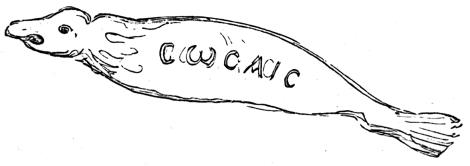
The article referred to appeared in the Illustrated London News of February 3rd, 1872, and the woodcut (fig. 11), an electrotype of which was most kindly presented to me by the proprietors of that paper, was one of the sketches that accompanied it.