Note 73 — LECTURE IV. (28th October 1881.) THE ARCHITECTURE OF THE BROCHS.
Reading edition
The Nuraghi of Sardinia are round towers built of uncemented stones. They are exceedingly numerous in the island, and it has been occasionally asserted that they bear a remarkable resemblance to the Scottish Brochs. It is true that they are like the Brochs externally, because they are round towers, (see Fig. 176), but they possess none of the characteristic features of the typical Broch structure. They contain vaulted and windowless chambers placed vertically above each other in the centre of the tower. The access to these chambers is by a winding stair, which traverses the thickness of the wall completely round the central chambers. Sometimes they have a more complex structure, consisting of a central tower rising from a square basement, with chambers also in the basement, as shown in the accompanying section (Fig. 179). It is thus apparent that the typical Nuraghe differs completely in idea from the typical Broch. Although the external form may be in some cases similar, the essential features of the Broch are not found in any one instance in the Sardinian Nuraghi. No Broch has vaulted chambers disposed vertically over each other in the centre of the tower, and no Nuraghe has its centre open, and its chambers, stairs, and galleries arranged in the ring of walling surrounding the central court and windows looking into it as the Brochs have.
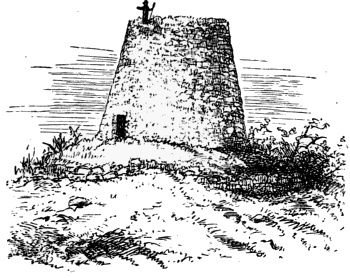
Fig. 176.—Nuraghe of Goni, in Sardinia.
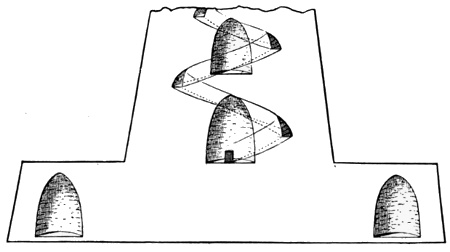
Fig. 177.—Section of Nuraghe, showing form of chambers and spiral stair. (From Tyndale’s Sardinia.)