Note 27 — Mat Materials.
Reading edition
Tikug mats are made in large numbers in Bohol. The straw for the most part is finer than that used in Samar and the patterns are chiefly stripes and checks. Very little embroidering is attempted.
Bohol mats are used principally for sleeping purposes. In northern Bohol there is scarcely a family that has not three or more large mats, which are rolled up and laid away during the day time and are unrolled upon the floor at night for a bed. They are durable and last for years. Large sleeping mats may be purchased in quantities as high as 40 to 100 during the Sunday market day in Talibon or on the Saturday market day in Ypil, a barrio of the same town. In price they range from one to three pesos each.
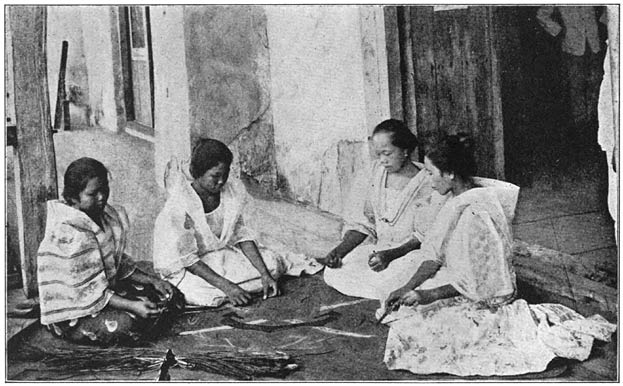
Plate LVIII. Embroidering a mat.
The second use of Bohol mats is for decorating walls, tables, and floors. Those so employed are smaller than the sleeping mats, usually square, but sometimes round. More care is exercised in their weaving and only fine young straws are used. The preparation of the straw and the dyeing are done with great care. Mats of the best quality are quite difficult to secure and the schools have recently been encouraging their production.
As in other regions, the tikug from which Bohol mats are made, grows wild in the rice fields after the harvest. It is found in abundance in northern Bohol in the municipalities of Getafe, Talibon and Ubay, and sparingly in other towns of the island (see map). The straws are gathered from the field by pulling them, thus breaking them off at the roots, and they are tied into bundles about 3 decimeters in circumference and sold in the market. The largest market for such bundles is found in the barrio of Ypil in the municipality of Talibon. The price is usually about 10 centavos per bundle. From two to four of these bundles are required to make a mat.
The tikug is not kept in the original bundles longer than one or two days, for it will turn black. The material is usually separated into two parts, one to be dyed, the other to be bleached. That to be dyed is spread in the sun and thoroughly dried for one or two days, care being taken that rain does not fall upon it and blacken it. The other part is boiled in a solution of acetic acid for twenty minutes, after which it is thoroughly dried in the sun and thus bleached.
The natural dyes used in Bohol for coloring tikug are dauda and turmeric. The former produces permanent colors, the latter fugitive ones. The artificial dyes bought at Chinese stores are also used in producing shades and tints of green, violet and ruby which are satisfactory. In general, those in crystal form have proven more satisfactory than the powder dyes. Before dyeing, the sheath-like leaf is pulled from the bottom of each straw and the material is looped into small bundles. Often the straws are dampened with water. Dyeing is usually done in a 5-gallon petroleum can two-thirds full of water, heated to boiling. If the artificial dyes are used the powder is stirred in and dissolved and the bundles of tikug are then pressed down into the liquid so that all the material is well covered. A stone is often laid upon the straws so as to keep them down in the boiling dye. It usually requires about twenty minutes to obtain the desired shade, which is nearly always a deep one. Where fresh dauda leaves are employed, about 2 pounds are placed in the water and boiled a few minutes before the tikug is put in. If dried leaves are used about one pound is soaked in cold water for a few minutes and the whole mass is then added to the boiling water. Turmeric roots are pounded in a mortar and then added to the boiling water, after which the tikug is added. All the dyes noted are combined to produce other colors and varying shades.
During the process of dyeing, the straw should be turned and moved about in the boiling water to insure an even color. The straw should never be boiled too long, or it will be cooked and become tender and weak. After the straw has taken on the shade desired, it is removed from the can and thrown on the ground. When the bundles are cool enough to be handled, they are untied and the straws spread out to dry, preferably in the shade. After it is thoroughly dried the material is rebundled and thus kept for weaving.
Before weaving, the straws are flattened by drawing each one separately between the edge of the knife and the heel of the weaver’s foot or the sole of the chinela. Damp days are best for this process. Weaving is done under the house or under trees. Evenings and nights are most suitable for this work on account of the dampness of the atmosphere. The embroidered mats of Bohol are decorated with split straws.
The mats of Bohol are bought by traders who exchange cloth and other goods for them. These men carry them to the towns of Bohol which do not produce mats, and to other islands, where they sell or exchange them at a good profit. When once the supply of mats on hand has been bought up in a mat producing town, several months elapse before the market there is replenished by a new supply. After completing a mat, the weaver has no immediate desire to begin another. It is quite probable that the output of mats could be increased considerably if the market and the price were better. It is estimated that the weavers earn not more than 20 centavos per day at the industry.