Note 17 — Mat Materials.
Reading edition
The pandan P. simplex, known as “karagumoy” or “carogumoy,” is the economic pandan of the Bicol peninsula in southern Luzon. It is usually found growing in well drained soil under the shade of banana and abaca plants and areca palms. It needs this protection because the leaves are easily broken or ruined by hard winds. The leaves are generally longer than those of sabutan (they are 2 meters to 3½ meters in length) and are but from 6 cm. to 10 cm. wide. They are very thick, being practically as coarse as the leaves of P. utilissimus. They bear stout spines on the midrib and along the margins, from two centimeters to three centimeters apart. A fungus disease often attacks them, causing dry hard patches, and not only spoiling the color but also making the material so brittle that it breaks in the preparation of the straw.
The plant is propagated by means of suckers in patches seldom over a half hectare in extent and often consisting of a few plants back of the house. The suckers are set out in rows and are probably one year old when the first leaves are taken, though the workers disagree on this point. At a specified time, from eight to fifteen leaves are cut from the plant each year; at other periods, two or three may be taken from the same plants. Most of the leaves are harvested during the rainy season. Karagumoy leaves have a commercial value in many of the places in which the plant occurs. In Tabaco, Albay, women cut the leaves and carry them in large bundles to the market, where they are sold at prices usually varying from 8 to 12 centavos per hundred.
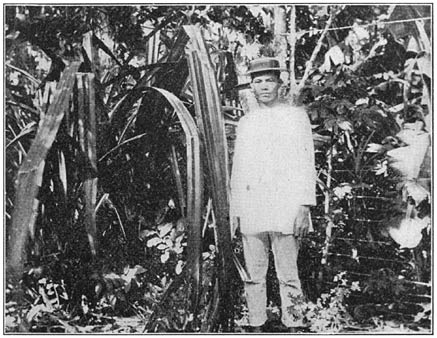
Plate XLIV. Karagumoy.
Throughout the Province of Albay mats are made from karagumoy, and in some towns the industry is of considerable importance. For instance, in the barrio of San Lorenzo in Tabaco, mats may be found in the making in nearly every house. In Sorsogon, too, the industry is widespread though not so important commercially. In Balusa the production is large enough to supply the local demand and leave a surplus for export to neighboring towns. In the Bicol provinces karagumoy is considered the best of all straws for the production of mats. In price the mats vary from thirty to ninety centavos, according to fineness.
In preparing the material, the spines and midrib are first removed and the leaves are divided into four strips of about equal width. The straw is prepared from these with the knife and gauge; it is dried in the shade for a few hours and drawn several times over a piece of bamboo as explained for sabutan in order to make it more supple and smooth. The mats are woven in the early morning and at night, the straw being more pliable then. Attempts have been made in the schools to dye karagumoy but no success has yet been attained. The mats are plain.