Note 9 — Chapter I · Distribution of Negritos
Reading edition
This paper concerns itself chiefly with the Zambales Negritos whose distribution in Zambales and the contiguous Provinces of Bataan, Pampanga, and Tarlac is treated in detail in the following chapter. But Negritos of more or less pure blood, known variously as Aeta, Agta, Baluga, Dumagat, etc., are found in at least eleven other provinces of Luzon. Beginning with the southern end of the island there are a very few Negritos in the Province of Sorsogon. They are found generally living among the Bicol population and do not run wild in the woods; they have probably drifted down from the neighboring Province of Albay. According to a report submitted by the governor of Sorsogon there are a few of these Negritos in Bacon and Bulusan, and four families containing Negrito blood are on the Island of Batang near Gabat.
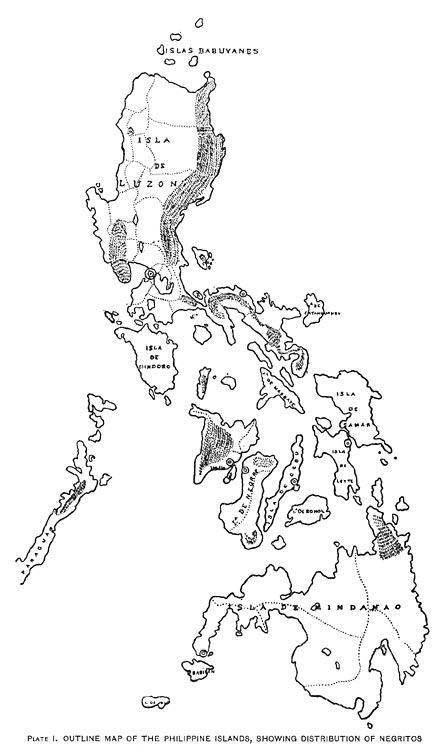
Outline map of the Philippine Islands, showing distribution of Negritos.
Eight pueblos of Albay report altogether as many as 800 Negritos, known locally as “Agta.” It is not likely any of them are of pure blood. In all except three of the towns they are servants in Bicol houses, but Malinao, Bacacay, and Tabaco report wandering groups in the mountains.
Meyer, who makes no mention of Negritos in Sorsogon or Albay, deems their existence in the Camarines sufficiently well authenticated, according to Blumentritt, who places Negrito half-breeds in the neighborhood of Lagonoy and around Mount Isarog. Information received by The Ethnological Survey places them in the mountains near Baao, Bulic, Iriga, Lagonoy, San José, Gao, and Tigaon, as well as scattered over the Cordillera de Isarog around Sagnay. All of these places are in the extreme southeastern part of the province contiguous to that part of Albay inhabited by Negritos. In neither province is the type pure. In the northern part of the province a few Negritos, called “Dumagat,” are reported near Sipocot and Ragay. The towns of San Vicente, Labo, Paracale, Mambulao, and Capalonga along the north coast also have Negritos, generally called “Aeta.” These are probably of purer blood than those around Mount Isarog. More than a hundred families of “Dumagat” are reported on the Islands of Caringo, Caluat, and Jomalic.
Farther to the north the Island of Alabat was first stated by Blumentritt to be inhabited by Dumagat, and in his map of 1882 he places them here but omits them in the map of 1890. Meyer deems their occurrence there to be beyond all doubt, as per Steen Bille’s reports (Reise der Galathea, German ed., 1852). Reports of The Ethnological Survey place Aeta, Baluga, and Dumagat on Alabat—the former running wild in the mountains, the latter living in the barrios of Camagon and Silangan, respectively. On the mainland of the Province of Tayabas the Negritos are generally known as Aeta and may be regarded as being to a large degree of pure blood. They are scattered pretty well over the northern part of the province, but do not, so far as is known, extend down into the peninsula below Pitogo and Macalelon. Only at Mauban are they known as Baluga, which name seems to indicate a mixed breed. The Island of Polillo and the districts of Infanta and Principe, now part of the Province of Tayabas, have large numbers of Negritos probably more nearly approaching a pure physical type than those south of them. The Negritos of Binangonan and Baler have received attention in short papers from Blumentritt, but it yet remains for someone to make a study of them on the spot.
Meyer noted in 1872 that Negritos frequently came from the mountains to Santa Cruz, Laguna Province. These probably came from across the Tayabas line, as none are reported in Laguna except from Santa Maria, in the extreme northern part. Even these are probably very near the boundary line into Rizal Province; perhaps they are over the line. Tanay, Rizal Province, on the shore of Laguna de Bay, reports some 300 Negritos as living in the mountains north of that town. From descriptions given by natives of Tanay they do not appear to be pure types. There is also a small group near Montalbán, in Rizal Province, not more than 20 miles from Manila.
Going northward into Bulacan we are in possession of more definite information regarding the whereabouts of these forest dwellers. Zúñiga in 1803 spoke of the Negritos of Angat—in those days head-hunters who were accustomed to send messages by means of knotted grass stalks.10
This region, the upper reaches of the Angat River, was visited by Mr. E. J. Simons on a collecting trip for The Ethnological Survey in February, 1903. Mr. Simons saw twenty-two little rancherias of the Dumagat, having a total population of 176 people. Some of them had striking Negroid characteristics, but nearly all bore evidence of a mixture of blood. In some cases full-blooded Filipinos have married into the tribe and adopted Negrito customs entirely. Their social state is about the same as that of the Negritos of Zambales, though some of their habits—for instance, betel chewing—approach more nearly those of lower-class Filipinos. A short vocabulary of their dialect is given in Appendix B.
Negritos are also found in northern Bulacan and throughout the continuous mountain region extending through Nueva Ecija into Isabela and the old Province of Principe. They are reported from Peñaranda, Bongabong, and Pantabangan, in Nueva Ecija, to the number of 500. This region is yet to be fully explored; the same may be said also of that vast range of mountains, the Sierra Madre, of Isabela and Cagayan. In the Province of Isabela Negritos are reported from all the towns, especially Palanan, on the coast, and Carig, Echague, Angadanan, Cauayan, and Cabagan Nuevo, on the upper reaches of the Rio Grande de Cagayan, but as there is a vast unknown country between, future exploration will have to determine the numerical importance of the Negritos. It has been thought heretofore that this region contained a large number of people of pure blood. This was the opinion set forth by Blumentritt. He says:
This coast is the only spot in the Philippines in which the original masters of the Archipelago, the Negritos, hold unrestricted possession of their native land. The eastern side of the Cordillera which slopes toward this coast is also their undisputed possession. However, the western slopes they have been compelled to share with branches of Malay descendants. Here they retain the greatest purity of original physique and character.
These statements stand much in need of verification. Inquiries pursued by The Ethnological Survey do not bear them out—in fact, point to an opposite belief.
There is a small body of what may be pure types near the boundary between Isabela and Cagayan, west of the Cagayan River, but the coast region, so far as is known, does not hold any Negritos.
As many as sixteen towns of Cagayan report Negritos to the total number of about 2,500. They are known commonly as “Atta,” but in the pueblo of Baggao there are three groups known locally as “Atta,” “Diango,” and “Paranan.” They have been described by natives of Baggao as being very similar to the ordinary Filipinos in physical characteristics except that they are darker in color and have bushy hair. Their only weapons are the bow and arrow. Their social status is in every way like that of the Negritos as distinguished from the industrious mountain. Malayans of northern Luzon. Yet future investigations may not associate these robust and warlike tribes with the weak, shirking Negritos. Negritos of pure type have not so far been reported from Cagayan.
At only two places in the western half of northern Luzon have Negritos been observed. There is a small group near Piddig, Ilokos Norte, and a wandering band of about thirty-five in the mountains between Villavieja, Abra Province, and Santa Maria, Ilokos Sur Province, from both of which towns they have been reported. It is but a question of time until no trace of them will be left in this region so thickly populated with stronger mountain peoples.
Although Negritos were reported by the early Spanish writers to be especially numerous in some of the southern islands, probably more of them are found on Luzon than on all the other islands in the Archipelago. Besides Luzon, the only large islands inhabited by them at present are Panay, Negros, Mindanao, and Paragua, but some of the smaller islands, as Tablas and Guimaras, have them.
Negritos of pure blood have not been reported from Mindoro, but only the half-breed Manguian, who belong in a group to themselves. It is questionable whether the unknown interior will produce pure types, though it is frequently reported that there are Negritos in the interior.
There is a rather large colony of Negritos on the west coast of Tablas near Odiungan, and also a few on the Isla de Carabao immediately south of Tablas. These have probably passed up from Panay. All the provinces of the latter island report Negritos, locally known as “Ati” and “Agta.” They seem to be scattered pretty well over the interior of Panay, being especially numerous in the mountainous region where the Provinces of Antique and Iloilo join. In Antique there are about 1,000 Negritos living in groups of several families each. They are reported from nearly all the towns, being more numerous along the Dalanas and Sibalon Rivers. The number of pure types is said, however, to be rapidly decreasing on account of intermarriage with the Bukidnon or mountain Visayan. They are of very small stature, with kinky hair. They lead the same nomadic life as the Negritos in other parts, except that they depend more on the products of the forest for subsistence and rarely clear and cultivate “ca-ĭng-ĭn.”11 They seem to have developed more of religious superstitions, and believe that both evil spirits and protecting spirits inhabit the forests and plains. However, these beliefs may have been borrowed from the Bukidnon, with whom they come much in contact. From a mixing of the Ati and Bukidnon are sprung the Calibugan, who partake more of the characteristics of their Visayan ancestors than those of the Ati, and generally abandon the nomadic life and live in clearings in the forest.
About ten years ago there was a group of about 200 Ati at a place called Labangan, on the Dalanas River, governed by one Capitán Andres. They made clearings and carried people across the river for a small remuneration. Many of them are said to have emigrated to Negros to escape public work to which the local authorities subjected them without compensation.
There is a small, wandering group of Negritos on Guimaras, probably emigrants from Panay. They have been reported from both Nagaba and Nueva Valencia, pueblos of that island.
Investigation does not bear out the statements of the historian previously quoted in regard to the early populations of Negros. At least it seems that if the southwestern part of that island known as Sojoton had been so thickly populated with Negritos early in the eighteenth century more traces of them would remain to-day. But they seem to have left no marks on the Malayan population. While in the Isio region in August, 1903, I made special investigation and inquiry into this subject and could find no trace of Negritos. Expeditions of the Constabulary into the interior have never met with the little blacks except a single colony near the boundary line between the two provinces just north of Tolon. A few Negritos have also been seen scattered in the interior of southern Oriental Negros back from Nueva Valencia, Ayuquitan, and Bais. From there no trace of them exists until the rugged mountains north of the volcano of Canlaon are reached, in the almost impenetrable recesses of which there are estimated to be a thousand or more. They are especially numerous back of Escalante and formerly made frequent visits to that pueblo, but recent military operations in the region have made them timid, as scouting parties have fired on and killed several of them. The sight of a white man or native of the plain is a signal for an immediate discharge of arrows. Also in the mountains behind Sagay, Cadiz, and Manapla live a few scattered families. I was fortunate in securing photographs of a Negrito captured by the Constabulary near Cadiz. (See Pl. XXVI.) He was much taller than the Negritos of Zambales, but with very little muscular development. He spoke Visayan, and said he knew no other dialect. While in Negros I also secured photographs of a small colony of Ati, who emigrated from Panay about twenty years ago and now live on a mountain hacienda on the slope of Mount Canlaon.
So far there is no evidence that Negritos exist on Cebu, Bohol, Samar, and Leyte. In Mindanao they are found only in the extreme northern part of Surigao, not having been reported below Tago. They are called “Mamanua,” and are not very numerous.
We have detailed accounts of both the Tagbanua and Batak of Paragua, by señor Manuel Venturello, a native of Puerto Princesa, who has lived among them twenty years. These interesting articles, translated by Capt. E. A. Helmick, Tenth United States Infantry, and published in pamphlet form by the Division of Military Information, Manila, are especially full as to customs, religion, language, etc., of the Tagbanua who inhabit the central part of Paragua from the Bay of Ulugan south to Apurahuan. However, the Tagbanua, although perhaps having a slight amount of Negrito blood, can not be classed with the Negritos. But, in my opinion, the Batak who inhabit the territory from the Bay of Ulugan north to Caruray and Barbacan may be so classed, although they are by no means of pure blood. They are described as being generally of small stature but well developed and muscular. They have very curly but not kinky hair, except in rare cases. Their weapons are the bow and arrow and the blowgun or sumpitan, here called “sumpit.” Their only clothing is a breechcloth and a short skirt of flayed bark. A notable feature of their customs is that both polygyny and polyandry are permitted, this being the only instance of the latter practice so far observed among the tribes of the Philippines. The Batak are not very numerous; their villages have been decimated by ravages of smallpox during the past five years.