Note 10 — Chapter I · FROM MOURZUK TO KOUKA IN BORNOU.
Reading edition
The sand of a fine cream colour: yesterday it had many particles of a black substance mixed with it.
Exposed rocks, sandstone of different kinds, mostly red, and a black kind like basalt from iron; fine specimens of petrified wood; the centre, sap, vessels and knots filled with a calcareous matter, the woody fibre changed into a siliceous substance; beautiful conical layers, and lines running like rays, from the centre to the circumference. Many columnar mounds of clay in the first basin, about ten feet high—the clay as if semi-baked: many are round, and the one we went to about thirty feet in circumference; these were probably the original height of the surface: the present form arises from the other part being washed away.
The depth of the well at Meshroo is from sixteen to twenty feet: the water good, and free from saline impregnations: the ground around is strewed with human skeletons, the slaves who have arrived exhausted with thirst and fatigue. The horrid consequences of the slave trade were strongly brought to our mind; and, although its horrors are not equal to those of the European trade, still they are sufficient to call up every sympathy, and rouse up every spark of humanity. They are dragged over deserts, water often fails, and provisions scarcely provided for the long and dreary journey. The Moors ascribe the numbers to the cruelty of the Tibboo traders: there is, perhaps, too much truth in the accusation. Every few miles a skeleton was seen through the whole day; some were partially covered with sand, others with only a small mound, formed by the wind: one hand often lay under the head, and frequently both, as if in the act of compressing the head. The skin and membranous substance all shrivel up, and dry from the state of the air: the thick muscular and internal parts only decay.
Course through basins, having low, rugged, conical hills to the eastward. The hills have a great similarity of geological structure to those of western Fezzan and Ghraat.
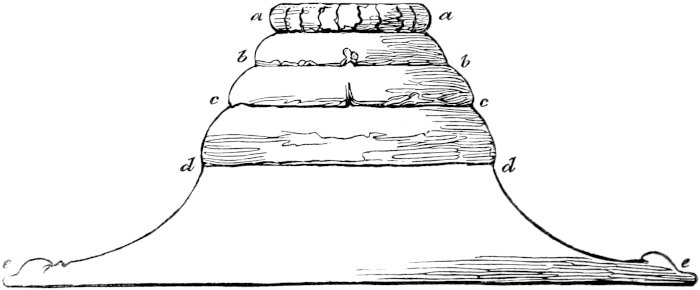
a b Sandstone of fine texture, of a black colour, giving it the appearance of basalt.
c Aluminous shistus.
d Clay iron stone, with here and there strata of bluish clay.
e Fine white sandstone, mixed with a large quantity of lime.
There is a fine blue, very hard stone, with slender white lime streaks, forming the surface of many of the lower grounds, evidently of recent formation. A similar formation is seen in the large sterile plain between the hills of Fezzan to the westward, and the Tuarick range: the fine white sandstone is found deep in the same hills; the aluminous slate in abundance. The kind of sandstone, the other rocks and similarity of appearance, show a sameness of geological structure as far as we have gone.
From a fine pass between two of the hills, the view from above had something of the grand. A rocky and sandy space, about two hundred yards broad, bounded on each side by a high rugged black hill, below a fine level plain, with low hills in the distance. The descent of the camels fine, and accomplished without an accident.
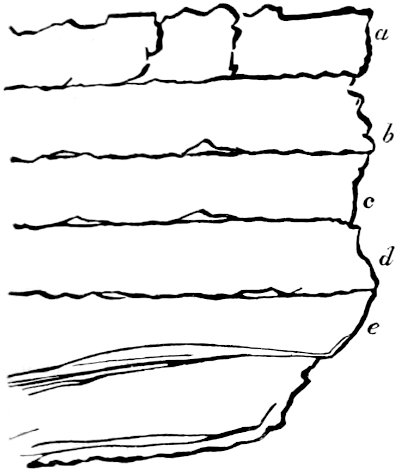
a sandstone.
b red and yellow iron ore, in very thick beds.
c sandstone.
d white shistus.
e white sandstone.
The surface of the plain has strata of a slatiform blue stone; frequently, however, massive, and so hard as not to be scratched by iron; imbedded in it is a large quantity of periform iron ore. After traversing this plain, we ascended a low hilly range, and passed across its stony surface. From here we saw El-Wahr, or Difficult: it is between two high hills. We passed many skeletons, both of human beings and camels, which always kept us in mind of the dangers we were exposed to.—W. O.