Note 22 — APPENDIX.
Reading edition
Section of the cliffs at Limestone Point—strata dipping to the N.N.W.
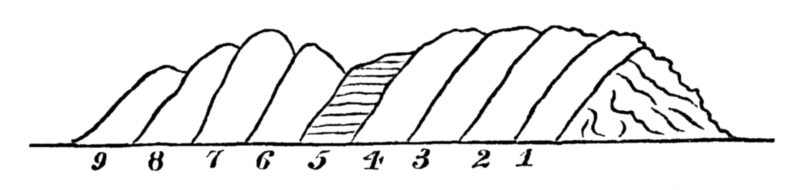
In the section the strata are represented much more inclined than they really are.
231 Fine-grained, nearly compact, yellowish-gray dolomite, forming the summit of the hill, but the first, or lowest stratum, in the language of geologists.
232 Compact, splintery dolomite, with a conchoidal fracture, and wax-yellow colour—second stratum.
233 A cherty dolomite; containing calc-spar—third stratum.
234 Bluish-gray dolomite, traversed by calc-spar—is nearly compact, and has an uneven, splintery fracture—forms the uppermost portion of the fourth stratum.
235 Talcose? limestone, having a curved slaty structure, and containing cherty portions—from the lower part of the fourth stratum.
236, 237 Earthy greenstone? forms the fifth stratum.
238 Brownish-red dolomite, with an uneven fracture; scarcely splintery. It has a compact structure, and is intersected by veins of calc-spar—from the sixth stratum.
239 Light yellowish gray dolomite, passing into chert—seventh stratum.
240, 241 Thin slaty beds of brownish-red dolomite, like 238—eighth stratum.
242 Bluish-white porcelain chert, sometimes mixed with red dolomite—243—ninth stratum.