Note 19 — MEXICAN COPPER TOOLS.
Stephen Salisbury translation
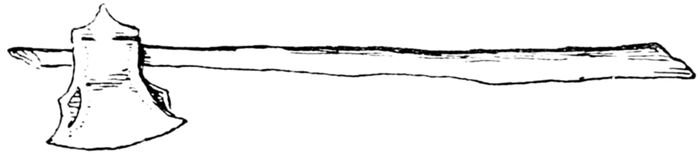
From Oviedo.
Herrera (Dec. III., Lib. 4, Cap. 5) having the original reports before his eyes, represents this scene as follows: “Multitudes of Indians flocked along the ways, astonished to see the beards and the dressing of the Spaniards. The chief person they met was Dirianjeu, the warlike cacique, who came attended by five hundred men and seventeen women, covered with gold plates, all drawn up in order, but without arms and with ten banners and trumpets, after their fashion. When they came near, the banners were displayed and the cacique touched Gonzales’ hand, as did all the five hundred, everyone giving him a turkey. Yet each of the women gave him twenty axes of gold (veinte hachas de oro) fourteen carats fine, each weighing eighteen pesos and some more.” We find in Oviedo (Gonzalo Fernandez de), Historia gen. y nat. de las Indias, at the end of Vol. IV., five folio quarto pages with illustrations referring to the chapter he wrote on Nicaragua, and we learn from his text that he made the sketches himself during his sojourn in Nicaragua (1524). They represent views of the volcano of Masaya, gymnastic sports of the Indians, a plan of the town of Tecoatega, and three Indian arms, an estorica, a porra and an alabarda. Each of the drawings is provided with a number which correctly corresponds to that written in the text, except those three drawings of the arms, for which we could not find the text. Upon closer examination we discovered a suggestion made (on page 81) that some ancient copyist or editor must have revised Oviedo’s original manuscript, who was supposed to have dropped the inscription to which the drawings of the three arms belong, perhaps, only on account of the illegibility of Oviedo’s handwriting. On the other hand, we cannot help expressing our doubts as to the fact that these three kinds of arms should have been in use with the Nicoyans or Nicaraguans. Notwithstanding we give the cut of the alabarda, which has the shape of a genuine mediæval battle-axe.