Note 1 — Chapter VIII
Reading edition
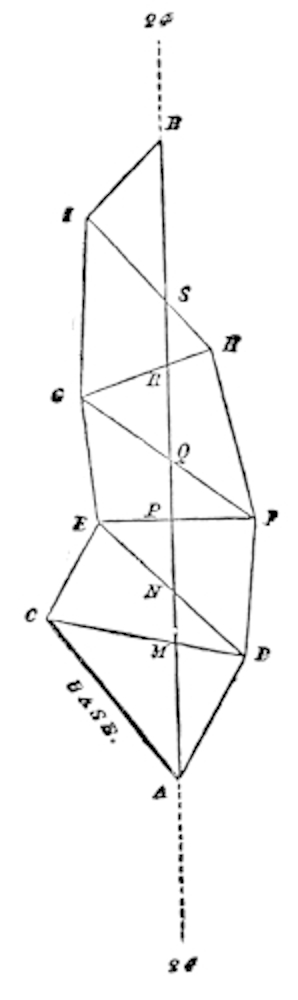
By the aid of the accompanying figure, the work called a triangulation may be understood. Let A B be the arc. Measure the base A C very carefully from the extremity A to the first station C. Take other stations, D, E, F, G, H, I, &c., on alternate sides of the meridian, and observe the angles of the triangles, A C D, C D E, D E F, E F G, &c. Then in the triangle A C D, the angles and the side A C being known, the side C D may be found. Likewise in the triangle C D E, C D and the angles being known, the side D E may be found; and so on through all the triangles. Now determine the direction of the meridian in the ordinary way, and observe the angle M A C which it makes with the base A C. Then in the triangle A C M, because A C and the adjacent angles are known. A M, C M, and the angle A C M, may be found, and A M is the first portion of the arc. Then in the triangle D M N, since the side D M = C D - C M, and the adjacent angles are known, the sides M N, D N, and the angle M N D may be found, and M N is the next portion of the arc. Again, in the triangle N E P, because E N = D E - D N, and the adjacent angles are known, N P, the third portion of the arc, may be found. By proceeding thus through all the triangles, piece by piece, the whole length of the arc A D may be determined.