Note 4 — Chapter VI
Reading edition
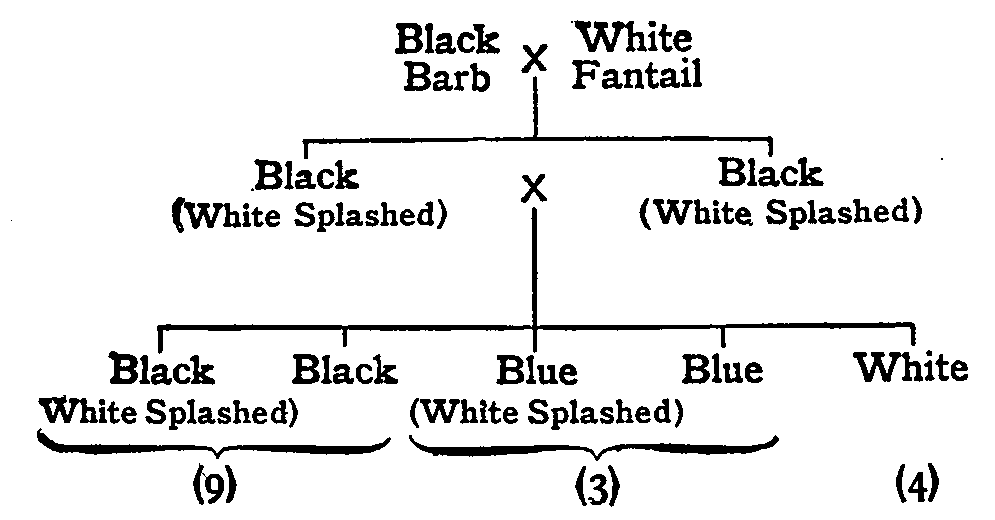
There is one other instance of reversion to which we must allude. This is Darwin's famous case of the occasional appearance of pigeons reverting to the wild blue rock (Columba livia), when certain domesticated races are crossed together.[4] As is well known, Darwin made use of this as an argument for regarding all the domesticated varieties as having arisen from the same wild species. The original experiment is somewhat complicated, and is shown in the accompanying scheme. Essentially it lay in following the results flowing from crosses between blacks and whites. Experiments recently made by Staples-Browne have shown that this case of reversion also can be readily interpreted in Mendelian terms. In these experiments the cross was made between black barbs and white fantails. The F1 birds were all black with some white splashes, evidently due to a separate factor introduced by the fantail. On breeding these blacks together they gave an F2 generation, consisting of blacks (with or without white splashes), blues (with or without white splashes), and whites in the ratio 9 : 3 : 4. The factors concerned are colour (C), in the absence of which a bird is white, and a black modifier (B), in the absence of which a coloured bird is blue. The original black barb contained both of these factors, being in constitution CCBB. The fantail, however, contained neither, and was constitutionally ccbb. The F1 birds produced by crossing were in constitution CcBb, and being heterozygous for two factors produced in equal numbers the four sorts of gametes CB, Cb, cB, cb. The results of two such series of gametes being brought together are shown in the usual way in Fig. 11. A blue is a bird containing the colour factor but lacking the black modifier, i.e. of the constitution CCbb, or Ccbb, and such birds as the figure shows appear in the F2 generation on the average three times out of sixteen. Reversion here comes about in F2, when the redistribution of the factors leads to the formation of zygotes containing one of the two factors but not the other.