Note 9 — Chapter XI
Reading edition
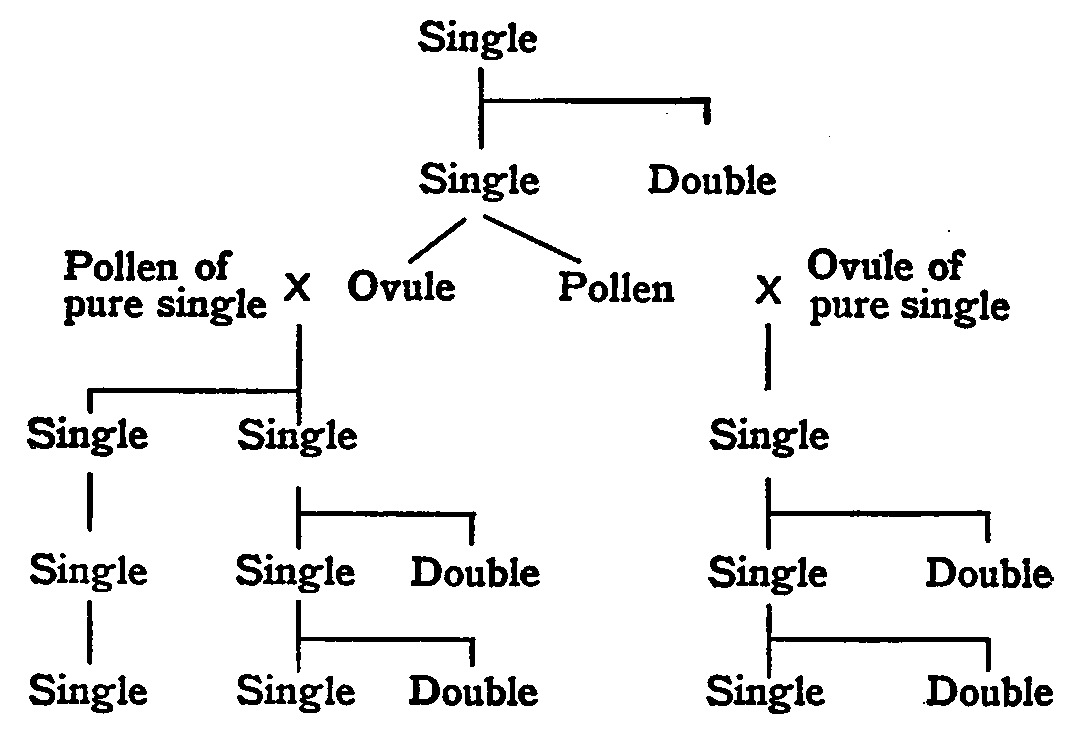
That the possibility of a difference between the ovules and pollen grains of the same individual must be taken into account in future work there is evidence from quite a different source. The double stock is an old horticultural favourite, and for centuries it has been known that of itself it sets no seed, but must be raised from special strains of the single variety. "You must understand withall," wrote John Parkinson of his gilloflowers,[9] "that those plants that beare double flowers, doe beare no seed at all ... but the onely way to have double flowers any yeare is to save the seedes of those plants of this kinde that beare single flowers, for from that seede will rise some that will beare single, and some double flowers." With regard to the nature of these double-throwing strains of singles, Miss Saunders has recently brought out some interesting facts. She crossed the double-throwing singles with pure singles belonging to strains in which doubles never occur. The cross was made both ways, and in both cases all the F1 plants were single. A distinction, however, appeared when a further generation was raised from the F1 plants. All the F1 plants from the pollen of the double-throwing single behaved like double-throwing singles, but of the F1 plants from the ovules of the double throwers some behaved as double throwers, and some as pure singles. We are led to infer, therefore, that the ovules and pollen grains of the double throwers, though both produced by the same plant, differ in their relation to the factor (or factors) for doubleness. Doubleness is apparently carried by all the pollen grains of such plants, but only by some of the ovules. Though the nature of doubleness in stocks is not yet clearly understood, the facts discovered by Miss Saunders suggest strongly that the ovules and pollen grains of the same plant may differ in their transmitting properties, probably owing to some process of segregation in the growing plant which leads to an unequal distribution of some or other factors to the cells which give rise to the ovules as compared with those from which the pollen grains eventually spring. Whether this may turn out to be the true account or not, the possibility must not be overlooked in future work.