Note 171 — MEMOIR OF THE LIFE OF DAVID RITTENHOUSE; CONTINUED, FROM THE TIME OF HIS SETTLEMENT IN PHILADELPHIA.
Reading edition
Mr. Holland was an able engineer in the British service, and held the military rank of captain.
This Line remained thus unsettled, until after the conclusion of the American war. Mr. Rittenhouse and Captain Holland having previously established the North-Eastern Corner of Pennsylvania, on that boundary, by ascertaining and marking thereon the beginning of the 43° of North latitude, the Pennsylvania Legislature, on the 31st of March, 1785, enacted a law, authorizing the Executive of the State to appoint a Commissioner, in conjunction with one or more on the part of New-York, to run and complete 239the Line. The person selected for this service by Pennsylvania, in addition to Mr. Rittenhouse, was Andrew Ellicott, Esq. an able Mathematician and Astronomer, and well qualified also, by his practical knowledge of Surveying or Land-Mensuration: this gentleman was accordingly commissioned[174] by the 240hon. Charles Biddle, Esquire, then Vice-President of the Supreme Executive Council of Pennsylvania, on the 16th of June, 1786.[175] The Commissioners on the part of New-York, were James Clinton and Simeon De Witt, Esquires: And by these gentlemen, appointed on behalf of their respective governments, this business was prosecuted; but it was not then completed.[176]
241The following letter, addressed by Mr. Rittenhouse to his wife, while he was engaged in this service, will not only furnish the reader with some idea of the manner in which the commissioners, with their attendants, were obliged to live in the wilderness, and the nature of their accommodations; but it will also present him with an interesting little story, illustrative of the manners and condition, in our day, of some of that unfortunate race of men, who were once the independent lords of that vast territory, over which the descendants of a grant transatlantic people now exercise all the rights of sovereignty and ownership. This letter is dated the 6th of August, 1786.
“It is,” says Mr. Rittenhouse, “six long weeks since I have had the happiness of seeing you or hearing from you; and this is the first opportunity I have had of conveying a letter to you, since I left Wyoming. As I cannot hope to receive a line from you until we approach nearer to the habitable world, my next greatest 242pleasure is to inform you of the favourable state of my health: this pleasure is indeed damped in some degree, by my fears that you will not give full credit to what I say, though I mean to abide strictly by the truth. The head-ach has been unknown to me, almost ever since I left you; my cough, though much better, is not quite removed; and I have no other complaint, except, that which will never leave me in this world: this, however, far from being worse than usual, is certainly something less troublesome; which I attribute to my being more at liberty to use moderate exercise, and less exposed to summer heats than I should be at home. This seems to be a different climate from that you are in; the weather is constantly cool, but not cold. We are at present situated on a pleasant bank of the Susquehanna, about fifteen miles above the mouth of the Chenango, one of the principal branches of this river. From this place to Middletown in Lancaster county, is, by estimation, 270 miles along the river: much of the road is very bad, so that we had a tedious journey.
“At Chenango, there are a few Indian families settled, amounting to forty souls. Some of these people frequently visit us, and bring us fish and venison; in return for which, they are very desirous to have flour or salted provisions: and we live in the greatest harmony with them. Five or six days ago, one of the Onondago Sachems with his family came up in three canoes, and encamped in the evening, just below us. 243Next morning, we received a message from them, requesting an audience for two young ladies of the family. To this, a proper answer was returned, (General Clinton having prudently brought an interpreter with him,) and at the time appointed they were introduced to us in our tent, unattended by any other Indians. After a draught of punch, and a decent silence, our visitors were told that we were ready to hear what they had to say. The eldest of the two, a fine girl of about twenty, and extremely well dressed, with a becoming modesty made a short speech; concluding with an handsome apology for acquitting herself no better, on account of her youth and sex. The purport of her speech was, that thinking it would not be disagreeable to us, they were come to spend a few days in our company: that they were poor, and in want of provisions, especially flour; and hoped we would furnish them with a small portion of our stores,—at least for present use, whilst they staid with us. We encouraged them to bring us fish and other fresh provision; in return for which, they should have salt meat and some bread. Business being over, some cheerful conversation ensued: and we had reason to think our interpreter went much further than he was warranted to do; for he made some proposition which the young lady negatived strongly, though we are ignorant of what it was. He was then bid to assure them, that no insult should be offered, and that they might visit us at our tents whenever they pleased: to this one gentleman 244added, that we would treat them as we would our own country women.
“It seems the old interpreter mistook the word treat, and construed it, the giving them victual and drink: in consequence of this mistake, the ladies expected to dine with us every day. They then departed, seeming well satisfied; but in the afternoon we received a message from them, complaining that we had already broken the treaty, in not sending for them to dinner. To this we sent a verbal answer, with an apology, and letting the ladies know we should expect them to tea. To my great surprise, we then received a written note, thanking us for our kindness and promising to drink tea with us,—signed, Jacowe and Sally: it was in the Indian language, and written by Miss Sally herself. We now thought it our duty to return a written compliment likewise; and this intercourse ended with a verbal message from Miss Sally, assuring us, that she thought herself honoured by our letter and would carefully preserve it. The ladies did not fail to come; and have drank tea every day, and sometimes dined with us. They are cheerful and agreeable; but cannot, or will not, speak one word of English. Mr. De Witt draws prettily, and is taking a very good picture of the young princess, which I hope to have the pleasure of shewing you in a few weeks. I have mentioned their writing, which you will be surprised at: but these Indians are in some measure civilized; many of them have learned to read;—they have the 245Common Prayer Book of the Church, printed in their own language, which is the Mohawk.[177] The family now with us have several books with them; likewise paper, pens and ink. Every evening, the females jointly sing several religious hymns, and their music is at least equal to any of this kind I have heard: the old mistress is very devout, and sometimes says her prayers with great fervency. They are, nevertheless, still but Indians; and Miss Sally will sit, with all her finery about her, flat on the ground for hours together, under a miserable bark shed, making buckskin shoes, until her eyes are almost smoked blind; then, by way of relaxation, she and her cousin will step into a little tottering canoe, where, standing upright, they row away with incredible swiftness.
“You will excuse me for entertaining you so long with an account of these poor wretches. But your news, and your politics, are almost forgotten. Still, my principal happiness is, that not only waking but frequently in my dreams, I feel all that esteem and affection for you, which I hope will never end. My companions 246are agreeable enough; but as every one has his own humours, it is by no means a desirable thing to be cooped up in a little tent, night and day, for weeks together, with any one. I want something to employ my leisure hours. This I could do by writing, but here is no privacy: I am at present obliged to write badly and in a small hand, to prevent its being overlooked. I cannot think of taking my departure for Philadelphia, until we approach nearer the inhabited country: our next station, but one, will be at or near Tioga, and from thence I shall return.”
* * * * * * * * * *
“God grant you health and spirits,” &c.

In 1787, Mr. Ellicott’s associates, in completing this line, were Col. Andrew Porter of Pennsylvania, and Abraham Hardenberg and William Morris, Esquires, of New York; Mr. Rittenhouse, who was engaged the same year in a similar occupation, being unable to attend the finishing of this boundary. It was then finally run and marked, by the other commissioners here named; and, in conformity to the return of these commissioners, their proceedings were ratified by a confirmatory law of Pennsylvania, passed on the 29th of September, 1789.
Thus did the labours of a great work,—of one which employed the talents of Mr. Rittenhouse towards 247the close of the year 1774—which were resumed by him in 1786, and were afterwards continued and completed by Mr. Ellicott and his associates,—receive the legislative sanction of Pennsylvania, fifteen years after the commencement of this arduous undertaking.
His studious habits, and zealous investigation of the works of nature, led Mr. Rittenhouse to devote as much of his time, as the delicate state of his health permitted him to retrench from occasional public employments and his private occupations, to those objects for the promotion of which the American Philosophical Society was instituted. After he fixed his residence in Philadelphia, the established seat of that Society, he attended their Meetings pretty regularly; and by that means had an opportunity of forming a more intimate acquaintance with many persons, most conspicuous, at that time, for talents, knowledge, and learning. His great abilities had then become almost universally known; and these, in connexion with the suavity of his deportment, his great modesty, and exemplary moral character, had not only procured him the esteem and respect of all good men; but confirmed the friendship of his old acquaintances, and attached to him the high and sincere regard of many new ones.
As one instance, among many, of the distinguished estimation in which Mr. Rittenhouse was held by his fellow-citizens, after a residence of between four and 248five years in Philadelphia; the American Philosophical Society petitioned the legislature, on the 6th of March, 1775, fer pecuniary aid, to enable them to erect an Observatory; and to allow Mr. Rittenhouse an annual salary, as the “Public Astronomical Observer.”
The objects of this application were important, in a public view; and its whole tenor was alike honourable to the enlightened patriotism of the Philosophical Society, and the merit of the person to whom, more particularly, it had reference.[178] Indeed, such a public act of so respectable a body as that society, is a testimonial reflecting great honour on the character of Mr. Rittenhouse; insomuch, that it would be doing injustice to his memory, not to insert it in these Memoirs of of his Life. It is as follows:
“To the honourable the Representatives of the Freemen of the province of Pennsylvania, in General Assembly met:
“The Representation and Petition of the American Philosophical Society, held at Philadelphia, for promoting useful knowledge.
249
“Gentlemen,
“It must yield a sensible satisfaction to the good people of this province, whom you represent, to find, that although it be among the youngest of our American settlements, its reputation has risen high among the sister colonies, and has extended even to the remotest part of Europe, on account of our many public-spirited institutions, and our rapid improvements in all useful arts. This satisfaction is also greatly increased, when we consider, that notwithstanding these institutions, through the necessity of the case, were generally obliged to derive much of their first support from the benevolence of individuals; yet a liberal spirit, for their encouragement and final establishment, has gone forth among our Representatives, in proportion to the increase of our provincial funds. And indeed the savings of public money, after supplying the exigencies of the state, are never more laudably directed, than towards the promoting whatever is useful and ornamental in society.
“It is with unfeigned gratitude that your petitioners recollect the repeated occasionsoccasions you have given them, of acknowledging your bounty and protection, in carrying on their designs ‘for the advancement of useful knowledge;’ and it is their firm resolution never to abuse your former indulgence, by any future unnecessary or unimportant applications. By the means now in their own power, they hope, in general, 250to be able to prosecute their plan; except so far as they may sometimes find it incumbent on them humbly to suggest to you the encouragement of useful inventions, and the patronizing undertakings beneficial to the whole community: And it is in this last view, that they presume to address you at this time.
“Amidst the variety of fields, which, in this new world, lie open to the investigation of your petitioners, they have, for several years, turned their views towards one, wherein they hope to gather some of their chief laurels, and to make discoveries alike honourable to their country and themselves. Our distance from the chief Observatories in the world, the purity and serenity of our atmosphere, invite us, nay loudly call upon us, to institute a series of regular Astronomical Observations; the comparison of which with those made in Europe, and elsewhere, might settle some very important points, and contribute greatly to give a last perfection to Geography and Navigation. The advantages derived to those noble and useful sciences, from such observations, are so obvious, that there is scarce a civilized nation in the world that has not made some provision for prosecuting them; and your petitioners have been honoured with repeated solicitations from some of the greatest men in Europe, to join with them in this great work, and in a mutual communication of our labours.
“It would be inexcusable, therefore, in your petitioners to neglect the present opportunity of endeavouring 251to set such a design on foot, when we have a Gentleman among us, whose Abilities, speculative as well as practical, would do Honour to any Country, and who is, nevertheless, indebted for bread to his daily toil, in an occupation the most unfriendly both to health and study. Under his auspices, the work may now be undertaken with the greatest advantages; and others may be bred up by him, to prosecute it in future times: but if the present opportunity is neglected, perhaps whole centuries may not afford such another. To rescue such a Man from the drudgery of manual labour, and give him an occasion of indulging his bent of genius, with advantage to his Country, is an Honour which crowned heads might glory in,—but it is an Honour also, which it is hoped, in the case of a native, PennsylvaniaPennsylvania would not yield to the greatest prince or people on earth!
“The design, which your petitioners have projected, and now humbly beg leave to lay before your honourable House, is as follows, viz.
“First, That the Honourable Proprietaries be petitioned to grant a Lot of Ground, for erecting a Public Observatory, and to give such other encouragement to the design as they may think proper. And from their known attachment to the interest of this country, as well as their professed readiness to serve the Gentleman who is proposed to conduct the design, 252your petitioners cannot have any doubt of their kind compliance with this humble request.
“Secondly, That the assistance of your honourable House be requested, agreeably to the concluding prayer of this petition.
“Thirdly, That a subscription be promoted for erecting a Public Observatory, and furnishing it with such instruments as may be wanted, in addition to those valuable ones now in the province. Of the success of this subscription among our benevolent fellow-citizens, there can be no doubt; and the expense of the additional instruments will not be great, as the Gentleman proposed to conduct the design, is capable of constructing them all with his own hand, in the most masterly manner.
“Fourthly, That the Observatory shall be at all times open to the curious; and, particularly, that captains and mates of vessels, and young gentlemen desirous of obtaining a practical knowledge in Astronomy, shall have admittance, and (under proper rules, to be framed for that purpose,) be taught the use of Instruments, and the method of making Observations, especially the new method of ascertaining the longitude at sea; for the perfecting of which, the Parliament of Great Britain has of late given such ample rewards, to the singular advantage of trade and navigation.
253“Fifthly, That the Observations to be made by the Public Observer, shall be annually published, under the inspection of the American Philosophical Society, and communicated to the learned Societies in Europe, with such remarks as may render them generally useful and entertaining.
“Sixthly, That the same person might also be appointed Surveyor of the high roads and waters; in order that when any public proposals are to be made, for improving navigation, and shortening the communications between capital trading places, there be always a person who has leisure, and is skilled in measuring and reducing distances, taking heights and levels, and who may be employed in conjunction with others, when necessary, to make report on all such matters, either at the expence of those who request such service, or at the public expence, as the case may require.
“Your Petitioners therefore humbly pray, that your Honourable House would take the premises into your consideration, and allow a yearly salary for such person, at least as a Public Astronomer, if you should not view the additional office of Surveyor of the high roads and waters in the same important light as it is viewed by your petitionors; and they further pray, that you would give them leave to bring in a bill for the legislative appointment of such Public Observer, 254and for regulating his duty in the executionexecution of his trust: and your petitioners shall ever pray, &c.
Signed in behalf and by order of the American Philosophical Society, at Philadelphia, March 6th 1775.
Thomas Bond, V. P.”[179]
Nothing was done, in pursuance of this application to the legislature; although there is not any reason whatever to doubt, that there was the most favourable disposition in that enlightened and liberal assembly, to promote the laudable views of the Philosophical Society, both as they regarded the public interest, and the personal advantage of Mr. Rittenhouse. But the period was then close at hand, and its arrival had been for some time before anticipated, when the public voice was expected to proclaim, in a tone of awful solemnity, “Cedant Armis Togæ:” and, in fact, the calamatous appeal to arms which soon after succeeded, seemed almost wholly to absorb all other considerations, than such as were connected with the defence of the country and a new organization of its internal polity.
Mr. Rittenhouse was among those, who early yielded to the call of their fellow-citizens to serve them in 255a civil capacity. Dr. Franklin and Major (afterwards General) Mifflin had been respectively appointed by the continental congress, in the year 1775, to be post-master general of “the United Colonies of North-America,” and quartermaster-general of the American army: and, in consequence of these appointments, both these gentlemen resigned, in the early part of the ensuing year, the seats they had occupied in the general assembly of Pennsylvania, as burgesses for the city of Philadelphia. To supply this vacancy in the representation of that city, Colonel (afterwards General) Joseph Reed and David Rittenhouse, Esq. were elected, in March 1776. Mr. Rittenhouse took his seat on the 5th day of the same month, and continued an useful member of that body until the termination of its legislative functions. But, although he was a valuable and highly respectable member of that house, he did not possess that species of talent which often enables a man of even moderate abilities, to make a prominent figure in popular assemblies: his perception was extremely quick; in deliberative powers he excelled; and all his reasoning faculties were most accurate: yet, an insuperable native diffidence—pursuits which precluded opportunities of public speaking—and, perhaps, a peculiar structure of his mind—all forbad his being an orator.
Notwithstanding the agitating and highly important public events which occupied men’s minds, in the memorable year 1776, Mr. Rittenhouse could not entirely 256abandon, even then, his darling pursuits. His ardent attachment to the Newtonian philosophy led him, on various occasions, to vindicate it against new-fangled theories which sometimes appeared against it: for there still remained a few speculative men, and, among these, some persons of considerable learning, who continued to adhere to the visionary principles of Descartes and his followers.[180] Of this, an instance occurred in the 257year 1776. A writer under the signature of M. W. (and who is supposed to have been the late Rev. 258Matthew Wilson, a respectable presbyterian clergyman, of Lewes,[181] in the county of Sussex on Delaware,) 259published in The Pennsylvania Magazine, for March and April in that year, (conducted by the late Mr. Robert Aitken of Philadelphia,) some speculations, under the head of “A proposal for reducing Natural Philosophy to a System, with Remarks on the Cartesian and Newtonian Theories.” In his lucubrations, this writer discovered a decided partiality for the doctrine of Descartes, in preference to those of Newton. Nor did this admirer of the justly exploded philosophy of the former long want a coadjutor: for, in the same Magazine, for the succeeding month, appeared another reverend gentleman of the same religious persuasion, and known to possess a copious fund of scholastic learning; who, under the signature of J. W. approved, in the main, of the opinions of his precursor, on this occasion. After acknowledging that the Newtonian system prevailed universally in Great Britain, and pretty generally throughout the rest of Europe, he asks—“Shall we then hear any thing against the Newtonian principles, in Answer?” He adds—“I answer, yes.” After rendering a constrained kind of compliment to the great Newton, for his “inexpressible service to Philosophy”—“so far as he adhered to his own plan,”—he proceeds with introducing 260“A few Thoughts on Space, Dimension, and the Divisibility of Matters in infinitum.”
Much as Mr. Rittenhouse was averse to controversy of any kind, he could not content himself without publicly pointing out one palpable fallacy, among the many mistakes which the last mentioned writer had fallen into: for he did not notice the preceding production of ‘M. W.’ not deeming it, probably, worthy of his attention. Accordingly, having been shewn ‘J. W.’s’ essay, with some remarks on it by his ingenious friend Mr. Ellicott (then quite a young man,) Mr. Rittenhouse drew up some observations, very concisely, on the errors of this Anti-Newtonian essayist.essayist. This piece will be found in the same periodical work, for June 1776. Being addressed to Mr. Aitken, the publisher of the Magazine, our Philosopher concludes his strictures thus: “I wish the gentleman would be more cautious, for the future; as well on your own account as for the sake of your readers, some of whom may be misled by the weakest reasoning, on a subject which they do not understand[182] and I will venture 261to assure him, that the whole doctrine of Infinites, which he is pleased to call a sophism, will not produce one contradiction in a mathematical head. Those of anotheranother cast[183] need not meddle with it, since there is a sufficient variety of literary subjects to engage every man, according to the bent of his genius.”
A further proof of Mr. Rittenhouse’s unremitting attachment to the interests of science, even “amidst the calamities of an unhappy war,” will be found in the following circumstances; a written memorial of which, is preserved in the family of his friend, the late Dr. W. Smith.
On the 2d day of November, 1776, Mr. Rittenhouse was engaged, in the city of Philadelphia, jointly with Dr. Smith and Mr. John Lukens, in observing the transit of Mercury over the Sun, which appeared that day. On the 9th of January, following, the Doctor and Mr. Rittenhouse employed themselves at the same place, in like Observations on an eclipse of the Sun, which then occurred. And, on the 24th of June, 1778, just one week after the evacuation of that city by the British army, the three gentlemen here named, together with Mr. Owen Biddle, were busied in making observations, there, on another eclipse of the Sun. The results of these several Observations, in the 262hand-writing of Dr. Smith, having been bound up by him with a copy of T. Mayer’s Lunar Tables, the writer of these Memoirs was obligingly permitted by Mr. Charles Smith, the Doctor’s son, to transcribe them, for publication in this work. A true copy of them is accordingly given in the Appendix.
But, to return to some political events of the year 1776: In the month of September of that year, Mr. Rittenhouse was one of twenty-four persons who were appointed justices of the peace, for the whole State of Pennsylvania; in their capacity of members of the then existing council of safety.
This appointment was made by virtue of an ordinance of the convention of Pennsylvania, which passed the first constitution of the state, on the 28th of September, 1776, of which he was also a member, for the city of Philadelphia. That convention could boast of possessing, among their members, two distinguished philosophers, Franklin[184] and Rittenhouse: but it cannot be ascertained, whether the opinions of these two eminent men, on the subject of government, had any decided influence on the deliberations of that assembly. Certain it is, however, that the Constitution framed and promulgated by the convention, was predicated on too many new and untried principles of civil polity; that it contained too many aberrations from maxims 263founded on a knowledge of human nature, to have warranted a reasonable expectation, that it could long prove practically beneficial. Hence, after an experiment of fourteen years continuance, it was succeeded by the present constitution of the state; one admirably well suited to secure the rights and liberties of its citizens, individually, and to promote the prosperity of the whole community, so long as it shall be faithfully and wisely administered.[185]
The thirteen British Colonies, which, on the memorable fourth day of July, 1776, had declared themselves free and independent States, assumed at the same time a national character, under the denomination of “The United States of America,” in the articles of confederation and perpetual union between the states, then published:[186] and by these articles it was 264agreed, that each state should retain its sovereignty, freedom and independence, and every power, jurisdiction and right, not expressly delegated to congress by the confederation. As soon, therefore, as Pennsylvania had adopted her state-constitution, measures were pursued for organizing her government, in conformity to its provisions. The right of appointing the treasurer of the state by annual election, was vested in the immediate representatives of the people, when assembled in their legislative capacity. This policy had been invariably pursued in the proprietary government of Pennsylvania, while she continued to be a British province: after the abrogation of the first constitution of the state, the same mode of appointing that important officer, the state-treasurer, was continued, and will probably long remain a constitutional provision.
The person first appointed to that high trust, under the republican government of Pennsylvania, was David Rittenhouse: a man whose stern integrity, numerous public services, and uniform adherence to those principles which gave rise to the American revolution, were well calculated to inspire a general confidence in his character; more especially, in times when virtue and talents were considered as meritorious qualities in public men, by those who elevated them to office. The first legislative body of the State, after the declaration of independence, assembled at Philadelphia in October, 1776; and, on the 14th day of January, in the following year, they chose Mr. 265Rittenhouse to be the state-treasurer, without a dissenting voice. In like manner, he was unanimously continued in that station, during twelve succeeding years; in the last of which, he sent to the legislature his resignation of that office: this event shall be more particularly noticed in its proper place in the order of time.
In consequence of the possession of the city of Philadelphia by the British army, from the latter end of September, 1777, until the beginning of the ensuing summer, the session of the state-legislature which intervened, was held at Lancaster. The compulsory removal from the capital, not only of the government of Pennsylvania but of congress also, and all the offices attached to the seat of the national government, produced an high degree of agitation and resentment in the public mind; more especially in Pennsylvania, where the evils occasioned by the occupancy of their capital by an hostile army, were more keenly felt by the citizens.
Under these impressions, the general assembly of that state passed a law on the 13th of October (only seventeen days after the British forces entered Philadelphia,) entitled “An act for constituting a council of safety, &c.” By this act, twelve persons therein named, of whom David Rittenhouse was one, were constituted that council: and to this body, jointly with the supreme executive council of the state, great 266and extraordinary powers were given, to punish (even capitally) offenders, “traitors or others, who from their general conduct, or conversation, should be deemed inimical to the common cause of liberty and the United States of North-America.” The irritation, that could have provoked such a measure, must have been extreme! for, surely, nothing less than an extremity of necessity could be urged as any sort of justification, in a free country, of a legislative act, whereby the constitution was grossly violated, laws were dispensed with, and a summary authority of the highest nature, vested in a tribunal unknown to the laws and unwarranted by the constitution.[187] It is believed, however, that no proceedings were had under 267this strange legislative act: and the writer is firmly persuaded, that neither Mr. Rittenhouse, nor some others of the gentlemen who constituted the tribunal erected by that act, would have undertaken to exercise some of the powers required of them, thereby.
Daring the occupancy of Philadelphia by the British forces under Sir William Howe, the commander in chief, from the 26th of September, 1777, until the evacuation of that city on the 18th of June, in the following year, Mr. Rittenhouse resided at Lancaster;[188] where he was busily employed in the duties of his office of treasurer of the state.[189] Before his removal 268from Philadelphia, he had placed his family at or in the vicinity of his farm in Norriton, distant about twenty miles in a north-westwardly direction from the capital; then conceiving that situation to be a place of safety from any hostile excursions. While he himself continued in the borough of Lancaster, he made his home at the house of the late William Henry, Esq. at that time treasurer of the rich and populous county of the same name; a situation which was very commodious for the business of his office, from its connexion 269with that of the county-treasurer, and one which was also rendered the more agreeable, by reason of Mr. Henry being a person of very considerable mechanical ingenuity.
This separation of Mr. Rittenhouse from his wife and children—attended too, as it was, by the most embarrassingembarrassing circumstances, and great uncertainty with respect to the extent of its continuance—produced, in such a disposition as his, the most poignant feelings. His lot, it is true, was that of thousands of his fellow-citizens: nor were the opposite party exempt from similar evils; many of whom were obliged to abandon their homes, and, after making great sacrifices, to seek an asylum among strangers. These were a part of the miseries inseparable from a state of war; and some of them were of that nature which necessarily resulted from a war of so singular a character; considerations, however, which could not afford much alleviation to the anxious feelings of our Philosopher, in his exile: those sensations were in his mind, extremely acute; aggravated as they were, by the almost hopeless condition of his native country at that time.[190]
270A letter which he wrote to his wife, from Lancaster, on the 26th of January, 1778, strongly bespeaks his inquietude and distress, at that alarming period; and is, besides, so very expressive of his purity of heart and the delicacy of his conjugal and parental affections, that the following extracts from it will, it is presumed, be strikingly indicative of his principles and temper.
“One of your last,” says Mr. Rittenhouse to his wife, “convinces me, that the fears I expressed in a former letter are well-founded; I mean, that you will write, when writing is painful to you: Indeed, my dear H. I am not so unreasonable as to desire it.”—“Your letters, my dearest H. give me mingled pleasure and pain. There is nothing in this world I value 271so much, as your esteem and affection: Your very kind expressions of regard, and concern for my health, would therefore make me happy, if it were not for our unfortunate situation. But we have long since talked of the necessity of reconciling ourselves to the prospect of a separation,—perhaps for years: this, I fear, you have still made little progress in doing, if I may judge from your letters. Nevertheless, the dismal prospect still continues. I cannot, indeed, boast of much more resolution myself. If providence has espoused the cause of our enemies, for wise reasons unknown to us,—Heaven, nevertheless, is my witness, with what integrity I have acted; and, that the virtue and happiness of my fellow-creatures has always been my principal object. I am, therefore, not at all distressed on my own account, confident of being happy, in whatever part of the world my lot may be thrown: but how to leave you exposed to the frowns of fortune; to leave you to the mercy of an unfeeling world, rendered more callous by general distress; to leave you thus, confiding only in the goodness of Providence, is what I have still to learn. May kind Heaven render it unnecessary!
“I shall perhaps, before I seal this, appoint a time to meet you. In my last, I partly promised to come and stay a fortnight with you: but I do not now think it so safe, as I did then. In our present situation, I should not think it prudent to stay above one night with you, as parties of horse are employed to pick up 272particular persons. For this reason, I would rather meet you at one of your brothers’,brothers’, or at sister’s;[191] but I apprehend the Schuylkill is, at present, difficult—if not dangerous—to cross, on account of the ice.
“Tuesday morning.—I am now nearly determined to appoint next Saturday week, in the evening, to meet you at brother John’s;[192] and yet I fear it may expose one or both of us to a very uncomfortable ride. I will, however, be there, if the weather be tolerable and health permit; but do not come, my dear H. if the weather should be bad; because if I do not find you there, I shall proceed to brother Israel’s,[193] where I shall be glad to find you on Sunday, in order to accompany you home. If you can find any opportunity to write before then, I shall be glad to receive a line.”
After experiencing the numerous and distressing privations incident to a nine months banishment from his home and separation from his family—during a period, too, of great calamity and suffering among his countrymen, Mr. Rittenhouse most joyfully returned to 273Philadelphia, soon after its abandonment by the hostile army; and there, once more, enjoyed the solace of a reunion with his wife and children; amidst whose tender embraces, and the mutual congratulations of his friends and fellow-citizens, especially of the returning exiles, he participated largely in those delightful sensations with which such an occasion, and such scenes, must have inspired a virtuous heart.
In Philadelphia, Mr. Rittenhouse resumed the discharge of his official functions, as treasurer of the state; an office, in the execution of which there were very numerous and complicated duties, arising out of the novel system of finance and paper-credit, pursued by both the general and state governments during the war: consequently, his attention to this business engrossed so much of his time, as to leave him little leisure for pursuits more congenial to his mind.
In a very short time after Mr. Rittenhouse’s return to Philadelphia he received a letter from Mr. Jefferson, congratulating him on that happy event: and expressing, in very forcible terms, the exalted sense that gentleman entertained of our Philosopher’s genius, talents, and usefulness. It indicates, also, the solicitude felt by its writer, lest the Orrery of Mr. Rittenhouse’s invention and construction, belonging to the College of Philadelphia, had been either removed or injured by the British forces, while they occupied that city. On this head, however, the apprehensions conceived 274by Mr. Jefferson proved to be groundless: for, not only was the Orrery not removed from its proper station; but, at the instance of the Rev. Dr. Smith, the provost of the College, the apartment in the College edifice which contained the invaluable machine, was closed up by order of Sir William Howe, to prevent its being injured; and no person was permitted to enter that apartment to view the Orrery, without the Provost’s consent; on which occasions he uniformly attended in person, with the keys kept in his possession. The means thus used, to secure from any injury property so inestimable to the friends of science, is a circumstance that certainly reflects much honour upon the parties by whom they were effected,—even though one of them was, at that time, necessarily viewed in the character of an “enemy.”
But, in order that the reader may be enabled to form his own judgment, on Mr. Jefferson’s estimate of genius, and concerning the rank and privileges to which the distinguished writer conceives men of great philosophical talents are entitled, the letter, just referred to, is now presented to him: it is as follows.
“Monticello in Albemarle, Virginia, July 19, 1778.
“Dear sir,
“I sincerely congratulate you on the recovery of Philadelphia, and wish it may be found uninjured by the enemy. How far the interests of literature may have suffered by the injury or removal of the Orrery 275(as it is miscalled), the public libraries, and your papers and implements, are doubts which still excite anxiety. We were much disappointed in Virginia generally, on the day of the great eclipse,[194] which proved to be cloudy in Williamsburg, where it was total. I understand, only the beginning was seen at this place, which is in Latitude 38° 8′ and Longitude West from Williamsburg, about 1° 45′ as is conjectured; eleven digits only were supposed to be covered. It was not seen at all till the moon had advanced nearly one-third over the sun’s disc. Afterwards, it was seen at intervals through the whole. The egress particularly was visible. It proved, however, of little use to me, for want of a time-piece that could be depended on; which circumstance together with the subsequent restoration of Philadelphia to you, has induced me to trouble you with this letter, to remind you of your kind promise of making me an accurate clock, which being intended for astronomical purposes only, I would have divested of all apparatus for striking, or for any other purpose, which by increasing its complication might disturb its accuracy. A companion to it, for keeping seconds, and which might be moved easily, would greatly add to its value. The 276theodolite, for which I spoke to you also, I can now dispense with, having since purchased a most excellent one.
“Writing to a Philosopher, I may hope to be pardoned for intruding some thoughts of my own, though they relate to him personally. Your time for two years past has, I believe, been principally employed in the civil government of your country. Though I have been aware of the authority our cause would acquire with the world from its being known that Yourself and Doctor Franklin were zealous friends to it, and am myself duly impressed with a sense of the arduousness of government, and the obligation those are under who are able to conduct it; yet I am also satisfied there is an order of geniuses above that obligation, and therefore exempted from it. Nobody can conceive that nature ever intended to throw away a Newton upon the occupations of a crown. It would have been a prodigality for which even the conduct of Providence might have been arraigned, had he been by birth annexed to what was so far below him. Co-operating with nature in her ordinary economy, we should dispose of and employ the geniuses of men according to their several orders and degrees. I doubt not there are in your country many persons equal to the task of conducting government: but you should consider that the world has but one Rittenhouse, and that it never had one before. The amazing mechanical representation of the solar system 277which you conceived and executed, has never been surpassed by any but the work of which it is a copy. Are those powers then, which, being intended for the erudition of the world, are, like air and light, the world’s common property, to be taken from their proper pursuit to do the common-place drudgery of governing a single state, a work which may be executed by men of an ordinary stature, such as are always and every where to be found? Without having ascended Mount Sinai for inspiration, I can pronounce that the precept, in the decalogue of the vulgar, that they shall not make to themselves the ‘likeness of any thing that is in the heavens above,’ is reversed for you, and that you will fulfil the highest purposes of your creation by employing yourself in the perpetual breach of that inhibition. For my own country in particular, you must remember something like a promise that it should be adorned with one of them. The taking of your city by the enemy has hitherto prevented the proposition from being made and approved by our legislature. The zeal of a true whig in science must excuse the hazarding these free thoughts, which flow from a desire of promoting the diffusion of knowledge and of your fame, and of one who can assure you truly that he is with much sincerity and esteem your most obedient and most humble servant.
Th. Jefferson.
278“P. S. If you can spare as much time as to give me notice of the receipt of this, and what hope I may form of my Clock, it will oblige me. If sent to Fredericksburg, it will come safe to hand.”
In the commencement of the year 1779, our benevolent Philosopher had an opportunity of testifying the friendly interest he took in the prosperity of his brother-in-law the Rev. Mr. Barton, and his family. This gentleman was then, with Mrs. Barton,[195] in the city of New-York; to which they went towards the close of the year 1778, in pursuance of a permission granted for that purpose by the government of Pennsylvania, under certain conditions. All Mr. Barton’s children excepting the eldest, (the writer of these Memoirs), who was then abroad, remained in Pennsylvania; those in their minority, being six of the seven so remaining, having been previously placed under the charge of suitable persons. After a long absence of the eldest son from his native country, he returned to Pennsylvania the beginning of the year 1779. Immediately after his arrival at Lancaster, he received a letter from Mr. Rittenhouse, dated in Philadelphia, January 24th 1779, in which he says—“I most sincerely congratulate you on your safe arrival, and impatiently 279expect the pleasure of seeing you here. I received yours from Baltimore, ten days after the date, and immediately wrote to your father,[196] supposing 280him to be still at New-York;[197] though we cannot be certain as to that matter.” The Rev. Mr. Barton, on the 15th of February, acknowledged the 281receipt of his brother-in-law’s letter to him, which, although dated the 16th of January, did not reach him until the 13th of the succeeding month. In this answer, Mr. Barton says;—“To see, and to be united with my children, is my most earnest wish; but how that happy event is to be obtained, I know not: If my son should choose to come to Elizabeth-Town, perhaps I might be indulged with a flag, to have an interview with him there.”[198]
In the autumn of the same year, Mr. Rittenhouse again manifested his friendly attachment to Mr. Barton’s family, on an occasion which offered, relating to the writer of these Memoirs personally. Soon after the appointment of the late Henry Laurens, Esq. to be envoy to Holland, Mr. Rittenhouse applied to that gentleman for the purpose of obtaining for the writer, who was well known to him, the secretaryship to that mission: but Mr. Laurens had determined to appoint no secretary; at least before he should arrive in Holland. In a letter to the writer of this, communicating the result of his application, Mr. Rittenhouse says—“I wish you could obtain some handsome thing of this 282kind; but there are such numbers of humble suitors to, and dependants on, members of congress, that every thing is snapped up, before you or I know any thing of the matter.”
In consequence of a territorial dispute which had arisen between Pennsylvania and Virginia, Mr. Rittenhouse was appointed by the legislature of the former, in the year 1779, one of the commissioners for settling that controversy: his colleagues, on that occasion, were George Bryan, Esq. and the reverend Dr. Ewing.
These commissioners, thus nominated on behalf of their own state, were authorised “to meet and agree with other commissioners, on the part of Virginia, upon the western boundary.” They accordingly met Dr. James Madison, president of the college of William and Mary, (late bishop of the protestant episcopal church in Virginia), and Robert Andrews, professor of mathematics in that institution, the commissioners appointed by Virginia,—for the purposes of their respective appointments. This meeting was held on the 31st day of August, 1779. The propositions for an amicable adjustment of the boundary line in dispute, were first made by Pennsylvania: and, at the meeting thus held, in consequence of, Virginia having acceded to those propositions, the joint commissioners of the two states entered into the following agreement:
283“We, George Bryan, John Ewing, and David Rittenhouse, commissioners from the state of Pennsylvania, and we, James Madison and Robert Andrews, commissioners for the state of Virginia, do hereby mutually, in behalf of our respective states, ratify and confirm the following agreement, viz. To extend Mason’s and Dixon’s line, due west, five degrees of longitude, to be computed from the river Delaware, for the southern boundary of Pennsylvania, and that a meridian, drawn from the western extremity thereof to the northern limit of the said state, be the western boundary of Pennsylvania for ever.”
This agreement, signed by the respective commissioners of the contending states, was, on the 19th of November ensuing, unanimously ratified and confirmed by the General Assembly of Pennsylvania, and its ratification duly transmitted to the government of Virginia.
But this agreement, thus solemnly concluded, did not quiet the pre-existing disputes. Divers persons, deriving authority, or pretending so to do, under the government of Virginia, proceeded to Fort Byrd in the county of Westmoreland, thirty miles at least within the line agreed on by the commissioners,—and upon lands originally settled under Pennsylvania, and long held as being within its unquestionable jurisdiction; and these intruders there exercised a summary and arbitrary authority, tending to the dispossession 284of the grantees under Pennsylvania; vexing and disturbing them, greatly, in the peaceable possession of lands which they had honestly purchased, and cultivated for a long course of years. Such injustice and outrages, on she part of the Virginia intruders, induced congress to interpose the little authority they possessed, for the purpose of tranquillizing the contending parties, at a period when the harmony of the citizens of the several states was highly important to the safety of the whole confederacy. Accordingly, in December, 1779, and nearly four months after the adjustment of the before disputed boundary by the persons duly empowered to settle the same, congress passed a resolution, attested by their secretary, in these words:
“In Congress, December 27, 1779.
“Whereas it appears to congress, from the representation of the delegates of the state of Pennsylvania, that disputes have arisen between the states of Pennsylvania and Virginia, relative to the extent of their boundaries, which may probably be productive of serious evils to both states, and tend to lessen their exertions in the common defence: Therefore,
“Resolved, That it be recommended to the contending parties, not to grant any part of the disputed land, or to disturb the possession of any persons living thereon; and to avoid every appearance of force, until the dispute can be amicably settled by both states, or 285brought to a just decision by the intervention of congress; that possessions forcibly taken be restored to the original possessors, and things be placed in the situation in which they were at the commencement of the present war, without prejudice to the claims of either party.”
It is evident from the face of this resolution, that congress were not disposed to notice this controversy, otherwise, than with extreme delicacy: and so cautious were they, under all existing circumstances, of interfering with the merits of this dispute between two great and powerful states, that they speak of the controversy as one then actually in existence, between those states; although, in regard to their respective governments, it had been settled long before. However, the day after the date of the resolution of Congress, the president and the supreme executive council of Pennsylvania issued a proclamation, requiring all officers, civil and military, and others, subjects of the state, to pay due obedience and respect to that resolution; and also encouraging the several grantees claiming under Pennsylvania to continue in the cultivation and improvement of their several estates and possessions, as well as in their allegiance and fidelity to the state,—notwithstanding any claims or pretences set up by the state of Virginia, or any other foreign jurisdiction; and assuring them of the protection and support of their own state, while so continuing in duty and obedience to its laws and government.
286Notwithstanding all these proceedings, this extraordinary controversy was not terminated until long afterwards. In consequence of a resolution of the general assembly of Pennsylvania, of the 28th of August, 1783, the supreme executive council of that state passed, on the 11th day of the succeeding month, a resolution on their part, stating,—that, as many of the objections which had hitherto prevented the determination of the boundary-line, in question, were then removed, it became necessary to close that business with all possible accuracy and dispatch; and that, to this end, four commissioners should be immediately appointed, with directions to provide the necessary astronomical apparatus, and to correspond with those appointed by the state of Virginia for the same purpose: they therefore appointed the Rev. John Ewing, D. D., David Rittenhouse, Esq. treasurer of the state and Thomas Hutchins, Esq. to perform that duty.
The arduous service thus assigned to these gentlemen, all of them possessing great abilities, was accordingly executed; and a law was thereupon passed by the legislature of Pennsylvania, on the 1st of April, 1784; which, after reciting that the boundary-line agreed on by the former commissioners, on the 31st of August, 1779,—and which is therein stated to have been unanimously confirmed by Pennsylvania on the 23d of September, 1780, with the condition attached 287thereto by Virginia,[199]—was by this law finally confirmed.
Mr. Rittenhouse bore so conspicuous a part, in negociating and executing this long-depending and important business, that the writer of his life could not deem it improper to introduce into it, this historical detail of a transaction of so much moment, which originated in 1779 and was not completed until 1784; and, more particularly, as (to use the words of Dr. Rush,) “to his talents, moderation and firmness, were ascribed, in a great degree, the satisfactory termination of that once alarming controversy.”
The death of the Rev. Mr. Barton, which occurred in the spring of 1780,[200] put a period to the sincere 288and intimate friendship between that gentleman and Mr. Rittenhouse, which had subsisted almost thirty years. This friendship, which may be said to have commenced almost in the youth of both parties, continued without interruption until the year 1776; when the declaration of American independence produced, unhappily, some abatement of it on each side; at least, so far as related to that great political measure, respecting which they entertained different opinions: For, although Mr. Barton was, in truth, warmly attached to the principles of the English whigs; and had, on various occasions, manifested his zeal for the liberties of the American people and rights of the colonists;[201] his opinions were conscientiously 289opposed, and only these, to the expediency of that measure. Yet it is believed, that the personal friendship 290of these intimate relatives was far from having ever subsided: the ties that early united them, were of the strongest kind; that union was of long continuance; and they were mutually sensible of each other’s worth and talents.
The name of the Rev. Mr. Barton, which has hitherto been so often introduced in the course of these Memoirs, is closely connected with that of Mr. Rittenhouse, in many of the more striking traits of his Life: the writer cannot, therefore, restrain himself from acknowledging, that he is happy in having this fair opportunity of rendering some small tribute of respect—and, for himself, of filial veneration—to the memory of a man distinguished by his virtue, his talents, and his learning; one, who, independently of those considerations, alone, which arose out of the American revolution, long enjoyed the friendship and esteem of many of the most prominent characters in America, by reason of his abilities and usefulness, as well as the urbanity of his manners. To have said 291less of this person, would be doing injustice to the life and character of Mr. Rittenhouse: to say more, would perhaps be deemed irrelevant to the subject; if not indecorous, as it regards the writer.
To return, however, more particularly to Mr. Rittenhouse. On the 10th day of March, 1780, he was elected, by the general assembly of Pennsylvania, a trustee of the loan-office of the state.
The institution here mentioned was a measure of financial policy, which had its origin in Pennsylvania, at an early period of the provincial government: and, from an experience of its beneficial effects, it was not only continued, at various intervals of time, from the year 1723, to the termination of that government; but was resorted to, and for some time continued, by the state legislatures after the revolution. The scarcity of gold and silver, among the earlier settlers of the province, subjected them to many and great inconveniences, and suggested to the legislature the necessity of adopting some rational and efficient means of remedying the evil. The expedient was, the emiting, and making current, bills of credit; which were loaned to cultivators of the soil on the security of their lands, and repayable with interest, in annual payments, within an assigned term of years. The first act of assembly for this purpose was passed the 11th of May, 1723; and the preamble to that law is expressive of its object: it states, that, “Forasmuch 292as through the scarcity of money, the trade of this province is greatly lessened and obstructed, and the payment of the public debts of this government rendered exceeding difficult, and likely so to continue, unless some medium in commerce be by law made current, instead of money: for remedy whereof, may it please the governor that it be enacted, and be it enacted by Sir William Keith, baronet, Governor, &c.” This act then goes on to direct the emission of “fifteen thousand pounds, current money of America, according to an act of Parliament made in the sixth year of Queen Anne, for ascertaining the rates of foreign coins in the Plantations;” and provides for the loaning of these bills, by persons thereby appointed “trustees of the general loan-office;” to be loaned out, upon the security of mortgages of real estates, within the province, of at least three times the value of the sums lent: which sums so loaned were made repayable in those bills, in eight years, in annual payments of one-eighth part of the amount of the principal with the addition of an interest of five per cent. per annum. The act also contains a provision (but one which was omitted in the subsequent loan-office laws,) for lending these bills upon the security of plate also, for the term of one year. This paper-money, thus established upon indubitable funds,[202] 293was made a legal tender in the payment of debts;—and it never suffered any depreciation of its nominal value.[203]
Hence, an interesting fact is presented to the view of the reader; that, ninety years ago, so small was 294the population, and so slender were the agricultural and commercial resources of Pennsylvania, that the scanty amount of a sum equivalent to forty thousand dollars, was deemed adequate to the relief of the public and private difficulties in the province, arising from the want of a sufficient circulating medium at that time. Yet such was the increase of population and trade, and such were the improvements in agriculture, in Pennsylvania, in half a century afterwards, that the last loan-office law, under the provincial government,[204] directed the emission of ten times the original sum; to be applied, in aid of land-improvements, in loans for the term of sixteen years; and repayable in like manner, with an annual interest of six per centum.
The same policy was pursued by the independent government of Pennsylvania. Under the first loan-office law of that state,[205] the sum of fifty thousand pounds was issued in bills of credit; and eight years afterwards, a further sum of half a million of dollars (or 187,500l.) was appropriated for the purposes of a loan-office on similar principles, in pursuance of a law of the state.[206] But, as the individual state-governments were prohibited by the constitution of the United 295States, then recently established, from emitting bills of credit, or making any thing but gold and silver coin a tender in payment of debts,—the money to be employed in loans, on mortgages of real estates, was to be borrowed, according to the provisions of the law last mentioned, from the bank of Pennsylvania; a power which the state had reserved, for that express purpose, in the act to incorporate the subscribers to that bank.[207]
This loan-office law was, however, the last in Pennsylvania.[208] The establishment of banks, for facilitating the purposes of trade, together with the great improvements and wealth to which the landed interest of the state had attained, by means of a widely extended foreign commerce, coming in aid of the benefits which the cultivators had previously derived from the loan-office system, superseded, in a great degree, the utility of this institution. In one year after the last loan-office was erected, the law for that purpose was repealed; the repealing act declaring—that it had been found inexpedient, and not to answer the purposes intended by the legislature. In fact, the establishment 296of banks in the interior of the country, not only supplies the place of a loan-office, in relation to the farmer, but greatly facilitates the extensive inland trade of the state. Experience has demonstrated, that, operating in this way, they are productive of all the important advantages of the loan-office system: and of this institution, the late governor Pownall speaks in these remarkable words—“I will venture to say, that there never was a wiser or a better measure; never one better calculated to serve the uses of an increasing country; that there never was a measure more steadily pursued, or more faithfully executed, for forty years together,[209] than the loan-office in Pennsylvania, formed and administered by the assembly of that province.”[210]
297In the year 1782, Mr. Rittenhouse was elected a Fellow of the Academy of Arts and Sciences, of Boston: his certificate bears date the 30th of January, in that year. This academy, which Dr. Morse ranks among the first literary institutions in the state of Massachusetts, holds a very respectable station in relation to science: yet it was not established till so lately as May 4, 1780. The end and design of the institution are stated to be—“to promote and encourage the knowledge of the antiquities of America, and of the natural history of the country, and to determine the uses to which its various natural productions may be applied: also, to promote and encourage medical discoveries, mathematical disquisitions, philosophical enquiries and experiments; astronomical, meteorological and geographical observations, improvements in 298agriculture, arts, manufactures, commerce, and the cultivation of every science that may tend to advance a free, independent and virtuous people.”[211]
It is supposed to have been somewhat about this time, that Mr. Rittenhouse exercised his ingenuity upon an object, which, though not of great importance, is nevertheless a matter of considerable utility and some curiosity; the invention of an Hygrometer, made wholly of wood. The simplicity of the construction of this instrument, renders it easily attainable by almost every one; and as it is found to answer, very well, the end for which more expensive instruments are often employed, it may be considered as being more generally useful. Descriptions of the construction, and principle of operation, of this Hygrometer, having been furnished to the writer through the obligingness of two of his friends,[212] a very concise account 299of it, drawn up from those descriptions, is given in the Appendix.
A circumstance shall be noticed in this place, which, although trivial in itself, will serve to shew the grateful sense entertained by our Philosopher of the merits of General Washington. It appears, that just about the time when the provisional articles of peace, concluded on between the United States and Great-Britain, were made known in America, Mr. Rittenhouse had forwarded to the General, at the head-quarters of the army, a pair of spectacles, and reading glasses,—as a small testimonial of his respect for the character and services of that great man. The terms of the letter that accompanied this little present, are not known to the writer of these memoirs; but, of what complexion they were, may be inferred from the General’s answer, which is in these words:
“Newburgh, 16th Feb. 1783.
“Sir,
“I have been honoured with your letter of the 7th, and beg you to accept my sincere thanks, for the favor conferred on me, in the Glasses—which are very 300fine; but more particularly, for the flattering expressions which accompanied the present.
“The Spectacles suit my eyes extremely well—as I am persuaded the Reading-Glasses also will, when I get more accustomed to the use of them. At present, I find some difficulty in coming at the proper focus; but when I do obtain it, they magnify perfectly, and shew those letters very distinctly, which at first appear like a mist—blended together and confused. With great esteem and respect, I am, Sir, your most obedient and humble servant,
“Go. Washington.
“David Rittenhouse, Esq.”
The grinding and polishing of the glasses were of Mr. Rittenhouse’s own workmanship; and they were made for the purpose. This circumstance, added to the manner and occasion of their being presented, could not fail of being highly acceptable to the General.
In the year 1784, Mr. Rittenhouse was employed on the part of Pennsylvania, for the purpose of determining the western extension of that state; and was associated in that business with Mr. Lukens, Dr. Ewing, and Capt. Hutchins: the commissioners in behalf of Virginia were Dr. (afterwards bishop) Madison, Mr. Ellicott,[213] Mr. J. Page, and the Rev. Mr. R. Andrews. 301A record of the astronomical observations which were made on this occasion, and on similar ones of an important nature, will be found detailed in a letter, under the date of April 2, 1795, addressed by Mr. Ellicott to Mr. Patterson, in the fourth volume of the Am. Philos. Society’s Transactions. Among the observations contained in the first part of that letter, are those of the immersions of the satellites of Jupiter, taken at Wilmington on the Delaware, by Messrs. Rittenhouse, Lukens, Page and Andrews, at divers days from the 1st to the 23d of August, in the year 1784; together with those taken at the western observatory by Messrs. Ellicott, Ewing, Madison and Hutchins, at divers days from the 17th of July to the 19th of August; also, the emersions of those satellites by the same eastern observers, from the 29th of August to the 19th of September; and by the same western observers, from the 27th of August to the 19th of September; all in the same year.
“After the determination,” says Mr. Ellicott, “we completed the southern boundary of Pennsylvania; it being likewise the north boundary of Maryland, and a part of Virginia; and which had been carried on some years before,[214] by Messrs. Mason and Dixon, the distance of 242 miles.” This line is in the parallel of 39° 43′ 18″ North latitude.[215]
302It was at the close of this year, that the college of William and Mary, in Virginia, complimented Mr. Rittenhouse with an honorary degree of Master of Arts, by an unanimous vote of the rectors and faculty of that institution. His diploma, which is a special one, and wherein he is styled the Chief of Philosophers,[216] has a place in the Appendix.
The college of William and Mary was founded in the joint reign of the king and queen of those names, who endowed it with twenty thousand acres of land, besides a small duty on certain exported tobaccoes, granted by stat. 25 Ch. II: in addition to which, the assembly of Virginia also gave to it, by temporary laws, a duty on liquors imported, and on skins and furs exported. And from these resources, its funds amounted, 303on a medium, to more than 3,000l. Virginia currency, (or $10,000,) per annum. The Hon. Robert Boyle,[217] of England, had also made a liberal donation to this college, for the purpose of instituting a professorship, called the Brafferton, (the name of the English estate, purchased with the money granted by him to the college,) for the purpose of compensating missionaries, 304to instruct the Indian natives and to convert them to Christianity. After the revolution, the constitution of the college of William and Mary underwent a considerable change: three of the six original professorships, that is to say, two of Divinity, and one of the Greek and Latin languages, were abolished; and three others, namely, one for Law and Police—one for Anatomy and Medicine—and a third for Modern Languages, were substituted in their stead; the Brafferton, it is presumed, has been diverted into other channels, if not wholly neglected.
This once respectable college, or university, is at present in an unprosperous condition; and will not probably soon, if ever, regain its former reputation. A country of which a large portion of the population consists of slaves, is ill suited for the site of an extensive seminary of learning, and for the education of youth: nor can it be expected, that where an almost despotic sway of masters over their slaves[218] is daily exhibited to the view 305of both young and old, the children of those masters will submit to that degree of subordination, and to that exercise of authority by their literary preceptors, which the discipline of an academic education renders indispensable. The late Bishop Madison contributed much by his abilities, his suavity of manners and his prudence, to maintain a due degree of order in this institution, over which he long presided with distinguished reputation; but the death of that respectable man, it is feared, augurs ill for the future prosperity of the seminary.
In the year following, the tracing of a meridian, northward, for the western boundary of Pennsylvania,—and, consequently, the eastern boundary of part of Virginia,—was commenced, from the western end of the southern line of Pennsylvania before mentioned. On this occasion, Mr. Rittenhouse addressed the following letter to Mr. Ellicott.
“Philadelphia, April 28th, 1785.
“Dear Sir,
“For some months past I had not the least apprehension of being obliged to visit the Ohio, this spring; 306but our affairs have taken such a turn, that at present it is probable I shall meet you, at the time and place appointed. Capt. Hutchins has been sent for to New York, by Congress, as the trustees of the university will not consent to Dr. Ewing’s absence. One or other of us will certainly set off in a few days, to meet you: our waggons are already gone.
“I have earnestly recommended to council to commission you to act in behalf of Pennsylvania,[219] after we pass the Ohio; and the president directs me to inform you, that they mean to send you a commission for the purpose: I hope it will suit your convenience.
“I ought long since to have informed you, that you were elected a member of our Philosophical Society—I wish you would favour us with a communication, on any subject you please. Pray let me hear from you, before you leave Baltimore. Have you any account from Virginia? I am, dear sir, yours with respect and sincerity.
“David Rittenhouse.
“Andrew Ellicott, Esq. Baltimore.”
This boundary-line was begun in May, 1785, by Messrs. Rittenhouse, Ellicott, Porter, and Nevill; 307assisted by the present Dr. Benjamin Smith Barton, then a youth about nineteen years of age, whose medical and other scientific acquirements rendered him, even at that early period of life, an useful associate of the commissioners. Mr. Nevill (who was employed on the part of Virginia) left the other commissioners late in August; and Mr. Rittenhouse, about the middle of September.[220] Dr. Barton remained until some time in October, when these operations ceased for that season. The line then wanted about 55⅓ miles of being completed: and this part of it, to its intersection of the margin of Lake Erie, was finished in the 308following year, by Col. Porter and Alexander Maclain, Esq.[221]
It will be readily conceived, that a person of Mr. Rittenhouse’s delicate constitution, and regularity in his mode of living when at home, must have experienced much inconvenience and felt many privations of comfort, while climbing rugged mountains, traversing vast uncultivated forests, and sleeping in a tent, for successive months, as he was necessarily obliged to do, when employed on occasions of this kind. For, although the government afforded to the gentlemen engaged in these arduous services, very liberal accommodations, there were, nevertheless, numerous conveniencies which the nature of the duty to be performed rendered unattainable. Yet it is a fact, that Mr. Rittenhouse always returned from these excursions with a better stock of health, than he sat out with; notwithstanding the hardships he sometimes endured, and the many unpleasant circumstances in regard to weather, diet, bedding, &c. which he was compelled to encounter. The two following letters, written by him to his wife, while he was engaged in the service of establishing the boundary-line last mentioned, will enable the reader to form a 309pretty good judgment of the kind of life he then passed. They will at the same time serve to shew, in some degree, the bent of his mind and the disposition of his heart.
The first of those letters, dated at “Wheeling Creek,” June 30th 1785, is in these words.
“My dearest H,
“I have not heard one word from Philadelphia, since I left you. About a month ago I wrote to you from Union Town, and I promise myself a letter from you by the first messenger from that place, who is now daily expected. To-morrow Mr. Armstrong sets off for Hanna’s Town, where he expects to meet brother Isaac Jacobs, so that I write in confidence of my letter reaching you.
“If I were to view only the dark side of my situation, I should complain that I am here secluded from the society of those I love, deprived of books and every other of my most favourite amusements; confined to homely fare by day, and a hard bed at night; and obliged, by our business, to take rather too much exercise. But these inconveniences are in some measure counterbalanced by several advantages: I am not condemned to hear that eternal din for money, which it pains me to think you are every day perplexed with;[222] politics have no existence here; constant 310and regular exercise causes me to sleep much better at nights, than I did at home;—we have a woman to cook for us, so that our bread is good, and every thing else tolerable. Colonel Porter is attentive, and cousin Benjamin[223] has recommended himself as an agreeable companion, to all of us; and I could almost call Mr. Ellicott a congenial soul.
“I ever delighted in a wild uncultivated country; this is truly romantic, and, at this season of the year, beautiful and luxuriant in the highest degree. A few days ago, I walked up a little rivulet, in company with Mr. Ellicott, for a considerable distance, in order to enjoy the romantic scene. It was bounded on each side by steep hills of an immense height: its bottom 311was finely paved with large flag-stones, rising in steps, with, every now and then, a beautiful cascade. The further we went, the more gloomy and cool we found it. At last, I advised Mr. Ellicott that we should proceed no further; for, if we did, we should in all probability find some of the water-goddesses,—perhaps stark naked and fast asleep. Mr. A—— went with us, for company-sake; but neither the nymphs nor their shady bowers have any charms for him.[224]—Nothing but your company was wanting to me, to heighten the enchanting scene.
“Deer are incredibly plenty here—I was the first that caught a young fawn, and hoped to have sent the beautiful little animal a present to H****. We kept it about a week, and it became quite tame; but our cows ran away, and it was starved for want of milk. Col. P. called it F—— B——, and says H**** shall at least have the skin. We have all been very healthy; my cough diminishes slowly, my old complaint is less troublesome, and I have no other.
“I am not yet determined, as to the time of my return. Later than September, I have no thoughts of staying; perhaps the fear of riding in hot weather may induce me to stay till then.
“We have, hitherto, made so slow a progress, that I am much dissatisfied with it; but do not know how 312to help it. Our greatest difficulty arises from the nature of the ground; and the idleness of the people of the country, is not the least. We have had about thirty men employed, and are not yet able to go more than a mile per day. I was about writing to the Vice-President, on this subject; but, on second thoughts, concluded it best not to do it: I wish, however, that council would, by some official letter, urge us to proceed with all the dispatch consistent with the accuracy they expect.
“I wish to write to B***** and H****; but you will not readily imagine how little leisure I have: Tired of the exercise of the day, I rejoice at the approach of night; and, after a cup of tea, generally lie down to rest as soon as it is dark, unless we have observations to make; and then we have generally half a mile to walk, through dark woods, from the place of observation to our encampment: this, however, does not happen above once in a fortnight.
“Sun, gallop down the western skies;
Go quick to bed, and quickly rise;”
Until you bring round the happy day, that will restore me again to the dear woman and children I so much love.
“Give my love to my children, and the few friends that are really concerned for my welfare. God bless you, and make you at least as happy as I am; 313and then, I am sure, you will not complain. Your ever affectionate
“D. Rittenhouse.
“Mrs. Hannah Rittenhouse.”
The other letter, dated at the “Head Waters of Buffalo,” the thirteenth of July, is as follows.
“My dearest H,
“I need not say how much I feel for you, on account of the disagreeable situation in which you last wrote. The only advice, I believe, which I thought it necessary to give you, at leaving you, was to keep up your spirits and endeavour to bear the fatigues of the office. What will you say, or what will you think, when I tell you, I believe it scarcely possible for any thing to contribute so much to reconcile me to your absence, as the aversion I have to the plagues of that same office.
“You have heard the reports concerning the Indians. We are still ignorant of the true state of matters; but, from every information we can get, it seems very improbable that we shall cross the Ohio this summer: on this side of the river, we do not apprehend the least danger.
314“On Saturday last, we suddenly emerged from the gloomy, uncultivated desert, into a habitable country; and encamped with joy in an open field where we could once more see the heavens around us,—a sight we had not been blest with, for five weeks past. Wheat, rye, and Indian-corn, growing, afforded a very pleasing sight; even the barking of dogs and crowing of cocks were agreeable. The next day being Sunday, several of the neighbours, their wives and daughters, paid us a visit; and amongst them, at least one spruce young lady, bred at the metropolis, Fort-Pitt.[225] But would you believe it? such is my unreasonable and incurable aversion to company, that their visits soon became irksome. They hindered me from enjoying a lonely walk, or some passage in Milton,—or, perhaps, a loll on my bed. Nay, even our fellow-commissioners, the Virginians, I mean; I sometimes wish their wine was better, and flowed more plentifully: not that I might enjoy it with them; but that I might enjoy myself the more, alone.
“Whether you will believe me or not, I do not know; but my health is really much better. As I 315told you in my last, my old complaint is the only one I have; and this is, and has been for several weeks, infinitely more supportable, than I have known it for months together. I do not, indeed, flatter myself with a cure; it is, in all probability, fixed for life: but an alleviation of the pain I have usually felt, is to me of much importance.
“We have, for three weeks past, had a much greater proportion of dry weather; and in this country, when it does not rain, the sky is always fair, of a beautiful blue, and the air serene. There has been nothing like a storm, nor scarce a puff of wind, since we came here. Though thunder, lightning, and rain, are so very frequent, they are never attended with high winds, nor scarcely a perceptible motion of the air. For a month past, we had a very decent woman to cook for us, but some little family broils obliged us to pack her home again. Our boys have, however, learnt from her to bake good bread, and to cook much better than they did. I mention this, because you will be pleased with any thing that can contribute to my comfort.
“I expect several opportunities of writing, before we reach the Ohio, none of which shall be neglected. I must lay down the pen, to retire to rest after the fatigues of the day. Wishing you a very good night, I conclude, &c. your ever affectionate
“David Rittenhouse.
“Mrs. Rittenhouse.”
316“P. S. Having mentioned the fatigues of the day, I must assure you that I find my strength fully equal to them: As to walking up the hills, I never pretend to it, having always a horse to ride—Col. P. is every thing I could wish; I mean, so far as is necessary to me.”
This arduous business of determining the territorial limits of several great states, which commenced before the American revolution, was not terminated until some years afterward. And on every occasion of that kind, where Mr. Rittenhouse’s situation, in respect to health and official duties, admitted of his being employed, his talents placed his services in requisition.
He had been at home but a few weeks, after being engaged in running the Western boundary of Pennsylvania, before he was elected by Congress, together with the Rev. Dr. Ewing, and Thomas Hutchins, Esq. afterwards Geographer of the United States, a commissioner “for running a line of jurisdiction between the states of Massachusetts and New-York, conformably to the laws of the said states.” This appointment was made on the 2d day of December, 1785.[226] It was not, however, until the year 1787, 317that the legislature of New-York ceded to the state of Massachusetts all the lands within their jurisdiction, Westward of a meridian to be drawn from a point in the Northern boundary of Pennsylvania, eighty-two miles West from the river Delaware; excepting one mile along the Eastern side of the Niagara river; and 318also ten townships between the Chenengo and Owegy rivers; reserving the jurisdiction to the state of New-York: a cession which was made to satisfy a claim of Massachusetts, founded upon their original charter.
This line was accordingly run, in the year 1787, by the commissioners so appointed for the purpose:—And “this last business, which was executed with his usual precision and integrity”—says Dr. Rush, speaking of Mr. Rittenhouse,—“ was his farewell peace-offering to the union and happiness of his country.”
It was not until the year 1786, that the American Philosophical Society were enabled to publish a second volume of their Transactions:[227] it then made its appearance. Into that volume is introduced a letter to the Society, in the original Latin, (accompanied with an English translation,)[228] from the celebrated 319C. Mayer, the Elector Palatine’s[229] Astronomer at Manheim, dated so long before as the 24th of April, 1778. The receipt of that letter had been acknowledged by Mr. Rittenhouse, according to a special order of the Society, so early as the 20th of August, 1779; and the answer, it is presumable, was duly transmitted to Mr. Mayer. Yet, although there was a lapse of seven years, from the date of Mr. Rittenhouse’s letter to the time of Mr. Mayer’s communication being printed in the Society’s Transactions, the former was, by some unaccountable circumstance, omitted and unnoticed! Nor will the reader’s surprise on this occasion be diminished, when he learns, that a member of the Society, having obtained from Mr. Rittenhouse a copy of his letter, had it read at their stated meeting on the 16th of March, 1792,—twelve 320years and a half after its date; that it was, thereupon, “referred to the committee of selection and publication:” and, notwithstanding, by some other fatality, that letter remained unpublished until now; being twenty-one years afterwards!
On a perusal of the answer to Mr. Mayer’s communication (in the Appendix,) it will be found, that the “eminent utility,” which he expected to result, at some future day, to astronomical science, from a prosecution of such discoveries as he had recently made among the fixed stars, had been long before anticipated by our Astronomer. In that answer Mr. Rittenhouse mentions, that he is induced to request his correspondent’s acceptance of a copy of the Oration he had delivered before the American Philosophical Society, “some years” before:—“because,” says the writer, “I therein gave my opinion, that the fixed stars afforded the most spacious field for the industry of future astronomers; and expressed my hopes, that the noblest mysteries would sometime be unfolded, in those immensely distant regions.”
This early opinion of his own concerning the fixed stars, to which Mr. Rittenhouse refers in his letter, is expressed in his Oration, in this short paragraph: “If astronomy shall again break those limits that now confine it, and expatiate freely in the superior celestial fields,—what amazing discoveries may yet be made among the fixed stars! That grand phænomenon the 321Milky way, seems to be the clue, that will one day guide us.”
Such were the expectations entertained by our Philosopher, more than three years before the date of Mr. Mayer’s communication of his discovery to the Philosophical Society;—a discovery which Mr. Rittenhouse, in his letter to that great astronomer, styles “excellent;” and one that proves his own “presage” to have been well founded. He, at the same time, modestly suggests to Mr. Mayer, the institution of a comparison between the many observations he had already made, in order to determine, whether the several changes observed will agree with any imagined motion of our system; remarking, that those he had communicated, seemed to favour such a supposition.
How important soever, in relation to astronomy, the phænomena observed by Mayer may be, the honour of first discovering them certainly belongs to him. Mr. Rittenhouse was not the discoverer: nor had he ever access to so complete and expensive an astronomical apparatus, as that used by Mayer on the occasion, and with which he was furnished by means of princely munificence. But all candid men of science will, nevertheless, be disposed to allow the American Astronomer no inconsiderable share of merit for the early “presage,” which his deep-discerning and vastly comprehensive mind enabled him to suggest, of some such future discoveries.
322The writer of these memoirs deemed it his duty to do justice to the memory of the subject of them, by giving publicity to these interesting circumstances; and the performance of this duty is the more gratifying to the writer, because he alone possesses a knowledge of all the facts he has stated, concerning them.
The late discoveries of Dr. Herschel, among the fixed stars, in addition to those previously made by Mr. Mayer, have in a greater degree realised the expectations which were formed, many years before either, by our Astronomer; such, indeed, as are almost entitled to the character of prescient annunciations, respecting that portion of the heavens which should, some time or other, be the scene of the most important astronomical discoveries. According to Herschel, the Milky Way is an immense nebula, near one of the sides of which, is placed the solar system; and he imagines, that each nebula, of which he had observed more than nine hundred, consists of a group of suns, with their attendant planets!
Mr. Rittenhouse never possessed the means of acquiring such stupendous and costly telescopes, as those used by Herschel, for the purpose of exploring the heavens. But the penetrating genius of our countryman seems to have contemplated, by anticipation, the actual existence of those sublime phænomena, some of which the vastly superior instruments of the Germano-Anglican Astronomer have since manifested; when, 323in language apparently prophetic, but certainly dictated by the most exalted pre-conceptions of the grandeur of celestial objects which were yet undiscovered, the American Philosopher observes, as he does in his Oration,—that “all yonder stars innumerable, with their dependencies, may perhaps compose but the leaf of a flower in the Creator’s garden, or a single pillar in the immense building of the Divine Architect.” Well might he exclaim, with rapturous extacy, after so beautiful and sublime a reflection,—“Here is ample provision made for the all-grasping mind of man!”
It will be evident to such as duly reflect on this subject, that those expectations which occupied the mind of Mr. Rittenhouse, so long since as the year 1775—concerning the “amazing discoveries” which should, at some future period, be made among the fixed stars, were not mere conjectures or vague hypotheses; but, that they were rational anticipations of realities, founded on the most acute observation and laborious research, as well as the profoundest philosophical judgment. As Newton is said to have revealed those truths in physics, which his predecessor, Bacon, had preconceived; so, that great practical astronomer, Herschel, and some other eminent observers of our day,[230] 324have been enabled, by means of the very important improvements recently made in astronomical instruments,[231] to verify a grand hypothesis in his favourite 325science, which had long before been conceived by the towering genius of Rittenhouse.
From the time our astronomer became established in Philadelphia, until the year 1787, he resided in a house belonging to the late Mr. Thomas Clifford, at the south-east corner of Arch and (Delaware) Seventh streets: But the mansion which Mr. Rittenhouse had erected for himself, the preceding year, on his Observatory-lot at the diagonal corner of those streets, being then compleated, he removed thither; and there continued his residence, during the residue of his life. It was about this time, perhaps towards the close of the year 1786, that he was compelled by the duties of his office, as sole trustee of the loan-office, to put in suit the bonds which accompanied the mortgages of sundry delinquent loanees. The bonds were placed in the hands of the Writer of these Memoirs, for that purpose; with instructions to treat the delinquents with every reasonable degree of forbearance. This lenity was observed, agreeably to Mr. Rittenhouse’s desire; few suits were instituted, and payment of the monies due, or the greater part of them, was not long after obtained.
326Early in the year 1787, the expected appearance of a new comet in that year, engaged Mr. Rittenhouse’s attention: and on that occasion he addressed the following letter to Mr. Ellicott.
“Philadelphia, Feb. 12, 1787.
“Dear Sir,
“The elements of the new Planet have been pretty well determined by several European astronomers. The following I have extracted from the Almanack[232] for 1787.
Mean Longitude 4h 2° 21′ 58″ To Dec. 31,

Mean Anomaly 4 8 53 56 1787, at noon,
Place of Aphel. 11 23 28 2 Paris.
Ascending Node 2 12 52 54
Mean Motion in Long. in 365 days 4° 19′ 47″
in 30 days 21′ 21″
in 24 hours 42″.7
“The Aphelion and Nodes move according to the precession of the Equinoxes; that is 50″.3 per ann.
Inclination of the Orbit 46′ 13″
Log. of greatest distance from the Sun 6.3007701
Log. of least distance 6.2594052
The Log. of the Earth’s mean dist. from ☉ being 5.0000000
327“Dr. Halley’s Table of the equation of ♃’s orbit will do very well for computing the place of Herschel’s planet, only subtracting 1/16 part of the equation there found; the greatest equation of this planet being 5° 27′ 16″. So, if from the Log. to any degree of anomaly, in the Table for Jupiter, we subtract 1/76 part of the excess of that Log. above the least, and to the remainder add the constant Logarithm .5647750, we shall have the Log. for ♅ sufficiently accurate. On these principles, I have computed the Right Ascension of ♅, and find both agree with my own observation, to a few seconds.
“I am sorry you have engaged the notice of *******. Men of his principles, with a printing-press at command, are the greatest pests of society.
“My very bad state of health, and a multiplicity of business, have prevented my answering yours as soon as I wished to have done it. I am, Dear Sir, your Friend and Humble Servant,
“David Rittenhouse.
“Andrew Ellicott, Esq. Baltimore.”
The correctness of the calculations respecting the Georgium Sidus, stated in this letter, is noticed in the following extract from one of Mr. Ellicott’s Almanacks.
328
“The reader will find in this Almanack a continuation of the planet ♅. The elements on which the calculations were made, appear by observation to be very accurately determined, not only by the astronomers in Europe, but by my ingenious friend Mr. Rittenhouse, whose knowledge of the theory and practice of astronomy, is not surpassed in the old world.”
From this time, until his resignation of the treasurership of Pennsylvania in the autumn of 1789[233], Mr. Rittenhouse appears to have continued to be pretty much engaged in the duties of that office. A short time before this event, the Writer of these Memoirs visited the city of New-York; where the first congress, chosen under the present constitution of the United States, were then convened, having commenced their session on the fourth day of March preceding: and on that occasion, Mr. Rittenhouse addressed a letter to General Washington, then President of the United States, recommendatory of his friend and nephew. Delicacy forbids this relative to present to public view that portion of the letter, which more especially relates to himself: but the introductory part of it is here presented to the reader, for the purpose of testifying the continuance of the high esteem entertained for the truly great man to whom it was addressed, 329by one who never disguised his sentiments. This extract is as follows:
“Philadelphia, Aug. 14, 1789[234]
“Sir,
“However unwilling I am to add to that multitude of letters which must encroach so much on your precious time, I cannot altogether forbear, without doing violence to my feelings. As we have, all of us, through the course of life, been greatly indebted to the good offices of others; so we are no doubt under obligations to perform the same in our turn, as well with respect to our particular friends, as society in general.
330“Mr. William Barton, my sister’s son, knowing that you have heretofore honoured me with your acquaintance, I might, perhaps, say friendship, is willing to believe that any thing I can say in his favour, might have some weight with your Excellency.—
* * * * * * * * *
* * * * * * * * *
* * * * * * * * *
* * * * * * * * *
“Wishing your Excellency every happiness, I have the honour to be, Sir, with the greatest respect, your most obedient humble servant,
“David Rittenhouse.
“His Excellency the President of the U. States.”
On the 10th of November, 1789, the following letter from Mr. Rittenhouse, offering his resignation of the office of treasurer of the state, was presented to the general assembly; and, after having been twice read, was, by order of the house, entered on their minutes.
November 9, 1789.
“Sir,
“On account of the very unfavourable state of my health, as well as because I most earnestly wish to devote some of the few remaining hours of my life to a favourite science, I find myself under the necessity of declining the office of treasurer.
331“I have now held that office for almost thirteen years, having been annually appointed by the unanimous voice, so far as I know, of the representatives of the freemen of this state; a circumstance I shall ever reflect on with satisfaction, and which does me the greatest honour.
“I will not pay so ill a compliment to those I owe so much, as to suppose the principal motive in these repeated appointments was any other than the public good; but I am nevertheless very willing to believe, that a regard to my interest was not wholly out of view. And I shall, perhaps, never have another opportunity of expressing, with so much propriety, my sincerest gratitude to the representatives of my countrymen, whose favour I have indeed often experienced on other occasions.
“I accepted the treasury, when it was attended with difficulty and danger, and consequently when there was no compensation for it. Soon afterwards, a depreciated currency, prodigiously accumulated, made it extremely burthensome, without any prospect of profit.
“In a more favourable situation of our affairs, it might have been lucrative, had not the very small commissions allowed by law, been scarcely equal to the risk of receiving and paying. In 1785, my commissions were increased, and the office was for some 332time profitable; but the difficulties or remissness in collecting the public revenues, again reduced it to a very moderate compensation.
“If, however, the embarrassments of the office have, in general, been little understood by those not immediately concerned in it; if the emoluments of it have been greatly exaggerated in the public opinion; I am still the more obliged to the several assemblies, who, under these impressions, have nevertheless continued me so long their treasurer.
“The confidence of the public I have ever esteemed so invaluable a possession, that it has been my fixed determination not to forfeit it, by any voluntary act of impropriety. Where my conduct has been deficient in the discharge of my duty, I hope it will be imputed to want of ability, and not of integrity.
“Fully sensible of the importance of the office I have the honour to hold, I cheerfully commit it into the hands of those who properly are, and ever must be, the guardians of the public good. I am, sir, with great respect, your most obliged and very humble servant—
“David Rittenhouse
“The honourable the Speaker of the Assembly.”
From the commencement of the year 1777, at which period Mr. Rittenhouse was invested with the treasurership 333of his native state, until the month of September following, when its capital was actually possessed by the British army, that city was in imminent danger of an hostile invasion. When it was reduced to a moral certainty, that the speedy occurrence of such an event was inevitable, he had retired with the treasury (as before noticed) to Lancaster, as a place of security; where he remained until the succeeding summer: when, after the evacuation of the capital by the British forces, he returned thither, and replaced the treasury in its ancient seat. The time, therefore, at which he accepted the office of treasurer, was truly one of “difficulty and danger.”
That it was not, for many years, a lucrative place, must be apparent from the ever memorable circumstance of the great and unexampled depreciation of that species of paper-currency, called continental money;[235] which was the only circulating medium of the 334United States, until the year 1782, when the bank of North America went into operation. The vast accumulation in the treasury, of that depreciated and daily depreciating substitute for money, must necessarily have been “extremely burthensome” to the treasurer, and could not have afforded him “any prospect of profit,” during the first five years of his tenure of the office. And it was not, in fact, until those last few years, which constituted the interval between the time of augmenting the commissions and his retirement from the office, that the treasurership was profitable to him. During the greater part of the time he held it, the profits of the office did not enable him to employ even a clerk: nor could he have performed the numerous and laborious duties of that station (such as they then were,) had he not been greatly assisted by 335the assiduity, care and abilities, of an excellent woman—Mrs. Rittenhouse. Singular as this circumstance may appear, this notice of it seems due to the memory of an highly meritorious wife; while, on the other hand, it must be acknowledged, that it does not reflect any honour on the liberality of a great, wealthy, and populous state. Such a man as David Rittenhouse ought to have been otherwise employed, by a generous and enlightened public: the exercise of his transcendent talents, in works of great and permanent public utility, would not only have constituted services which would have entitled him to a bountiful remuneration; but such as would have conferred great additional benefits and honours on his country.
That he should have had, in thirteen years, successively, an unanimous annual vote for the office of treasurer, is a very strong testimonial of the exalted sense which his countrymen entertained of his integrity: it would have been so, under a popular government, at any period. But when it is considered, that, during the whole of the time he held the treasurership, the people of Pennsylvania were divided into two opposing parties, which sprung into existence with the adoption of the state-constitution of 1776, the unanimity of their representatives in favour of this individual, is still more conclusive evidence of his merits. Most of those men in the community, best acquainted with human nature, and practically versed in the science of politics, very early pointed out the radical defects of 336the new frame of government; and predicted the utter incompetency of that instrument, as they conceived, to promote the true interest and happiness of civil society. In a single legislative body, a plural executive, and in a limited duration of the judicial authority—consequently, an undue dependence of the judges on the executive for their re-appointment,—they foresaw those evils, which were too soon realized: and in a septennial council of censors, such as that constitution provided for,[236] they beheld a political chimera, 337at variance with common sense and the experience of mankind. Men entertaining these views, formed, of course, one of these parties.
338The other was composed of the projectors of the constitution of 1776, and other speculative politicians; together with all those whom they were enabled to influence, through the medium of their prejudices, their inexperience or their interests.
These two parties continued to divide the state, until the adoption of the fœderal constitution. The great and multiplied evils which resulted to the people of the United States, after the restoration of peace, and which had also been severely felt during the greater part of the war, from the inefficacy of the original confœderation of the States, had convinced all thinking men of the necessity of forming a more energetic national government, as the only remedy for those evils. And the actual formation of such a government, aided by the long experience which the citizens of Pennsylvania had then acquired, of the injurious effects of their own existing constitution, disposed them soon after to establish the present constitution of the state, which was done in convention on the 2d of September 1790; a form of government, free from the palpable errors of the preceding one, and much more consonant to the genius and spirit of the fœderal constitution.
It is, then, a very extraordinary circumstance, and one that reflects great honour on the character of Mr. Rittenhouse, that, in the long course of years during 339which the people of Pennsylvania were thus divided into two contending parties, he alone could unite the favourable opinion of both parties, respecting his superior claims to hold one of the most important offices in the government.
Although little more than six years and an half intervened, from the time of Mr. Rittenhouse’s resigning the treasurership of the state, until the period of his decease, literary and other public honours then flowed in upon him. He enjoyed, likewise, the satisfaction of experiencing, during that short interval, multiplied proofs of the esteem in which his abilities and character were held, both at home and abroad. And, notwithstanding it appears to have been his wish, when he retired from the treasury, to decline for the future any official situation, or public employment of any kind, not connected with science; in order that he might, without interruption, devote the remainder of his life to his favourite pursuits; a variety of public trusts, some of them requiring arduous duties, were constantly pressed upon his acceptance.
Shortly before he resigned the treasurership, the degree of Doctor of Laws was conferred on Mr. Rittenhouse, by the College of New-Jersey: his diploma bears date the 30th of September, 1789. This respectable seminary had given him the degree of Master in the Arts, seventeen years before[237]; and this new 340honour was a further pledge of the high estimation in which he continued to be held by the regents of the institution. His diploma for the Doctorate has a place in the Appendix.
The College at Princeton, in New Jersey, then possessed—as she still does—the first Orrery constructed by Dr. Rittenhouse; a monument of his genius and abilities, that seemed to give him a just claim to this highest academical honour, appropriate to his character, which the college could confer.
This institution, called Nassau Hall, was founded about the year 1738; but its original charter was enlarged by Governor Belcher, in 1747. The president and trustees of Nassau Hall possessed a power, by their charter, of granting to “the students of the college, or to any others thought worthy of them, all such degrees as are granted in either of the universities, or any other college, in Great Britain.” This privilege, it is believed, was not enjoyed generally—if at all, in any other instance[238], by the American colleges, before the revolution; as it is supposed they were restricted, prior to that era, to the conferring of degrees in the Arts only. But all the superior seminaries of learning, in the United States, now possess the right of creating Bachelors and Doctors, in Divinity, Law, and Medicine: and it is greatly to be wished, that 341they may always dispense these high academic honours with impartiality and a due discretion.
The college-edifice at Princeton is a stately and durable one, constructed of stone; and it will afford satisfaction to the reader, to be informed, that in this building is deposited the Rittenhouse Orrery. He will derive additional pleasure from learning, that this grand machine has, lately, been repaired in some considerable degree, and at a great expence, by the ingenious Mr. Henry Voight, of the Mint: by whom, that belonging to the University of Pennsylvania, has likewise been put in good order. Neither of these Orreries appeared to have suffered any material injury from the British troops, during the war of the revolution; though it has been generally believed, they did. The libraries, indeed, and some of the apparatus, belonging to both the colleges in which the Orreries are placed, experienced great losses from the presence of an hostile army in their vicinity: but the officers of that army seem to have respected these greater works of human ingenuity.[239]
342On the first day of January, 1790,[240] Dr. Rittenhouse was elected one of the Vice-presidents of the 343American Philosophical Society; his colleagues, in this office, being the Rev. William Smith, D. D. and John Ewing, D. D. both of them able and distinguished astronomers.
This appointment he held but one year; in consequence of the death of Dr. Franklin,[241] on the 17th day of April following.[242]
344In supplying the vacancy which had thus occurred in the Presidentship of the Society, the members of 345that body could not hesitate in selecting, for that honourable station, a suitable successor to their late venerable patron and chief: the eyes of all were immediately directed towards Dr. Rittenhouse. He was accordingly elected to be President, at the stated annual meeting of the Society for the purpose of chosing their officers, held in January, 1791. On being notified of this appointment, he addressed the following letter to Mr. Patterson, one of the secretaries of the Society.
346
“Philadelphia, Jan. 22 1791.
“Sir,
“I am extremely sensible of the honour the members of the Philosophical Society have done me, by electing me their President, in the room of that very worthy patron of the Society, the late Doctor Franklin.
“They have, by this act of theirs, laid an additional obligation on me to promote the interests of the institution, by the best means in my power, to which I shall ever be attentive; though my ill state of health will frequently deny me the pleasure of attending the stated meetings.
“I send you, herewith, two letters which you will please to communicate to the society.—I am, Sir, your very humble servant.
“David Rittenhouse.”
“In this elevated situation, the highest that Philosophy can confer in our country,” says his learned and eloquent Eulogist,[243] “his conduct was marked by its usual line of propriety and dignity.”—“Never,” continues his Eulogist, “did the artificial pomp of station command half the respect, which followed his 347unassuming manners in the public duties of this office. You will,” says he, “often recollect, Gentlemen, with a mixture of pleasure and pain, the delightful evenings you passed in the Society, every time he presided in your meetings. They were uniformly characterized by ardour in the pursuits of science, urbanity, and brotherly kindness.”
About the time of Dr. Rittenhouse’s elevation to the Presidency of the Philosophical Society, and indeed pretty generally afterwards, the delicate state of his health confined him much to his house and his observatory. On a dry day, he would, occasionally, walk a little abroad; in the proper seasons, he would now and then recreate himself in a pretty little flower-garden adjoining his house, which Mrs. Rittenhouse took pleasure in decorating. His evenings were uniformly passed at home; except at the times of the stated meetings of the Philosophical Society, when he usually attended, if the weather permitted.
Besides a few of his most intimate friends, who were in the habit of visiting him pretty often towards the close of the day[244], many strangers of distinction, 348and persons who had no particular claims upon him on the score of friendship, made him occasional visits at other times: but in such portions of his time as he could retrench from these avocations, he was much employed in reading; and the books he read comprehended works of literature, taste, and science. He blended the utile cum dulci, in the choice of his subjects; 349and while he devoted some of what might be called his leisure hours, such as were abstracted from his more appropriate pursuits, to works of amusement, he did not neglect studies of a more serious and important nature. He was at no loss for books: independently of his own collection, he had ready access to two valuable and extensive public libraries[245]; those of several literary gentlemen were open to him; and some of his friends occasionally supplied him with new publications. The following note addressed to him by Mr. Jefferson, in the beginning of the year 1791, will shew that Dr. Rittenhouse then devoted some attention to chemistry, and that he continued to read works of natural science, in French, as well as in his own language.
“Th. Jefferson sends to Mr. Rittenhouse Bishop Watson’s essay on the subjects of chemistry, which is too philosophical not to merit a half an hour of his time, which is all it will occupy. He returns him Mr. Barton’s papers[246], which he has perused with great pleasure; and he is glad to find the subject has 350been taken up by so good a hand: he has certainly done all which the scantiness of his materials would admit. If Mr. Rittenhouse has done with the last number of the Journal de Physique, sent him by Th. J. he will be glad to receive it, in order to forward it on to Mr. Randolph: if not done with, there is no hurry.
“Monday morning.”
The relation in which Dr. Rittenhouse now stood to the American Philosophical Society, of which he had attained to the honour of being the President, renders it proper that some account should be given, in this place, of an institution heretofore distinguished by its Transactions. The following are the leading features in its history.
This Society was instituted on the 2d day of January, 1769, by an union of two literary societies that had subsisted some time previously, in Philadelphia. In the same year this united body petitioned the general assembly of the province to grant them the privilege of erecting a building, suitable for their accommodation, on some part of the State-House square. But the Library Company of Philadelphia, also a very useful and respectable institution and a much older corporation, having about the same time made a similar application to the legislature, in their own behalf, 351the prayer of neither was then granted. The latter have, long since, erected for their accommodation a large, commodious and elegant structure[247], on a lot of ground purchased by them for the purpose, in the immediate vicinity of the public square originally contemplated for its site.
A second petition was presented to the general assembly by the Philosophical Society, for the same purpose, soon afterwards; though without success. But, finally, in pursuance of another application to the state legislature by the Society, for the same object, a law was enacted on the 28th of March, 1785; by which a lot of ground (being part of the State-House Square) was granted to them, for the purpose of erecting thereon a Hall, Library, &c. “for their proper accommodation.”
The ground appropriated by the legislature, for this purpose, contains seventy feet in front on (Delaware) Fifth-Street, (and nearly opposite the Hall of the Philadelphia Library-Company,) and fifty feet in depth; on which the Society erected, between the years 1787 and 1791, a neat, convenient, and spacious edifice: it was completed under the direction and superintendence of Samuel Vaughan, Esq. formerly 352a vice-president of the Society; and by means of this gentleman’s disinterested exertions, principally, somewhat more than $3500 were obtained from about one hundred and fifty contributors, towards defraying the expense of the building. Dr. Franklin gave at sundry times, towards this object, nearly $540 in the whole amount.[248]
The act of assembly of 1785 having, however, restricted the corporation of this Society, not only from selling or transferring, but from leasing, any part of the ground thus granted to them, or of the erections to be made on it, a supplement to that act was obtained, on the 17th of March, in the following year; authorizing the Society to let out any part of their Building, for such purposes as should have an affinity to the design of their institution; but restricting the profits arising from any such lease to the uses for which the Society was originally instituted. The cellars and some of the apartments in the house, have been leased accordingly; and the profits arising from these leases constitute a considerable part of the Society’s funds, which are of very moderate extent. The resident members pay to the Treasurer a small annual assessment, fixed by a by-law of the Society: these payments, in addition to occasional donations in money, 353made by members and others,[249] form the residue of the funds of the Society; besides which, they receive from time to time valuable presents, in books, astronomical and other instruments, &c. Their library, philosophical apparatus, and collections of various kinds, are now respectable.
The objects of this institution are readily comprehended, from its name; the style of the corporation being—“The American Philosophical Society held at Philadelphia, for promoting Useful Knowledge:” And with this view, in its formation, the fundamental laws (passed on the 3d day of February, 1769,) direct, that “The members of the Society shall be classed into one or more of the following committees:
1. Geography, Mathematics, Natural Philosophy and Astronomy.
2. Medicine and Anatomy.
3. Natural History and Chemistry.
4. Trade and Commerce.
5. Mechanics and Architecture.
6. Husbandry and American Improvements.”
The same original laws and regulations of the Society indicate the style of the several officers of the institution, 354and prescribe the duties of their respective stations: they likewise direct the manner in which the general economy of the Society shall be managed, and their proceedings, in the more appropriate business of their institution, arranged and conducted. “These Rules,” say the Society (in an Advertisement prefixed to the first volume of their Transactions,) “were adopted from the Rules of that illustrious Body, the Royal Society, of London; whose example the American Philosophical Society think it their honour to follow, in their endeavours for enlarging the sphere of knowledge and useful arts.”
The Officers of the Philosophical Society are—a patron, who is the governor of the state for the time being—a president—three vice-presidents—a treasurer—four secretaries, and three curators,—together with twelve counsellors; which last board of officers was created by an act of the legislature, in the year 1780, and the same law designates the duties of their appointment.
The number of members of this Society is not limited: it consisted of three hundred, forty years ago; and, probably, now amounts to about four hundred and fifty. Of this number, however, a large proportion is made up of foreigners; many of whom are eminent personages, and men of the most distinguished abilities in various departments of science, in different parts of the world.
355The Proceedings, hitherto, of this very respectable association of literary and scientific characters, have been published in six[250] quarto volumes, denominated the “Transactions” of the Society: Besides which, several learned and ingenious Orations—including two or three of much eloquence, under the title of Eulogiums—have been delivered before the Society and by their appointment, by members of their body.
These outlines will serve to furnish the reader with some ideas of the nature, condition, and character of an institution, which has, in many respects, reflected honour on the country to which it belongs. Its usefulness,[251] it is earnestly to be wished, will not be suffered 356to diminish, by any declension of that noble ardour in cultivating, that public spirit in promoting, learning and science, which, while they adorn the names of individuals, contribute to the glory of a nation. Let a hope be still cherished, that notwithstanding the tumult, the folly, and the distractions, which at the present day pervade a large portion of the civilized world, the period is not remote, when tranquillity, good sense and order, shall resume their blest dominion over the conduct of the too many now infatuated nations of the earth.—Let a belief be yet encouraged, that under the guidance of a benign Providence, not only the rising generation will be found zealous to emulate the fair fame of a Franklin and a Rittenhouse; but even, that good and rational men in our own time, and among ourselves, will continue to cultivate the arts of peace, and to promote those objects of literature and science, which, at the same time they meliorate the heart and elevate the mind, contribute to the happiness of the individual and the general welfare of mankind.
Dr. Rittenhouse’s attachment to the interests of the institution of which he had been thus recently elected President, was amply manifested soon after. In the month of November, of the same year, he presented to the Society, the sum of 308l. (equivalent to 357821⅓ dollars,) for the purpose of discharging a debt due by their corporation to the estate of the late Francis Hopkinson, Esq. the treasurer, then deceased. This liberal donation was thankfully received; and the acknowledgments of their grateful sense of it were made to the donor, by the following address,—expressive as well of their feelings on the occasion, as of the high opinion they entertained of his merits and character.
“To David Rittenhouse, Esq. LL.D. President of the American Philosophical Society, held at Philadelphia, for promoting Useful Knowledge.
“Sir,
“The American Philosophical Society embrace the present occasion of a meeting for stated annual business, to acknowledge the receipt of your letter, dated Nov. 15th, addressed to their treasurer; in which you are pleased to inform him, that you have paid the 308l. due to the late Judge Hopkinson, and will lay the bond and mortgage before the Society; expressing your hopes, that this benefaction, on your part, may “encourage the Society to exert themselves to get rid of some other heavy debts and incumbrances.”
“This renewed instance of your liberality joined to the consideration of the illustrious part which you have taken in their labours, for many years past, has 358made such an impression upon them, that they are at a loss in what manner they can best express their gratitude, or their respect and veneration for your name.
“At any time, and in any country, such a “brilliant present” would indicate a mind that can feel the inseparable connection between Learning and Human Felicity: But in the present state of our finances, it is a most important benefaction; and a noble specimen of Literary Patronage in a young empire, where many other improvements must share with the Arts and Sciences, in the public attention and bounty.
“We are sensible of the necessity of extinguishing the other heavy debts of the Society, with all possible speed, and have appointed a proper committee for that purpose.
“Signed in behalf, and by order, of the Society, at a meeting held the 16th day of December, 1791.
“John Ewing, William Smith, Th. Jefferson, Vice Presidents.
“James Hutchinson, Jonathan Williams, Samuel Magaw, Secretaries.”
To which address, Dr. Rittenhouse returned this answer.
“Gentlemen,
“The satisfaction I feel, in contributing something towards promoting Science, the interests whereof are, 359I am persuaded, inseparable from those of humanity, is greatly increased by your very polite approbation.
“My sincerest wishes are, that you may ever merit public encouragement, and enjoy the patronage of the generous and the good.”
In the spring succeeding Dr. Rittenhouse’s election to the Presidency of the Philosophical Society, his name was included, jointly with those of Thomas Willing, Esq. and the late Samuel Howell, Esq. in a commission to receive subscriptions, in Pennsylvania, to the Bank of the United States. This appointment was made by President Washington, on the 26th of March, 1791.
Soon after, he was commissioned by Governor Mifflin to be one of three joint “Agents of Information,” relating to the business of opening and improving certain roads, rivers and navigable waters, in Pennsylvania. His colleagues in this commission were the Rev. Dr. William Smith and William Findley, Esq. and this board of commissioners, whose appointment bears date the 10th of May, 1794, was erected in pursuance of an act of assembly, passed the 13th of April, preceding. These gentlemen, it appears, proceeded on that service; for, about two months after their appointment, monies were advanced to them, towards defraying the expences to be incurred in executing the duties of their commission.
360These duties, it is believed, were in some way connected with an investigation of the most practicable route for a turnpike-road between Philadelphia and Lancaster. A company, which had been formed some time before, for the purpose of constructing such a road, were incorporated by the governor of the state, by virtue of a law passed the 9th of April, 1792. Dr. Rittenhouse was a member of that company, and he actually superintended the surveyors, who were employed in tracing one of the then contemplated routes: Dr. Ewing was likewise engaged in the same service. Neither of those gentlemen held any appointment for such purposes, from the managers of the turnpike-company, nor received any compensation from them, for their services: it is therefore presumed, that Dr. Rittenhouse officiated under the commission last mentioned; and perhaps Dr. Ewing acted, also, under a similar commission.[252] The former, however, was 361himself one of the board of managers; in which capacity he acted as a member of several committees, particularly in 1792: but at the end of that year, he declined to continue any longer a manager.[253]
It has been before noticed, that, on the elevation of the College of Philadelphia to the grade of an University, by an act of assembly passed in November, 1779, Dr. Rittenhouse was one of the trustees of the new institution, created by that law. On the 30th of September, 1791, almost twelve years afterwards, a compromise was effected between the respective advocates of the old and the new institution; a law of the state being then passed, “to unite the University of the state of Pennsylvania, and the College, 362Academy and Charitable School of Philadelphia, &c.” By this act, the then existing trustees of each institution were to elect twelve trustees; and the twenty-four persons who should be thus chosen, together with the governor of the state for the time being, as president of the board, were to be the trustees of this united seminary, under the denomination of “The Trustees of the University of Pennsylvania.”
On this occasion, Dr. Rittenhouse was again chosen a member of the corporation, on the part of the University, the election having been made the 3d of November, 1791; at which time, Bishop White was president of the board of the College trustees, and Dr. M‘Kean, late governor of Pennsylvania, of that of the University. By an act of assembly, passed the 6th of March, 1789, so much of the act erecting the University, as affected the charters, franchises and estates of the College of Philadelphia, had been repealed, and the powers of the former trustees revived: but by the act of 1791, all the estates of the two institutions were vested in this one, composed of both.
The union of the separate interests of those seminaries, it may be reasonably expected, will eventually prove a fortunate circumstance: because, by its extinguishing the jealousies and rivalship[254] that heretofore 363subsisted between the friends of each, which must, too, have continued to operate, had they remained separate; and, by consolidating their estates and pecuniary resources into one fund, greatly encreasing the sphere of their usefulness, beyond the ratio in which they could have been enjoyed separately; the important interests of literature might be expected to be proportionably advanced. A doubt can not be entertained, that this was an object very desirable by the benevolent Rittenhouse, as well as by the trustees, generally, of these conjoint institutions.[255]
364It has been already noticed, that the first academic honour conferred on Dr. Rittenhouse, was obtained from the College of Philadelphia: he might therefore consider it as being his Alma Mater; and his attachment to that seminary must have been strengthened, by the circumstance of one of his (only two) Orreries having been acquired by it, and its being deposited in the college-edifice. But, besides these considerations, 365he officiated, for some time, as Vice-provost and a professor in the institution, after it became an University. To the first of these stations, he was elected on the 8th of February, 1780; having been unanimously appointed professer of astronomy, the 16th of December preceding: a salary of one hundred pounds per annum was annexed to the vice-provostship, and three hundred pounds per annum to the professor’s chair. These places Dr. Rittenhouse resigned, the 18th of April 1782.
Thus attached to, and connected with, this very respectable seminary of learning, as Dr. Rittenhouse was, the following occurrences in the history of its origin and advancement, will not be deemed uninteresting, by the reader.
The Academy and Charitable School, of Philadelphia, originated in the year 1749. This institution, which was opened in that year, was projected by a few private gentlemen; and many others, of the first respectability, gave their countenance to it, as soon as it became known: some of them were, on its first establishment, appointed trustees of the infant seminary.
The persons on whom the charge of arranging and digesting the preparatory measures for this important undertaking, were Thomas Hopkinson,[256] Tench 366Francis,[257] Richard Peters and Benjamin Franklin, Esquires.[258] The last mentioned of these distinguished and patriotic gentleman draughted and published the original proposals; and on the opening of the Academy, another of them, Mr. Peters, (afterwards D. D. and rector of Christ’s-Church and St. Peter’s in Philadelphia,) who long officiated as provincial secretary, preached an appropriate sermon—on the 7th of January, 1751—from these words (St. John, viii. 32.) “And ye shall know the truth, and the truth shall make you free.”—“This reverend and worthy gentleman” said Dr. Smith, in his account of this institution, first published among his works in the year 1762 “(who, amid all the labours of his public station, as well as the private labours in which his benevolence continually engaged him, has still made it his care to devote some part of his time to classical learning, and the study of divinity, to which he was 367originally bred,) took occasion, from these words of our blessed Saviour, to shew the intimate connexion between truth and freedom,—between knowledge of every kind, and the preservation of civil and religious liberty.”
The Rev. William Smith, M. A. (afterwards D. D.) was inducted, on the 25th of May, 1754, as head of this seminary, under the title of Provost, with the professorship of natural philosophy[259] annexed to that station.station.
On the 14th of May, 1755, an additional charter was granted by the Proprietaries to this seminary, by which a College was engrafted upon the original Academy: a joint government was agreed on for both, under the style of “The College, Academy and Charitable School, of Philadelphia, in Pennsylvania;” and this enlarged institution became invested with a power of conferring degrees, and appointing professors in the various branches of the arts and sciences.
The first commencement, in this College and Academy, was held the 17th of May, 1757;[260] on which 368occasion, an excellent charge was delivered to the graduates, by the Provost. One passage in that charge is so patriotic and impressive, as to merit attention at all times, in a country that boasts of a free constitution of government; its introduction at this time, and on the present occasion, cannot be considered improper: it is the following animated and eloquent exhortation to active patriotism, in times of misrule, popular delusion, and public danger:—
“Should your Country call, or should you perceive the restless tools of faction at work in their dark cabals, and ‘stealing upon the secure hour of Liberty;’ should you see the corruptors, or the corrupted, imposing upon the public with specious names,—undermining 369the civil and religious principles of their country, and gradually paving the way to certain Slavery, by spreading destructive notions of Government;—then, Oh! then, be nobly roused! Be all eye, and ear, and heart, and voice, and hand, in a cause so glorious! Cry aloud, and spare not,—fearless of danger, regardless of opposition, and little solicitous about the frowns of power, or the machinations of villany. Let the world know, that Liberty is your unconquerable delight; and that you are sworn foes to every species of bondage, either of body or of mind. These are subjects for which you need not be ashamed to sacrifice your ease and every other private advantage. For, certainly, if there be aught upon earth suited to the native greatness of the human mind, and worthy of contention,—it must be to assert the cause of Religion, and to support the fundamental rights and liberties of mankind, and to strive for the constitution of your country,—and a government of laws, not of Men.”
In the year 1765, the original plan of this institution was greatly enlarged, by the addition of the Medical School;[261] with the appointment of Professors,[262] 370for reading lectures in anatomy, botany, chemistry, the materia medica, the theory and practice of physick, 371and also for delivering clynical lectures in the Pennsylvania Hospital.[263] Since that period, and after the 372erection of the whole of the College-establishment into an University, the Medical department has been still 373further extended, by the creation of other Professorships in the Schools of Medicine, and filling these 374new chairs—as well as those originally instituted—with men of distinguished learning and abilities: By 375which means, the Medical School in Philadelphia, connected with the University of Pennsylvania, now justly vies with that of Edinburgh, in celebrity.
376The whole of the literary and scientific institution, thus formed—which, besides the Medical Schools, 377was composed of the College, the Academy and the Charitable School, continued under the provostship of 378the Rev. Dr. Smith, assisted by able teachers and professors,[264] from his induction in the year 1754, until the 379establishment of the University, in 1779:[265] during which time, comprehending a period of twenty-five 380years, this seminary increased in reputation and flourished; and indeed it was indebted for much of its respectability 381and usefulness to the zeal,[266] the talents and the services of Dr. Smith.
382This gentleman was educated in the university of Aberdeen,[267] in Scotland, where he graduated as Master 383of Arts. He soon after obtained clerical orders, in the Church of England; and, in the year 1759, he 384was honoured with the degree of Doctor in Divinity, from the University of Oxford, on the recommendation of the archbishop of Canterbury, and the bishops of Durham, Salisbury, Oxford and St. Asaph.[268] About the same time, he received a similar degree from the University of Trinity-College, Dublin. Dr. Smith died the 14th of May, 1803, at the age of seventy-six years.
On the 10th of April, 1792, an act was passed by the general assembly of Pennsylvania, for the purpose of enabling the governor to incorporate a company for opening a canal and water-communication between the rivers Delaware and Schuylkill: and by this act, David Rittenhouse, William Moore, Eliston Perot, Cadwallader Evans, jun. and Francis Johnston, Esquires, were appointed commissioners to receive subscriptions of stock, for constituting a fund for this purpose.
Thus, after having been engaged in the course of eleven years, at a prior period, in the improvement of a great natural highway of his native country, he was again employed, in conjunction with others, by the legislative body of that country, after a lapse of nineteen years from the time of his first appointment to a similar duty, in forwarding the great design of uniting more intimately, and more beneficially for the purposes 385of agriculture and commerce, the waters of the beautiful stream near whose banks he was born, with those of the majestic Delaware.
This comparatively inconsiderable appointment was presently after succeeded by a most important one. Dr. Rittenhouse was commissioned to be Director of the Mint, by President Washington, the 14th of April, 1792; but he did not take the requisite qualifications for that office, until the 1st of July following. He entered upon the duties of this arduous and very respectable station with great reluctance: it was, indeed, pressed upon him; not only by Mr. Jefferson, then secretary of state, with whom Dr. Rittenhouse had long been in habits of intimate friendship; but (through the means of Mr. Secretary Hamilton, of the Treasury,) by the illustrious President himself, who always entertained the highest regard for him: and this esteem was mutual, notwithstanding some “shades of difference” in the political tenets of these two great and good men; for no person could hold a more exalted opinion of the integrity, abilities, and public services of Washington, than Dr. Rittenhouse uniformly did. Such was the extreme diffidence with which our Philosopher accepted this appointment thus honourably conferred on him, that he declined, for a considerable time, to be sworn into office; until, finally, on applying to the writer of these memoirs, he obtained his promise to render such assistance to him as he should be able to do, in the event of his own incapacity, 386from want of health or by reason of any incidental circumstance, to devote a sufficient portion of his time to the duties of the station. Although the writer was never required to act in the capacity thus proposed to him, circumstances not occurring to render it necessary, he shall always consider the arrangement then made upon the subject, on the voluntary proposition of Dr. Rittenhouse, as an estimable testimonial of his confidence in his friend and relative: yet the writer would have introduced the mention of these particulars, into the present work, with greater hesitation than he does, did he not conceive that a statement of facts of this kind will evince the delicate sensibility of Dr. Rittenhouse, on the occasion.
As soon as he had determined to accept the Directorship of the Mint, he began to make suitable arrangements for carrying the institution into operation. Towards this end, he suggested to the secretary of state the expediency of purchasing two contiguous houses and lots of ground, conveniently situated, for the establishment; in preference to taking buildings upon lease, for a purpose that seemed to require something like a permanent position. His proposal relative to this matter, it appears, was communicated to the secretary of state, for the purpose of being submitted to the consideration of the President: for, on the 9th of June, 1792, his approbation of the plan was expressed in the following note to the secretary.
387
“Dear Sir,
“I am in sentiment with you and the Director of the Mint, respecting the purchase of the lots and houses which are offered for sale, in preference to renting—as the latter will certainly exceed the interest of the former.
“That all the applications may be brought to view, and considered, for Coining &c., Mr. Lear will lay the letters and engravings before you, to be shewn to the Director of the Mint:—I have no other object or wish in doing it, than to obtain the best. Yours, &c.
“Go. Washington.
“Mr. Jefferson.”
Dr. Rittenhouse executed this high trust with great ability and unimpeachable integrity, during three years; at the expiration of which he resigned it, on the 30th of June, 1795. He had, long before, expressed his anxious wish to retire from this station; but continued in office until that time, on the solicitation of the President and at the earnest desire of Mr. Jefferson.
As he was the first person appointed to that office, after the institution of the Mint under the present federal government of the Union, the duties that devolved 388upon him, in conducting it, were arduous and complicated. He directed the construction of the machinery; made arrangements for providing the necessary apparatus; and, in daily visits to the Mint, whenever his health permitted, personally superintended, with the most sedulous fidelity, not only the general economy of the institution, but its operations in the various departments;—duties, which his love of system and order, his extensive knowledge, and his practical skill in mechanicks, eminently qualified him to perform with peculiar correctness. At those times when he was prevented, by indisposition, from attending at the Mint in person, reports were made to him by the proper officers, either verbally or in writing, of the state of the institution and the progress of its business; and those officers received from him, on such occasionsoccasions, the instructions requisite for their several departments.
In conducting the affairs of the Mint, Dr. Rittenhouse was seconded by capable and trusty officers; among whom was Mr. Voight, the Chief Coiner, with whose ingenuity and skill, as an operative mechanic, he was well acquainted, having long before employed him in that capacity, while he was engaged in constructing one of his Orreries and carrying on other branches of his professional business. Dr. Nicholas Way, a physician of some eminence, officiated at the same time as Treasurer of the Mint; and that respectable co-adjutor of the then Head of this important 389institution in the national economy, has borne testimony to his scrupulous attention to the public interests, in its direction:—“I have been informed by his colleague in office, Dr. Way,”—says Dr. Benjamin Rush,[269] who succeeded that gentleman in the Treasurership of the Mint,—“that, in several instances, he,” (speaking of the Director) “paid for work done at the Mint out of his salary,[270] where he thought the charges for it would be deemed extravagant by the United States.[271]
390When Dr. Rittenhouse resigned the Directorship of the Mint, in June 1792, he was succeeded in that office by Henry William De Saussure, Esq. of South Carolina, a gentleman of distinguished talents and respectability. But Mr. De Saussure did not long hold the appointment: Some invidious and illiberal, as well as ill-founded insinuations, were soon cast upon the establishment and the manner in which it was conducted, by certain persons in the government, who had very early evinced an hostility to the institution itself; and it is not improbable, that some of this description were also influenced in their inimical views towards it, by personal considerations. Mr. De Saussure, disgusted with such unworthy conduct, retired from the Directorship, after having held that office only a few months; during which short period, he executed his trust in such a manner, as to obtain the approbation of President Washington, and entitle him to the public esteem.
The following letter, which was addressed by Mr. De Saussure to the editors of the Charleston City Gazette, and published in that paper, soon after his resignation, will serve to elucidate this subject: as a vindication of that gentleman, and also of his predecessor, from the injurious aspersions so unjustly thrown out against the institution of the Mint by its enemies, that publication is entitled to a place in the Memoirs of Rittenhouse; it shall now close the narrative of Dr. Rittenhouse’s connexion with the Mint.
391
“Messrs. Freneau and Payne,
“I was filled with no less indignation than surprise, on reading the debates in the house of representatives of the United States, on Tuesday the 19th of January, respecting the Mint, to find that a good deal of censure had been thrown out by some of the members against the management of that establishment, in such general and indiscriminating terms as might be deemed to implicate me, during the short time I was in the Directorship.
“Several members spoke in hasty and unguarded terms; and one member, whose name the printer had not given, passed all the bounds of moderation. He is represented as having said, “that the institution is a bad one, and is badly conducted: it had been most scandalously carried on, and with very little advantage to the public. If the institution is not better carried on than it has been, it ought to be thrown aside.”—If I could tamely endure these imputations, which in their generality may be supposed to reach me, I should be unworthy the esteem of my fellow-citizens.
“It ought, perhaps, to be sufficient for me to produce to the public eye the entire approbation which the President of the United States was pleased to express of my conduct, when quitting the office of the Director. I laid before him a full and exact state of the situation of the Mint, and of the coinage prior to, 392and during my being in office. His approbation is contained in a letter which he wrote me at the moment of my leaving Philadelphia,—dated the 1st of Nov. 1795; from which these words are an extract—“I cannot, at this moment of your departure, but express my regret, that it was not accordant with your views to remain in the Directorship of the Mint: Permit me to add thereto, that your conduct therein gave entire satisfaction; and to wish you a pleasant voyage, and a happy meeting with your friends in South Carolina.”
“To those who know the President of the United States well,—who know the caution with which he is accustomed to speak, and that he possesses the talent of correctly estimating, as well as vigorously overcoming, the difficulties which present themselves in every circumstance of business,—this would rescue any character from the unqualified censure of the members of the house of representatives. But I will go further, and will shew the grounds on which the President formed his judgment, so that every man may form his own opinion.”
The Writer then proceeds with some details, respecting the condition of the Mint on his coming into office, and at the time he left it; in the course of which he states some difficulties, and unavoidable obstructions to the progress of the coinage, which existed in the time of his predecessor, and some of which could not be obviated while he remained in the direction: 393and to this statement he annexes a table, exhibiting an account of the gold and silver coinage at the Mint, from its establishment to the close of October, 1795; at the foot of which he remarks, that “there never was any period at which the Mint was supplied with bullion, in a state for coinage, sufficient to keep it regularly and fully employed for any considerable time; except,” continues the writer, “near the close of my direction; to wit, from the 1st to the 24th of October.” Mr. De Saussure thus concludes his very satisfactory letter on this subject:
“Whilst I am vindicating myself from the censure, indiscriminately thrown upon the management of the Mint, I do by no means concede that the censure is justly applicable to my respectable predecessor. The solid talents of Mr. Rittenhouse will be remembered with pride, and his mild virtue recollected with tenderness, by his countrymen, when many of his censors will be forgotten in the silent dust. His lofty and correct mind, capable alike of ascending to the sublimest heights of science, and of condescending to regulate the minute movements of mechanical machinery, organized the Mint, and created the workmen and the apparatus; amidst the complicated difficulties from which the most persevering minds might have shrunk without dishonour. A very long and debilitating state of ill health prevented him from giving the establishment all the activity of which it was susceptible; and he long wished to retire before he was permitted. 394His country suffered him to retire, without remembering, that it was the duty of a liberal nation to provide an independent retreat in his old age, for one of the noblest of her Philosophers; and to this neglect, it is attempted to add unmerited obloquy.
“I quit the ungrateful theme with disgust. I am consoled by the approbation of him, by whom to be approved, will gladden the heart through a long life. I rejoice that I quitted an office which subjects its holder to such unjust censure, by the advice of my friends, who in prophetic spirit told me, ‘that such offices were suited to men who could bear up against censure, though they did not deserve it,’ which they did not believe me formed to endure.”
“Henry Wm. De Saussure.
Charleston, S. C. Feb. 5. 1796.”
A national coin having been always considered as a proper, if not an absolutely necessary, attribute of the sovereignty of a state,[272] the establishment of a Mint, for the United States, was pretty early contemplated. A plan for that purpose was brought into the 395view of congress, in the last year of the war; although no national coinage was instituted until ten years afterwards. The early part of the year 1780 was extremely disastrous to the affairs of the United States. The fall of Charleston, S. C. depressed the spirits of the country: and the almost total failure of public credit, accompanied by a want of money, and other means of carrying on the war, about that period, paralyzed the measures of the government. Such was the apathy of the public mind, in regard to the perilous condition of the country at that crisis, that many members of the general assembly of Pennsylvania, which was convened on the 10th of May, in that year, came thither with petitions from their constituents, praying to be exempt from the payment of taxes.
But while this assembly were in session, a letter was received from General Washington by the Supreme Executive Council of the state, and by them confidentially communicated to the legislative body, in which the distressed condition of the army was faithfully described. Among other things the General stated, that, notwithstanding his confidence in the attachment of the army to the cause of their country, the distresses of the soldiery, arising from a destitution of those necessaries which were indispensable, had become extreme; insomuch, that appearances of mutiny were so strongly marked on the countenances of the army, as to occasion in his mind hourly apprehensions of the event.
396This appalling information, and from such a source, elicited some latent sparks of public spirit. Voluntary contributions were immediately begun; and Robert Morris, Esq. a merchant of the highest credit—as well as a man whose patriotism, talents and enterprize, inspired confidence—contributed two hundred pounds, Pennsylvania currency, in (what was then called) hard money. This subscription commenced the 8th of June, 1780: but it amounted, in the whole to only 200l. hard money, and 101,360l. in the public bills of credit, or paper-money, denominated continental.
On the 17th of the same month, however, a meeting of the contributors to this fund (which was intended as a donation, towards carrying on the recruiting service,) and of others, was convened in Philadelphia: with a view to promote the object more extensively. At this meeting it was resolved—“to open a security-subscription, to the amount of 300,000l. in real money; the subscribers to execute bonds to the amount of their subscription, and to form a Bank thereon, for supplying the army.”
This was the origin of the “Bank of North-America,” which thus took its rise from an association of “a number of patriotic persons” in the city of Philadelphia. The plan they formed for the purpose was communicated to congress by the secretary at war, on the 20th of June; and the next day they were honoured with a vote of thanks.
397On the 20th of February, 1781, Mr. Morris was unanimously elected by congress to the office of Superintendant of Finance, then first created. This gentleman arranged, in the spring following[273], the system of the present Bank of North-America; whereupon, many of the subscribers to the first-formed bank transferred their subscriptions to this institution. These were incorporated by an ordinance of congress[274], passed the 31st of December, 1781; and in the beginning of the succeeding year, this Bank commenced its operations in Philadelphia. By the incorporating ordinance, the following gentlemen were nominated by congress to be the president and directors of the institution, until a choice of a new direction should be made by the stockholders; namely, Thomas Willing, Thomas Fitzsimons, John Maxwell Nesbitt, James Wilson, Henry Hill, Samuel Osgood, Cadwalader Morris, Andrew Caldwell, Samuel Inglis, 398Samuel Meredith, William Bingham, and Timothy Matlack, Esquires. Mr. Willing, a merchant of high credit and respectability, was president of the board.
Some doubts having arisen, respecting the right of congress, under the then existing confederation, to exercise the power of erecting any corporate body, an act was passed by the general assembly of Pennsylvania, the 1st of April, 1782, to incorporate this Bank, in order to obviate such doubts. That act was repealed, the 13th of September, 1785; but on the 18th of March, 1787, the charter was renewed for the term of fourteen years, and has been since further continued.
It was by means of this establishment, that Mr. Morris, the superintendant of the finances, was enabled to support the public credit, and, in the words of Dr. Gordon, “to keep things in motion,” at a most critical period of the American affairs, and when the national credit was in the lowest possible state of depression.[275]
399The establishment of a Mint seems to be a necessary appendage to that of a national Bank. Accordingly, Mr. Morris, in his capacity of superintendant of the finances, addressed a letter to congress, on the 15th of January 1782, “touching the establishment of a Mint.” On the 21st of the succeeding month, they approved his proposal,—directing him, at the same time, “to prepare and report to congress a plan:” But nothing further appears to have been done in this business, until the 16th of October 1786, when congress passed “An Ordinance for the establishment of the Mint of the United States,” &c.
About two years, however, after the commencement of the present federal government (viz. March 3. 1791,) a resolution of congress was passed, concerning the establishing of a Mint, under such regulations as should be directed by law. Previously to this, the late Alexander Hamilton, Esq. had communicated to the house of representatives, by their order, the result of his enquiries and reflexions on the subject, in a 400diffuse and masterly official report. In his report, this able financier, alike distinguished as a statesman and a soldier,[276] remarked, that “the unequal values 401allowed in different parts of the Union to coins of the same intrinsic worth; the defective species of them, which embarrass the circulation of them in some of the states; and the dissimilarity in their several monies of account, are inconveniences, which if not to be ascribed to the want of a national coinage, will at least be most effectually remedied by the establishment of one; a measure that will at the same time give additional security against impositions, by counterfeit as well as by base currencies.”—“It was with great reason, therefore,” continues the Secretary, “that the attention of congress, under the late confederation, was repeatedly drawn to the establishment of a Mint; and it is with equal reason that the subject has been resumed; now that the favourable change 402which has taken place in the situation of public affairs, admits of its being carried into execution.”
The Mint has been continued in Philadelphia, ever since its establishment,—a great commercial city being very properly considered the most suitable situation for such an institution; its operations have been conducted, for many years past, with activity; and there are few coins superior in beauty, to those of the American Mint.
In less than a year after Dr. Rittenhouse had engaged himself in the duties appertaining to the Directorship of the Mint, he was again called upon to assist his countrymen, by the aid of his talents, in effecting an important water-communication, inland, which was then contemplated. An association, called “The Conewago-Canal Company,” was formed in Philadelphia, in pursuance of a law enacted the 13th of April, 1791; by which the sum of fourteen thousand dollars was appropriated, for the purpose of improving the navigation of the river Susquehanna, between Wright’s Ferry (now the thriving town of Columbia) and the mouth of the Swatara. This company consisted of seventeen members, of whom Dr. Rittenhouse was one: and they were incorporated by an act of assembly, passed the 10th of April, 1793.
Just about this period, an occurrence took place at Philadelphia, then the seat of the national government, 403which excited much public feeling at the time, and—contrary to the expectations of some good men of sanguine dispositions—became the source of many political evils, afterwards. This was the formation of what was called the Democratic Society; a political association, produced by the effervescences of the French revolution, while that all-important event was yet viewed in a favourable light by free nations: and of this society, Dr. Rittenhouse was elected President.
That Dr. Rittenhouse should have been selected as the President of the Democratic Society, and chosen for that station, can be readily accounted for. This gentleman had evinced, from the commencement of the troubles between the American colonies of Great-Britain and the parent country, an ardent attachment to the cause of his native land. The benevolence of his disposition rendered him the well-wisher of all mankind: hence every thing that, in his view, bore the semblance of oppression, was odious to him. But the wrongs which the country of his nativity, more particularly, experienced, from the unconstitutional claims of the British Parliament, roused those feelings of patriotism, with which his virtuous breast was animated, at the beginning of the American discontents: he was, therefore, an early and decided Whig; and the same principles that induced him to become such, continued to actuate him throughout the contest between the two countries.
404The benignity of his temper must, nevertheless, have induced him to be truly rejoiced at the return of peace. When that happy event took place, he had too much goodness of heart to remember past injuries, too much understanding to be influenced by unworthy and mischievous prejudices; he had not a particle of malignity in his nature. At the period of the Declaration of American Independence by Congress, he believed, with a great majority of his countrymen, that necessity justified the separation: and from that epocha, he was heartily disposed to hold the mother-country, as his compatriots then declared they did the rest of mankind,—“enemies in war, in peace friends.”
When the French revolution commenced, the benevolence of his feelings led him to believe, as almost every American then did, that it would meliorate the condition of a great nation, whose inhabitants constituted a large portion of the population of the European world;—a nation, which, by the rigourous policy of its government, under a long succession of ambitious and arbitrary monarchs, anterior to the one then on the tottering throne of that ill-fated country, had become extremely corrupt among the higher orders of the people; and in which, the inferior classes were subjected to great oppression. The American people having, on their separation from the mother-country, instituted for themselves, as an independent nation, a constitution wholly republican; they were disposed to attribute the vices of the French government, before 405the revolution, to the circumstance of its being a monarchy, and the sufferings of the people of France, as necessarily resulting from the monarchial system of rule over them. When, therefore, a republican form of government was erected in France on the ruins of the throne; the excesses, and even the atrocities of the people, which attended the demolition of the ancient government of that country, and the establishment of political institutions entirely new to its inhabitants, found palliatives in the dispositions of most good men among us: they were ascribed to the strong conflicting passions naturally produced between the great body of the people, on the one part, and their rulers on the other; excited by the long sufferings of the former, and an unwillingness to part with power, in the latter. Great enormities were considered as the inevitable consequences of these opposite interests, when brought into action amidst a population of many millions of men, whose national characteristic is that of levity of temper and vehement passions; and a conflict, wherein all the malign dispositions of the most depraved characters, actuated by motives the most flagitious, intermingled themselves with the designs of those who meant well. Such men, freed from all the restraints of government and law, and utterly disregarding all the obligations of either religious or moral duties, had then an opportunity of giving a full vent to their views, whether of ambition, avarice or personal resentments; and they did not fail to embrace it. While, on the one hand, demagogues 406fanned the popular flame by the vilest artifices; put on the semblance of patriotism, and by practising the most detestable hypocrisy, professed themselves to be the friends of the people, whom they were deluding into premeditated ruin. Even virtuous Frenchmen, and many of them possessing no inconsiderable share of discernment, soon fell victims to the machiavelian policy of these pretended patriots. These, in their turn, were sacrificed under the denunciations of their compeers, or other aspiring villains; and thus, others still in succession: until, finally, a fortunate military usurper, restored the monarchy in his own person, with absolute sway; and by substituting an horrible military despotism, in the place of a most sanguinary anarchy, confounded all ranks of his subjects in one vast mass of miserable slaves; who have been since employed in destroying the peace, freedom and happiness of their fellow-men, in other countries. Such have been, hitherto, the fruits of the French revolution; from which, at its commencement, myriads of good men fondly anticipated an issue precisely the reverse.reverse.[277]
407Notwithstanding the criminal excesses committed by many of the French revolutionists, before the institution of their short lived and turbulent republic, it was hoped by most true Americans, attached by fidelity as well as principle to that system of government, which was then the legitimate one in their own country, 408that its ultimate establishment in France would produce permanent benefits, to that country at least, which would infinitely overbalance what were considered, by zealous republicans, as temporary and partial evils, such as seemed to be unavoidable, in bringing about a radical change in the fundamental institutions of a great and powerful empire. Many Americans were not, indeed, so sanguine in their expectations: but such were, nevertheless, the prevailing sentiments of the citizens of the United States,—even among the best-informed men.
The deliberative and cautionary proceedings (as they purported to be) of the more prominent revolutionary characters in France, in their minor popular assemblies, prior to the establishment of their national constitutional form of government, were judged of, in the United States, with respect to their objects and utility, as similar assemblies, under the denominations of councils of safety, committees of safety, &c. were considered by their own citizens, at the commencement of the American revolution: they were deemed to be necessary agents of the people in each country, respectively, during the interregnum which succeeded the abandonment of their ancient governments.
The Jacobin Club of Paris was one of these political engines of the French revolution, for some time after its commencement; and, perhaps, that assembly 409contained many worthy members, originally, although it afterwards became notoriously infamous, by the monstrous enormity of the crimes it countenanced and produced.
Chief Justice Marshall has observed (in his Life of Washington,) that “soon after the arrival of Mr. Genet,[278] a Democratic Society was formed in Philadelphia, 410which seems to have taken for its model the Jacobin Club of Paris:”—“Its organization,” continues the historian, “appears to have been completed on the 30th of May, 1793.”
It will nevertheless be recollected, that, about that period, the shock given to the humane feelings of the American people, by the murder of Louis XVI. their benefactor during the war in this country, and by the death and sufferings of his queen and family, had mostly subsided. The great American public still continued warmly and sincerely attached to what was then viewed as the cause of the French people: and therefore, whatever may have been the real design of setting up a Democratic Society in Philadelphia, at that point of time—a design only known to its founders,—it is certain, that many highly estimable and meritorious citizens, and firm friends of the existing government, were elected members of that society, without any previous intimation being given to them of such an intention: some of those persons never attended any of the meetings of the society; and others soon 411discontinued their attendance. If it were actually formed on the model of the Jacobin Club of Paris, by some of those with whom the scheme originated, it cannot be rationally presumed that men of great purity of reputation, in public as well as private life, would either seek admission into such an assembly, knowing it had any criminal views; nor would they, if chosen members of it without their knowledge and consent, participate in its proceedings, should these be found to be unconstitutional, illegal, or dishonourable. Yet it is a matter of notoriety, that persons of such characters were in some instances enrolled among the members of the Democratic Society in Philadelphia, at its commencement and soon after its organization, in the spring of 1793.
It may be readily supposed, that such of its members as meant well, would be desirous of placing at the head of that body, a man of unimpeachable patriotism and integrity; and it is equally reasonable to conclude, that, had there been a majority of its members, whose secret designs were inimical to the true interest of the country or the well-being of the government,—even these would wish to disguise their intentions, under the nominal auspices of a character universally respected and esteemed. Such a man was Dr. Rittenhouse; and therefore was he selected by the Philadelphia Democratic Society, as their President. At the time of his election to that station, he 412held the highly important office of Director of the Mint, under a commission from President Washington; for whose public and private character he always entertained the most exalted respect, besides the personal regard, which the writer of these Memoirs knows to have subsisted between them. It is not presumable, taking all considerations into view, that Dr. Rittenhouse suffered any serious diminution in the esteem of that virtuous and discerning statesman, by the circumstance of the Doctor being placed at the head of the Democratic Society: for he not only continued to hold the Directorship of the Mint, but, when he offered his resignation of that high trust, two years afterwards, the President’s reluctance to accept it yielded only to the Doctor’s urgent solicitation to decline a further continuance in the office.
Whatever, therefore, may have been the real views and intentions of some of the members of the Democratic Society which was formed in Philadelphia, in 1793,—even if those of a majority of their number were highly unjustifiable,—no imputation, unfavourable to Dr. Rittenhouse’s character, either as a good citizen or an upright man, could in the smallest degree be attached to him, by reason of his having been chosen a President of that body, at the time of its organization.[279]
413That Dr. Rittenhouse was a zealous advocate for the liberties of mankind, is unquestionable: but, much as he abhorred slavery and oppression of every kind, did he deprecate turbulence and licentiousness in the people, and wars of ambition, avarice or injustice, undertaken by their rulers. He was decidedly friendly to those measures of civil government, which are best calculated to maintain order, tranquillity, and safety in the state, on just and honourable principles. It can scarcely be doubted by any one, intimately acquainted with his character, that he must have concurred in sentiments similar to those attributed by the biographer of Washington to that great man, or this subject,—in the following observation: “Between a balanced republic and a democracy the difference is like that between order and chaos. Real liberty, he thought, was to be secured only by preserving the authority of the laws, and maintaining the energy of government. Scarcely did society present two characters which, in his opinion, less resembled each other, than a patriot and a demagogue.”
414Mr. Rittenhouse, it must be rationally supposed, was less acquainted with mankind, than General Washington was known to be: he had much fewer and more limited opportunities of studying human nature; and professions of pretended patriots were, therefore, more likely to impose on the unsuspecting honesty of his nature. He may even have been deceived, for a while, and ere the plausible fallacies of theorists in matters of civil polity, emanating from the philosophy of the French school, had yet been manifested to the world. A practical philosopher himself, he must have contemplated with pity, if not with indignation, the doctrines of the followers of Pyrrho: with whom it was a fundamental principle, that there is nothing that can be denominated true or false, right or wrong, honest or dishonest, just or unjust; or, in other words, that there is no standard beyond law or custom; and that uncertainty and doubt are attached to all things. Nevertheless, on these doctrines of the sceptical philosophers of antiquity are founded that monstrous and wicked tenet of most of the modern sceptics, that the end justifies the means!—a principle destructive of all the foundations of religion and morals. Well might the Abbé le Blanc exclaim, when noticing this mischievous sect of philosophers, seventy years ago,—“Is it not surprising, that men should endeavour to acquire the esteem of the public, by striving to break the most sacred band of all societies; in declaring their opinion to others, that there is neither virtue nor vice, truth nor doubt.”—“Our modern 415philosophers,”[280] says the learned Abbé in another place, “have been too confident.”
This is certainly correct, in one point of view; although the assertion seems to imply a contradiction in terms, so far as it applies to the metaphysical scepticism of many, assuming the honourable appellation of Philosophers, without being entitled to the true character. What were the sentiments of Dr. Rittenhouse, concerning the tenets of men of this description, may be fairly inferred, not only from the manner in which he has introduced the names of Berkeley and Hume into the Oration which he pronounced before the Philosophical Society, in the year 1775, but from other observations and reflexions contained in that discourse, as well as from the general tenure of opinions expressed by him on various occasions.
At an early period of the French revolution, a circumstance occurred, which, from its connexion in some particulars with the life of our Philosopher, is here entitled to notice.
416On the 7th of August 1783, and after peace had been proclaimed, congress unanimously passed a resolution in the following words——“Resolved, That an equestrian statue of General Washington be erected at the place where the residence of Congress shall be established;—that the statue be of bronze: the General to be represented in a Roman dress, holding a truncheon in his right hand, and his head, encircled with a laurel wreath. The Statue to be supported by a marble pedestal, on which are to be represented, in basso relievo, the following principal events of the war, in which General Washington commanded in person: the evacuation of Boston;—the capture of the Hessions, at Trenton;—the battle of Princeton;—the action of Monmouth;—and the surrender of York.—On the upper part of the front of the pedestal, to be engraved as follows: “The United States in Congress assembled ordered this Statue to be erected, in the year of our Lord 1783, in honour of George Washington, the illustrious Commander in Chief of the Armies of the United States of America, during the war which vindicated and secured their Liberty, Sovereignty and Independence.”[281]
417This was an honourable testimony of the gratitude and affectionate respect of the nation, towards the Hero and Patriot, who so eminently merited both; and it was a sincere effusion of the heart, in the representatives of the American people, while the transcendent virtues of a Washington, and his then recent services in his country’s cause, yet inspired every generous breast with a faithful remembrance of his worth: It was a laudable proof of the patriotism that actuated the public mind, at a period, when, in the words of an enlightened historian,[282] “the glow of expression in which the high sense universally entertained of his services was conveyed, manifested a warmth of feeling seldom equalled in the history of man.”
The fascination which the revolution of France spread over a large portion of Europe and America, for some time after its commencement, and during the 418time it yet bore the semblance of a virtuous cause,—while it seemed to enchant the true friends of freedom every where; and the oft-resounded and captivating name of “Liberty,” produced in men of ardent tempers, and speculative notions, ideas of its reality of the most extravagant nature, and in numerous instances of very mischievous tendency.
Among those of the latter description was Joseph Ceracchi, an Italian artist of celebrity. Mr. Ceracchi was a statuary, of great eminence in his profession; and to the manners and accomplishments of a gentleman, he united much genius and taste. Though born and bred in the dominions of the papal see, he fostered the principles of a republican. Conceiving that the genius of a free government comported with these alone, he became an enthusiastic admirer of the French republic. Finding the turbulent state of France, at the beginning of her troubles, unfavourable to the exercise of his art, in that country; and believing as he did, that the tranquil and prosperous condition of the United States would afford full employment for his talents, in a manner congenial to his inclinations, as well as beneficial to his private interest; he arrived, with his wife—a German lady of some distinction—at Philadelphia, then the seat of the national government, sometime (it is supposed) in the year 1793.
The great equestrian statue, which congress had, ten years before, decreed to be erected in honour of 419General Washington, had not yet been executed; and Mr. Ceracchi imagined that the gratitude of the American republic would furnish, besides this primary work, ample scope for the exercise of his talents, in erecting honorary memorials of some of the more illustrious characters, which the American revolution had produced. The aptitude, beauty and magnificence, which the artist designed to display in some great public monuments of this kind, were exhibited in models which he executed, for the purpose of testifying his abilities in the art he professed: these were universally admired, as the productions of superior genius, taste and skill. Yet Mr. Ceracchi remained unemployed: the national council did not, even at that late day, avail themselves of so favourable an opportunity of engaging him to erect the statue decreed to Washington,—a work which continues unexecuted at the present moment[283]! and the talents of that eminent artist 420were, not long afterwards, for ever lost to the country.
Among the gentlemen with whom Mr. Ceracchi became acquainted, in Philadelphia, were some members of the Philosophical Society in that city; and, on their recommendation of him, he was, himself, soon associated with this institution.
In this body, as the Writer believes, Dr. Rittenhouse acquired a knowledge of Mr. Ceracchi’s person and character. Both Dr. and Mrs. Rittenhouse, from their kind and unceasing attentions to this gentleman and his wife, appear to have considered them as persons of merit: the Doctor, particularly, by his friendly deportment towards the husband, during the time he continued his residence in this country, testified the esteem he had conceived for this ingenious foreigner; heightened too, perhaps, by a delicate sensibility towards him, on account of the disappointment in his expectations of public patronage in his profession, which he experienced while here. For it is known to the Memorialist, that when, in consequence of such disappointment, Mr. Ceracchi became embarrassedembarrassed in his pecuniary affairs, Dr. Rittenhouse contributed liberally to his relief.
421Some time in the summer of the year 1794 (if the Writer’s recollection be correct,) our benevolent philosopher having occasion to view the canal, intended to form a communication between the waters of the Delaware and the Schuylkill, invited Mr. Ceracchi to accompany him, for the purpose of examining the quality of the marble in the great quarries of that material, situated near the margin of the latter river, in the vicinity of the western end of the canal. The Memorialist joined in this little excursion, during which, Dr. Rittenhouse was, as usual, communicative, cheerful and instructive.
On inspecting the quarries just mentioned—so far as time then permitted an examination of them,—Mr. Ceracchi seemed to think they contained only laminated strata of stone; not massy blocks, without fissures or veins, like the marbles of Carrara, and those in some other parts of Europe: that, although this Schuylkill marble was generally of a good quality and of a whiteness sufficiently pure, it could not be obtained in masses thick enough for the larger subjects of fine statuary. Yet this artist observed, that a large proportion of the slabs appeared to be of dimensions suitable for various subjects of sculpture; and more especially, that they furnished an excellent material for many purposes, ornamental as well as useful, in public edifices and other structures[284]. No 422other quarries of marble were viewed, on this excursion: but it is probable Mr. Ceracchi would have found the marbles of Hitner’s and Henderson’s quarries—which are at nearly the same distance from Philadelphia, though not situated very near the river Schuylkill—much better adapted in every respect, to the uses he contemplated. This unfortunate man appeared to have possessed, in addition to genius and fine professional talents, the exalted virtue of gratitude. Dr. Rittenhouse was his benefactor; and the Philosophical Society had elected him a member of their body: a fine bust of the Philosopher in the antique style, was executed by Ceracchi in white marble, and by him presented to the Society, on the 6th of February, 1795. It is supposed that he left America about twelve months after this date; and it is said, that he afterwards perished on a scaffold, in Paris, in consequence of its being alleged, that he was engaged in a conspiracy against the life of Bonaparte.
423In the spring of the year 1794, the Earl of Buchan, P. S. S. A. and James Anderson, LL. D. both distinguished characters in Scotland, were elected members of the American Philosophical Society, at Philadelphia: and it appears probable, from a note addressed to Dr. Rittenhouse by President Washington, that they had been put in nomination, or, at least, that their election had been advocated by the former, at the instance of the latter; the note is in these words—
“The President presents his compliments to Mr. Rittenhouse, and thanks him for the attention he has given to the case of Mr. Anderson and the Earl of Buchan.
“Sunday afternoon, 20th April, 1794.”
At the commencement of the following year, Lord Buchan[285] wrote to Dr. Rittenhouse the following letter:
“Dryburgh Abbey, Jan. 12, 1795.
“Sir,
“My worthy friend, Mr. John Miller, son of the eminent professor, John Miller, of Glasgow, whom I recommend to your attention, has charged himself with this letter, and will deliver to you a Writing-Box, which I dedicate to your use, as President of the Philosophical Society at Philadelphia, and to 424your successors in office, as a testimony of my high esteem for your literary character and for that of the Society over which you preside.
“This Box is made of Yew, of Black Cherry tree, and Acacia and Barberry, and veneered with Holly; all the growth of my garden at this place, and joined, fitted and finished, by my own joiner, in this house.
“On the lid is an authentic picture of Copernicus, and in the inside thereof is a similar one of Napier. That of Copernicus is from the accurate copy of the Chancellor Hupazzuoski’s original picture, which was sent by the learned Dr. Wolf, of Dantzic, to the Royal Society of London; and this limning of mine is most faithfully delineated and shaded, from a drawing made by Mr. Thomas Parke, of Picadilly, formerly a pupil of Valentine Green, engraver at London, from the picture in the Royal Society, on a scale proportional in all parts and with great fidelity; so that I can assure you of my limning being a fac simile, as to the features and countenance. That of Napier[286] is indeed 425a most exquisitely beautiful piece, by John Brown, of Edinburgh, executed with the black-lead pencil, from an original portrait in the possession of Lord Napier; and, as a drawing with black-lead, excels, I believe, every thing of the kind now extant: Mr. Brown having by drawing, during twelve years in Italy, from statues, obtained a super-eminent accuracy and beauty of design.
“I consecrate this interesting piece of furniture to American Science, and to the Philosophical Society of Philadelphia: willing, however, that in consideration of the high esteem I bear to you personally, you should have the custody and use of it in your own house, during your life; producing it only to the Society for the use of the Secretary, when you think proper. I have subjoined by way of postscript to this letter, some particulars relating to the Residence of Copernicus, and his Tomb; which I wish you to communicate to our Society.[287]
“Permit me to repeat my earnest request, that you should be kind and attentive to the Bearer (and his Family,) who I hope will have the happiness to obtain a literary establishment in the United States, and 426prove of much utility to the public. I am, Sir, with esteem, your obliged humble servant—
Buchan.”
“Dr. Rittenhouse, Pres. of the Am. Phil. Society.”
This really “interesting piece of furniture” was viewed by Dr. Rittenhouse and the Philosophical Society, in the light it was intended to be,—as a mark of the Donor’s good-will towards this institution, and of his respect for the character of its President. The Box has been disposed of, agreeably to his Lordship’s desire: it is inserted in the list of Donations to the Society, prefixed to the fourth volume of their Transactions, under the date of May 15, 1795, and it is, at present, deposited in their Hall.
The friendship that subsisted between Dr. Rittenhouse and Mr. Jefferson, was produced, in a great measure, by the congeniality of these gentlemen in the concerns of science. The correct and penetrating mind of the former knew how to estimate at their just value, without over-rating them, the literary and scientific acquirements of the latter; while, on the other hand, this last was fully capable of discerning the sublime genius and most extraordinary talents of that man whom he greatly admired. While Mr. Jefferson resided in Philadelphia, as secretary of State, he made frequent visits to Dr. Rittenhouse: he thus became intimately acquainted with his character, for which he conceived the highest respect; and, as a mark of his esteem for 427him, he presented him with his own bust, in the costume of the day, cast in plaster, from one in marble executed by Houdon, of Paris.
Mr. Jefferson has testified to the world the exalted opinion he entertained of our Philosopher. In his refutation of the Count de Buffon’s preposterous theory, “of the tendency of nature to belittle her productions on this side the Atlantic,” he makes the following remarks, on the assertion of another French philosopher[288]—that America has not produced “one able mathematician, one man of genius in a single art or a single science:”—“In war,” says Mr. Jefferson, “we have produced a Washington, whose memory will be adored while liberty shall have votaries, whose name will triumph over time, and will in future ages assume its just station among the most celebrated worthies of the world: when that wretched philosophy shall be forgotten, which would have arranged him among the degeneracies of nature. In physics,“ continues 428Mr. Jefferson, “we have produced a Franklin, than whom no one of the present age has made more important discoveries, nor has enriched philosophy with more, or more ingenious solutions of the phænomena of nature.—We have supposed Mr. Rittenhouse second to no astronomer living: that in genius, he must be the first, because he is self-taught. As an artist he has exhibited as great a proof of mechanical genius, as the world has ever produced. He has not indeed made a world; but he has by imitation approached nearer its Maker, than any man who has lived from the creation to this day.”[289]
Mr. Jefferson retained the highest esteem for Dr. Rittenhouse, during his life; and it is believed this sentiment was mutual. Letters of friendship were occasionally interchanged by them: part of one of the latest of these, is as follows:
“Monticello, Feb. 24, 1795.
“Dear Sir,
....[290]
“I am here immersed in the concerns of a farmer, and more interested and engrossed by them, than I 429had ever conceived it possible. They in a great degree render me indifferent to my books, so that I read little and ride much; and I regret greatly the time I have suffered myself to waste from home. To this, indeed, is added another kind of regret, for the loss of society with the worthy characters with which I became acquainted, in the course of my wanderings from home. If I had but Fortunatus’s wishing cap, to seat myself sometimes by your fireside, and to pay a visit to Dr. Priestly, I would be contented: his writings evince, that he must be a fund of instruction, in conversation, and his character an object of attachment and veneration.
“Be so good as to present my best respects to Mrs. Rittenhouse; and to accept, yourself, assurances of the high esteem of, dear sir, your sincere friend and humble servant,
“Th. Jefferson.
“David Rittenhouse.”
At this time, Dr. Rittenhouse still held the Directorship of the Mint, though he resigned it a few months after; and from that period, his health being then much on the decline, he seemed to be desirous of passing the remainder of his days in tranquillity, and an abstraction from all business and severe studies, in the society of his family and a few particular friends. He now received numerous proofs of the affectionate respect and high consideration, in which his person 430and character were held; both among his own countrymen and in foreign nations. Many of his fellow-citizens were assiduous in their attentions to him: they frequently visited him; and, when he was suffering in his health, he experienced repeated acts of friendship and kindness:—President Washington often made calls upon him, and enquiries concerning his health; and among his other friends, the late Mr. Henry Hill and Mr. Robert Morris manifested towards him the kindest attentions.
In the spring of the year 1795, our amiable Philosopher was admitted a member of the Royal Society of London. He was apprized of this new mark of distinction conferred on him, by the following note, addressed to him by Phineas Bond, Esq. late the British Consul, resident in Philadelphia.
“Chesnut Street, 15th June, 1795.
“Mr. Bond has the honour to inform Mr. Rittenhouse, that he has received a letter from his friend Mr. George Chalmers, of the office of the Lords of the Committee of Council for Trade, &c. at White-hall, in which he requests him to apprize Mr. R. of his election as a Fellow of the Royal Society of London, which took place on the 23d of April.
“Mr. B. begs leave to congratulate Mr. R. on this new honour, to which his merits, as a Philosopher, so eminently entitle him.
“David Rittenhouse, Esq.”
431It was not until towards the close of the summer, that Dr. Rittenhouse received the certificate of his Fellowship, in the Royal Society. His Diploma, for this honour, bears date the 16th of April, 1795;[291] and was accompanied by the following letter:
“Sir,
“Having the honour to transmit to you the Diploma of your election into the Royal Society, as a foreign Member, I beg leave to congratulate you on this proof of the high esteem in which you are held by that illustrious body. I have the honour to be, with the greatest respect, Sir, your most obedient and very humble servant.
“Charles Peter Layard.
“R. Society’s Apartments, Somerset Place,
“London, July 3d, 1795.”
The Royal Society of London has dealt out the honour of Fellowship with a sparing hand, to foreigners; and very few Americans have been admitted into that body, at any time: the Writer does not recollect any others than Dr. Franklin, Dr. Johnson, formerly 432of Connecticut, and the late Dr. Morgan and Mr. John Bartram, of Philadelphia, who were Fellows of the Royal Society before the American revolution; and since that period, he believes Dr. Rittenhouse to have been one of but two or three native Americans who have borne that mark of distinction.
Soon after Dr. Rittenhouse became associated with that illustrious band of scientific men, a letter was written to him by Mr. Lalande, the celebrated Astronomer of France; of which the following translation is given in this place, as it will be perused with interest by the reader versed in astronomy.
“Paris, at the College of France, May 14th, 1795.
“It is a long time, my dear Associate, since I have heard from you: but Mr. Adet, our worthy ambassador, will probably procure for me that satisfaction. You will see by the little history which I send you, that the troubles of the revolution have not impaired my labours; and that I have, now, twenty-seven thousand stars, observed.
“I have seen with great pleasure, in the transactions of your Philosophical Society, the annular eclipse of 1791:[292] I have calculated the conjunction 4337h 42′ 19″; but I have been obliged to take one minute from the phases of the ring, and to suppose {6h 49′ 30″} / {6h 53′ 47″}, in order to agree, either with your end of the eclipse, or the difference of meridians, already known with sufficient accuracy by the transit of Venus, which gives 9h 10′ 6″; and your eclipse gives, 9h 10′ 3″, or 5h 0′ 43″ in relation to Greenwich.
“What has given me still greater pleasure, is, that the duration of the ring, as you observed it, agrees very well with the diameters of the Sun and of the Moon, which T have adopted in the third edition of my Astronomy (1792), and the diminutions that I there propose for eclipses; viz. 3″½ to be taken from the diameter of the Sun, and 2″ from that of the Moon.[293]
434“I pray you to make many compliments for me, to the astronomers whom I know, in your country, Mr. Willard at Beverley and Mr. Williams at Cambridge: Is there any other astronomer, now, who applies himself seriously to astronomy? I greet you with health and brotherhood.
“Lalande.
“Professor of Astronomy, and Inspector of the
College of France,[294] Cambray Place.“
The mind of Dr. Rittenhouse, ever intent on doing, good, was always zealously engaged on occasions which afforded him opportunities of contributing to the 435rewards of merit and the promotion of beneficial establishments, or useful undertakings of any kind.
Such an occasion presented itself, at the close of the year 1795. His nephew Dr. B. S. Barton, to whom he was attached by the strongest ties of friendship, then held the Professorship of Botany and Natural History in the University of Pennsylvania: but a vacancy being at that time expected in the chair of the Materia Medica, which branch of medicine was then taught by Dr. Samuel Powell Griffitts, Dr. Rittenhouse exerted himself to obtain that appointment for his nephew; upon whom it was conferred soon after, in conjunction with the chair he already occupied.
With a view to the gratification of his anxious wishes, in the attainment of this object, Dr. Rittenhouse addressed himself personally to some of his colleagues in the board of trustees of the University: and to Dr. M‘Kean, president of that board, he wrote the following letter[295] on the subject.
436
“Philadelphia, Dec. 26th, 1795.
“Dear Sir,
“I am informed that Dr. Griffitts intends to resign his Professorship in the University, sometime this winter. On this occasion, I beg leave to recommend to your favourable notice my nephew, Dr. Barton. He certainly has abilities sufficient to enable him to be useful in any branch of medicine, and ambition enough to induce him to make the greatest exertions: Besides, the Materia Medica seems so nearly connected with Botany and Natural History, his favourite studies, that I flatter myself he will be successful in his intended application to the honourable Board of Trustees; yet I am certain this will much depend on your interest. I am, Dear Sir, with the sincerest affection and esteem, your most obedient Servant,
“David Rittenhouse.[296]
(Superscribed.)
“Hon. Thomas M‘Kean, LL. D.
Chief Justice of Pennsylvania.”
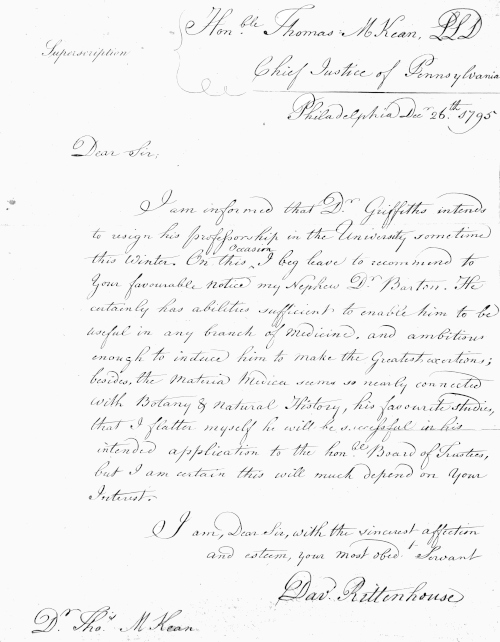
The affectionate regard and high respect which Professor Barton uniformly cherished for the person 437and character of this worthy relative,—who, on all occasions, evinced himself to be his sincere friend,—cannot be better manifested, than by citing his own words. In his dedication to Dr. Rittenhouse, of a dessertation, entitled, A Memoir concerning the fascinating faculty which has been ascribed to the Rattle-Snake and other American Serpents, is this passage—“In inscribing this Memoir to you, dear sir, I follow the regular course of my feelings, which, when I have received acts of friendship or kindness, ever lead me to acknowledge them. Whilst your example early implanted in me an ardent love of science, the assistance which you afforded me, by removing many of the obstacles that have opposed my advancement in life, has enabled me to devote a portion of my time to the cultivation of science; and thereby to increase the quantity of my happiness:” This was written just four months before the decease of our Philosopher. And in a subsequent inscription by the same gentleman,—that of his New Views of the Origin of the Tribes and Nations of America,—dedicated to Mr. Jefferson, and dated about a year after that event, he says: “The only dedications I ever wrote, were to two persons[297] whom I greatly esteemed and loved; the last, to a common friend, whose virtues and science endeared him to his country, and whose removal from us, we shall long have reason to deplore.”
438Soon after Dr. Priestley’s arrival in Pennsylvania, our Philosopher became personally acquainted with him, and presently conceived for his fellow-labourer in science a sincere esteem. This was reciprocal; and, therefore, while the celebrated English philosopher remained in Philadelphia, and also when he occasionally visited that city after his removal to the town of Northumberland on the Susquehanna, he passed much of his time in Dr. Rittenhouse’s family. So far as the pursuits of these gentlemen, in matters of science, were congenial—for, in some respects they were very dissimilar,—their opinions appeared to harmonize with each other: but, how far their sentiments accorded on other subjects, or whether at all, the Writer cannot undertake to pronounce; not possessing the necessary means to enable him to do so with a sufficient degree of certainty. Dr. Rittenhouse’s intercourse with Dr. Priestley, either personal or epistolary, was, however, of short duration; being terminated by the death of the former, in little more than two years after the latter first came to Philadelphia. One of the last interviews which Dr. Rittenhouse had with his friend Priestley, was very shortly before our philosopher’s death: he was one of a select few whom the writer had the pleasure of meeting at Dr. Rittenhouse’s, to dine, on the 18th of March, 1796.
That learned and eminent foreigner,—for Dr. Priestley never became a naturalized citizen of the United 439States,—died at Northumberland in Pennsylvania, at an advanced age, on the 6th day of February 1804.
The scanty remnant of life that yet remained to the great American Astronomer and Mathematician, was neither uselessly, nor altogether unpleasantly employed. In this interval of time, short as it was, such portions of it as afforded him some respite from sickness and pain, were either devoted to the society of his family and friends, or occupied in study. From these sources of rational enjoyment, be derived much comfort; and the solace he drew from them, was greatly heightened by the endearing attentions, which, amidst the rapid decline of his health and strength, he experienced, in an eminent degree, in the bosom of his affectionate family and some surrounding relatives. He was fully sensible of the approaching crisis of his disease; and he appeared to be quite prepared to meet the awful stroke, with the fortitude which a retrospective view of a well-spent life would naturally inspire; as well as with the resignation, which an entire confidence in the goodness, the wisdom, and the mercy of his omnipotent Creator, taught him to be a duty. His elevated conceptions of the Deity, together with his decided belief of the immortality of the soul, according at the same time with the doctrines of a pure religion, animated him with the stedfast hope of an happy futurity, worthy of a Christian and a Philosopher. His intimate knowledge of the sublimest works of creation, rendered him highly sensible of the wisdom and 440power of the Great Supreme; while that knowledge, aided by the lights furnished by the Christian dispensation, led him to ascribe suitable attributes to the Author of Nature,—a Being infinitely good, as well as perfect: for, as he once familiarly expressed himself,[298] he was “firmly persuaded, that we are not at the disposal of a Being, who has the least tincture of ill-nature, or requires any in us.”[299]
441It is an observation of a judicious biographer,[A] that “nothing can awaken the attention, nothing affect the heart of man, more strongly, than the behaviour of eminent personages in their last moments; in that only scene of life where we are all sure, later or sooner, to resemble them.” The writer of these Memoirs feels a sort of pensive gratification, in having it in his power to announce the manner in which the great American Astronomer deported himself, during the closing scene of his life: The following information on this head, was communicated by the writer’s brother, Professor Barton, the deceased’s nephew and friend,—for some years, also, his family-physician; and who, in his medical capacity, attended him in the whole of his last illness.
“The last visit I ever received from Mr. Rittenhouse was about the middle of June, 1796. He called at my humble habitation in Fifth street, to inquire about 442my health, and to learn from me the result of the experiments and inquiries in which he knew I was, at this time engaged, concerning the mode of generation and gestation of our opossum, an animal to whose economy and manners he had himself paid some attention, and whose history he justly considered one of the most interesting in the whole range of zoology.
“It was on this occasion, that our excellent friend first informed me, that he had received a diploma from the Royal Society. He observed, with a tone of voice and with a certain expression of countenance, which were not calculated to afford me any pleasure, “that a few years ago, such a mark of respect from that illustrious body would have been received by him with pleasure and with pride.”
“In fact, Mr. Rittenhouse, now and for some months past, was strongly impressed with the idea, that his career of usefulness and virtue was nearly at an end. He had several times, during the preceding part of the spring and summer, intimated to me (and doubtless to others of his friends) his impressions on this head. In what precise condition of his system, whether physical or intellectual, these impressions were founded, I have only been able to form a distant, and unsatisfactory conjecture.
“A few days after this interview, viz. on the 22d of June, I was sent for to visit Mr. Rittenhouse. I found 443him in his garden, where he loved to walk, and soon learned that he laboured under a severe attack of cholera, accompanied, however, with more fever than we generally find with this disease; and with a great increase of that violent pain and sense of oppression at the region of his stomach, to which he had been subject for at least thirty years. Notwithstanding his age, the debility of his system, and the unfavourable state of the season, I ventured to flatter myself, that the attack would not prove mortal. On the following day, however, finding him no better, but rather worse, I requested permission to call in the aid of another physician; and having mentioned the name of Dr. Adam Kuhn, that gentleman accordingly visited our friend, in company with me, during the remainder of his illness.
His febrile symptoms being very urgent, it was thought necessary to bleed our patient; and notwithstanding his great and habitual repugnance to the practice on former occasions, he now readily consented to the operation, on condition that I would perform it myself. The blood which was drawn, exhibited a pretty strong inflammatory crust; and the operation seemed to give him a temporary relief from his pain. Soon after this, his strength gradually declined; and on the third day of his illness, it was but too obvious, that our illustrious relative was soon to be separated from his friends. He expired without a struggle, and in the calmest manner, ten minutes before two o’clock on the morning of Sunday the 26th, in 444the presence of his youngest daughter, Mrs. Waters, and myself. His excellent wife, who had ever been assiduous in her attention on her husband, both in sickness and in health, had retired from his chamber about two hours before, unable to support the awful scene of expiring genius and virtue.
“There can be no doubt, I think, that Mr. Rittenhouse, from the first invasion of his disease, or at least from the day when he was confined to his bed or room, entertained but little hopes of his recovery. He signed his will in my presence. He discovered no more solicitude about his situation, than it is decorous and proper in every good or great man to feel, when in a similar situation. During the greater part of his illness, he manifested the most happy temperament of mind: and it was only in the last hour or two of his life, that his powerful intellects were disturbed by a mild delirium. About eight hours before he died, the pain in the region of his stomach being unusually severe, a poultice composed of meal and laudanum was applied to the part. In less than two hours after the application, I called to see him, and upon asking him if he did not feel easier, he calmly answered, in these memorable words, which it is impossible for me to forget,—for they were the last he ever distinctly uttered, and they make us acquainted with the two most important features in his religious creed,—“Yes, you have made the way to God easier!”
445“Such were the dying words, as it were, of our illustrious relative and friend. He was dear to us both, to all his relatives and friends; and to his country. To me, let me add, he was peculiarly dear. The most happy and profitable hours of my life were passed in the society of this virtuous man. I followed his foot-steps in the wilderness of our country, where he was the first to carry the telescope, and to mark the motions and positions of the planets. In the bosom of his family, I listened to his lessons, as an humble disciple of Socrates, or Plato. Science mixed with virtue was ever inculcated from his lips.—But to me, Mr. Rittenhouse was more than a friend and preceptor. He was a father and supporter. He laid the foundation of what little prosperity in life I now, or may in future, enjoy: and if it shall ever be my fortune, either by my labours or my zeal, to advance the progress of science, or to reflect any honour upon my country, I should be the most ungrateful of men, if I did not acknowledge, and wish it to be known, that it was David Rittenhouse who enabled me to be useful.”
Such was the death of David Rittenhouse,—soon after his entrance into the sixty-fifth year of his age:—“Thus, with a heart overflowing with love to his family, friends, country, and to the whole world, he peacefully resigned his spirit into the hands of his 446God.”[300] Thus did his immortal soul gently pass away, from this transitory but variegated scene; from a theatre of mingled afflictions and comforts, of privations and enjoyments, of absolute certainty with respect to the non-continuance of this state, and of equal incertitude as to our possible knowledge of the term of its duration:—And it is most confidently believed, that his departed spirit, while yet hovering on the confines of time, devoutly relied on being “promoted to a more exalted rank among the creatures of God.”[301]
145. Joseph Galloway, Esq. a representative in assembly from the county of Bucks. He was speaker of the house, from the year 1766 to 1773, inclusively; excepting a short interval in the session of 1768-9, in which Joseph Fox, Esq. officiated as speaker.
146. William Allen, Esq. chief-justice of the supreme court of Pennsylvania, and a member of assembly from the county of Cumberland.
147. Equal to 533 Spanish or American dollars.
148. John and George Ross, Esqrs. lawyers of great respectability, and brothers; the former a resident in Philadelphia; the latter in Lancaster. Mr. George Ross was a member of the first congress; and was appointed by the assembly on the 5th of April, 1775, judge of the admiralty-court for Pennsylvania.
149. Edward Biddle, Esq. a lawyer of eminence, and a representative in assembly for the county of Berks, in which he resided. This gentleman was one of the delegates appointed to the congress of the 10th of May, 1775, under an unanimous resolution of the assembly, passed in December, 1774; but, having succeeded Mr. Galloway as speaker of that house, in the session of 1774-5, he did not take his seat in congress, with his colleagues. These were John Dickinson, Charles Humphreys, John Morton, George Ross, Thomas Mifflin, Benjamin Franklin, Thomas Willing and James Wilson, Esqrs.
150. Emanuel Carpenter, Esq. long a respectable member of assembly from Lancaster county.
151. Thomas Minshull, Esq. a respectable member of the house, from York county.
152. The Hon. John Penn.—This worthy gentleman, a grandson of the celebrated William Penn, was lieutenant-governor of Pennsylvania, under the chief proprietaries of the province, from October 1763, to May 1771; and again, from August 1773, until the revolution.
153. The proprietary’s and governor’s council, consisting of James Hamilton, William Allen, Joseph Turner, William Logan, Richard Peters (D. D.), Lynford Lardner, Benjamin Chew, Thomas Cadwallader, Richard Penn, James Tilghman, Andrew Allen, and Edward Shippen, jun. Esquires. Joseph Shippen, jun. Esquire, officiated many years as provincial secretary and clerk of the council.
154. Matthias Slough, Esq. who served several years with reputation as a representative in the assembly, from the county of Lancaster.
155. On the 4th of Feb. 1770, he mentioned to Mr. Barton his then contemplated removal into that city, in these terms—“Dr. Smith, to whom I am indebted for many kindnesses, is very urgent to have me come to Philadelphia to reside, which it is probable I may do shortly: but I am not yet determined. If I live to write again, you shall know more of my mind; in the mean time, I shall be glad to have your opinion of the matter.”
156. Since writing the above the author has ascertained, that towards the close of April, 1770, the orrery was purchased for the college of New-Jersey. On the 23d of that month, Dr. Witherspoon, then the president of that college, accompanied by some gentlemen, went to Norriton for that purpose, and it appears that the orrery was then nearly finished.
157. The following extract of a letter from Dr. Smith to Mr. Barton, written the day after Mr. Rittenhouse’s on the same subject, will further explain the embarrassing circumstances that attended this transaction, and the delicate situation in which Mr. Rittenhouse, particularly, was placed.
“I never,” said the Doctor, “met with greater mortification, than to find Mr. Rittenhouse had, in my absence, made a sort of agreement to let his Orrery go to the Jersey College. I had constantly told him, that if the Assembly did not take it, I would take it for our College, and would have paid the full sum, should I have begged the money. I thought I could depend, as much as on any thing under the sun, that after Mr. Rittenhouse knew my intentions about it, he would not have listened to any proposal for disposing of it, without advising me, and giving our College the first opportunity to purchase. I think Mr. Rittenhouse was never so little himself, as to suffer himself to be taken off his guard on this occasion. This province is willing to honour him, as her own: and believe me, many of his friends wondered at the newspaper article; and regretted that he should think so little of his noble invention, as to consent to let it go to a village; unless he had first found, on trial, that his friends in this city had not spirit to take it: For if he would wish to be known by this work—and introduced to the best business and commissions for instruments, from all parts of the continent,—his Orrery being placed in our College, where so many strangers would have an opportunity of seeing it, was the sure way to be serviceable to Himself.
“You will think, by all this, that I am offended with him, and that our friendship may hereby be interrupted: Far from it—I went to see him, the day the newspaper announced the affair. I soon found that I had little occasion to say any thing: he was convinced, before I saw him, that he had gone too far. But still, as no time was fixed for delivering the Orrery, I was glad to find he had concluded that it should not be delivered till next winter; against which time, he said, he could have a second one made, if this one staid with him for his hands to work by. As I love Mr. Rittenhouse, and would not give a man of such delicate feelings a moment’s uneasiness, I agreed to wave the honour of having the first Orrery, and to take the second.”
In fact, the Orrery was not at that time finished; for Mr. Rittenhouse then informed Dr. Smith, that he was under the necessity of waiting for brass from England, to enable him to complete it. “The result (continued the Doctor) will be, I think, that he will keep his Orrery till towards winter; and should they not then receive it, in the Jersies, they will take it at New-York.”
On the 7th of the following month, Dr. Smith wrote thus finally, to Mr. Barton, on this subject—“Your and my friend, Mr. Rittenhouse, will be with you on Saturday. The Governor says, the Orrery shall not go: he would rather pay for it, himself. He has ordered a meeting of the Trustees on Tuesday next; and declares it as his opinion, that we ought to have the first Orrery, and not the second,—even if the second should be the best.”
158. The Rev. Dr. Peters wrote thus to Mr. Barton, under the date of March 22, 1771—“Dr. Smith has done wonders in favour of our friend Rittenhouse. His zeal has been very active: he has got enough to pay him for a second orrery; and the assembly has given him 300l. The Doctor, in his introductory lecture, was honoured with the principal men of all denominations, who swallowed every word he said, with the pleasure that attends eating the choicest viands; and in the close, when he came to mention the orrery, he over-excelled his very self!”—“Your son will acquaint you with all the particulars respecting it. The lectures are crowded by such as think they can, thereby, be made capable of understanding that wonderful machine: whereas, after all, their eyes only will give them the truth, from the figures, and motions, and places, and magnitudes of the heavenly bodies.”
159. The author of The Vision of Columbus, a Poem, (first published at Hartford in Connecticut, in the beginning of the year 1787,) alludes to the Rittenhouse-Orrery, and to the numerous resort of persons to the College-Hall, for the purpose of viewing that machine, in the following lines, (book vii.)
“See the sage Rittenhouse, with ardent eye,
Lift the long tube and pierce the starry sky;
Clear in his view the circling systems roll,
And broader splendours gild the central pole.
He marks what laws th’ eccentric wand’rers bind,
Copies Creation in his forming mind,
And bids, beneath his hand, in semblance rise,
With mimic orbs, the labours of the skies.
There wond’ring crouds with raptur’d eye behold
The spangled Heav’ns their mystic maze unfold;
While each glad sage his splendid Hall shall grace,
With all the spheres that cleave th’ ethereal space.”
160. In a letter from Dr. Smith to Mr. Barton, dated March 23, 1771, is this paragraph:—
“I have been so busy these two months past, that I could not find a moment’s leisure to write. A good deal of time was to be given to the public lectures, the Orrery, and the getting our dear friend Rittenhouse brought into as advantageous a light as possible, on his first entrance into this town as an inhabitant; all which has succeeded to our utmost wishes; and the notice taken of him by the province, is equally to his honour and theirs. The loss of his wife has greatly disconcerted him; but we try to keep up his spirits, under it.”
161. Joseph Galloway, Esq. was then speaker.
162. The committee, named in the above order of the general assembly, made the following report to that body, on the 24th of September, 1771; viz.
“The committee appointed to agree with, and purchase from Mr. Rittenhouse a new Orrery for the use of the public, beg leave to report, that they have, in pursuance of the order of assembly, agreed with Mr. Rittenhouse for a new Orrery, at the price of four hundred pounds, the price limited by the house; to consist of one principal square (face,) of eight feet or more each way, with two wings; making in the whole one large front, as nearly resembling the form of the Orrery now standing in the College of the city of Philadelphia, as its superior size will admit.” (Signed by all the members of the committee.)
163. Messrs. Dickinson, Humphreys, Morton, Ross and Biddle, together with Mifflin and Franklin, were delegated on the part of Pennsylvania to the first general congress, which met in Philadelphia on the 5th of September, 1774; and the same gentlemen, with the addition of Messrs. Willing and Wilson, were also delegates from Pennsylvania in the second general congress, which met in the same city on the 10th of May, 1775. Of these “dignified and ever memorable assemblies,” composed of that “illustrious band of patriots whose worth sheds a lustre on the American character,” the great Washington was also a member.
Mr. Dickinson, the writer of the celebrated Farmer’s Letters, was a distinguished lawyer, statesman and scholar. Dr. Ramsay (who published his History of the AmericanAmerican Revolution at the close of the year 1789,) remarks, that “the stamp-act, which was to have taken place in 1765, employed the pens and tongues of many of the colonists,” and, that “the duties imposed in 1767, called forth the pen of John Dickinson, who in a series of letters, signed ‘A Pennsylvania Farmer,’ may be said to have sown the seeds of the revolution.”
From the commencement of the momentous controversy between the North-American colonies and the parent state, Mr. Dickinson was an able and strenuous assertor of the rights of the colonists. In the summer of the year 1768, the Rev. Mr. Barton sent him a little artificial fountain or jet-d’eau, called a perpetual fountain, prettily contrived and ornamented. On that occasion, the patriotic feelings of Mr. Dickinson were thus expressed, in an handsome allusion to this engine; feelings, called forth by some sentiments contained in the letter which accompanied this small present,—“I wish” (said he, in his answer to Mr. Barton’s letter, dated the 29th of August,)—“I wish ‘a perpetual fountain’ may water the tree of American liberty—I shall always be ready and willing, with pious hands, to sprinkle its roots; even though, for every drop of the pure element I throw upon them, the free-booters should pour upon me all the foul waters in which they delight to dabble. I have acted from the best of motives, the love of freedom and of my country. If reproaches can influence the weak and malicious, they never can blot from my memory the pleasing consciousness of having endeavoured to do my duty. I am extremely sensible of my own frailties; and yet I think I have so much charity, that I reflect with pleasure, that perhaps these very people who abuse me, may derive some little advantage from those very actions of mine for which they abuse me. May heaven grant this to be the case! It is all the revenge I desire to take of them; and this I think, my good sir, is a Christian revenge.”
Messrs. Allen, Ross, and Biddle, shall be noticed in another place.
Mr. Sellers was a sensible and ingenious country-gentleman, possessed of some skill in mathematical and astronomical science. Messrs. John and Israel Jacobs (whose sister was the second wife of Mr. Rittenhouse) were also well-informed country-gentlemen: the former was speaker of the general assembly of Pennsylvania, and the latter a member of congress, after the revolution. Mr. James Wright was a very respectable representative of the county of Lancaster, before the revolution. The gentlemen named in the committee of the general assembly, to treat with Mr. Rittenhouse for the purchase of an Orrery for the use of the public, were likewise conspicuous for their worth. Of these, Mr. Rhoads was one of the vice-presidents of the American Philosophical Society, and Mr. Morton, a judge of the supreme court of Pennsylvania, before the revolution: both were afterwards members of congress.
164. See Note 167.
165. Dr. William Cadogan’s “Dissertation on the Gout and all Chronic Diseases,” &c. made its appearance in America about that time; and the Rev. Mr. Barton, who had long experienced an hereditary gouty affection, then thought favourably of the Doctor’s general theory, although he could not adopt that ingenious theorist’s doctrine, denying the existence of any hereditary diseases.
166. Mr. Barton and some others of Mr. Rittenhouse’s friends had repeatedly recommended to him to visit England: the former, particularly, often urged him to it, and for the reasons assigned in the text. That he had, himself, long contemplated that voyage, is apparent from the extract of his letter to Mr. Barton, of the 15th of March 1771, already quoted; and his last mentioned letter to the same gentleman shews, that, nearly a year afterwards, he still had that object steadily in view.
167. In a preceding letter, Mr. Barton had sent him some Mathematical Problems, for solution. These had been furnished by a schoolmaster, in Mr. Barton’s neighbourhood; who, although reputed a pretty good mathematician, possessed but a small share of genius or invention, while he had a large portion of confidence in his own abilities. In noticing these problems, Mr. Rittenhouse could not refrain from shewing some little irritation: he thought the communications too trifling, too destitute of originality, or too useless, to merit his attention; and, accordingly, he thus expressed himself on the occasion, in a letter dated Feb. 3, 1772:
“I entreat you not to insist on my measuring heads with any pragmatical schoolmaster, who is heartily welcome, for me, to divert himself with his x. y. z’s, at which he may be very expert, and yet be, as you say, both ignorant and conceited. His first question, however, may be answered by any young algebraist: the second and third are more difficult, and will admit of various answers. The fourth contains four observations, picked out, (and carelessly enough, several of the figures being wrong,) of a set made on the comet of 1682, which I shewed your son William in about half a dozen different books; you will find them in Dr. Halley’s Astronomical Tables. Every thing relating to this comet has long ago been settled by Dr. Halley; so that, to give a complete answer to the question, I need only transcribe from him: but you cannot conceive how much I despise this kind of juggle, where no use is proposed. If your schoolmaster will give me but three good observations (I do not want four) of the comet of 1769, I will accept them with thanks, and soon undertake the laborious task of determining its orbit, which we yet know nothing about.”
To this Mr. Barton replied, in a vein of good-humoured pleasantry:
“I imagine you have mistaken me, with regard to the mathematical questions. They were not sent as trials of your abilities: but, for reasons with which W. B. is acquainted, and which I have desired him to give you, in order to afford you a laugh. I shalt never “insist” on your “measuring heads” with a “schoolmaster,” of any kind; because I know full well, already, that your head is longer than all the heads of the whole tribe. Had you known what diversion your solutions would have afforded me, you would have sent them.”
168. It is not improbable, that about the time of writing the letter of the 3d of Feb. 1772, from which extracts are given in the text, he began to think seriously of marrying again. Both his natural disposition and his habits endeared to him the comforts of domestic society; and these he could not enjoy in a single state, his two only children being infants. He therefore married, in December 1772; at which time he was only in the forty-first year of his age. The lady he chose as his companion, was a sensible, prudent and valuable woman; whose family were members of the religious society of Friends, and with whose brothers Mr. Rittenhouse had long been intimately acquainted. By that marriage there was but one child, a daughter, who died in her infancy. Mrs. Rittenhouse survived her husband little more than three years. She died in October, 1799.
169. See the preceding note.
170. The first law of Pennsylvania, for removing rocks, sandbars and gravel, from the bed of the river Schuylkill, so as to render it passable with rafts, boats, and other small river-craft, was passed the 14th of March 1761.
172. The Marks, &c. are particularly described in the Pennsylvania Act of Assembly, passed the 29th of Sept. 1779, entitled “An Act to establish and confirm the Boundary Line between this state and the state of New-York.”
173. The Law, referred to in the preceding note, states the extent of their further progress in the business at that time, which was inconsiderable.
In September 1772, the Philosophical Society announced in the public prints, the receipt, by them, of sundry communications: among which were various astronomical observations, made in Canada, by this gentleman and two other military officers, from June 1765, to May 1770, (captain Holland being, at that period, surveyor-general of the district of Quebec.) These observations were communicated to the society by Mr. Rittenhouse; but, having been received after the first volume of the Society’s Transactions was published, their publication in the subsequent volumes was by some means omitted.