Note 17 — Chapter VII
Reading edition
Before his death (in 1832) Carnot had obtained a clear perception of the true state of the case, and of the complete doctrine of the conservatism of energy. [See extracts from Carnot's unpublished writings appended, with a biography, to the reprinted Memoir, by his younger brother, Hippolyte Carnot.]
18 This equation for the porous plug experiment may be established in the following manner, which forms a good example of Thomson's second definition of absolute temperature. Take pressure and volume of the gas on the supply side of the plug as p + dp and v, and on the delivery side as p and v + dv, so that dp and dv are positive. The net work done in forcing the gas through the plug = (p + dp) v − p (v + dv) = − pdv + vdp. Let a heating effect result so that temperature is changed from T to T + ∂T. Let this be annulled by abstraction of heat Cp∂T at constant pressure. (Cp = sp. heat press. const.) [It is to be understood that dv is the total expansion existing, after this abstraction of heat.] The energy e of the fluid has been increased by de = − pdv + vdp − Cp∂T.
Now, since the original temperature has been restored, the same expansion dv if imposed isothermally would involve the same energy change de; but in that case heat dH (dynamical) would be absorbed, and work pdv would be done by the gas. Hence de = dH − pdv. This, with the former value of de, gives dH = vdp − Cp∂T. Thomson's work-ratio is thus pdv ⁄ (vdp − Cp∂T). Now suppose dp imposed without change of volume, and dT to be the resulting temperature change. The temperature and pressure ratios are dT ⁄ T, dp ⁄ p. Thus dT ⁄ T = dp dv ⁄ (vdp − Cp∂T), or
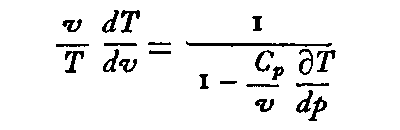
which is Thomson's equation. The minus sign on the right arises from a heating effect having been taken here as the normal case.
If the temperature T is restored by removing the heat at constant volume, a similar process gives the equation
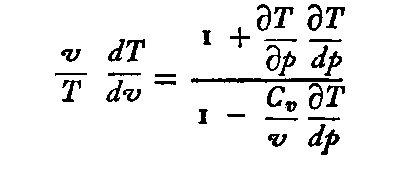
where dp is the change of pressure before the restoration of the temperature T, and ∂T ⁄ ∂p is the rate of variation of T with p, volume constant.