Note 189 — Chapter IV · MEXICAN HIEROGLYPHICS—MANUSCRIPTS—ARITHMETIC—CHRONOLOGY—ASTRONOMY
Reading edition
The following table of two of the four indictions of thirteen years each will make the text more clear. The first column shows the actual year of the great cycle, or “bundle.” The second, the numerical dots used in their arithmetic. The third is composed of their hieroglyphics for rabbit, reed, flint, house, in their regular order.
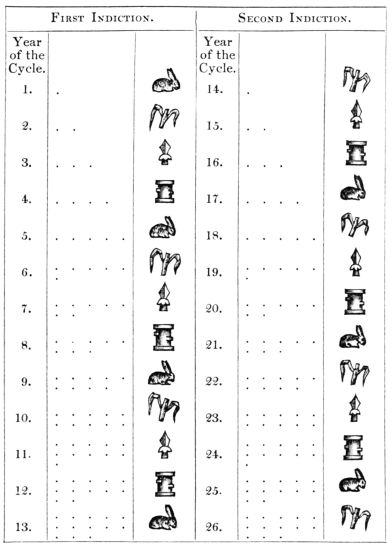
By pursuing the combinations through the two remaining indictions, it will be found that the same number of dots will never coincide with the same hieroglyphic. These tables are generally thrown into the form of wheels, as are those also of their months and days, having a very pretty effect. Several have been published, at different times, from the collections of Siguenza and Boturini. The wheel of the great cycle of fifty-two years is encompassed by a serpent, which was also the symbol of “an age,” both with the Persians and Egyptians. Father Toribio seems to misapprehend the nature of these chronological wheels: “Tenian rodelas y escudos, y en ellas pintadas las figuras y armas de sus Demonios con su blason.” Hist. de los Indios, MS., Parte 1, cap. 4.