Note 13 — Chapter I · VOYAGE OF HERNANDEZ DE CÓRDOBA TO YUCATAN. 1516-1517.
Reading edition
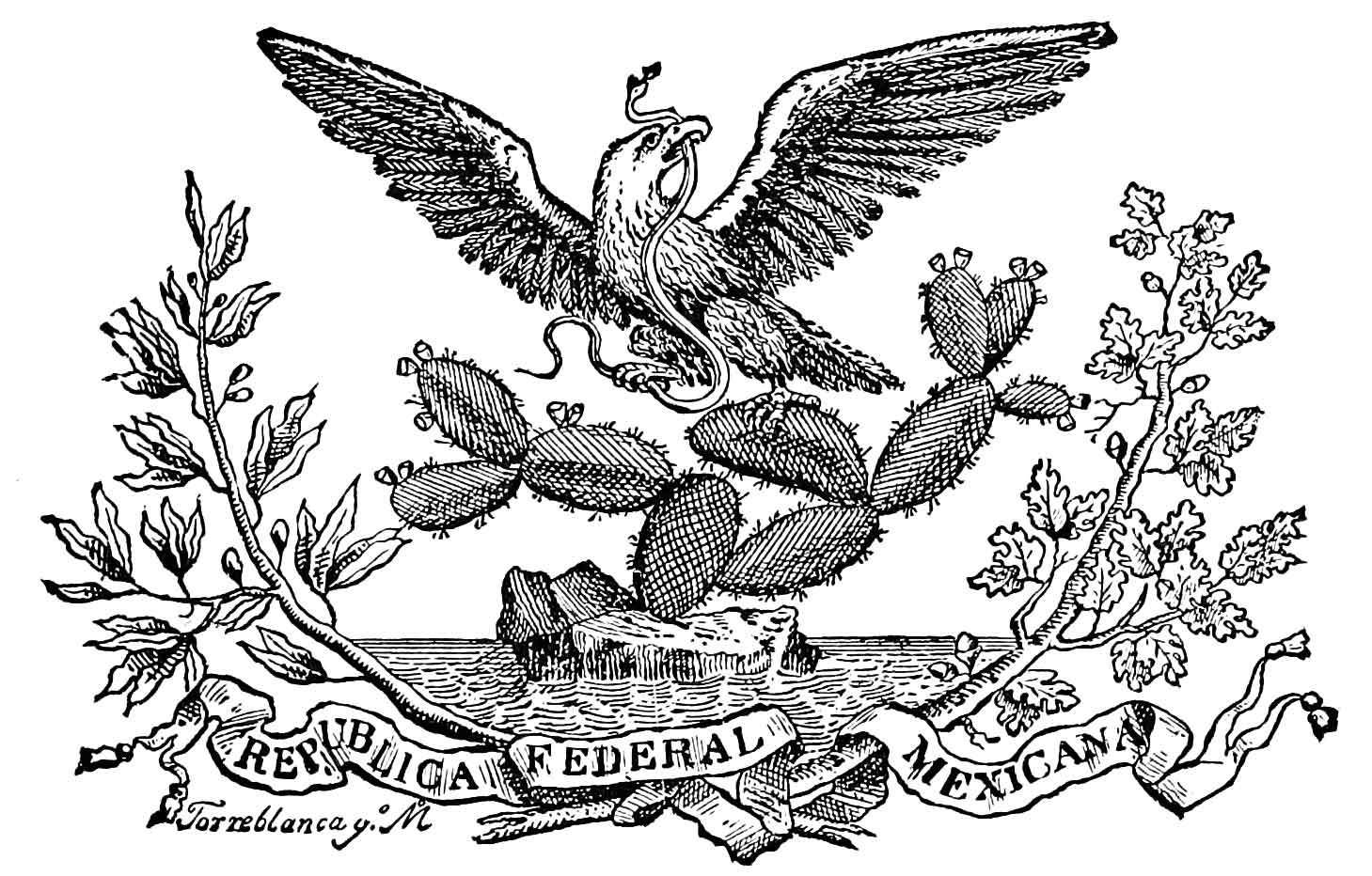
Arms of the Republic of Mexico.
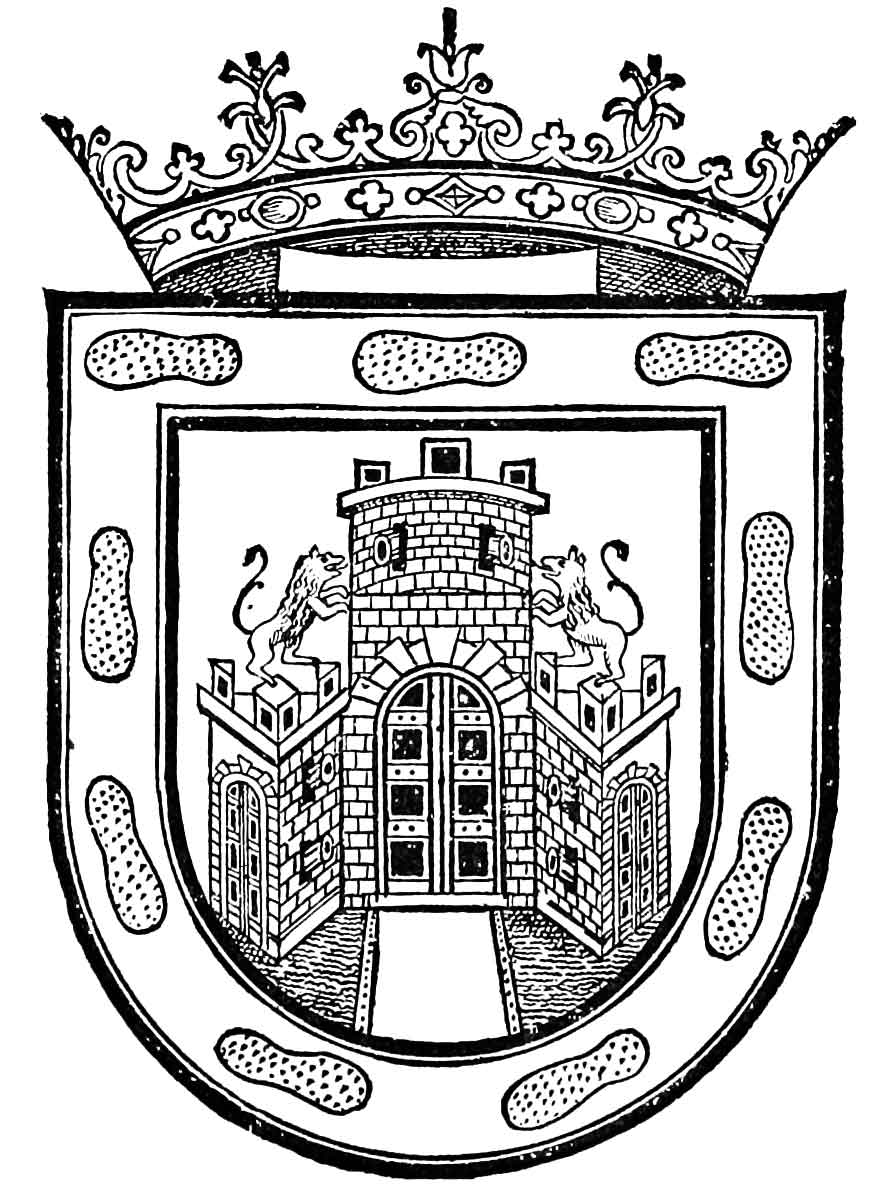
Ancient Arms of the City of Mexico, from a rare print.
The term Mexico has widely different meanings under different conditions. At first it signified only the capital of the Nahua nation, and it was five hundred years before it overspread the territory now known by that name. Mexico City was founded in 1325, and was called Mexico Tenochtitlan. The latter appellation has been connected with Tenuch, the Aztec leader at this time, and with the sign of a nopal on a stone, called in Aztec, respectively nochtli and tetl, the final syllable representing locality, and the first, te, divinity or superiority. The word Mexico, however, was then rarely used, Tenochtitlan being the common term employed; and this was retained by the Spaniards for some time after the conquest, even in imperial decrees, and in the official records of the city, though in the corrupt forms of Temixtitan, Tenustitan, etc. See Libro de Cabildo, 1524-9, MS. Torquemada, i. 293, states distinctly that even in his time the natives never employed any other designation for the ancient city than Tenochtitlan, which was also the name of the chief and fashionable ward. Solis, Conq. Mex., i. 390, is of opinion that Mexico was the name of the ward, Tenochtitlan being applied to the whole city, in which case Mexico Tenochtitlan would signify the ward Mexico of the city Tenochtitlan. Gradually the Spanish records began to add Mexico to Tenochtitlan, and in those of the first provincial council, held in 1555, we find written Tenuxtitlan Mexico. Concilios Prov., i. and ii., MS. In the course of time the older and more intricate name disappeared, though the city arms always retained the symbolic nopal and stone. Clavigero, Storia Mess., i. 168; iv. 265-70; Soc. Mex. Geog., Boletin, viii. 408-15; Veytia, Hist. Ant. Méj., ii. 157-9; Humboldt, Essai Pol., i. 146-7; Cavo, Tres Siglos, i. 2; Carbajal Espinosa, Hist. Mex., i. 92-3. See also Molina, Vocabulario. A number of derivations have been given to the word Mexico, as mexitli, navel of the maguey; metl-ico, place amidst the maguey; meixco, on the maguey border; mecitli, hare; metztli, moon; amexica, or mexica, you of the anointed ones. The signification spring, or fountain, has also been applied. But most writers have contented themselves by assuming it to be identical with the mexi, mexitl, or mecitl, appellation of the war god, Huitzilopochtli, to which has been added the co, an affix implying locality; hence Mexico would imply the place or settlement of Mexica, or Mexicans. This war god, Huitzilopochtli, as is well known, was the mythic leader and chief deity of the Aztecs, the dominant tribe of the Nahua nation. It was by this august personage, who was also called Mexitl, that, according to tradition, the name was given them in the twelfth century, and in these words: ‘Inaxcan aocmoamotoca ynamaz te ca ye am mexica,’ Henceforth bear ye not the name Azteca, but Mexica. With this command they received the distinguishing mark of a patch of gum and feathers to wear upon their forehead and ears. Bancroft’s Native Races, ii. 559; iii. 295-6; v. 324-5 et passim. I can offer no stronger proof as to the way in which the name was regarded at the time of the conquest, and afterwards, than by placing side by side the maps of the sixteenth century and instituting a comparison. In Apiano, Cosmographica, 1575, is a map, supposed to be a copy of one drawn by Apianus in 1520, on which Themisteton is given apparently to a large lake in the middle of Mexico; Fernando Colon, in 1527, and Diego de Ribero, 1529, both give the word Mexico in small letters, inland, as if applied to a town, although no town is designated; Ptolemy, in Munster, 1530, gives Temistitan; Munich Atlas, no. vi., supposed to have been drawn between 1532 and 1540, Timitistan vel Mesicho; Baptista Agnese, 1540-50, Timitistan vel Mesico; Ramusio, 1565, Mexico; Mercator’s Atlas, 1569, Mexico, as a city, and Tenuchitlan; Michael Lok, 1582, Mexico, in Hondius, about 1595, in Drake’s World Encompassed, the city is Mexico, and the gulf Baia di Mexico; Hondius, in Purchas, His Pilgrimes, Laet, Ogilby, Dampier, West-Indische Spieghel, Jacob Colom, and other seventeenth-century authorities, give uniformly to the city, or to the city and province, but not to the country at large, the name as at present written.