Note 211 — Chapter V
Reading edition
Comparative Statement of Average Sailings of various Transatlantic Steamers during the Year 1856.
Liverpool to New York. New York to Liverpool.
Cunard (Boston) 13·07 days 11·12 days
Cunard (New York) 12·67 days 11·03 days
Collins 12·16 days 12·03 days
Bremen 15·00 days 14·12 days
Old Havre 14·18 days 13·16 days
Havre (Vanderbilt) 13·00 days 13·00 days
Havre (French) 17·00 days 15·00 days
Glasgow 15·12 days 13·08 days
Hamburg 15·12 days 16·00 days
[212] The dimensions of the Scotia are, length of keel and forerake, 367 feet (nearly twice the length of the Britannia); breadth of beam moulded, 47½ feet; depth for tonnage, 30½ feet; gross register 3871 tons. Her engines are 975 nominal horse-power, but she works at sea up to 4200 horse-power. The diameters of her two cylinders are respectively 100 and 144 inches. Her paddle-wheels are upwards of 40 feet in diameter, and her bunkers contain 1800 tons of coal. The weight of iron in her hull alone is 2800 tons. On her trial trip she attained a speed of 19 statute miles an hour. Her cost ready for sea was 170,000l., but labour, iron, and other materials have risen considerably in price since she was contracted for in 1860.
[213] “The Steam Fleet of Liverpool,” p. 17.
[214] This is her nominal power, but as her cylinder is 87 inches diameter, and stroke 48, the power indicated is from 2700 to 3000 horses.
[215] The compound engine has two cylinders, one frequently double the diameter of the other. Steam at a high pressure is admitted from the boiler into the smaller cylinder, and, after it has driven the piston up or down, it is allowed to pass into the larger cylinder when, by its expansive property, it assists in driving the larger piston down or up. When it has exerted its full expansive effect, it is then in a condition to be condensed; and thus a compound engine combines the advantages of both a high pressure and low pressure or condensing engines. Compound engines are sometimes called “high and low pressure” engines, and there are a great many modifications of them, their principle however, being always the same.
[216] In the course of this work I have frequently had occasion to refer to the skill and genius displayed by the Americans in their adaptation of appliances to reduce or dispense with manual labour, but perhaps none of their inventions with this object in view can be compared with the windlass of Messrs. Harfield and Company (formerly Brown, Harfield, and Company), of London, who, beyond other inventions, have produced in their patent windlass, of which the following is an illustration—
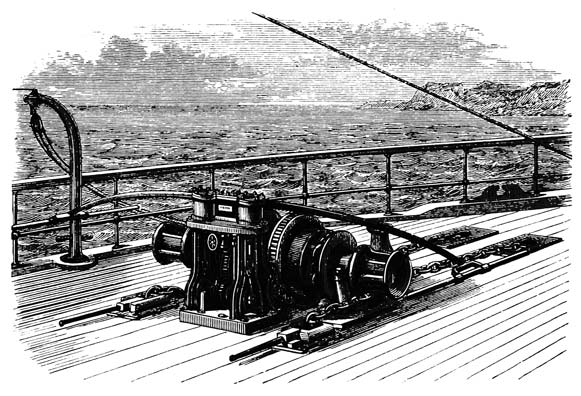
a machine of strength, simplicity, and power, applicable to vessels of all descriptions, which has never been surpassed. This very compact instrument can be worked either by manual labour or by steam, and of its value in the latter case Mr. Harfield remarks: “The two principal points of advantage are (1) that the cable is led from the hawsepipe to the underside of the chain-wheel, then over and half round the side standard (formed like a riding-bit) away to the after stopper, thus forming the strongest means for riding securely; (2ndly), the chain-wheels are not attached rigidly to the windlass, but have a very simple frictional connection which can be set up to any desired extent so as to yield to a heavier strain.”