Note 216 — Chapter V
Reading edition
In the course of this work I have frequently had occasion to refer to the skill and genius displayed by the Americans in their adaptation of appliances to reduce or dispense with manual labour, but perhaps none of their inventions with this object in view can be compared with the windlass of Messrs. Harfield and Company (formerly Brown, Harfield, and Company), of London, who, beyond other inventions, have produced in their patent windlass, of which the following is an illustration—
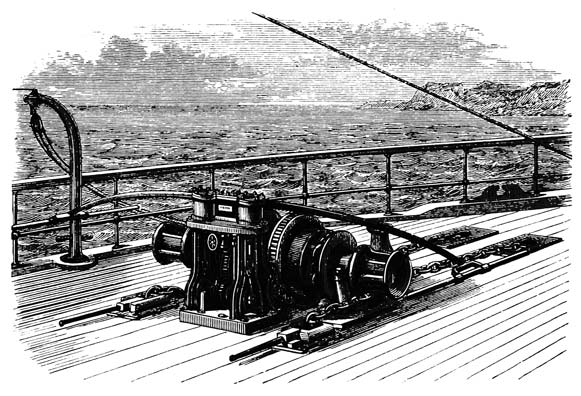
a machine of strength, simplicity, and power, applicable to vessels of all descriptions, which has never been surpassed. This very compact instrument can be worked either by manual labour or by steam, and of its value in the latter case Mr. Harfield remarks: “The two principal points of advantage are (1) that the cable is led from the hawsepipe to the underside of the chain-wheel, then over and half round the side standard (formed like a riding-bit) away to the after stopper, thus forming the strongest means for riding securely; (2ndly), the chain-wheels are not attached rigidly to the windlass, but have a very simple frictional connection which can be set up to any desired extent so as to yield to a heavier strain.”