Note Footnotes — Front matter
Reading edition
[1] Montesquieu, Grandeur et Décadence des Romains, xviii.
[2] Suetonius, Cæsar, 22.
[3] “Cæsar resolved to pass into Britain, the people of which had, in nearly all wars, assisted the Gauls.” (Cæsar, Gallic War, IV. 20.)
[4] Suetonius, Cæsar, 47.
[5] Appian, Civil Wars, I. 110, 326, edit. Schweighæuser.
[6] Cicero, Epistolæ ad Atticum, XIV. 10.
[7] In fact, how many disturbances, civil wars, and revolutions in Europe since 1815! in France, Spain, Italy, Poland, Belgium, Hungary, Greece, and Germany!
[8] Grandeur et Décadence des Romains.
[9] Titus Livius I. 44.—Dionysius of Halicarnassus, speaking of the portion of the rampart between the Porta Æsquilina and the Porta Collina, says, “Rome is fortified by a fosse thirty feet deep and a hundred or more wide in the narrowest part. Above this fosse rises a wall supported internally by a lofty and wide terrace, so that it cannot be shaken by battering rams, or overthrown by undermining.” (Antiq. Roman., IX. 68.)
[10] “Since that time (the time of Servius Tullius) Rome has been no farther enlarged ... and if, in face of this spectacle, any one would form a notion of the magnitude of Rome, he would certainly fall into error, for he would not be able to distinguish where the town ends and where it is limited, so close the suburbs come up to the town.... The Aventine, till the reign of Claudius, remained outside the Pomœrium, notwithstanding its numerous inhabitants.” (Aulus Gellius, XIII. 14.—Dionysius of Halicarnassus, IV. 13.)
[11] Dionysius of Halicarnassus, IV. 49.
[12] “By this treaty, the Romans and their allies engage not to navigate beyond the Bonum Promontorium (a cape situated to the north and opposite Carthage, and now called by navigators the Cape of Porto-Farino).... The Carthaginians undertake to respect the Ardeates, the Antiates, the Laurentes, the Circeii, the Tarracinians, and indeed all the Latin peoples subject to Rome.” (Polybius, III. 22.)
[13] “When Tarquinius Priscus regulated, with the foresight of a skilful prince, the state of the citizens, he attached great importance to the dress of children of condition; and he decreed that the sons of patricians should wear the bulla with the robe hemmed with purple: but even this privilege was restricted to the children of those fathers who had exercised a curule dignity; the sons of other patricians had merely the prætexta, and it was necessary that even their fathers should have served the prescribed time in the cavalry.” (Macrobius, Saturnalia, I. 6.)
[14] “The plebeians were excluded from all offices, and put only to agriculture, the breeding of cattle, and mercantile occupations.” (Dionysius of Halicarnassus, II. 9.)—“Numa encouraged the agriculturists; they were excused from service in war, and discharged from the care of municipal affairs.” (Dionysius of Halicarnassus, II. 76.)
[15] Dionysius of Halicarnassus, II. 9.—Plutarch, Romulus, 13.
[16] “Agrorum partes attribuerant tenuioribus.” (Festus, under the word Patres, p. 246, edit. O. Müller.)
[17] Dionysius of Halicarnassus, IV. 24.
[18] These questions have been the object of learned researches; but, after an attentive perusal of the works of Beaufort, Niebuhr, Gœttling, Duruy, Marquardt, Mommsen, Lange, &c., the difference of opinions is discouraging: we have adopted those which appeared most probable.
[19] Dionysius of Halicarnassus, V. 40.—Titus Livius, II. 16.
[20] Titus Livius, II. 48.—Dionysius of Halicarnassus, IX. 15.
[21] Titus Livius, II. 64.
[22] Dionysius of Halicarnassus, X. 15.
[23] “They called a decree of the people (scitum populi) the measure which the order of patricians had voted, on the proposal of a patrician, without the participation of the plebs.” (See Festus, under the words Scitum populi, p. 330.)—Titus Livius, speaking of the tribunes, puts the following words into the mouth of Appius Claudius: “Non enim populi, sed plebis, eum magistratum esse.” (Titus Livius, II. 56.)
[24] “The plebs was composed of all the mass of the people which was neither senator nor patrician.” (See Festus, under the words Scitum populi.)
[25] “Populus autem non omnis hominum cœtus quoquo modo congregatus, sed cœtus multitudinis juris consensu et utilitatis communione sociatus.”—(Cicero, De Republica, I. 25.)
[26] “Populus curiatis eum (Numam) comitiis regem esse jusserat. Tullum Hostilium populus regem, interrege rogante, comitiis curiatis creavit. Servius, Tarquinio sepulto, populum de se ipse consuluit jussusque regnare legem de imperio suo curiatam tulit.” (Cicero, De Republica, II. 13-21.)
[27] “The predecessors of Servius Tullius brought all causes before their tribunal, and pronounced judgment themselves in all disputes which regarded the State or individuals. He separated these two things, and, reserving to himself the cognizance of affairs which concerned the State, abandoned to other judges the causes of individuals, with injunctions, nevertheless, to regulate their judgments according to the laws which he had passed.” (Dionysius of Halicarnassus, IV. 25.)
[28] “The consuls, like the ancient kings, have twelve lictors carrying axes and twelve lictors carrying rods.” (Appian, Syrian Wars, 15.)
[29] “From that time Tarquinius Superbus carried, during the rest of his life, a crown of gold, a toga of embroidered purple, and a sceptre of ivory, and his throne was also of ivory; when he administered justice, or walked abroad in the town, he was preceded by twelve lictors, who carried axes surrounded with rods. (Dionysius overlooks the twelve other lictors who carried rods only.) After the kings had been expelled from Rome, the annual consuls continued to use all these insignia, except the crown and the robe with purple embroidery. These two only were withdrawn, because they were odious and disagreeable to the people. But even these were not entirely abolished, since they still used ornaments of gold and dress of embroidered purple, when, after a victory, the Senate decreed them the honours of the triumph.” (Dionysius of Halicarnassus, III. 62.)
[30] “The soldiers of Romulus, to the number of three thousand, were divided into three bodies, called ‘tribes.’” (Dio Cassius, Fragm., XIV., edit. Gros.—Dionysius of Halicarnassus, II. 7.—Plutarch, Romulus, 25.)—“The name of tribune of the soldiers is derived from the circumstance that the three tribes of the Ramnes, the Luceres, and the Tatiens each sent three to the army.” (Varro, De Lingua Latina, V. § 81, p. 32, edit. O. Müller.)
[31] Dionysius of Halicarnassus, II. 35. Attempts have been made to explain in different ways the origin of the word curia. Some have derived it from the word curare, or from the name of the town of Cures, or from κὑριος, “a lord:” it seems more natural to trace it to quiris (curis), which had the signification of a lance (Dionysius of Halicarnassus, II. 48.—Plutarch, Romulus, for thus we obtain a term analogous with that of the Middle Ages, where spear signified a man-at-arms, accompanied by six or eight armed followers. And as the principal aim of the formation of the curia was to furnish a certain number of armed citizens, it is possible that they may have given to the whole the name of a part. We read in Ovid, Fasti, II. lines 477-480:—
“Sive quod hasta curis priscis est dicta Sabinis, Bellicus a telo venit in astra deus: Sive suo regi nomen posuere Quirites, Seu quis Romanis junxerat ille Cures.”
[32] Titus Livius, 1. 43.
[33] Dionysius of Halicarnassus, II. 14, and IV. 20.
[34] “The appeal to the people existed even under the kings, as the books of the pontiffs show.” (Cicero, De Republica, II. 31.)
[35] Plutarch, Numa, 17.—Pliny, Natural History, XXXIV. 1.
[36] “Servius Tullius conformed no longer as aforetime to the ancient order of three tribes, distinguished by origin, but to the four new tribes which he had established by quarters.” (Dionysius of Halicarnassus, IV. 14.)
[37] Dionysius of Halicarnassus, III. 61.—Titus Livius, I. 35.
[38] Dionysius of Halicarnassus, IV. 22.
[39] Dionysius of Halicarnassus, IV. 19. “Servius Tullius, by these means, threw back upon the richest all the costs and dangers of war.” (Dionysius of Halicarnassus, IV. 20.)
[40] “If Numa was the legislator of the religious institutions, posterity proclaims Servius as the founder of the order which distinguishes in the Republic the difference of rank, dignity, and fortune. It was he who established the census, the most salutary of all institutions for a people destined to so much greatness. Fortunes, and not individuals, were called upon to support the burdens of the State. The census established the classes, the centuries, and that order which constitutes the ornament of Rome during peace and its strength daring war.” (Titus Livius, I. 42.)
[41] Dionysius of Halicarnassus, IV. 16.
[42] “When Servius Tullius had completed the taking of the census, he ordered all the citizens to assemble in arms in the greatest of the fields situated near the town, and, having arranged the horsemen in squadrons, the footmen in phalanx, and the light-armed men in respective orders, he submitted them to a lustration, by the immolation of a bull, a ram, and a he-goat. He ordered that the victims should be led thrice round about the army, after which he sacrificed to Mars, to whom this field was dedicated. From that epoch to the present time the Romans have continued to have the same ceremony performed, by the most holy of magistracies, at the completion of each census; it is what they call a lustrum. The total number of all the Romans enumerated, according to the writing of the tables of the census, gave 300 men less than 85,000.” (Dionysius of Halicarnassus, IV. 22.)
[43] “This good order of government (under Servius Tullius) was sustained among the Romans during several centuries, but in our days it has been changed, and, by force of circumstances, has given place to a more democratic system. It is not that the centuries have been abolished, but the voters were no longer called together with the ancient regularity, and their judgments have no longer the same equity, as I have observed in my frequent attendance at the comitia.” (Dionysius of Halicarnassus, IV. 21.)
[44] “The poorest citizens, in spite of their great number, were the last to give their vote, and made but one century.” (Dionysius of Halicarnassus, IV. 21.)
[45] Titus Livius, I. 43.
[46] “From the age of seventeen years, they were called to be soldiers. Youth began with that age, and continued to the age of forty-six. At that date old age began.” (Aulus Gellius, X. 28.—Dionysius of Halicarnassus, IV. 16.)
[47] Titus Livius speaks only of a hundred and ninety-two centuries; Dionysius of Halicarnassus reckons a hundred and ninety-three. “In the Roman plebs, the poorest citizens, those who reported to the census not more than fifteen hundred ases, were called proletarii; those who were not worth more than three hundred and seventy-five ases, and who thus possessed hardly anything, were called capite censi. Now, the fortune and patrimony of the citizen being for the State a sort of guarantee, the pledge and foundation of his love for his country, the men of the two last classes were only enrolled in case of extreme danger. Yet the position of the proletarii was a little more honourable than that of the capite censi; in times of difficulty, when there was want of young men, they were incorporated in the hastily-formed militia, and equipped at the cost of the State; their name contained no allusion to the mere poll-tax to which they were subjected; less humiliating, it reminded one only of their destination to give children to their country. The scantiness of their patrimony preventing them from contributing to the aid of the State, they at least contributed to the population of the city.” (Aulus Gellius, XVI. 10.)
[48] “Tarquinius Priscus afterwards gave to the knights the organisation which they have preserved to the present time.” (Cicero, De Republica, II. 20.)
[49] “It is said that the number of citizens inscribed under this title was 80,000. Fabius Pictor, the most ancient of our historians, adds that this number only includes the citizens in condition to bear arms.” (Titus Livius, I. 44.)
[50] The different censuses of the people furnished by the ancient historians have been explained in different manners. Did the numbers given designate all the citizens, or only the heads of families, or those who had attained the age of puberty? In my opinion, these numbers in Livy, Dionysius of Halicarnassus, and Plutarch, applied to all the men in a condition to carry arms, that is, according to the organisation of Servius Tullius, to those from seventeen to sixty years old. This category formed, in fact, the true Roman citizens. Under seventeen, they were too young to count in the State; above sixty, they were too old.
We know that the aged sexagenarians were called depontani, because they were forbidden the bridges over which they must go to the place of voting. (Festus, under the word sexagenarius, p. 834.—Cicero, Pro S. Roscio Amerino, 35.)
80,000 men in condition to carry arms represent, according to the statistics of the present time, fifty-five hundredths of the male part of the population, say 145,000 men, and for the two sexes, supposing them equal in number, 290,000 souls. In fact, in France, in a hundred inhabitants, there are 35 who have not passed the age of seventeen, 55 aged from seventeen to sixty years, and 10 of more than sixty.
In support of the above calculation, Dionysius of Halicarnassus relates that in the year 247 of Rome a subscription was made in honour of Horatius Cocles: 300,000 persons, men and women, gave the value of what each might expend in one day for his food. (V. 25.)
As to the number of slaves, we find in another passage of Dionysius of Halicarnassus (IX. 25) that the women, children, slaves, merchants, and artisans amounted to a number triple of that of the citizens.
If, then, the number of citizens in condition to carry arms was 80,000, and the rest of the population equalled three times that number, we should have for the total 4 x 80,000 = 320,000 souls. And, subtracting from this number the 290,000 obtained above, there would remain 30,000 for the slaves and artisans.
Whatever proportion we admit between these two last classes, the result will be that the slaves were at that period not numerous.
[51] Dionysius of Halicarnassus, IV. 9, 23.
[52] “Within the town, the buildings were not allowed to approach the ramparts, which they now ordinarily touch, and outside a space extended which it was forbidden to cultivate. To all this space, which it was not permitted to inhabit or cultivate, the Romans gave the name of Pomœrium. When, in consequence of the increase of the town, the rampart was carried farther out, this consecrated zone on each side was still preserved.” (Titus Livius, I. 44.)
[53] “Founded on the testimony of the sacred books which are preserved with great care in the temples.” (Dionysius of Halicarnassus, XI. 62.)
[54] “These precious pledges, which they regard as so many images of the gods.” (Dionysius of Halicarnassus, VI. 45.)
[55] “Hence is explained the origin of the name given to the Capitol: in digging the foundation of the temple, they found a human head; and the augurs declared that Rome would become the head of all Italy.” (Dionysius of Halicarnassus, IV. 61.)
[56] “This recourse to the opinions of the priests and the observations of religious worship made the people forget their habits of violence and their taste for arms. Their minds, incessantly occupied with religious ideas, acknowledged the intervention of Providence in human affairs, and all hearts were penetrated with a piety so lively that good faith and fidelity to an oath reigned in Rome more than fear of laws or punishments.” (Titus Livius, I. 21.)
[57] Titus Livius, I. 45.
[58] “Assemblies of people, levies of troops—indeed, the most important operations—were abandoned, if the birds did not approve them.” (Titus Livius, I. 36.)
[59] “Numa established also the auspicious and inauspicious days, for with the people an adjournment might sometimes be useful.” (Titus Livius, I. 19.)
[60] “We have a town, founded on the faith of auspices and auguries; not a spot within these walls which is not full of gods and their worshippers; our solemn sacrifices have their days fixed as well as the place where they are to be made.” (Titus Livius, V. 52, Speech of Camillus, VI. &c.)
[61] Cicero, De Republica, II. 14.
[62] “All religious acts, public and private, were submitted to the decision of the pontiff; thus the people knew to whom to address themselves, and disorders were prevented which might have brought into religion the neglect of the national rites or the introduction of foreign ones. It was the same pontiff’s duty also to regulate what concerned funerals, and the means of appeasing the Manes, and to distinguish, among prodigies announced by thunder and other phenomena, those which required an expiation.” (Titus Livius, I. 20.)
[63] “The grand pontiff exercises the functions of interpreter and diviner, or rather of hierophant. He not only presides at the public sacrifices, but he also inspects those which are made in private, and takes care that the ordinances of religious worship are not transgressed. Lastly, it is he who teaches what each individual ought to do to honour the gods and to appease them.” (Plutarch, Numa, 12.)
[64] “Numa divided the year into twelve months, according to the moon’s courses; he added January and February to the year.” (Titus Livius, I. 19.—Plutarch, Numa, 18.)
[65] Dionysius of Halicarnassus, II. 73.
[66] Dionysius of Halicarnassus, II. 64.
[67] Salian is derived from salire (to leap, to dance). (Dionysius of Halicarnassus, II. 70.)—It was their duty, on certain occasions, to execute sacred dances, and to chant hymns in honour of the god of war.
[68] Dionysius of Halicarnassus, II. 72.—“The name of feciales is derived from the circumstance that they presided over the public faith between peoples; for it was by their intervention that war when undertaken assumed the character of a just war, and, that once terminated, peace was guaranteed by a treaty. Before war was undertaken, some of the feciales were sent to make whatever demands had to be made.” (Varro, De Lingua Latina, V. § 86.)—“If allies complained that the Romans had done them wrong, and demanded reparation for it, it was the business of the feciales to examine if there were any violation of treaty.” (Dionysius of Halicarnassus, II. 72.)—Those fecial priests had been instituted by Numa, the mildest and most just of kings, to be guardians of peace, and the judges and arbiters of the legitimate motives for undertaking war. (Plutarch, Camillus, 20.)
[69] Dionysius of Halicarnassus, IV. 14.—Pliny, Natural History, XXI. 8.
[70] Numa raised a temple to Romulus, whom he deified under the name of Quirinus. (Dionysius of Halicarnassus, II. 63)
[71] “Temple of Vesta, emblem of chastity; temple to Public Faith; raised by Numa.” (Dionysius of Halicarnassus, II. 65 and 75.)
[72] “The god Terminus; the festival in honour of Pales, the goddess of shepherds; Saturn, the god of agriculture; the god of fallow-grounds, pasture,” &c. (Dionysius of Halicarnassus, II. 74.)
[73] “After having done these things in peace and war, Servius Tullius erected two temples to Fortune, who appeared to have been favourable to him all his life, one in the oxen-market, the other on the banks of the Tiber, and he gave her the surname of Virilis, which she has preserved to the present day among the Romans.” (Dionysius of Halicarnassus, IV. 27.)
[74] “The Temple of Janus had been closed twice since the reign of Numa: the first time by the consul Titus Manlius, at the end of the first Punic war; the second, when the gods granted to our age to see, after the battle of Actium, Cæsar Augustus Imperator give peace to the universe.” (Titus Livius, I. 19.)—And Plutarch says, in his Life of Numa, XX., “Nevertheless, this temple was closed after the victory of Cæsar Augustus over Antony, and it had previously been closed under the consulate of Marcus Atilius and of Titus Manlius, for a short time, it is true; it was almost immediately opened again, for a new war broke out. But, during the reign of Numa, it was not seen open a single day.”
[75] We employ intentionally the word republic, because all the ancient authors give this name to the State, under the kings as well as under the emperors. It is only by translating faithfully these denominations that we can form an exact idea of ancient societies.
[76] “We acknowledge how many good and useful institutions the Republic owed to each of our kings.” (Cicero, De Republica, II. 21.)
[77] “Among the Romans, the children possess nothing of their own during their father’s life. He can dispose not only of all the goods, but even of the lives of his children.” (Dionysius of Halicarnassus, VIII. 79; II. 25.)
[78] Dionysius of Halicarnassus, II., 25, 26.—“From the beginning,” says Mommsen, “the Roman family presented, in the moral order which reigned among its members, and their mutual subordination, the conditions of a superior civilisation.” (Roman History, 2nd edit., I., p. 54.)
[79] “Morals were so pure that, during two hundred and thirty years, no husband was known to repudiate his wife, nor any woman to separate from her husband.” (Plutarch, Parallel of Theseus and Romulus.)
[80] Cicero admires the profound wisdom of the first kings in admitting the conquered enemies to the number of the citizens. “Their example,” he says, “has become an authority, and our ancestors have never ceased granting the rights of citizens to conquered enemies.” (Oration for Balbus, xxxi.)
[81] Roman colonies (coloniæ civium cum jure suffragii et honorum).—First period: 1-244 (under the kings).
Cænina (Sabine). Unknown. Antemnæ (Sabine). Unknown. Cameria (Sabine). Destroyed in 252. Unknown. Medullia (Sabine). Sant’-Angelo.—See Gell., Topogr. of Rome, 100. Crustumeria (Sabine). Unknown. Fidenæ (Sabine). Ruins near Giubileo and Serpentina. Re-colonised in 326. Destroyed, according to an hypothesis of M. Madvig. Collatia. Ostia (the mouth of the Tiber). Ruins between Torre Bovacciano and Ostia.
Latin colonies (coloniæ Latinæ).—First period: 1-244 (under the kings).
We cannot mention with certainty any Latin colony founded at this epoch, from ancient authorities. The colonies of Signia and Circeii were both re-colonized in the following period, and we shall place them there.
[82] “Tarquin embellished also the great circus between the Aventine and Palatine hills; he was the first who caused the covered seats to be made round this circus.” (Dionysius of Halicarnassus, III. 68.)
[83] Titus Livius, I. 44.—“Immediately the centurions, whose centuries had taken flight, and the antesignani who had lost their standard, were condemned to death: some had their heads cut off; others were beaten to death. As to the rest of the troops, the consul caused them to be decimated; in every ten soldiers, he upon whom the lot fell was conducted to the place of execution, and suffered for the others. It is the usual punishment among the Romans for those who have quitted their ranks or abandoned their standards.” (Dionysius of Halicarnassus, IX. 1.)
[84] “Romulus placed upon their hair a crown of laurels.” (Plutarch, Romulus, XX.)
[85] “The Senate and the people decreed to King Tarquin the honours of the triumph.” (Combat of the Romans and Etruscans, Dionysius of Halicarnassus, III. 60.)—“An ovation differs from a triumph, first, because he who receives the honours of it enters on foot at the head of the army, and not mounted in a car; secondly, that he has neither the crown of gold, nor the toga embroidered with gold and of different colours, but he carries only a white trabea bordered with purple, the ordinary costume of the generals and consuls. Besides having only a crown of laurel, he does not carry a sceptre. This is what the little triumph has less than the great; in all other respects there is no difference.” (Dionysius of Halicarnassus, V. 47.)
[86] Romulus kills Acron, routs the enemies, and returns to offer to Jupiter Feretrius the opima spolia taken from that prince.
“After Romulus, Cornelius Cossus was the first who consecrated to the same gods similar spoils, having slain with his own hand, in a combat where he commanded the cavalry, the general of the Fidenates.
“We must not separate the example of M. Marcellus from the two preceding. He had the courage and intrepidity to attack on the banks of the Pô, at the head of a handful of horsemen, the king of the Gauls, though protected by a numerous army; he struck off his head, and carried off his armour, of which he made an offering to Jupiter Feretrius. (Year of Rome 531.)
“The same kind of bravery and combat signalised T. Manilius Torquatus, Valerius Corvus, and Scipio Æmilianus. These warriors, challenged by the chieftains of the enemies, made them bite the dust; but, as they had fought under the auspices of a superior chief, they did not offer their spoils to Jupiter.” (Year of Rome 392, 404, 602.) (Valerius Maximus, III. 2, §§ 3, 4, 5, 6.)
[87] “Tarquin divided the seats (of the great circus) among the thirty curiæ, assigning to each the place which belonged to him.” (Dionysius of Halicarnassus, III. 68.)—“It was then (after the war against the Latins) that the site was chosen which is now called the great circus. They marked out in it the particular places for the senators and for the knights.” (Titus Livius, I. 35.)
[88] “The hundred senators were divided into ten decaries, and each chose one of its members to exercise this authority. The power was collective: one alone carried the insignia of it, and walked preceded by the lictors. The duration of this power was for five days, and each exercised it in turn ... The plebs was not long before it began to murmur. Its servitude had only been aggravated; instead of one master, it had a hundred. It appeared disposed to suffer only one king, and to choose him itself.” (Titus Livius, I. 17.)
[89] “For the rest, this liberty consisted at first rather in the annual election of the consuls than in the weakening of the royal power. The first consuls assumed all its prerogatives and all its insignia; only it was feared that, if both possessed the fasciæ, this solemnity might inspire too much terror, and Brutus owed to the deference of his colleague the circumstance of possessing them first.” (Titus Livius, II. 1.)
[90] “The death of Melius was justified,” said Quinctius, “to appease the people, although he might be innocent of the crime of aspiring to the kingly power.” (Titus Livius, IV. 15.)
[91] “From these inflexible hearts came a sentence of death, which was odious to the judges themselves.” (Titus Livius, VI. 20.)
[92] Discourse on Titus Livius, I. 5.
[93] Proofs of the disagreement of the two consuls: “Cassius brought secretly as many Latins and Hernici as he possibly could to have their suffrages; there arrived in Rome such a great number, that in a short time the town was full of strangers. Virginius, who was informed of it, caused a herald to proclaim in all the public places that all those who had no domicile in Rome should withdraw immediately; but Cassius gave orders contrary to those of his colleague, forbidding any one who had the right of Roman freedom to quit the town until the law was confirmed and received.” (Year of Rome 268.) (Dionysius of Halicarnassus, VIII. 72.)—“Quinctius, more indulgent than his colleague, willed the concession to the people of all their just and reasonable demands; Appius, on the contrary, was willing to die rather than to yield.” (Year of Rome 283.) (Dionysius of Halicarnassus, IX. 48.)
[94] “The two consuls were of the most opposite tempers, and were always in discord (dissimiles discordesque).” (Titus Livius, XXII. 41.)—“While they lost their time in quarrels rather than in deliberations.” (Titus Livius, XXII. 45.)
[95] Titus Livius, XXI. 52.—Dio Cassius, Fragments, CCLXXI. edit. Gros.
[96] Titus Livius, XXI. 52.
[97] “In the Roman army the two consuls enjoyed an equal power; but the deference of Agrippa in concentrating the authority in the hands of his colleague, established the unity so necessary for the success of great enterprises.” (Titus Livius, III. 70.)—“The two consuls commanded often both in the day of battle.” (Titus Livius, Battle of Mount Vesuvius, VIII. 9; Battle of Sentinum, X. 27.)—“A fatal innovation; from that time each had in view his personal interest, and not the general interest, preferring to see the Republic experience a check than his colleague covered with glory, and evils without number afflicted the fatherland.” (Dio Cassius, Fragments, LI. edit. Gros.)
[98] “They called tribunes of the people those who, from tribunes of the soldiers, which they were first, were charged with the defence of the people during its retreat at Crustumerium.” (Varro, De Lingua Latina, V. 81, edition of O. Müller.)
[99] “The discontented obtained from the patricians the confirmation of their magistrates; afterwards they demanded of the Senate the permission to elect annually two plebeians (ediles) to second the tribunes in all things in which they might have need of aid, to judge the causes which these might entrust into their hands, to have care of the sacred and public edifices, and to ensure the supplying of the market with provisions.” (Year of Rome 260.) (Dionysius of Halicarnassus, VI. 90.)
[100] Dionysius of Halicarnassus, VI. 89.
[101] The tribunes oppose the enrolment of troops. (Year of Rome 269.) (Dionysius of Halicarnassus, VIII. 81.)—“Licinius and Sextius re-elected tribunes of the people, allowed no curule magistrate to be elected; and, as the people continued to re-appoint the two tribunes, who always threw out the elections of the military tribunes, the town remained five years deprived of magistrates.” (Year of Rome 378.) (Titus Livius, VI. 35.)—“Each time the consuls convoked the people to confer the consulship on the candidates, the tribunes, in virtue of their powers, prevented the holding of the assemblies. So also, when these assembled the people to make the election, the consuls opposed it, pretending that the right of convoking the people and collecting the suffrages belonged to them alone.” (Year of Rome 271.) (Dionysius of Halicarnassus, VIII. 90.)—“Sometimes the tribunes prevented the patricians from assembling for the election of the interrex, sometimes they forbade the interrex himself making the senatus consultus for the consular comitia.” (Year of Rome 333.) (Titus Livius, IV. 43.)
[102] Titus Livius, III. 30.
[103] Dionysius of Halicarnassus, X. 31.
[104] “The most remarkable event of this year (the year of Rome 282), in which military successes were so nearly balanced, and in which discord broke out in the camp and in the town with so much fury, was the establishment of the comitia by tribes, an innovation which gave to the plebeians the honour of the victory, but little real advantage. In fact, the exclusion of the patricians deprived the comitia of all their pomp, without augmenting the power of the people or diminishing that of the Senate.” (Titus Livius, II. 60.)
[105] Assembly of the people both of the town and country; the suffrages were given in it, not by centuries, but by tribes:—“The day of the third market, from an early hour in the morning, the public place was occupied by so great a crowd of country people as had never been seen before. The tribunes assembled the people by tribes, and, dividing the Forum by ropes stretched across, formed as many distinct spaces as there were tribes. Then, for the first time, the Roman people gave its suffrages by tribes, in spite of the opposition of the patricians, who tried to prevent it, and demanded that they should assemble by centuries, according to the ancient custom.” (Year of Rome 263.) (Dionysius of Halicarnassus, VII. 59.)—“From that period (the year 283, consulate of Appius) to our days, the comitia by tribes have elected the tribunes and ediles, without auspices or observation of other auguries. Thus ended the troubles which agitated Rome.” (Dionysius of Halicarnassus, IX. 49.)—“The Roman people, more irritated than ever, demanded that for each tribe a third urn should be added for the town of Rome, in order to put the suffrages in it.” (Year of Rome 308.) (Dionysius of Halicarnassus, XI. 52.)
[106] “Duas civitates ex una factas: suos cuique parti magistratus, suas leges esse.” (Titus Livius, II. 44.)—“In fact, we are, as you see yourselves, divided into two towns, one of which is governed by poverty and necessity, and the other by abundance of all things and by pride and insolence.” (Year of Rome 260). (Speech of Titus Larcius to the envoys of the Volsci, Dionysius of Halicarnassus, VI. 36,)
[107] The clients began to vote in the comitia by tribes after the law Valeria Horatia; we see, by the account of Titus Livius (V. 30, 32), that in the time of Camillus the clients and the patricians had already entered the comitia by tribes.
[108] Appian, Civil Wars, I. 1.
[109] Titus Livius, III. 9.
[110] Lectorius, the most aged of the tribunes of the people, spoke of laws which had not been long made. “By the first, which concerned the translation of judgments, the Senate granted to the people the power of judging any one of the patricians.” (Year of Rome 283.) (Dionysius of Halicarnassus, IX. 46.)
[111] “The laws voted by the people in the comitia by tribes were to be obligatory on all Romans, and have the same force as those which were made in the comitia by centuries. The pain of death and confiscation was even pronounced against any one who should be convicted of having in anything abrogated or violated this regulation. This new ordinance cut short the old quarrels between the plebeians and the patricians, who refused to obey the laws made by the people, under the pretext that what was decided in the assemblies by tribes was not obligatory on all the town, but only on the plebeians; and that, on the contrary, what was decided in the comitia by centuries became law as well for themselves as for the other citizens.” (Year of Rome 305.) (Dionysius of Halicarnassus, XI. 45.)—“One point always contested between the two orders was to know if the patricians were subjected to the plebiscita. The first care of the consuls was to propose to the comitia assembled by centuries a law to the effect that the decrees of the people assembled by tribes should be laws of the State.” (Year of Rome 305.) (Titus Livius, III. 55.)—“The patricians pretended that they alone had the power of giving laws.” (Titus Livius, III. 31.)
[112] “The comitia by curiæ for everything which concerns military affairs; the comitia by centuries for the election of your consuls and of your military tribunes, &c.” (Titus Livius, V. 52.)
[113] Aulus Gellius, XV. 27.—Festus, under the words Scitum populi.
[114] Titus Livius, IV. 3.
[115] “The indignation of the people was extreme, on account of the refusal to take the auspices, as if it had been an object for the reprobation of the immortal gods.”—“The tribune demanded for what reason a plebeian could not be consul, and was told in reply that the plebeians had not the auspices, and that the decemvirs had interdicted marriage between the two orders only to hinder the auspices from being troubled by men of equivocal birth.” (Titus Livius, IV. 6.)—“Now in what hands are the auspices according to the custom of our ancestors? In the hands of the patricians, I think; for the auspices are never taken for the nomination of a plebeian magistrate.”—“Is it not then the same thing as to annihilate the auspices in this city, to take them, in electing plebeian consuls, from the patricians, who alone can observe them?” (Year of Rome 386.) (Titus Livius, VI. 41.)
To the consul, the prætor, and the censor was reserved the right of taking the great auspices; to the less elevated magistracies that of taking the lesser ones. The great auspices appear, in fact, to have been those of which the exercise was of most importance to the rights of the aristocracy. The ancients have not left us a precise definition of the two classes of auspices; but it appears to result from what Cicero says of them (De Legibus, II. 12), that by the great auspices were understood those for which the intervention of the augurs was indispensable; the little auspices, on the contrary, were those which were taken without them. (See Aulus Gellius, XIII. 15.)
As to the auspices taken in the comitia where the consular tribunes were elected, passages of Titus Livius (V. 14, 52; VI. 11) prove that they were the same as for the election of the consuls, and consequently that they were the great auspices; for we know from Cicero (De Divinatione, I. 17; II. 35—compare Titus Livius, IV. 7) that it was the duty of the magistrate who held the comitia to bring there an augur, of whom he demanded what the presages announced. The privileges of the nobility were maintained by causing the comitia for the election of the consular tribunes to be held by an interrex chosen by the aristocracy.
[116] Titus Livius, VI. 5.
[117] Titus Livius, VII. 17.
[118] In 333, the number was increased to four. Two, overseers for the guard of the treasury and the disposition of the public money, were appointed by the consuls; the two others, charged with the administration of the military chest, were appointed by the tribes.
[119] “The master of the knights was so called because he exercised the supreme power over the knights and the accensi, as the dictator exercised it over the whole Roman people; whence the name of master of the people, which was also given to him.” (Varro, De Lingua Latina, V. 82, edit. Müller.)
[120] “The duumvirs charged with the sacred rites were replaced by the decemvirs, half plebeians, half patricians.” (Titus Livius, VI. 37.)
[121] Titus Livius, VII. 5.
[122] “Appius convokes an assembly, accuses Valerius and Horatius of the crime of perduellio, calculating entirely on the tribunian power with which he was invested.” (Year of Rome 305.) (Dionysius of Halicarnassus, XI. 39.)
[123] “In the interim, there was at Rome a conspiracy of several slaves, who formed together the design of seizing the forts and setting fire to the different quarters of the town.” (Year of Rome 253.) (Dionysius of Halicarnassus, V. 51.)—“From the summit of the Capitol, Herdonius called the slaves to liberty. He had taken up the cause of misfortune; he had just restored to their country those whom injustice had banished, and delivered the slaves from a heavy yoke; it is to the Roman people that he wishes to give the honour of this enterprise.” (Year of Rome 294.) (Titus Livius, III. 15.)—“The slaves who had entered into the conspiracy were, at different points, to set fire to the town, and, while the people were occupied in carrying assistance to the houses which were in flames, to seize by force of arms the citadel and the Capitol. Jupiter baffled these criminal designs. On the denunciation of two slaves, the guilty were arrested and punished.” (Year of Rome 336.) (Titus Livius, IV. 45.)
[124] “Finally, under the consulship of M. Minucius and A. Sempronius, wheat arrived in abundance from Sicily, and the Senate deliberated on the price at which it must be delivered to the citizens.” (Year of Rome 263.) (Titus Livius, II. 34.)—“As the want of cultivators gave rise to the fear of a famine, people were sent to search for wheat in Etruria, in the Pomptinum, at Cumæ, and even as far as Sicily.” (Year of Rome 321.) (Titus Livius, IV. 25.)
[125] “When Romulus had distributed all the people in tribes and curiæ, he also divided the lands into thirty equal portions, of which he gave one to each curia, reserving, nevertheless, what was necessary for the temples and the sacrifices, and a certain portion for the domain of the Republic.” (Dionysius of Halicarnassus, II. 7.)
[126] “Numa distributed to the poorest of the plebeians the lands which Romulus had conquered and a small portion of the lands of the public domain.” (Dionysius of Halicarnassus, II. 62.)—“ Similar measures are attributed to Tullius Hostilius and Ancus Martius.” (Dionysius of Halicarnassus, III. 1, 48.)—“As soon as he was mounted on the throne, Servius Tullius distributed the lands of the public domain to the thetes (mercenaries) of the Romans.” (Dionysius of Halicarnassus, IV. 13.)
[127] Romulus, according to Dionysus of Halicarnassus, sent two colonies to Cænina and Antemnæ, having taken from those two towns the third of their lands. (II. 35.)—In the year 252, the Sabines lost ten thousand acres (jugera) of arable land. (Dionysius of Halicarnassus, V. 49.)—A treaty concluded with the Hernici, in 268, deprived them of two-thirds of their territory. (Titus Livius, II. 41.)—“In 413, the Privernates lost two-thirds of their territory; in 416, the Tiburtines and Prenestines lost a part of their territory.” (Titus Livius, VIII. I, 14.)—“In 563, P. Cornelius Scipio Nasica took from the Boians nearly half their territory.” (Titus Livius, XXXVI. 39.)
[128] Appian, Civil Wars, I. vii.—This citation, though belonging to a posterior date, applies nevertheless to the epoch of which we are speaking.
[129] “Servius published an edict to oblige all who had appropriated, under the title of usufructuaries or proprietors, the lands of the public domain, to restore them within a certain time, and, by the same edict, the citizens who possessed no heritage were ordered to bring him their names.” (Dionysius of Halicarnassus, IV. 10.)
[130] “We need not be astonished if the poor prefer the lands of the domain to be distributed (to all the citizens) than to suffer that a small number of the most shameless should remain sole possessors. But if they see that they are taken from those who gather their revenues, and that the public is restored to the possession of its domain, they will cease to be jealous of us, and the desire to see them distributed to each citizen would diminish, when it shall be demonstrated to them that these lands will be of greater utility when possessed in common by the Republic.” (Year of Rome 268.) (Speech of Appius, Dionysius of Halicarnassus, VIII. 73.)
[131] Agannius Urbicus, De Controversiiss agrorum, in the Gromatici veteres, ed. Lachmann, vol. I, p. 82.
[132] Titus Livius, II. 48.
[133] “Lucius Æmilius said that it was just that the common goods should be shared among all the citizens, rather than leave the enjoyment of them to a small number of individuals; that in regard to those who had seized upon the public lands, they ought to be sufficiently satisfied that they had been left to enjoy them during so long a time without being disturbed in their possession, and that if afterwards they were deprived of them, it ill became them to be obstinate in retaining them. He added that, besides the public law acknowledged by general opinion, and according to which the public goods are common to all the citizens, just as the goods of individuals belong to those who have acquired them legitimately, the Senate was obliged, by a special reason, to distribute the lands to the people, since it had passed an ordinance for that purpose already seventeen years ago.” (Dionysius of Halicarnassus, IX. 51.)
[134] Titus Livius, III. 31.—Dionysius of Halicarnassus, X. 33 et seq.
[135] “The plebeians complain loudly that their conquests have been taken from them; that it is disgraceful that, having conquered so many lands from the enemy, not the least portion of it remains to them; that the ager publicus is possessed by rich and influential men who take the revenue unjustly, without other title than their power and unexampled acts of violence. They demand finally that, sharing with the patricians all the dangers, they may also have their share in the advantages and profit derived from them.” (Year of Rome 298.) (Dionysius of Halicarnassus, X. 36.)
[136] “The moment would have been well chosen, after having taken vengeance on the seditious, to propose, in order to soothe people’s minds, the partition of the territory of the Bolani; they would thus have weakened the desire for an agrarian law which would expel the patricians from the public estates they had unjustly usurped. For it was an indignity which cut the people to the heart, this rage of the nobility to retain the public lands they occupied by force, and, above all, their refusal to distribute to the people even the vacant lands recently taken from the enemy, which, indeed, would soon become, like the rest, the prey of some of the nobles,” (Year of Rome 341.) (Titus Livius, IV. 51.)
[137] Titus Livius, V. 30.
[138] Titus Livius, VI. 21.—It appears that the Pontine Marshes were then very fertile, since Pliny relates, after Licinius Mucianus, that they included upwards of twenty-four flourishing towns. (Natural History, III. v. 56, edit. Sillig.)
[139] Titus Livius, VI. 35-42.—Appian, Civil Wars, I. 8.
[140] See the remarkable work of M. A. Mace, Sur les Lois Agraires, Paris, 1846.
[141] Roman Colonies.—Second period: 244-416
Lavici (Labicum) (336). Latium. (Via Lavicana.) La Colonna. Vitellia (359). The Volscians. (Via Prænestina.) Uncertain. Civitella or Valmontone. Satricum (370). The Volscians. Banks of the Astura. Casale di Conca, between Anzo and Velletri.
Latin Colonies.—Second period: 244-416.
Antium (287). Volscians. Torre d’Anzio or Porto d’Anzio. Suessa Pometia (287). Near the Pontine Marshes. Disappeared at an early period. Cora. Volscians (287). Cori. Signia (259). Volscians. Segni. Velitræ (260). Volscians. Velletri. Norba (262). Volscians. Near the modern village of Norma. Ardea (312). Rutuli. Ardea. Circeii (361). Aurunces. Monte Circello: San Felice or Porto di Paolo. Satricum (369). Volscians. Casale di Conca. Sutrium (371). Etruria. (Via Cassia.) Sutri. Setia (372) Volscians. Sezze. Nepete (381). Etruria. Nepi.
[142] It is thus that we see, in 416, each poor citizen receiving two jugera, taken from the land of the Latins and their allies. In 479, after the departure of Pyrrhus, the Senate caused lands to be distributed to those who had fought against the King of Epirus. In 531, the Flaminian law, which Polybius accuses wrongly of having introduced corruption into Rome, distributed by head the Roman territory situated between Rimini and the Picenum; in 554, after the capture of Carthage, the Senate made a distribution of land to the soldiers of Scipio. For each year of service in Spain or Africa, each soldier received two jugera, and the distribution was made by decemvirs. (Titus Livius, XXXI. 49.)
[143] “Marcus Valerius demonstrated to them that prudence did not permit them to refuse a thing of small importance to citizens who, under the government of the kings, had distinguished themselves in so many battles for the defence of the Republic.” (Year of Rome 256.) (Dionysius of Halicarnassus, V. 65.)—“On one hand, the plebeians pretended not to be in a condition to pay their debts; they complained that, during so many years of war, their lands had produced nothing, that their cattle had perished, that their slaves had escaped or had been carried away in the different incursions of the enemies, and that all they possessed at Rome was expended for the cost of the war. On the other hand, the creditors said that the losses were common to everybody; that they had suffered no less than their debtors; that they could not consent to lose what they had lent in time of peace to some indigent citizens in addition to what the enemies had taken from them in time of war.” (Year of Rome 258.) (Dionysius of Halicarnassus, VI. 22.)
[144] Those who pleaded the causes of individuals were nearly all senators, and exacted for this service very heavy sums under the title of fees. (Titus Livius, XXXIV. 4.)
[145] “The days following, Servius Tullius caused a report to be drawn up of the insolvent debtors, of their creditors, and of the respective amount of their debts. When this was prepared, he caused counters to be established in the Forum, and, in public view, repaid the lenders whatever was due to them.” (Dionysius of Halicarnassus, IV. 10.)
[146] “Servilius caused a herald to proclaim that all persons were forbidden to seize, sell, or retain in pledge the goods of Romans who served against the Volsci, or to take away their children, or any one of their family, for any contract whatever.”—“An old man complains that his creditor has reduced him to slavery: he declares loudly that he was born free, that he had served in all the campaigns as long as his age permitted, that he was in twenty-eight battles, where he had several times gained the prize of valour; but that, since the times had become bad, and the Republic was reduced to the last extremity, he had been constrained to borrow money to pay the taxes. After that, he added, having no longer wherewith to pay my debts, my merciless creditor has reduced me to slavery with my two children, and, because I expostulated slightly when he ordered me to do things which were too difficult, caused me to be disgracefully beaten with several blows.” (Year of Rome 259.) (Dionysius of Halicarnassus, VI. 29.)—“The creditors contributed to the insurrection of the populace, they cast aside all moderation, but threw their debtors into prison, and treated them like the slaves whom they would have bought for money.” (Year of Rome 254.) (Dionysius of Halicarnassus, V. 53.)
[147] “The poor, especially those who were not in condition to pay their debts, who formed the greatest number, refused to take arms, and would hold no communication with the patricians, until the Senate should pass a law for the abolition of debts.” (Year of Rome 256.) (Dionysius of Halicarnassus, V. 63.)
[148] Dionysius of Halicarnassus, V. 64.
[149] Appius Claudius Sabinus expressed an opinion quite contrary to that of Marcus Valerius: he said that “there could be no doubt that the rich, who were not less citizens than the poor, and who held the first rank in the Republic, occupied the public offices, and had served in all the wars, would take it very ill if they discharged their debtors from the obligation of paying what was due.” (Year of Rome 256.) (Dionysius of Halicarnassus, V. 66.)
[150] It results from the testimony of Polybius, Dionysius of Halicarnassus, Livy, Florus, and Eutropius, that at the moment of the fall of Tarquinius Superbus, the domination of Rome extended over all Latium, over the greater part of the country of the Sabines, and even as far as Ocriculum (Otricoli) in Umbria; that Etruria, the country of the Hernici, and the territory of Cære (Cervetri), were united with the Romans by alliances which placed them, with regard to these, in a state of subjection.
The establishment of the consular government was, for the peoples subject to Rome, the signal of revolt. In 253, all the peoples of Latium were leagued against Rome; with the victory of Lake Regillus, in 258, that is, fourteen years after the overthrow of the Tarquins, the submission of Latium began, and it was finished by the treaty concluded by Spurius Cassius with the Latins in the year of Rome 268. The Sabines were only finally reduced by the consul Horatius in 305. Fidenæ, which had acknowledged the supremacy of Tarquin, was taken in the year 319, then taken again, after an insurrection, in 328. Anxur (Terracina) was only finally subjected after the defeat of the Volsci; and Veii and Falerium only fell under the power of the Romans in the year 358 and 359. Circci, where a Latin colony had been established in the times of the kings, only received a new one in the year 360. Cære was reunited to the Roman territory in the year 364, and it was only at the time of the Gallic invasion that Antium and Ecetra were finally annexed to the Roman territory. In 408, the capture of Satricum, at the entrance of the country of the Volscians, prevented that people from supporting an insurrection which had already begun among the Latins. In 411, the whole plain of Latium was occupied by Roman citizens or allies, but in the mountains there remained Volscian and Latin cities which were independent and secretly enemies. Nevertheless it may be said that, towards that period, the Republic had re-conquered the territory which it possessed under the kings, although Rome had again, in 416, to suppress a last insurrection of the Latins.
[151] Mommsen, Roman History, I., p. 241, 2nd edit.
[152] In fourteen years, from 399 to 412, the patricians allowed only six plebeians to arrive at the consulship.
[153] Titus Livius, X. 23.
[154] Titus Livius, X. 9.
[155] “Who does not see clearly that the vice of the dictator (Marcellus) in the eyes of the augurs was that he was a plebeian?” (Titus Livius, VIII. 23.—Cicero, De Divinatione, II. 35, 37; De Legibus, II. 13.)
[156] The consuls and prætors could only assemble the comitia, command the armies, or give final judgment in civil affairs, after having been invested with the imperium and with the right of taking the auspices (jus auspiciorum) by a curiate law.
[157] Second Oration on the Agrarian Law, 9.
[158] Titus Livius, IV. 3.
[159] If a citizen refused to give his name for the recruitment, his goods were confiscated; if he did not pay his creditors, he was sold for a slave. Women were forbidden the use of wine. (Polybius, VI. 2.)—The number of guests who could be admitted to feasts was limited. (Athenæus, VI. p. 274.)—The magistrates also, on entering on office, could not accept invitations to dinner, except from certain persons who were named. (Aulus Gellius, II. 24.—Macrobius, II. 13.)—“Marriage with a plebeian or a stranger was surrounded with restrictive measures; it was forbidden with a slave or with a freedman. Celibacy, at a certain age, was punished with a fine.” (Valerius Maximus, II. ix. 1.)—There were regulations also for mourning and funerals. (Cicero, De Legibus, II. 24.)
[160] Aulus Gellius, IV. 12.
[161] Plutarch, Cato the Censor, 23.
[162] Historians have always assigned as the northern frontier of Italy, under the Republic, the River Macra, in Etruria; but that the limit was farther south is proved by the fact that Cæsar went to Lucca to take his winter quarters; this town, therefore, must have been in his command and made part of Cisalpine Gaul. Under Augustus, the northern frontier of Italy extended to the Macra.
[163] Speech of Cæsar to the Senate, reported by Sallust. (Conspiracy of Catilina, li.)
[164] This paragraph, expressing with great clearness the policy of the Roman Senate, is extracted from the excellent Hist. Romaine of M. Duruy, t. I., c. xi.
[165] As, for example, to put the wife in complete obedience to her husband; to give the father absolute authority over his children, etc.
[166] In the origin, the municipia were the allied towns preserving their autonomy, but engaging to render to Rome certain services (munus); whence the name of municipia. (Aulus Gellius, XVI. 13.)
[167] To be able to enjoy the right of city, it was necessary to be domiciliated at Rome, to have left a son in his majority in the municipium, or to have exercised there a magistracy.
[168] Aul. Gellius, XVI. xiii.—Paulus Diaconus, on the word Municipium, p. 127.
[169] In this category were sometimes found municipia of the third degree, such as Cære. (See Festus, under the word Præfecturæ, p. 233.)—Several of these towns, such as Fundi, Formiæ, and Arpinum, obtained in the sequel the right of suffrage; they continued, however, by an ancient usage, to be called by the name of præfecturæ, which was also applied by abuse to the colonies.
[170] Socius et amicus (Titus Livius, XXXI. 11).—Compare Dionysius of Halicarnassus, VI. 95; X. 21.
[171] With Carthage, for example. (Polybius, III. 22.—Titus Livius, VII. 27; IX. 19, 43.)
[172] Thus with the Latins. “Ut eosdem quos populus Romanus amicos atque hostes habeant.” (Titus Livius, XXXVIII. 8.)
[173] Cicero, Oration for Balbus, xvi.
[174] The freedmen were, in fact, either Roman citizens, or Latins, or ranged in the number of the dediticii; slaves who had, while they were in servitude, undergone a grave chastisement, if they arrived at freedom, obtained only the assimilation to the dediticii. If, on the contrary, the slave had undergone no punishment, if he was more than thirty years of age, if, at the same time, he belonged to his master according to the law of the quirites, and if the formalities of manumission or affranchisement exacted by the Roman law had been observed, he was a Roman citizen. He was only Latin if one of these circumstances failed. (Institutes of Gaius, I. § 12, 13, 15, 16, 17.)
[175] “Valerius sent upon the lands conquered from the Volsci a colony of a certain number of citizens chosen from among the poor, both to serve as a garrison against the enemies, and to diminish at Rome the party of the seditious.” (Year of Rome 260.) (Dionysius of Halicarnassus, VI. 43.)—This great number of colonies, by clearing the population of Rome of a multitude of indigent citizens, had maintained tranquillity (452). (Titus Livius, X. 6.)
[176] Modern authors are not agreed on this point, which would require a long discussion; but we may consider the question as solved in the sense of our text by Madvig, Opuscula, I. pp. 244-254.
[177] “There the people (populus) named their magistrates; the duumviri performed the functions of consuls or prætors, whose title they sometimes took (Corpus Inscriptionum Latin., passim); the quinquennales corresponded to the censors. Finally, there were questors and ediles. The Senate, as at Rome, was composed of members, elected for life, to the number of a hundred; the number was filled up every five years (lectio senatus).” (Tabula Heracleensis, cap. x. et seq.)
[178] A certain number of colonies figure in the list given by Dionysius of Halicarnassus of the members of the confederacy (V. 61).
[179] Pliny, Natural History, III. iv. § 7.
[180] Because it named its magistrates, struck money (Mommsen, Münzwesen, p. 317), privileges refused to the Roman colonies, and preserved its own peculiar laws according to the principle: “Nulla populi Romani lege adstricti, nisi in quam populus eorum fundus factus est.” (Aulus Gellius, XVI. xiii. 6.—Compare Cicero, Oration for Balbus, viii. 21.)
[181] Cicero, Oration on the Agrarian Law, ii. 27.
[182] Titus Livius, XXVII. 9.
[183] Florus, I. 16.
[184] Titus Livius, VIII. 13, 14.
[185] Titus Livius, VIII. 14. These towns had the right of city without suffrage; of this number were Capua (in consideration of its knights, who had refused to take part in the revolt), Cumæ, Fundi, and Formiæ.
[186] Velleius Paterculus, I. 15.
[187] Titus Livius, VIII. 14.
[188] Titus Livius, VIII. 14, et seq.—Valerius Maximus, VI. ii. 1.
[189] Florus, I. 16.
[190] Titus Livius, VIII. 26; XXI. 49; XXII. 11.
[191] “Eam solam gentem restare.” (Titus Livius, VIII. 27.)
[192] Cicero, de Officiis, iii. 30.
[193] Titus Livius, IX. 24, 28.
[194] Diodorus Siculus, XX. 36.—Titus Livius, IX. 29.
[195] Diodorus Siculus, XIX. 101.
[196] Titus Livius, IX. 31.
[197] Diodorus Siculus, XX. 35.
[198] Now Lago di Vadimone or Bagnaccio, situated on the right bank and three miles from the Tiber, between that river and the Lake Ciminius, about the latitude of Narni.
[199] Titus Livius, IX. 43.—Cicero, Oration for Balbus, 13.—Festus, under the word Præfecturæ, p. 233.
[200] Titus Livius, IX. 45.—Diodorus Siculus, XX. 101.
[201] Titus Livius, IX. 45; X. 3, 10.
[202] Appian, Samnite Wars, § vii., p. 56, edit. Schweighæuser.
[203] Diodorus Siculus, XIX. 10.
[204] Titus Livius, X. 11, et seq.
[205] Titus Livius, X. 22, et seq.—Polybius, II. 19.—Florus, I. 17.
[206] Volsiniæ, Perusia, and Arretium. (Titus Livius, X. 37.)
[207] Orosius, III. 22.—Zonaras, VII. 2.—Eutropius, II. 9.
[208] Velleius Paterculus, I. 14.—Festus, under the word Præfecturæ, p. 233.
[209] Dionysius of Halicarnassus, Excerpta, p. 2335, edit. Schweighæuser.
[210] Polybius, II. 19, 24.
[211] Titus Livius, Epitome, XII., XIII., XIV.—Plutarch, Pyrrhus, et seq.—Florus, I. 18.—Eutropius, II. 11, et seq.—Zonaras, VIII. 2.
[212] Valerius Maximus, III. vii. 10.
[213] Appian (Samnite Wars, X. iii., p. 65) says that Pyrrhus advanced as far as Anagnia.
[214] Cicero, Oration for Balbus, xxii.
[215] Titus Livius, Epitome, XIV.—Orosius, IV. 3.
[216] Florus, I. 20.
[217] Titus Livius, Epitome, XV.—Fasti Capitolini, an. 487.
[218] Roman Colonies.—Third period: 416-488.
Antium (416). A maritime colony (Volsci). Torre d’Anzo or Porto d’Anzo. Terracina (425). A maritime colony (Aurunci). (Via Appia.) Terracina. Minturnæ (459). A maritime colony (Aurunci). (Via Appia.) Ruins near Trajetta. Sinuessa (459). A maritime colony (Campania). (Via Appia.) Near Rocca di Mondragone. Sena Gallica (465). A maritime colony (Umbria, in agro Gallico). (Via Valeria.) Sinigaglia. Castrum Novum (465). A maritime colony (Picenum). (Via Valeria.) Giulia Nuova.
Latin Colonies.
Cales (420). Campania. (Via Appia.) Calvi. Fregellæ (426). Volsci. In the valley of the Liris. Ceprano(?). Destroyed in 629. Luceria (440). Apulia. Lucera. Suessa Aurunca (441). Aurunci. (Via Appia.) Sessa. Pontiæ (441). Island opposite Circeii. Ponza. Saticula (441). On the boundary between Samnium and Campania. Prestia, near Santa Agata de’ Goti. Disappeared early. Interamna (Lirinas) (442). Volsci. Terame. Not inhabited. Sora (451). On the boundary between the Volsci and the Samnites. Sora. Already colonised in a previous period. Alba Fucensis (451). Marsi. (Via Valeria.) Alba, a village near Avezzano. Narnia (455). Umbria. (Via Flaminia.) Narni. Strengthened in 555. Carseoli (456). Æqui. (Via Valeria.) Cerita, Osteria del Cavaliere, near Carsoli. Venusia (463). Frontier between Lucania and Apulia. (Via Appia.) Venosa. Re-fortified in 554. Adria (or Hatria) (465). Picenum. (Via Valeria and Salaria). Adri. Cosa (481). Etruria or Campania. Ansedonia(?), near Orbitello. Re-fortified in 557. Pæstum (481). Lucania, Pesto. Ruins. Ariminum (486). Umbria, in agro Gallico. (Via Flaminia.) Rimini. Beneventum (486). Samnium. (Via Appia.) Benevento.
[219] Campanians: Stellatina. Etruscans: Tromentina, Sabatina, Arniensis, in 367 (Titus Livius, VI. 5). Latins: Mœcia, and Scaptia, in 422 (Titus Livius, VIII. 17). Volsci: Pomptina, and Publilia, in 396 (Titus Livius, VII. 15). Ausones: Ufentina and Falerna, in 436 (Titus Livius, IX. 20). Æqui: Aniensis and Terentina, in 455 (Titus Livius, X. 9). Sabines: Velina and Quirina, in 513 (Titus Livius, Epitome, XIX.).
[220] At the beginning of each consular year, the magistrates or deputies of the towns were obliged to repair to Rome, and the consuls there fixed the contingent which each of them was to furnish according to the list of the census. These lists were drawn up by the local magistrates, who sent them to the Senate, and were renewed every five years, except in the Latin colonies, where they seem to have taken for a constant basis the number of primitive colonists.
[221] The country of the Samnites, among others, was completely cut up by these domains.
[222] Titus Livius places in the mouth of the consul Decius, in 452, these remarkable words: “Jam ne nobilitatis quidem suæ plebeios pœnitere” (Titus Livius, X. 7); and later still, towards 538, a tribune expresses himself thus: “Nam plebeios nobiles jam eisdem initiatos esse sacris, et contemnere plebem, ex quo contemni desierint a patribus, cœpisse.” (Titus Livius, XXII. 34.)
[223] Titus Livius, XIV. 48.
[224] We have the proof of this in the condemnation of those who transgressed the law of Stolo. (Titus Livius, X. 13.)
[225] Valerius Maximus, IV. iii. 5.—Plutarch, Cato, iii.
[226] Valerius Maximus, IV. iii. 6.
[227] Valerius Maximus, IV. iii. 9.
[228] Titus Livius, IX. 46.
[229] “The goods of the debtor, not his body, should be responsible for the debt. Thus all the captured citizens were free, and it was forbidden for ever to put in bonds a debtor.” (Titus Livius, VIII. 28.)
[230] Ignorance of the calendar, and of the method of fixing the festivals, left to the pontiffs alone the knowledge of the days when it was permitted to plead.
[231] “The lawyers, for fear that their services might become useless in judicial proceedings, invented certain formulæ, in order to make themselves necessary.” (Cicero, Pro Murena, xi.)
[232] Titus Livius, Epitome, XI.—Pliny, XVI. x. 37.
[233] Cicero, Brutus, C. xiv.—Zonaras, Annales, VIII. 2.
[234] “You see here all the principal senators who set you the example. They will partake with you the fatigues and perils of war, although the laws and their age exempt them from carrying arms.” (Speech of the Dictator Postumius to his troops; Dionysius of Halicarnassus, VI. 9.)
[235] Titus Livius, X., XII. 49.
[236] Valerius Maximus, II. viii. 4, 7.
[237] Plutarch, Flamininus, xxviii.
[238] Aur. Victor, Ill. Men, xxxvi. and xxvii.
[239] Titus Livius, IX. 10
[240] “A sedition was already rising between the patricians and the people, and the terror of so sudden a war (with the Tiburtini) stifled it.” (Titus Livius, VII. 12.)—“Appius Sabinus, to prevent the evils which are an inevitable consequence of idleness, joined with want, determined to occupy the people in external wars, in order that, gaining their living for themselves, by finding on the lands of the enemy abundant provisions which were not to be had in Rome, they might render at the same time some service to the State, instead of troubling at an unseasonable moment the senators in the administration of affairs. He said that a town which, like Rome, disputed empire with all others, and was hated by them, could not want a decent pretext for making war; that, if they would judge the future by the past, they would see clearly that all the seditions which had hitherto torn the Republic had never arrived except in time of peace, when people no longer feared anything from without.” (Dionysius of Halicarnassus, IX. 43.)
[241] Claudius made war thus in Umbria, and took the town of Camerinum, the inhabitants of which he sold for slaves. (See Valerius Maximus, VI. v. § 1.—Titus Livius, Epitome, XV.)—Camillus, after the capture of Veii, caused the free men to be sold by auction. (Titus Livius, V. 22.)—In 365, the prisoners, the greater part Etruscans, were sold in the same manner. (Titus Livius, VI. 4.)—The auxiliaries of the Samnites, after the battle of Allifæ (447), were sold as slaves to the number of 7,000. (Titus Livius, IX. 42.)
[242] “The military port alone contained two hundred and twenty vessels.” (Appian, Punic Wars, VIII. 96, p. 437, ed. Schweighæuser.)
[243] Appian, Punic Wars, VIII. 95, p. 436.
[244] Strabo, XVII. iii. § 15.
[245] Appian, Punic Wars, VIII. 130, p. 490.
[246] 5,820,000 francs [£232,800]. (Appian, Punic Wars, CXXVII. 486.) Following the labours of MM. Letronne, Böckh, Mommsen, &c., we have admitted for the sums indicated in the course of the present work the following reckonings:—
The as of copper = 1/10 deniers = 5 centimes. The sestertius = 0.975 grammes = 19 centimes. The denarius = 3.898 grammes = 75 centimes. The great sestertius = 100,000 sestertii = 19,000 francs [£760]. The Attic or Euboic talent, of 26 kilogrammes, 196 grammes = 5,821 francs [£232 16s.]. The mina, of 436 grammes = 97 francs. The drachma, of 4.37 grammes = 97 centimes. The obolus, of 0.73 grammes = 16 centimes.
The Æginetic talent was equivalent to 8,500 Attic drachmas (37 kilogrammes, 2 gr.) = 8,270 francs [£330 16s.]. The Babylonic silver talent is of 33 kilogrammes, 42 = 7,426 francs [£297]. (See, for details, Mommsen, Römisches Münzwesen, pp. 24-26, 55. Hultsch, Griechische und Römische Metrologie, pp. 135-137.)
[247] Nearly 700,000 francs [£28,000]. (Athenæus, XII. lviii. 509, ed. Schweighæuser.)
[248] Strabo, XVII. iii. § 15.
[249] Scylax of Caryanda, Periplus, p. 51 et seq., ed. Hudson.
[250] See the work of Heeren, Ideen über die Politik, den Verkehr, und den Handel der vornehmsten Völker der alten Welt, Part I., Vol. II., secs. v. and vi., p. 163 et seq., 188 et seq. 3rd edit.
[251] Athenæus informs us that Polemon had composed an entire treatise on the mantles of the divinities of Carthage. (XII. lviii. 541.)
[252] Herodotus, VII. 145.—Polybius, I. 67.—Titus Livius, XXVIII. 41.
[253] Reckoning, after Titus Livius, her troops at the time of the second Punic War, we find a force of 291,000 foot and 9,500 horse. (Titus Livius, Books XXI. to XXIX.)
[254] Carthage, under certain circumstances, could make daily a hundred and forty shields, three hundred swords, five hundred lances, and a thousand darts for catapults. (Strabo, XVII. iii. § 15.)
[255] Strabo, XVII. iii. § 15.
[256] In 513, 3,200 Euboic talents (18,627,200 francs [£745,088]); in 516, 1,200 talents (6,985,200 francs [£279,408]); in 552, 10,000 talents (58,210,000 francs [£2,328,400]). Scipio, the first Africanus, brought, besides this, 123,000 pounds weight of gold from this town. (Polybius, I. 62, 63, 88; XV. 18.—Titus Livius, XXX. 37, 45.)
[257] Aristotle, Politics, VII. iii. § 5.—Polybius, I. 72.
[258] Diodorus Siculus, XX. 17.
[259] Pliny, Natural History, V. iii. 24.
[260] Scylax of Caryanda, Periplus, p. 49. edit. Hudson.
[261] Polybius, XII. 3.
[262] Titus Livius, XXXIV. 62.
[263] 58,200 francs (£2,328). (Titus Livius, XXII. 31.)
[264] Sallust, Jugurtha, xix.
[265] Pliny, citing this fact, throws doubt upon it. (Natural History, V. i. 8.)—See the Periplus of Hanno, in the collection of the minor Greek geographers.
[266] Strabo, III. v. § 3.
[267] Strabo, III. ii. § 1.
[268] Pliny, Natural History, III. iii. 30.—Strabo, III. ii. § 8.
[269] Strabo, III. ii. § 3.—Pliny, III. i. 3; XXXIII. vii. 40.
[270] Above 25,000 francs [£1,000]. (Strabo, III. ii. § 10.)
[271] 767,695 pounds of silver and 10,918 pounds of gold, without reckoning what was furnished by certain partial impositions, sometimes very heavy, such as those of Marcolica, one million of sestertii (230,000 francs [£9,200]), and of Certima, 2,400,000 sestertii (550,000 francs [£22,000]). (See Books XXVIII. to XLVI. of Titus Livius.) Such were the resources of Spain, even in the smallest localities, that in 602, C. Marcellus imposed on a little town of the Celtiberians (Ocilis) a contribution of thirty talents of silver (about 174,600 francs [£6,984]); and this contribution was regarded by the neighbouring cities as most moderate. (Appian, Wars of Spain, VI. xlviii. 158, ed. Schweighæuser.) Posidonius, cited by Strabo (III. iv., p. 135), relates that M. Marcellus extorted from the Celtiberians a tribute of six hundred talents (about 3,492,600 francs [£139,704]).
[272] A fabulous people, spoken of by Homer. (Athenæus, I. xxviii. 60, edit. Schweighæuser.)
[273] Diodorus Siculus, V. 34, 35.
[274] Pliny, Natural History, XIX. i. 10.
[275] In the time of Hannibal, this town was one of the richest in the peninsula. (Appian, Wars of Spain, xii. 113.)
[276] Strabo, III. iv. § 2.
[277] Polybius, XXXIV., Fragm., 8.
[278] The medimnus of barley (52 litres) sold for one drachma (97 centimes); the medimnus of wheat, 9 oboli (about 1 franc 45 centimes). (The medium value of 52 litres in France is 10 francs.) A metretes of wine (39 litres) was worth one drachma (97 centimes); a hare, one obolus (16 centimes); a goat, one obolus (16 centimes); a lamb, from 3 to 4 oboli (50 to 60 centimes); a pig of a hundred pounds weight, 5 drachmas (4 francs 85 centimes); a sheep, 2 drachmas (1 franc 95 centimes); an ox for drawing, 10 drachmas (9 francs 70 centimes); a calf, 5 drachmas (4 francs 85 centimes); a talent (26 kilogrammes) of figs, 3 oboli (45 centimes).
[279] Strabo, III. ii. § 1.
[280] Appian, Wars of Spain, i. 102.—Pompey, in the trophies which he raised to himself on the coast of Catalonia, affirmed that he had received the submission of eight hundred and seventy-seven oppida. (Pliny, Natural History, III. iii. 18.)—Pliny reckoned two hundred and ninety-three in Hispania Citerior, and a hundred and seventy-nine in Bætica. (Natural History, III. iii. 18.)—We may, moreover, form an idea of the number of inhabitants by the amount of troops raised to resist the Scipios. In adding together the numbers furnished by the historians, we arrive at the fearful total of 317,700 men killed or made prisoners. (Titus Livius, XXX. et. seq.)—In 548, we see two nations of Spain, the Ilergetes and the Ausetani, joined with some other petty tribes, put on foot an army of 30,000 infantry and 4,000 cavalry. (Titus Livius, XXIX. 1.)—We remark fifteen to twenty others whose forces are equal or superior. After the battle of Zama, Spain furnished Hasdrubal with 50,000 footmen and 4,500 horsemen. (Titus Livius, XXVIII. 12, 13.)—Cato has no sooner appeared with his fleet before Emporiæ, than an army of 40,000 Spaniards, who could only have been collected in the surrounding country, is ready prepared to resist him. (Appian, Wars of Spain, 40, p. 147.)—In Lusitania itself, a country of which the population was much less, we see Servius Galba and Lucullus killing 12,500 men. (Appian, Wars of Spain, 58, 59, p. 170 et. seq.)—Although laid waste and depopulated by these two generals, the country, at the end of a few years, furnished again to Viriathus considerable forces.
[281] Titus Livius, XXII. 20.
[282] Strabo, IV. i. § 11; ii. § 14; iii. § 3.
[283] See what M. Amedée Thierry says, Hist. des Gaul., II. 134 et seq. 3d edit.
[284] Pliny, XXI. 31.
[285] Diodorus Siculus, V. 26.—Athenæus, IV. xxxvi. 94.
[286] Demosthenes, Thirty-second Oration against Zenothemis, 980, edit. Bekker.
[287] Strabo, IV. vi. § 2, 3.
[288] Diodorus Siculus, V. xxxix.
[289] See Titus Livius, XXXII. to XLII.
[290] See Strabo, V. i. § 10, 11.
[291] Strabo, V. i. § 12.
[292] Gold was originally very abundant in Gaul; but the mines whence it was extracted, and the rivers which carried it, must have been soon exhausted, for the quality of the Gaulish gold coins becomes more and more abased as the date of their fabrication approaches that of the Roman conquest.
[293] Strabo, V. i. § 7.—Titus Livius, X. 2.
[294] Pliny, Natural History, III. xvi. 119.—Martial, Epigr., IV. xxv.—Antonine Itinerary, 126.
[295] Pliny, Natural History, XXXVII. iii. § 11.
[296] Small vessels, quick sailers, and rapid in their movements, excellent for piracy; also called liburnæ, from the name of the people who employed them.
[297] Polybius, II. 5.
[298] Titus Livius, XLI. 2, 4, 11.
[299] Polybius, II. 8.
[300] Titus Livius, XXXIX. 5.
[301] Pliny, XXXV. 60.
[302] Polybius, XXII. 13.
[303] Polybius, XXX. xv. § 5.—Titus Livius, XLV. 34.
[304] Plutarch, Flamininus, 2.
[305] Polybius, V. 9.
[306] Aristides, Panathen., p. 149.
[307] Pausanias, Attica, xxviii.
[308] Plutarch, Sylla, 20.
[309] Pausanias, Laconia, xi. We must further mention the famous temple of bronze of Minerva, the two gymnasia, and the Platanistum, a spacious place where the competitions of the youths took place, (Pausanias, Laconia, xiv.)
[310] Stephanus of Byzantium, under the word Λακεδαἱμων, p. 413.
[311] Pausanias, Laconia, xxi.
[312] Titus Livius, XXXIV. 29.
[313] Pausanias, Arcadia, xlv.
[314] Pausanias, Arcadia, xli. Thirty-six columns out of thirty-eight are still standing.
[315] Pliny, Natural History, XIX. i. 4.
[316] Pausanias, Elis, II. 23 and 24.
[317] Pausanias, Elis, I. ii.
[318] Strabo, VIII. § 10, 19.
[319] Pausanias, Corinth, xxviii. 1.
[320] Pausanias, Corinth, xxvii.
[321] “Goods were not obliged to make the circuit by Corinth; a direct road crossed the isthmus in the narrowest part, and they had even established there a system of rollers on which vessels of small tonnage were transported from one sea to the other.” (Strabo, VIII. ii. § 3.—Polybius, IV. 19.)
[322] Pausanias, Attica, ii.
[323] Cicero, De Republica, II. 4.—Strabo, VIII. vi. § 20.
[324] Strabo, VIII. vi. § 23.—Pliny, Natural History, XXXV. x. § 36.
[325] Arrian, Expedition of Alexander, I. xvi. 4.—Velleius Paterculus, I. 40.—Plutarch, Alexander, 16.
[326] Athenæus, VI. 272.
[327] Titus Livius, XXXII. 16.
[328] Titus Livius, XLV. 18, 29.
[329] Titus Livius, XLII. 12.
[330] “These were, in money, 100 talents (582,000 francs [£23,280]), and in wheat, 100,000 artabæ (52,500 hectolitres); and also considerable quantities of ship-building timber, tar, lead, and iron.” (Polybius, V. 89.)
[331] About 1,164,000 francs [£46,560]. Perseus had promised him twice as much. (Titus Livius, XLII. 67.)
[332] Titus Livius, XLIV. 42.
[333] Titus Livius, XLIV. 41.
[334] Titus Livius, XLV. 82.
[335] Titus Livius, XLV. 33.
[336] It lasted three days: the first was hardly sufficient to pass in review the 250 chariots laden with statues and paintings; the second day, it was the turn of the arms, placed on cars, which were followed by 3,000 warriors carrying 750 urns full of money; each, borne by four men, contained three talents (the whole amounting to more than 13 millions of francs [£520,000]). After them came those who carried vessels of silver, chased and wrought. On the third day appeared in the triumphal procession those who carried the gold coins, with 77 urns, each of which contained three talents (the total about 17 millions [£680,000]); next came a consecrated cup, of the weight of ten talents, and enriched with precious stones, made by order of the Roman general. All this preceded the prisoners, Perseus and his household; and, lastly, came the car of the triumphant general. (Plutarch, Paulus Æmilius, 32, 33.)
[337] Titus Livius, XLV. 40.
[338] Polybius, IV. 38, 44, 45.
[339] Aristotle, Politics, VI. 4, § 1.—Ælian, Various Histories, III. 14.
[340] Strabo, VII. vi. § 2; XII. iii. § 11.
[341] Cicero, Oration for the Law Manilia, vi.
[342] Plutarch, Sylla, xxv.
[343] Especially the fish called pelamydes, objects of research throughout Greece. (Strabo, VII. vi. § 2; XII. iii. § 11, § 19.)
[344] Strabo, XII. iii. § 19.
[345] Strabo, XII. iii. § 13. Gadilonitis extended to the south-west of Amisus (Samsoun).
[346] Polybius, V. 44, 55.—Ezekiel xxvii. 13, 14.
[347] Xenophon, Retreat of the Ten Thousand, V. v. 34.—Homer, Iliad, II. 857.
[348] Strabo, XII. iii. § 19.
[349] There passed in the procession a statue of gold of the King of Pontus, six feet high, with his shield set with precious stones, twenty stands covered with vases of silver, thirty-two others full of vases of gold, with arms of the same metal, and with gold coinage; these stands were carried by men followed by eight mules loaded with golden beds, and after whom came fifty-six others carrying ingots of silver, and a hundred and seven carrying all the silver money, amounting to 2,700,000 drachmas (2,619,000 francs [£104,760]). (Plutarch, Lucullus, xxxvii.)
[350] Plutarch, Lucullus, xxiii.
[351] Strabo, XII. iii. § 13, 14.
[352] Appian, War against Mithridates, lxxviii.
[353] Plutarch, Lucullus, xiv.
[354] See what is reported by Plutarch (Lucullus, xxix.) of the riches and objects of art of every species with which Tigranocerta was crammed.
[355] Appian, Wars of Mithridates, xiii. p. 658; xv. p. 662; xvii. p. 664.
[356] Appian, Wars of Mithridates, xvii. 664. Lesser Armenia furnished 1,000 horsemen. Mithridates had a hundred and thirty chariots armed with scythes.
[357] Strabo, XII. iv. § 2.—Stephanus Byzantinus, under the word Νικομἡδειον.—Pliny, Natural History, V. xxxii. 149.
[358] Strabo, XII. iii. § 6.
[359] Appian, Wars of Mithridates, xvii.
[360] Strabo, XII. v. § 7.
[361] Strabo (XII. v. § 3) tells us that Pessinus was the greatest mart of the province.
[362] Titus Livius, XXXVIII. 23.
[363] Titus Livius, XXXVIII. 26.
[364] Diodorus Siculus, XVIII. 16.
[365] Strabo, XII. ii. § 10.
[366] About 3,500,000 francs [£140,000]. (Titus Livius, XXXVIII. 37.) See Appian, Wars of Syria, xlii.—“Demetrius obtained soon afterwards a thousand talents (5,821,000 francs [£232,840]) from Olophernes for having established him on the throne of Cappadocia.” (Appian, Wars of Syria, xlvii.)
[367] Strabo, XII. ii. 7, 8.
[368] Falkener, Ephesus: London, 1862.
[369] Natural History, V. xxx. 126.
[370] It was thence that the fleets of the kings of Pergamus put to sea. (Titus Livius, XXXVIII. 40; XLIV. 28.)
[371] The name of Pergamus is preserved in our modern languages in the word “parchment” (pergamena), which was used to designate the skin which was prepared in that town to serve as paper, after the Ptolemies had prohibited the exportation of Egyptian papyrus.
[372] Attalus I., King of Pergamus, gave to the Sicyonians 11,000 medimni of wheat. (Titus Livius, XXXII. 40.)—Eumenius II. lent 80,000 to the Rhodians. (Polybius, XXXI. xvii. 2.)
[373] Strabo, XII. viii. § 11.
[374] Athenæus, XV. xxxviii. 513, ed. Schweighæuser.
[375] The Sea of Marmora took its name from these quarries of marble.
[376] Κυξικηνοἱ στατἡρες, whence the word sequins.
[377] Strabo, XIII. i. § 23.
[378] Strabo, XV. iii. § 22.
[379] Titus Livius, XXXII. 16; XXXVI. 43.
[380] Titus Livius, XXXVII. 8.
[381] The petty king Moagetes, who reigned at Cibyra, in Phrygia, gave a hundred talents and 10,000 medimni of corn (Polybius, XXII. 17.—Titus Livius, XXXVIII. 14 and 15); Termessus, fifty talents; Aspendus, Sagalassus, and all the cities of Pamphylia, paid the same (Polybius, XXII. 18 and 19); and the towns of this part of Asia contributed, at the first summons of the Roman general, for about 600 talents (3,500,000 francs [£140,000]); they also delivered to him about 60,000 medimni of corn.
[382] Titus Livius, XXXIX. 6.
[383] Manlius, although he had been despoiled on his way home of a part of his immense booty by the mountaineers of Thrace, displayed, at his triumph, crowns of gold to the weight of 212 pounds, 220,000 pounds of silver, 2,103 pounds of gold, more than 127,000 Attic tetradrachms, 250,000 cistophori, and 16,320 gold coins of Philip. (Titus Livius, XXXIX. 7.)
[384] Appian, Wars of Mithridates, lxiii.
[385] Arrian, Campaigns of Alexander, I. xx. § 3.—Diodorus, XVII. 23.
[386] Strabo, XIV. ii. 565.
[387] Strabo, XIV. i. § 6.
[388] Pliny, Natural History, V. 31.
[389] Strabo, XIV. iii. § 6.
[390] Titus Livius, XXXVIII. 39.
[391] Scylax, Periplus, 39, ed. Hudson.—Dio Cassius, XLVII. 34.
[392] Herodotus, I. 176.
[393] Pliny, Natural History, V. 28.
[394] Strabo, XIV. v. § 2.
[395] Strabo, XIV. v. § 2.
[396] Tarsus had still naval arsenals in the time of Strabo (XIV. v. § 12 et seq.).
[397] Arrian, Anabasis, II. 5.
[398] Polybius, XXII. 7.
[399] Seleucus founded sixteen towns of the name of Antiochia, five of the name of Laodicea, nine of the name of Seleucia, three of the name of Apamea, one of the name of Stratonicea, and a great number of others which equally received Greek names. (Appian, Wars of Syria, lvii. 622.)—Pliny (Natural History, VI. xxvi. 117) informs us that it was the Seleucides who collected into towns the inhabitants of Babylonia, who before only inhabited villages (vici), and had no other cities than Nineveh and Babylon.
[400] Pliny (Natural History, VI. 26, 119) mentions one of these towns which was 70 stadia in circuit, and in his time was reduced to a mere fortress.
[401] Strabo, XVI. ii. § 5.—Pausanias, VI. ii. § 7.
[402] John Malalas, Chronicle, VIII. 200 and 202, ed. Dindorf.
[403] Strabo, XVI. ii. § 4.
[404] Strabo, XVI. ii. § 6.
[405] Strabo, XVI. ii. § 10.
[406] It was raised on a terrace a thousand feet long by three hundred feet broad, and was built with stones 70 feet long.
[407] The empire of Seleucus comprised seventy-two satrapies. (Appian, Wars of Syria, lxii. 630.)
[408] Polybius, X. 27. Ecbatana paid to Antiochus III. a tribute of 4,000 talents (Attic talents = 23,284,000 francs [£931,360]), the produce of the casting of silver tiles which roofed one of its temples. Alexander the Great had already carried away those of the roof of the palace of the kings.
[409] The country of Gerra, among the Arabians, paid 500 talents to Antiochus (Attic talents = 2,910,500 francs [£116,420]). (Polybius, XIII. 9.)—There was formerly a great quantity of gold in Arabia. (Job xxviii. 1, 2.—Diodorus Siculus, II. 50.)
[410] Strabo, XVI. iii. § 3.
[411] Strabo, XI. ii. 426 et seq.
[412] Pliny, Natural History, VI. 11.
[413] Polybius, V. 54. If, as is probable, Babylonian talents are intended, this would make about 7,426,000 francs [£297,040], Seleucia, on the Tigris, was very populous. Pliny (Natural History, VI. 26) estimates the number of its inhabitants at 600,000. Strabo (XVI. ii. § 5) tells us that Seleucia was even greater than Antioch. This town, which had succeeded Babylon, appears to have inherited a part of its population.
[414] In 565, Antiochus III. gives 15,000 talents (Euboic talents = 87,315,000 francs [£3,492,600]). (Polybius, XXI. 14.—Titus Livius, XXXVIII. 37.) In the treaty of the following year, the Romans stipulated for a tribute of 12,000 Attic talents of the purest gold, payable in twelve years, each talent of 80 pounds Roman (69,852,000 francs [£2,794,080]). (Polybius, XXII. 26, § 19.) In addition to this, Eumenes was to receive 359 talents (2,089,739 francs [£83,589]), payable in five years (Polybius, XXII. 26, § 20).—Titus Livius (XXXVIII. 38) says only 350 talents.
[415] The father of Antiochus, Seleucus Callinicus, sent to the Rhodians 200,000 medimni of wheat (104,000 hectolitres). (Polybius, V. 89.) In 556, Antiochus gave 540,000 measures of wheat to the Romans. (Polybius, XXII. 26, § 19.)
[416] According to Strabo (XV. 3), wheat and barley produced there a hundredfold, and even twice as much, which is hardly probable.
[417] Strabo, XVI. 2.
[418] Athenæus, XII. 35, p. 460, ed. Schweighæuser.
[419] Polybius, XXXI. 3.—There were seen in these festivals a thousand slaves carrying silver vases, the least of which weighed 1,000 drachmas; a thousand slaves carrying golden vases and a profusion of plate of extraordinary richness. Antiochus received every day at his table a crowd of guests whom he allowed to carry away with them in chariots innumerable provisions of all sorts. (Athenæus, V. 46, p. 311, ed. Schweighæuser.)
[420] Polybius, V. 79.
[421] Titus Livius, XXXVII. 37.
[422] Strabo, XVI. 2.
[423] Polybius, V. 70.
[424] Titus Livius, XXXIII. 41.—Polybius, V. 59.—Strabo, XVI. 2.
[425] Strabo, XVI. 2.
[426] Strabo, XIV. 5.
[427] In 558, Antiochus sent to sea a hundred covered vessels and two hundred light ships. (Titus Livius, XXXIII. 19.)—It is the greatest Syrian fleet mentioned in these wars. At the battle of Myonnesus, the fleet commanded by Polyxenus was composed of ninety decked ships (574). (Appian, Wars of Syria, 27.)—In 563, before the final struggle against the Romans, that prince had forty decked vessels, sixty without decks, and two hundred transport ships. (Titus Livius, XXXV. 43.)—Finally, the next year, a little before the battle of Magnesia, Antiochus possessed, not including the Phœnician fleet, a hundred vessels of moderate size, of which seventy had decks. (Titus Livius, XXXVI. 43; XXXVII. 8.)—This navy was destroyed by the Romans.
[428] Herodotus, II. 177.—Diodorus Siculus, I. 31.
[429] A measure great enough to make thirty loaves. (Franz, Corpus Inscript. Græcarum, III. 303.—Polybius, V. 79.)
[430] Böckh, Staatshaushaltung der Athener, I. xiv. 15.
[431] Flavius Josephus, Jewish Antiquities, XII. 4.
[432] Athenæus, V. p. 203.
[433] Appian (Preface, § 10).—We may, nevertheless, judge from the following data of the enormity of the sums accumulated in the treasuries of the kings of Persia. Cyrus had gained, by the conquest of Asia, 34,000 pounds weight of gold coined, and 500,000 of silver. (Pliny, XXXIII. 15.)—Under Darius, son of Hystaspes, 7,600 Babylonian talents of silver (the Babylonian talent = 7,426 francs [£297]) were poured annually into the royal treasury, besides 140 talents devoted to the pay of the Cilician cavalry, and 360 talents of gold (14,680 talents of silver), paid by the Indies. (Herodotus, III. 94.)—This king had thus an annual revenue of 14,500 talents (108 millions of francs [£4,320,000]). Darius carried with him in campaign two hundred camels loaded with gold and precious objects. (Demosthenes, On the Symmories, p. 185, xv. p. 622, ed. Müller.)—Thus, according to Strabo, Alexander the Great found in the four great treasuries of that king (at Susa, Persia, Pasargades, and Persepolis) 180,000 talents (about 1,337 millions of francs [£53,480,000]).
[434] Polybius, V. 89.
[435] Strabo, XVII. 1.
[436] Strabo, XVII. 1.
[437] Strabo, XVI. 4; XVII.
[438] Strabo, XVII. 1.
[439] Diodorus Siculus, III. 43.
[440] Appian, Preface, § 10.—In 537, at Raphia, the Egyptian army amounted to 70,000 foot, 5,000 cavalry, and 73 elephants. (Polybius, V. 79; see also V. 65.)—Polybius, who gives us these details, adds that the pay of the officers was one mina (97 francs [£3 17s. 7d.]) a day. (XIII. ii.)
[441] Theocritus, Idylls, XVII. lines 90-102.—Athenæus (V. 36, p. 284) and Appian, Preface, § 10, give the details of this fleet.—Ptolemy IV. Philopator went so far as to construct a ship of forty ranges of rowers, which was 280 cubits long and 30 broad. (Athenæus, V. 37, p. 285.)
[442] Herodotus, IV. 199. The plateau of Barca, now desert, was then cultivated and well watered.
[443] The most important object of commerce of the Cyrenaica was the silphium, a plant the root of which sold for its weight in silver. A kind of milky gum was extracted from it, which served as a panacea with the apothecaries and as a seasoning in the kitchen. When, in 658, Cyrenaica was incorporated with the Roman Republic, the province paid an annual tribute in silphium. Thirty pounds of this juice, brought to Rome in 667, were regarded as a miracle; and when Cæsar, at the beginning of the civil war, seized upon the public treasury, he found in the treasury chest 1,500 pounds of silphium locked up with the gold and silver. (Pliny, XIX. 3.)
[444] Diodorus Siculus, III. 49.—Herodotus, IV. 169.—Athenæus, XV. 22, p. 487; 38, p. 514.—Strabo, XVII. iii. 712.—Pliny, Natural History, XVI. 33; XIX. 3.
[445] Pindar, Pythian Odes, IV. 2.—Athenæus, III. 58, p. 392.
[446] Diodorus Siculus, XVII. 49.
[447] Aristotle, Politics, VII. 2, § 10.
[448] Josephus, Jewish Antiquities, XIII. 12, § 2, 3.
[449] Ælian, History of Animals, V. lvi.—Eustathius, Comment. on Dionysius Periegetes, 508, 198, edit. Bernhardy.
[450] Strabo, XIV. 6.—Pliny, Natural History, XXXIV. 2.
[451] Virgil, Æneid, I. 415.—Statius, Thebais, V. 61.
[452] Strabo, X. 4.
[453] Polybius, XIII. 8.
[454] Cretan mercenaries are found in the service of Flamininus in 557 (Titus Livius, XXXIII. 3), in that of Antiochus in 564 (Titus Livius, XXXVII. 40), in that of Perseus in 583 (Titus Livius, XLII. 51), and in the service of Rome in 633.
[455] Iliad, II. 656.
[456] Polybius, XXX. 7, year of Rome 590.
[457] Strabo, XIV. 2. The town of Rhoda in Spain, establishments in the Baleares, Gela in Sicily, Sybaris and Palæopolis in Italy, were Rhodian colonies.
[458] This happened especially at the epoch when the famous Colossus of Rhodes fell, and when the town was violently shaken by an earthquake. Hiero, tyrant of Syracuse, Ptolemy, king of Egypt, Antigonus Doson, king of Macedonia, and Seleucus, king of Syria, sent succours to the Rhodians. (Polybius, V. 88, 89.)
[459] We see, in fact, with what care the Rhodians spared their allies on the coast of the Pontus Euxinus. (Polybius, XXVII. 6.)
[460] Polybius, IV. 38.
[461] Strabo, VII. 4.
[462] Titus Livius, XXXIII. 18.
[463] During the siege of Rhodes, Demetrius had formed the design of delivering to the flames all the public buildings, one of which contained the famous painting of Ialysus, by Protogenes. The Rhodians sent a deputation to Demetrius to ask him to spare this masterpiece. After this interview, Demetrius raised the siege, sparing thus at the same time the town and the picture. (Aulus Gellius, XV. 31.)
[464] In 555, twenty ships; in 556, twenty vessels with decks; in 563, twenty-five ships with decks, and thirty-six vessels. This last fleet of thirty-six vessels was destroyed, and yet the Rhodians were able to send to sea again, the same year, twenty vessels. In 584 they had forty vessels. (Titus Livius, XXXI. 46; XXXII. 16; XXXVI. 45; XXXVII. 9, 11, 12; XLII. 45.)
[465] Pliny, XXXIV. 17.
[466] Strabo, XIV. 2.
[467] Athenæus, XII. 35, p. 461.
[468] Titus Livius, XXIII. 34.
[469] Titus Livius, XXIII. 40.
[470] Titus Livius, XLI. 12, 17, 28.—The number of 80,000 men whom the Sardinians lost in the campaign of T. Gracchus, in 578 and 579, was given by the official inscription which was seen at Rome in the temple of the goddess Matuta. (Titus Livius, XLI. 28.)
[471] Festus, p. 322, edit. O. Müller.—Titus Livius, XLI. 21.
[472] See Heeren, vol. IV. sect. I. chap. ii.—Polybius, I. 79.—Strabo, V. ii. 187.—Diodorus Siculus, V. 15.—Titus Livius, XXIX. 36.
[473] Titus Livius, XXX. 38.
[474] Strabo, V. 2.
[475] Diodorus Siculus, V. 14.—The Corsicans having revolted, in 573, had 2,000 slain. (Titus Livius, XL. 34.)—In 581, they lost 7,000 men, and had more than 1,700 prisoners. (Titus Livius, XLII. 7.)
[476] Strabo, V. 2.
[477] Pliny, Natural History, III. 6.
[478] Diodorus Siculus, V. 13.—In 573, the Corsicans were taxed by the Romans at 1,000,000 pounds of wax, and at 200,000 in 581. (Titus Livius, XL. 34; XLII. 7.)
[479] Cicero, Second Oration against Verres, II. ii. 74.—The oxen furnished hides, employed especially for the tents; the sheep, an excellent wool for clothing.
[480] Cicero, Second Oration against Verres, II. III. 70.
[481] Titus Livius, XXV. 31.
[482] Polybius, I. 17, 18.
[483] Polybius, IX. 27.—Strabo, VI. 2.
[484] See what is said by Titus Livius (XXIX. 26) and Polybius (I. 41, 43, 46).—Florus, II. 2.
[485] See the work of the Duke of Serra di Falco, Antichità della Sicilia.
[486] Thus the Jupiter of the Capitol and the Italic Juno, at least in their official worship, were the protectors of virtuous morals and punished the wicked, while the Phœnician Moloch and Hercules, worshipped at Carthage, granted their favours to those who made innocent blood run upon their altars. (Diodorus Siculus, XX. 14.)—See the remarkable figures of Moloch holding a gridiron destined for human sacrifices. (Alb. della Marmora, Sardinian Antiquities, pl. 23, 53, tom. ii. 254.)
[487] Polybius, I. 7, 11.
[488] Polybius, I. 16.—Zonaras, VIII. 16 et seq.
[489] We have seen before that Rome, after the capture of Antium (Porto d’Anzo), had already a navy, but she had no galleys of three ranks or five ranks of oars. Nothing, therefore, is more probable than the relation of Titus Livius, who states that the Romans took for a model a Carthaginian quinquireme wrecked on their coast. In spite of the advanced state of science, we have not yet obtained a perfect knowledge of the construction of the ancient galleys, and, even at the present day, the problem will not be completely solved until chance furnishes us with a model.
[490] The Romans employed the triremes of Tarentum, Locri, Elea, and Naples to cross the Strait of Messina. The use of quinquiremes was entirely unknown in Italy.
[491] Polybius, I. 20, 21.
[492] Each vessel carried 300 rowers and 120 soldiers, or 420 men, which makes, for the Carthaginian fleet, 147,000 men, and, for the Roman fleet, 138,600. (Polybius, I. 25 and 26.)
[493] Nearly thirteen millions of francs [£520,000]. (Polybius, I. 62.)
[494] Polybius, I. 36.
[495] Valerius Maximus, V. i. 2.
[496] Titus Livius, Epitome, XIX.
[497] Polybius, III. 10, 27, 28.
[498] The Sardinians owed their civilisation to the Phœnicians; the Sicilians had received theirs from the Greeks. This difference explains the attachment of the first for Carthage, and the repulsion of the others for the Punic rule.
[499] Polybius, II. 4, 5, 10.
[500] Hahn, Albanesische Studien.
[501] Florus, II. 5.—Appian, Wars of Illyria, 7.
[502] Polybius, II. 11 et seq.
[503] Titus Livius, Epitome, XX., year of Rome 533.—Orosius, IV. xiii.
[504] Polybius, III. 16 et seq.
[505] A people situated between the Rhone and the Alps. (Polyb., II. 22, 34.)
[506] “It was not Rome alone that the Italians, terrified by the Gaulish invasion, believed they had thus to defend; they understood that it was their own safety which was in danger.” (Polybius, II. 23.)
[507] The following, according to Polybius (II. 24), was the number of the forces of Italy:—
FOOT. HORSE.
Two consular armies, each of two legions, of 5,200 foot and 300 cavalry20,800 1,200
Allied troops30,000 2,000
Sabines and Etruscans50,000 more than 4,000
Umbrians and Sarsinates, inhabitants of the Apennines20,000 —
Cenomani and Veneti30,000 —
At Rome20,000 1,500
Allies (of the reserve)30,000 2,000
Latins80,000 5,000
Samnites70,000 7,000
Iapygians and Messapians50,000 16,000
Lucanians30,000 3,000
Marsi, Marrucini, Frentani, and Vestinic20,000 4,000
In Sicily and at Tarentum, two legions of 4,200 foot and 200 horse8,400 400
Roman and Campanian citizens250,000 23,000
699,200 69,100
[508] See the Memoir of Zumpt, Stand der Bevölkerung im Alterthum. Berlin, 1841.
[509] Polybius, III. 30.
[510] Titus Livius, XXI. 7.
[511] Appian, Wars of Spain, 10.
[512] Polybius, III. 90.—“The allies had till then remained firm in their attachment.” (Titus Livius, XXII. 61.)—“This fidelity which they have preserved towards us in the midst of our reverses.” (Speech of Fabius, Titus Livius, XXII. 39.)
[513] There were among the Roman troops Samnite cavalry. (Titus Livius, XXVII. 43.)
[514] Titus Livius, XXII. 49; XXIII. 12.—“In the second Punic war, the use of rings had already become common; otherwise it would have been impossible for Hannibal to send three modii of rings to Carthage.” (Pliny, XXXIII. 6.)—We read in Appian: “The tribunes of the soldiers wear the gold ring, their inferiors have it of ivory.” (Punic Wars, VIII. cv.)
[515] “The Greek towns, inclined to maintain their alliance with Rome.” (Titus Livius, XXIV. 1.)—Even in Bruttium, the small town of Petelia defended itself against Hannibal with the greatest energy; the women fought like the men. (Appian, VII. 29.)
[516] Eutropius, III. 6.
[517] Titus Livius, XXVI. 1.
[518] Titus Livius, XXIV. 14.
[519] “The Oppian law, proposed by the tribune C. Oppius, under the consulship of Q. Fabius and Tiberius Sempronius (539), in the height of the second Punic war, forbad the women to have for their use more than half an ounce of gold, to wear dresses of different colours, &c., to be driven or carried about Rome, within a radius of seven miles, in a chariot drawn by horses, except to attend the public sacrifices.” This law, being only temporary, was revoked, in spite of the opposition of P. Cato, in 559. (Titus Livius, XXXIV. 1, 6.)
[520] Valerius Maximus, I. i. 15.
[521] “It was in his cavalry that Hannibal placed all his hopes.” (Polybius, III. 101.)—“Hannibal’s cavalry alone caused the victories of Carthage and the defeats of Rome.” (Polybius, IX. 3.)—“The loss of 500 Numidians was felt more by Hannibal than any other check, and from that time he had no longer the superiority in cavalry which had previously given him so much advantage” (543). (Titus Livius, XXVI. 38.)
[522] “Hannibal remembered how he had failed before Placentia.” (Titus Livius, XXVII. 39.)
[523] Titus Livius, XXIII. 15 and 18.—Hannibal reduced by famine the fortresses of Casilinum and Nuceria; as to the citadel of Tarentum, it resisted five years, and could not be taken by force. (Titus Livius, XXVII. 25.)
[524] “Hannibal descends towards Naples, having at heart to secure a maritime place to receive succours from Africa.” (Titus Livius, XXIII. 15.)
[525] Polybius, III. 106.
[526] Appian, Wars of Hannibal, 26.
[527] Plutarch, Marcellus, 11, 33.
[528] Titus Livius, XXVII. 49.
[529] Appian, Wars of Hannibal, 54.
[530] In 536, Rome had at sea 220 quinquiremes and 20 small vessels (Titus Livius, XXI. 17), with which she protected efficiently the coasts of Sicily and Italy. (Titus Livius, XXI. 49, 51.)—In 537, Scipio, with 35 vessels, destroyed a Carthaginian fleet at the mouth of the Ebro (Titus Livius, XXII. 19), and the consul Servilius Geminus effected a landing in Africa with 120 vessels, in order to prevent Carthage from sending reinforcements to Hannibal. (Titus Livius, XXII. 31.)—In 538, the fleet of Sicily is reinforced with 25 ships. (Titus Livius, XXII. 37.)—In 539, Valerius Lævinus had 25 vessels to protect the coast of the Adriatic, and Fluvius the same number to watch the coast of Ostia (Titus Livius, XXIII. 32) after which the Adriatic fleet, raised to 55 sails, is sent to act as a check upon Macedonia. (Titus Livius, XXIII. 38.)—The same year, the fleet of Sicily, under Titus Otacilius, defeats the Carthaginians. (Titus Livius, XXIII. 41.)—In 540 Rome has 150 vessels (Titus Livius, XXIV. 11) this year and the following, the Roman fleet defends Apollonia, attacked by the King of Macedonia, and lands troops which ravage the territory of Utica. The effective strength of the Roman fleet appears not to have varied until 543, the epoch at which Greece again required the presence of 50 Roman ships and Sicily 100. (Titus Livius, XXVI. 1.)—In 544, 20 vessels were stationed in the waters of Rhegium, to secure the passage of provisions between Sicily and the garrison of Tarentum. (Titus Livius, XXVI. 39.)—In 545, 30 sails are detached from the fleet of Sicily to cruise before that town. (Titus Livius, XXVII. 22.)—In 546, Carthage was preparing a formidable fleet of 200 sails (Titus Livius, XXVII. 22); Rome opposes it with 280 ships: 30 defend the coast of Spain, 50 guard Sardinia, 50 the mouths of the Tiber, 50 Macedonia, 100 are stationed in Sicily, ready to make a descent in Africa, and the Carthaginian fleet is beaten before Clupea. (Titus Livius, XXVII. 29.)—Lastly, in 547, a second victory gained by Valerius Lævinus renders the sea entirely free. (Titus Livius, XXVIII. 4.)
[531] “The Carthaginians, occupied only with the care of maintaining themselves in Spain, sent no succour to Hannibal, as though he had had nothing but successes in Italy.” (Titus Livius, XXVIII. 12.)
[532] Titus Livius, XXIII. 13 and 41.
[533] Appian, Wars of Hannibal, liv.
[534] In 540, Rome had on foot eighteen legions; in 541, twenty legions; in 542 and 543, twenty-three legions; in 544 and 546, twenty-one; in 547, twenty-three; in 551, twenty; in 552, sixteen; in 553, fourteen; in 554, the number is reduced to six. (Titus Livius, XXIV. 11-44; XXV. 3; XXVI. 1, 28; XXVII. 22, 36; XXX. 2, 27, 41; XXXI. 8.)
[535] “The Romans raised their infantry and cavalry only in Rome and Latium.” (Titus Livius, XXII. 37.)
[536] Titus Livius, XXIII. 23.
[537] Q. Metellus said “that the invasion of Hannibal had re-awakened the slumbering virtue of the Roman people.” (Valerius Maximus, VII. ii. 3.)
[538] The Senate demanded of thirty colonies men and money. Eighteen gave both with eagerness, namely, Signia, Norba, Saticulum, Brundusium, Fregellæ, Luceria, Venusia, Adria, Firmum, Ariminum, Pontia, Pæstum, Cosa, Beneventum, Isernia, Spoletum, Placentia, and Cremona. The twelve colonies which refused to give any succours, pretending that they had neither men nor money, were: Nepete, Sutrium, Ardea, Cales, Alba, Carseoli, Cora, Suessa, Setia, Circeii, Narnia, Interamna. (Titus Livius, XXVII. 9.)
[539] “The quarrels and struggles between the two parties ended in the second Punic war.” (Sallust, Fragments, I. vii.)
[540] “Four tribes referred it to the Senate to grant the right of suffrage to Formiæ, Fundi, and Arpinum; but they were told in reply that to the people alone belonged the right of suffrage.” (Titus Livius, XXXVIII. 36.)
[541] “The annual change of generals was disastrous to the Romans. They recalled all those who had experience in war, as though they had been sent not to fight, but only to practice.” (Zonaras, Annales, VIII. 16.)
[542] Titus Livius, XXII. 29.
[543] Titus Livius, XXVII. 5, 7.
[544] Titus Livius, XXXII. 28.
[545] Titus Livius, XXXI. 4, 49.
[546] Titus Livius, XXIV. 49.—Polybius, III. 75.
[547] Zonaras, Annales, VIII. 16.
[548] Titus Livius, XXXIX. 3.
[549] Plutarch, Marcellus, 28.
[550] Titus Livius, XXIII. 30.
[551] Titus Livius, XXXIV. 54.
[552] “Et equites Romanos milites et negociatores.” (Sallust, Jugurtha, 65.)
[553] “In 342, a senator and two knights were charged, during a famine, with the provisioning of Rome.” (Titus Livius, IV. 3.)
[554] Seminarium senatus. (Titus Livius, XLII. 61.)
[555] Titus Livius, XXIII. 49.—Valerius Maximus, V. vi. 8.
[556] Titus Livius, XXI. 63; XXV. 3.
[557] Valerius Maximus, IV. viii. 2.
[558] Valerius Maximus, IV. v. 1.
[559] They had no deliberative voice, because, according to the public Roman law, no acting magistrate could vote. (See Mommsen, i. 187.)
[560] “Now you have still the comitia by centuries, and the comitia by tribes. As for the comitia by curiæ, they are observed only for the auspices.” (Cicero, Second Oration on the Agrarian Law, 9.)
[561] The ancient mode of division by curiæ had lost all significance and ceased to be in use. (Ovid, Fasti, II. 1. 531.) So Cicero says, speaking of them: “The comitia, which are retained only for the sake of form, and because of the auspices, and which, represented by the thirty lictors, are but the appearance of what was before. Ad speciem atque usurpationem vetustatis.” (Oration on the Agrarian Law, II. 12.)—In the latter times of the Republic, the curiæ, in the election of the magistrates, had only the inauguration of the flamens, of the king of the sacrifices (rex sacrificulus), and probably the choice of the grand curion (curio maximus). (Titus Livius, XXVII. 8.—Dionysius of Halicarnassus, V. 1.—Aulus Gellius, XV. 27.—Titus Livius, XXVII. vi. 36.)
[562] “Achaia alone had twelve hundred for her share.” (Titus Livius, XXXIV. 50.)
[563] Titus Livius, XXXIII. 32.
[564] “The allies exclaimed that the war must be continued, and the tyrant exterminated, without which the liberty of Greece would be always in danger. It would have been better not to have taken up arms at all than to lay them down without having attained the end. The consul replied, ‘If the siege of Lacedæmon retained the army a long time, what other troops could Rome oppose to a monarch (Antiochus) so powerful and so formidable?’” (Titus Livius, XXXIV. 33.)
[565] Titus Livius, XXXIII. 12.
[566] Titus Livius, XXXIV. 58.
[567] “Other peoples of Greece had shown in this way a no less culpable forgetfulness of the benefits of the Roman people.” (Titus Livius, XXXVI. 22.)
[568] Titus Livius, XXXVII. 45.
[569] Appian, Wars of Hannibal, 43.
[570] Titus Livius, XL. 38; XLII. 22.
[571] Roads from Arezzo to Bologna, from Placentia to Rimini (Titus Livius, XXXIX. 2), and from Bologna to Aquileia.
[572] Roman Colonies—488-608.
Æsulum (507), or Æsium, according to Mommsen, Jesi in Umbria, on the River Æsis. Alsium (507), a maritime colony, Etruria (Via Aurelia); Palo, near Porto. Fregenæ (509), a maritime colony, Etruria (Via Aurelia); Torre Maccarese. Pyrgi (before 536), maritime colony, Etruria (Via Aurelia); Santa Severa. Castrum (555), Pagus, near Sylaceum; Bruttium, near Squillace; united in 631 to the colony Minerviæ. Puteoli (560), maritime colony, Campania; Pozzuoli; Prefecture. Vulturnum (560), maritime colony, Campania; Castelamare, or Castel di Volturno; Prefecture. Liternum (560), maritime colony, Campania; Tor di Patria, near the Lago di Patria; Prefecture. Salernum (560), maritime colony, Campania; Salerno; decreed three years before. Buxentum (560), maritime colony, Lucania; Policastro. Sipontum (560), maritime colony, Apulia; Santa Maria di Siponto; recolonised. Tempsa (Temesa) (560), maritime colony, Bruttium; perhaps near to Torre del Piano del Casale. Croton (560), maritime colony, Bruttium; Cotrone. Potentia (570), maritime colony, Picenum; Porto di Potenza, or di Ricanati. Pisaurum (570), maritime colony, Gaulish Umbria (Via Flaminia); Pesaro. Parma (571), Cispadane Gaul (Via Æmilia); Parma; Prefecture. Mutina (571), Cispadane Gaul (Via Æmilia); Modena; Prefecture. Saturnia (571), Etruria (centre); Saturnia. Graviscæ (573), maritime colony, Etruria (south) (Via Aurelia); San Clementino or Le Saline (?). Luna (577), Etruria (north), (Via Aurelia); Luni, near Sarzana. Auximum (597), maritime colony, Picenum; Osimo.
Latin Colonies: 488-608.
Firmum (490), Picenum (Via Valeria); Fermo. Æsernia (491), Samnium; Isernia. Brundisium (510), Iapygian Calabria (Via Egnatia); Brindisi. Spoletum (513), Umbria (Via Flaminia); Spoleto. Cremona (536), Transpadane Gaul; Cremona; reinforced in 560. Placentia (536), Cispadane Gaul (Via Æmilia); Piacenza. Copiæ (territory of Thurium) (561), Lucania. Vibo, or Vibona Valentia, called also Hipponium, Bruttium (565, or perhaps 515); Bibona. Monte-Leone. Bononia (565), Cispadane Gaul (Via Æmilia); Bologna. Aquileia (573), Transpadane Gaul; Aquileia. Carteia (573), Spain; St. Roque, in the Bay of Gibraltar.
[573] Titus Livius, XXXIX. 26.
[574] Titus Livius, XLI. 19.
[575] Titus Livius, XLI. 22.
[576] Titus Livius, XLII. 62.
[577] Titus Livius, XLI. 5.
[578] Titus Livius, XLV. 21 et seq.
[579] Titus Livius, XLV. 29.
[580] Titus Livius, XLV. 26.
[581] Titus Livius, XLV. 18.—“The laws given to the Macedonians by Paulus Æmilius were so wisely framed, that they seemed to have been made not for vanquished enemies, but for allies whose services it was desired to reward; and in which, after a long course of years, use, the sole reformer of laws, showed nothing defective.” (Titus Livius, XLV. 32.)
[582] Polybius, XXX. 10; XXXV. 6.
[583] Titus Livius, XLII. 24.—We see by the following passage in Livy that Masinissa feared the justice of the Senate as against his own interest: “If Perseus had had the advantage, and if Carthage had been deprived of the Roman protection, nothing would then have hindered Masinissa from conquering all Africa.” (Titus Livius, XLII. 29.)
[584] Titus Livius, XLV. 13.
[585] Titus Livius, XLV. 42.
[586] Titus Livius, XLV. 44.
[587] Titus Livius, XXXVIII. 45.
[588] Titus Livius, XLI. 7.
[589] Titus Livius, XLIII. 1.
[590] Titus Livius, XXXIX. 3.
[591] “It was commonly said that the masters of the Spanish provinces themselves opposed the prosecution of noble and powerful persons.” (Titus Livius, XLIII. 2.)
[592] Valerius Maximus, VI. ix. 10.
[593] Montesquieu, Grandeur et Décadence des Romains, ix. 66.
[594] Scipio reproves the people, who wished to make him perpetual consul and dictator. (Titus Livius, XXXVIII. 56.)
[595] Cato used interpreters in speaking to the Athenians, though he understood Greek perfectly. (Plutarch, Cato the Censor, 18.)—It was an old habit of the Romans, indeed, to address strangers only in Latin. (Valerius Maximus, II. ii. 2.)
[596] Plutarch, Cato the Censor, 8, 25.
[597] Titus Livius, Epitome, XLVIII.—Valerius Maximus, IV. i. 10.
[598] Plutarch, Cato the Censor, 34.—Aulus Gellius, VI. 14.
[599] Titus Livius, Epitome, XLIX.
[600] “Cato barked without ceasing at the greatness of Scipio.” (Titus Livius, XXXVIII. 54.)
[601] “P. Cato had a bitter mind, a sharp and unmeasured tongue.” (Titus Livius, XXXIX. 40.)
[602] “He declaimed against usurers, and he himself lent out, at high interest, the money which he got from his estates. He condemned the sale of young slaves, yet trafficked in the same under an assumed name.” (Plutarch, Cato the Censor, 33.)
[603] Drumann, Geschichte Roms, v., p. 148.
[604] “The last act of his political life was to cause the ruin of Carthage to be determined on.” (Plutarch, Cato the Censor, 39.)
[605] Titus Livius, Epitome, XLVIII.
[606] At Carthage, the multitude governed; at Rome, the power of the Senate was absolute. (Polybius, VI. 51.)
[607] Titus Livius, L. 16.
[608] Appian, Punic Wars, 93 et seq.
[609] Justin, XXXIV. 1.—Titus Livius, Epitome, LI.—Polybius, I. 2, 3.
[610] Pausanias, VII. 16.—Justin, XXXIV. 2.
[611] Polybius, XL. 11.
[612] Appian, Wars of Spain, 52.
[613] Eutropius, IV. 7.
[614] The town of Garray, in Spain, situated about a league from Soria, on the Duero, is built on the site of ancient Numantia. (Miñano, Diccionario Geográfico de España.)
[615] Appian, Civil Wars, V. iv. 38.
[616] Velleius Paterculus, II. 20.
[617] Titus Livius, XXXIV. 31.
[618] Titus Livius, XLV. 21.
[619] Titus Livius, VII. 43.
[620] In 555, 585, and 639. (Titus Livius, XLV. 15.)—Aurelius Victor, Illustrious Men, lxii.
[621] The tribune Licinius Crassus proposed, in 609, to transfer to the people the election of the pontiffs, until then nominated by the sacerdotal college. This proposition was adopted only in 650 by the law Domitia, and was anew abolished by Sylla.
[622] Titus Livius, Epitome, LVII.
[623] The expedition against the Scordisci, in 619.
[624] Sallust, Fragm., I. 8.
[625] “Corruption especially had increased, because, Macedonia destroyed, the empire of the world seemed thenceforth assured to Rome.” (Polybius, XI. 32.)
[626] Sallust, Fragm., I. 10.
[627] The Romans expatriated themselves to such a degree that, when Mithridates began war, and caused all the Roman citizens spread over his states to be massacred in one day, they amounted to 150,000, according to Plutarch (Sylla, xlviii.); 80,000 according to Memnon (in the Bibliotheca of Photius, Codex CCXXIV. 31) and Valerius Maximus (IX. 2, § 3).—The small town of Cirta, in Africa, could only be defended against Jugurtha by Italiotes. (Sallust, Jugurtha, 26.)
[628] Sallust, Jugurtha, 35.
[629] “And Rome refused to admit in the number of her citizens the men by whom she had acquired that greatness of which she was so proud as to despise the peoples of the same blood and of the same origin.” (Velleius Paterculus, II. 15).
[630] See the list of Censuses at Note (^4) of page 256.
[631] Mommsen, Geschichte Roms, I., p. 785.
[632] The lands taken from the town of Leontium were of the extent of thirty thousand jugera. They were, in 542, farmed out by the censors; but at the end of some time, there remained only one citizen of the country among the eighty-four farmers who had installed themselves in them; all the others belonged to the Roman nobility. (Mommsen, ii. 75.—Cicero, Second Prosecution of Verres, III. 46 et seq.)
[633] Plutarch, Tiberius Gracchus, 9.
[634] Diodorus Siculus, Fragments, XXXIV. 3.
[635] Diodorus Siculus, Fragments, XXXVI., p. 147, ed. Schweighæuser.
[636] Strabo, XIV. v. 570.
[637] “Our ancestors feared always the spirit of slavery, even in the case where, born in the field and under the roof of his master, the slave learnt to love him from his birth. But since we count ours by nations, each of which has its manners and gods, or perhaps has no gods, no, this vile and confused assemblage will never be kept under but by fear.” (Tacitus, Annales, XIV. 44.)
[638] In 442, the censor Appius Claudius Cæcus causes the freedmen to be inscribed in all the tribes, and allows their sons the entrance to the Senate. (Diodorus Siculus, XX. 36.)—In 450 the censor Q. Fabius Rullianus (Maximus) confines them to the four urban tribes (Titus Livius, IX. 46); towards 530, other censors opened again all the tribes to them; in 534, the censors L. Æmilius Papus and C. Flaminius re-established the order of 450 (Titus Livius, Epitome, XX.); an exception is made in favour of those who have a son of the age of more than five years, or who possess lands of the value of more than 30,000 sestertii (XLV. 15); in 585, the censor Tiberius Sempronius Gracchus expels them from the rustic tribes, where they had been again introduced, and unites them in one sole urban tribe, the Esquiline. (Titus Livius, XLV. 15.—Cicero, De Oratore, I. ix. 38.)—(639.) “The Æmilian law permits freedmen to vote in the four urban tribes.” (Aurelius Victor, Illustrious Men, 72.)
[639] Valerius Maximus, VI. 2, § 3.—Velleius Paterculus, II. 4.
[640] “I know Romans who have waited for their elevation to the consulship to begin reading the history of our ancestors and the precepts of the Greeks on military art.” (Speech of Marius, Sallust, Jugurtha, 85.)
[641] Plutarch, Tiberius Gracchus, 8.
[642] “Tiberius Gracchus genere, forma, eloquentia facile princeps.” (Florus, III. 14.)
[643] Velleius Paterculus, II. 2.—Seneca the Philosopher, De Consolatione, ad Marciam, xvi.
[644] Plutarch, Parallel between Agis and Tiberius Gracchus, iv.
[645] “Pure and just in his views.” (Velleius Paterculus, II. 2.)—“Animated by the noblest ambition.” (Appian, Civil Wars, I. 9.)
[646] Plutarch, Tib. Gracchus, 9.
[647] “It was at the instigation of the rhetorician Diophanes and the philosopher Blossius that he took counsel of the citizens of Rome most distinguished for their reputation and virtues: among others, Crassus, the grand pontiff; Mucius Scævola, the celebrated lawyer, then consul; and Appius Claudius, his father-in-law.” (Plutarch, Tib. Gracchus, 9.)
[648] Plutarch, Tib. Gracchus, 9.
[649] Aulus Gellius relates two passages from the speech of C. Gracchus, which we think ought rather to be ascribed to Tib. Sempronius Gracchus. In one, he has stated the case of a young noble who caused a peasant to be murdered because he made a joke upon him as he passed in a litter; in the other, he told the story of a consul who ordered the most considerable men in the town of Teanum to be beaten with rods, because the consul’s wife, going to bathe, had found the baths of the town not clean. (Aulus Gellius, X. 3.)
[650] Appian, Civil Wars, I. 12.
[651] Plutarch, Tib. Gracchus, 16.
[652] Appian, Civil Wars, I. 13.
[653] Plutarch, Tib. Gracchus, 12.
[654] Machiavelli, Discourse on Titus Livius, I. 37.
[655] Plutarch, Tib. Gracchus, 16.
[656] Appian, Civil Wars, I. 14.
[657] Plutarch, Tib. Gracchus, 16, 22.
[658] Plutarch, C. Gracchus, 5.
[659] They interdicted to the magistrates deposed by the people the exercise of all functions, and authorised criminal proceedings against the magistrate who had been the author of the illegal banishment of a citizen. The first of these struck openly at Octavius, whom Tiberius had deposed; the second at Popilius, who, in his prætorship, had banished the friends of Tiberius. (Plutarch, C. Gracchus, 8.)
[660] Appian, Civil Wars, I. 21.
[661] “In 556, the curule ediles Fulvius Nobilior and Flaminius distributed to the people a million of modii of Sicilian wheat, at two ases the bushel.” (Titus Livius, XXXIII. 42.)
[662] Appian, Civil Wars, I. 21.—Cicero, Tusculan Disputations, III. 20.
[663] Plutarch, C. Gracchus, 7. According to what Polybius says, the period of service was fixed at ten years, for we read in Plutarch: “Caius Gracchus said to the censors that, obliged only by the law to ten campaigns, he had made twelve.” (Plutarch, C. Gracchus, 4.)
[664] Fifth Period.—Roman Colonies.
Dertona (630). In Liguria, now Tortona. Fabrateria (630). Among the Volsci (Latium Majus). Now Falvaterra. A colony of the Gracchi. Aquæ Sextiæ (631); Aix (Mouths of the Rhone). Cited erroneously as a colony, was only a castellum. Minervia (Scylacium) (632). In Calabria, now Squillace. A colony of the Gracchi. Neptunia (Tarentum) (632). In Calabria, now Taranto. A colony of the Gracchi. Carthago (Junonia). In Africa. A colony of the Gracchi, was only commenced. Narbo Martius (636). In Narbonnese Gaul, now Narbonne. Founded under the influence of the Gracchi. Eporedia (654). In Transpadane Gaul, now Ivrea.
In this period Rome ceases to found Latin colonies. The allied countries and the towns of the Latin name began to demand the right of city; the assimilation of Italy, in respect to language and manners, is indeed so advanced that it is superfluous, if not dangerous, to found new Latin cities.
The name of Colonies of the Gracchi is given to those which were established essentially for the aid of the poor citizens, and no longer, as formerly, with a strategic view.
Carthage and Narbonne are the first two colonies founded beyond the limits of Italy, contrary to the rule previously followed. The only example which could be mentioned as appertaining to the previous period is that of Italica, founded in Spain by Scipio in 548, for those of his veterans who wished to remain in the country. They received the right of city, but not the title of colony. The inhabitants of Aquæ Sextiæ must have been in much the same situation.
[665] Velleius Paterculus, II. 6, 15.—Plutarch, C. Gracchus, 7, 8.
[666] Appian, Civil Wars, I. 19 et seq.
[667] Plutarch, C. Gracchus, 9.—Appian, Civil Wars, I. 23.
[668] Sallust, Jugurtha, 27.—Cicero, Oration on the Consular Provinces, 2, 15; Oration for Balbus, 27.
[669] Cicero, Oration for Rabirius, 4.
[670] Plutarch, C. Gracchus, 7, 12.—According to Velleius Paterculus (II. 6), “he would have extended this right to all the peoples of Italy as far as the Alps.”
[671] Pseudo-Sallust, First Letter to Cæsar, vii.—Titus Livius, XXVI. 22.
[672] “Aut censoria locatio constituta est, ut Asiæ, lege Sempronia.” Cicero, Second Prosecution of Verres, III.—See, on this question, Mommsen, Inscriptiones Latinæ Antiquissimæ, pp. 100, 101.
[673] In the province, the domain of the soil belongs to the Roman people; the proprietor is reputed to have only the possession or usufruct. (Gaius, Institutes, II. 7.)
[674] The senators were reproached with the recent examples of prevarication given by Cornelius Cotta, by Salinator, and by Manius Aquilius, the conqueror of Asia.
[675] Yet the Epitome of Titus Livius (LX.) speaks of 600 knights instead of 300. (See Pliny, Natural History, XXXIII. 7.—Appian, Civil Wars, I. 22.—Plutarch, C. Gracchus, 7.)
[676] Plutarch, C. Gracchus, 12.
[677] Appian, Civil Wars, I. 24.
[678] Appian, Civil Wars, I. 17.
[679] “I am not one of those consuls who think that it is a crime to praise in the Gracchi, as magistrates whose counsels, wisdom, and laws carried a salutary reform into many parts of the administration.” (Cicero, Second Speech on the Agrarian Law, 5.)
[680] Appian, Civil Wars, I. 27.
[681] Sallust, Jugurtha, 31.
[682] Sallust, Jugurtha, 5.
[683] “Marius had only made his temper more unyielding.” (Plutarch, Sylla, 39.)—“Talent, probity, simplicity, profound knowledge of the art of war, Marius joined to the same degree the contempt of riches and pleasures with the love of glory.” (Sallust, Jugurtha, 63.)—Marius was born on the territory of Arpinum, at Cereatæ, now Casamari (the house of Marius).
[684] “Obtained the esteem of both parties.” (Plutarch, Marius, 4.)
[685] Sallust, Jugurtha, 85.
[686] Plutarch, Marius, 10.
[687] Plutarch, Marius, 19.
[688] Plutarch, Marius, 11.
[689] Plutarch, Marius, 28.
[690] Plutarch, Marius, 29.
[691] Titus Livius, XXIII. 22.
[692] In our opinion, bellum sociale, or sociorum, has been wrongly translated by “social war,” an expression which gives a meaning entirely contrary to the nature of this war.
[693] Velleius Paterculus, II. 15.
[694] List of the different Censuses:—
Year of Rome Census
187.80,000. The first census under Servius Tullius. (Titus Livius, I. 44. —Dionysius of Halicarnassus, IV. 22.—Eutropius, I. 7.)
245.130,000.(Plutarch, Publicola, 14.)
278.110,000.(Upwards of). (Dionysius of Halicarnassus, IX. 25.)—119,309 according to Eutropius, I. 14; and 120,000 according to G. Syncellus, 452, ed. Bonn.
280.190,000.(Rather more than). (Dionysius of Halicarnassus, IX. 36.)
(Towards 286).8,714.(sic.) (Titus Livius, Epitome, III., ed. O. Jahn.) Correct it to 118,714.
295.117,319.(Titus Livius, III. 24.)—117,219 according to the Epitome.
331.120,000.(Canon of Eusebius, Olympiad lxxxix. 2; 115,000 according to another manuscript.) This passage is wanting in the Armenian translation.
365.152,573.(Pliny, Natural History, XXXIII. 16, ed. Sillig.)
415.165,000.(Eusebius, Olymp. cx. 1.)
422 to 435 250,000(Titus Livius, IX. 19.—G. Syncellus, Chronographia, 525, has 250,000. the number 260,000.)
460.262,321.(Titus Livius, X. 47; the Epitome, 272,320.—Eusebius, Olymp. cxxi. 4, writes 270,000; the Armenian translator, 220,000.)
465.272,000.(Titus Livius, Epitome, XI.)
474.287,222.(Titus Livius, Epitome, XIII.)
479.292,334.(Eutropius, II. 10.)—271,234 according to Titus Livius (Epitome, XIV.).
489.382,234.(Titus Livius, Epitome, XVI.) Correct it to 282,234.
502.297,797.(Titus Livius, Epitome, XVIII.)
507.241,212.(Titus Livius, Epitome, XIX.)
513.260,000.(Eusebius, Olymp. cxxxiv. 4.)
534.270,213.(Titus Livius, Epitome, XX.)
546.137,108.(Titus Livius, XXII. 36.)—This enormous difference is wrongly ascribed to the losses experienced in the first five years of the Second Punic war, and Titus Livius states but a very small difference, minor aliquanto numerus quam qui ante bellum fuerat, which would give us cause to believe in an error of the copyist in the number of the census, so that we should read 237,108.
550.214,000.(Titus Livius, XXIX. 37; Fasti Capitolini.)—The censors, as is formally stated, had extended their operations to the armies; in addition to which, many allies and Latins had come to take their domicile in Rome, and had been included in the census.
561.143,7 04.(Titus Livius, XXXV. 9.) Here, also, there doubtless exists an error; we must read 243,704. Perhaps, too, the censors did not include in that number of citizens the soldiers in campaign.
566.258, 318.(Titus Livius, XXXVIII. 36); Epitome, 258,310. Many allies of the Latin name had been included in the census.
576.288, 294.(Titus Livius, Epitome, XLI.) The figures of the census of preceding and following years lead us to adopt this number, though the manuscripts give only 258,294.
581.269, 015.(Titus Livius, XLII. 10); Epitome, 267,231. “The reason of the inferiority of the census of 581 was,” according to Titus Livius, “the edict of the Consul Postumius, in virtue of which those who belonged to the class of the Latin allies were to return, to be taken for their censuses, in their respective towns, according to the edict of the Consul C. Claudius, so that there was not a single person of the allies who was taken at Rome.” (Titus Livius, XLII. 10.)
586.312, 805.(Titus Livius, Epitome, XLV.)
591.337, 022.(Titus Livius, Epitome, XLVI.)
595.328, 316.(Titus Livius, Epitome, XLVII.)
600.324, 000.(Titus Livius, Epitome, XLVIII.)
608.334, 000.(Eusebius, Olymp. clviii. 3.)
613.327, 442.(Titus Livius, Epitome, LIV.)
618.317, 933.(Titus Livius, Epitome, LVI.)
623.318, 823.(Titus Livius, Epitome, LIX.)
629.394, 726.(Titus Livius, Epitome, LX.)
639.394, 336.(Titus Livius, Epitome, LXIII.)
667.463, 000.(Eusebius, Olymp. clxxiv. 1.)
684.900, 000.(Titus Livius, Epitome, XCVIII.)—Dio Cassius (XLIII. 25) relates that the census ordered by Cæsar after the civil war had presented a frightful diminution of the number of the population (δεινἡ ὁλιγανθροπἱα). Appian (II. 102) says that this number had only reached about the half of the previous census. According to Plutarch (Cæsar, 55), upon 320,000 citizens counted before the war, Cæsar had only found 150,000. They confounded the registers of the distribution of wheat with the lists of the census. (See Suetonius, Cæsar, 41.)
Augustus says expressly that between the years 684 and 726 there was no census taken, post annum alterum et quadragesimum. (Monument of Ancyra, tab. 2.)—The number of citizens whom he found at that epoch, 4,063,000, is about that which Cæsar might have declared. (Photius, Biblioth., cod. xcvii.—Fragm. Histor., ed. Müller, III. 606.)
726.4,063,000. Closing of the lustrum by Augustus on his sixth consulship, with M. Agrippa for his colleague. (Monument of Ancyra.)
746. 4,233,000. Second closure of the lustrum by Augustus alone. (Monument of Ancyra.)
767. 4,037,000. According to the Monument of Ancyra; 9,300,000 according to the Chronicle of Eusebius; third closure of the lustrum by Augustus and Tiberius Cæsar, his colleague, under the consulate of Sex. Pompeius and Sex. Appuleius.
[695] These two words are found on the Italiote medals struck during the war. A denarius in the Bibliothèque Impériale presents the legend ITALIA in Latin characters, and, on the reverse, the name of Papius Mutilus in Oscan characters: Gai, PAAPI + G (ai fili).

[696] This measure satisfied the Etruscans. (Appian, Civil Wars, I. 49.)
[697] Velleius Paterculus, II. 20.—Appian, Civil Wars, I. 49.
[698] See Note (^1) to page 226.
[699] “P. Sulpicius had sought by his rectitude the popular esteem: his eloquence, his activity, his mental superiority, and his fortune, made of him a remarkable man.” (Velleius Paterculus, II. 18.)
[700] Plutarch, Marius, 36.
[701] Plutarch, Sylla, 11.
[702] Appian, Civil Wars, I. 57.
[703] Appian, Civil Wars, I. 59. “Populus Romanus, Lucio Sylla dictatore ferente, comitiis centuriatis, municipiis civitatem ademit.” (Cicero, Speech for his House, 30.)
[704] “In conferring upon the peoples of Italy the right of Roman city, they had been distributed into eight tribes, in order that the strength and number of these new citizens might not encroach upon the dignity of the old ones, and that men admitted to this favour might not become more powerful than those who had given it to them. But Cinna, following in the steps of Marius and Sulpicius, announced that he should distribute them in all the tribes; and, on this promise, they arrived in crowds from all parts of Italy.” (Velleius Paterculus, II. 20.)
[705] Velleius Paterculus, II. 20.
[706] Plutarch, Pompeius, 3.
[707] Plutarch, Sertorius, 5.
[708] “Cinna counted on that great multitude of new Romans, who furnished him with more than three hundred cohorts, divided into thirty legions. To give the necessary credit and authority to his faction, he recalled the two Marii and the other exiles.” (Velleius Paterculus, II. 20.)
[709] Quod parcius telum recepisset. This expression appears to be borrowed from the combats of gladiators, which derived their origin from similar human sacrifices performed at the funerals. (See Cicero, Speech for Roscius Amerinus, 12.—Valerius Maximus, IX. xi. 2.)
[710] Plutarch, Sylla, 6.
[711] Appian, Civil Wars, I. 77.
[712] Appian, Civil Wars, I. 79.
[713] Appian, Civil Wars, I. 95.
[714] Velleius Paterculus, II. 27. The Samnites thus designated the Romans, in allusion to the wolf, the nurse of the founder of Rome. A Samnite medal represents the bull, the symbol of Italy, throwing the wolf to the ground. It bears the name of C. Papius Mutilus, with the title Embratur, an Oscan word corresponding to the Latin imperator.

[715] “Thus terminated two most disastrous wars: the Italic, called also the Social War, and the Civil War; they had lasted together ten years; they had mown down more than a hundred and fifty thousand men, of whom twenty-four had been consuls, seven prætors, sixty ediles, and nearly two hundred senators.” (Eutropius, V. 6.)
[716] “Sylla fomented these disorders by loading his troops with largesses and profusions without bounds, in order to corrupt and draw to him the soldiers of the opposite parties.” (Plutarch, Sylla, 16.)
[717] Dio Cassius (XXXIV. cxxxvi. § 1) gives the number as 8,000; Appian as 3,000. Valerius Maximus speaks of three legions (IX. 2, § 1).
[718] “A great number of allies and Latins were deprived by one man of the right of city, which had been given to them for their numerous and honourable services.” (Speech of Lepidus, Sallust, Fragm., I. 5.)—“We have seen the Roman people, at the proposal of the dictator Sylla, take, in the comitia of centuries, the right of city from several municipal towns; we have seen it also depriving them of the lands they possessed.... As to the right of city, the interdiction did not last even so long as the military despotism of the dictator.” (Cicero, Speech for his House, 30.)
[719] Appian, Civil Wars, I. 95.—Velleius Paterculus, II. 28.
[720] Appian, Civil Wars, I. 95.
[721] Strabo, V. iv. 207.
[722] Dio Cassius, XXXIV. 137, § 1.
[723] Dio Cassius, XXXIV. 137.
[724] Valerius Maximus, IX. ii. 1.
[725] Plutarch, Cato of Utica, 21.
[726] Appian, Civil Wars, I. 96.—Titus Livius, Epitome, LXXXIX.
[727] Appian, I. 100.—Velleius Paterculus, II. 31.—The auxilium was the protection accorded by the tribune of the people to whoever claimed it.
[728] Appian, Civil Wars, I. 100 et seq.
[729] Appian, Civil Wars, I. (See, on an inscription raised by the freedmen in honour of the dictator, and which has been discovered in Italy, Mommsen, Inscriptiones Latinæ Antiquissimæ, p. 168.)
[730] Titus Livius, Epitome, LXXXIX.
[731] Appian, Civil Wars, I. 100.
[732] Appian, Civil Wars, I. 100.—In 574, the age required for the different magistracies had already been fixed. (Titus Livius, XL. 44.)
[733] Appian, Civil Wars, I. 101.—Titus Livius, Epitome, LXXXIX.
[734] Aulus Gellius, II. 24.
[735] Cicero, Familiar Letters, III. 6, 8, 10.
[736] Titus Livius, Epitome, LXXXIX.—Tacitus, Annals, XI. 22.—Aurelius Victor, Illustrious Men, lxxv.
[737] Cicero, De Oratore, II. 39.—“A law which, among the ancients, embraced different objects: treasons in the army, seditions at Rome, diminution of the majesty of the Roman people by the bad administration of a magistrate.” (Tacitus, Annals, I. 72.)
[738] Appian, Civil Wars, I. 104.
[739] He waited the death of the dictator to rob the treasury of a sum which he owed to the State. (Plutarch, Sylla, 46.)
[740] Appian, Civil Wars, I. 106.
[741] Sylla had taken the name of Fortunate (Felix). (Mommsen, Inscriptiones Latinæ Antiquissimæ, p. 168), or of Faustus, according to Velleius Paterculus.
[742] “It cannot be denied that Sylla had then the power of a king, although he had restored the Republic.” (Cicero, Speech on the Report of the Aruspices, 25.)
[743] The celebrated German author, Mommsen (Roman History, III. 15), does not admit this date of 654. He proposes, under correction, the date of 652, for the reason that the ages required for the higher offices of State, since Sylla’s time, were thirty-seven for the edileship, forty for the prætorship, forty-three for the consulship, and as Cæsar was curule ædile in 689, prætor in 692, consul in 695, he would, had he been born in 654, have filled each of these offices two years before the legal age.
This objection, certainly of some force, is dispelled by other historical testimony. Besides, we know that at Rome they did not always observe the laws when dealing with eminent men. Lucullus was raised to be chief magistrate before the required age, and Pompey was consul at thirty-four. (Appian, Civil Wars, I. 14.)—Tacitus speaks on this matter thus: “With our ancestors this magistracy (the questorship) was the prize of merit only, for every citizen of ability had then the right to aim at these honours; even age was so little regarded, that extreme youth did not exclude from either the consulship or the dictatorship.” (Annals, XI. 22.)—In any case, if the opinion of M. Mommsen be adopted, the birth of Cæsar must be referred to 651, not 652. For, if he was born in the month of July, 652, he could only be forty-three years of age in the month of July, 695; and as the nomination of the consuls preceded by six months their entering into office, it would be in the month of July, 694, when he would have attained the legal age, which would bring the date of his birth to the year 651. But Plutarch (Cæsar, 69), Suetonius (Cæsar, 88), and Appian (Civil Wars, II. 149) all agree in saying that Cæsar was fifty-six when he was assassinated on the 15th of March, 710, which fixes his birth in the year 654. On the other hand, according to Velleius Paterculus (II. 43), Cæsar was appointed flamen of Jupiter by Marius and Cinna when scarcely out of infancy, and at Rome infancy ended at about fourteen; and the consulship of Marius and Cinna being in 668, Cæsar, according to our calculation, would then, in fact, have entered on his fourteenth year. The same author adds that he was about eighteen in 672, when he left Rome to escape the proscriptions of Sylla, a new reason for retaining the preceding date.
Cæsar made his first campaign in Asia, at the taking of Mitylene, in 674 (Titus Livius, Epitome, LXXXIX.), which makes him twenty at the date of his entrance into the service. According to Sallust (Catilina, 49), when Cæsar was nominated grand pontiff in competition with Catulus, he was almost a youth (adolescentulus); and Dio Cassius says the same, in nearly the same terms. Doubtless they expressed themselves thus because of the great disproportion in the age of the two candidates. The expression of these authors, although unfitting, nevertheless agrees better with our reckoning, which ascribes thirty-seven years of age to Cæsar, than to the other, which gives him thirty-nine. Tacitus also, as we shall see in a note to a subsequent page, when speaking of the accusation against Dolabella, tends to make Cæsar too young rather than too old.
[744] The family of the Julii was very ancient, and we find personages bearing this name from the third century of Rome. The first of whom history makes mention was C. Julius Julus, consul in 265. There were other consuls of the same family in 272, 281, 307, 324; consular tribunes in 330, 351, 362, 367; and a dictator, C. Julius Julus, in 402; but their filiation is little known. The genealogy of Cæsar begins in a direct line only from Sextus Julius Cæsar, prætor in 546. We borrow the genealogy of the family of the Julii from the History of Rome by Families, by the learned professor W. Drumann (Vol. III., page 120; Kœnigsberg, 1837), introducing one variation only, explained in Note (4) of page 290.

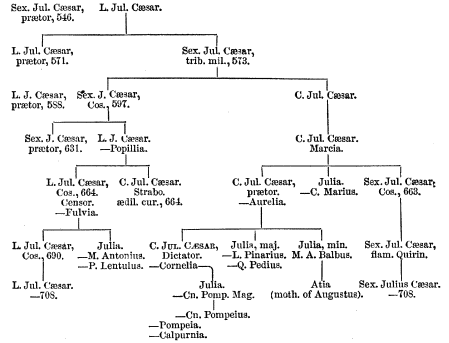
The opinion most accredited with the ancients, on the origin of the name of Cæsar, was that Julius slew an elephant in a fight. In the Punic tongue cæsar signifies “an elephant.” The medals of Cæsar, as grand pontiff, confirm this hypothesis; on the reverse is an elephant crushing a serpent beneath its feet. (Cohen, Consular Medals, plate xx. 10.)—We know that some symbols on the Roman medals are a species of canting heraldry. Pliny gives another etymology of the name of Cæsar: “Primusque Cæsarum a cæso matris utero dictus, qua de causa et Cæsones appellati.” (Natural History, VII. 9.)—Festus (p. 57) thus expresses himself: “Cæsar a cæsarie dictus est; qui scilicet cum cæsarie natus est;” and page 45: “Cæsariati (comati).”—Finally, Spartianus (Life of Ælius Verus, ii.) sums up in these words the greater part of the etymologies: “Cæsorem vel ab elephante (qui lingua Mauroram cæsar dicitur) in prœlio cæso, cum qui primus sic appellatus est, doctissimi et eruditissimi viri putant dictum; vel quia mortua matre, ventre cæso sit natus; vel quod cum magnis crinibus sit utero parentis effusus; vel quod oculis cæsiis et ultra humanum morem viguerit.” (See Isidore, Origines, IX. iii. 12.—Servius, Commentary on the Æneid, I. 290, and Constantine Manasses, p. 71.)
[745] Pliny, Natural History, VII. 53.—“Cæsar was in his sixteenth year when he lost his father.” (Suetonius, I.)
[746] “He sprang from the noble family of the Julii, and, according to an opinion long believed in, he derived his origin from Venus and Anchises.” (Velleius Paterculus, II. 41.)
[747] In fact, the gens Marcia, one of the most illustrious patrician families in Rome, reckoned among its ancestors Numa Marcius, who married Pompilia, the daughter of Numa Pompilius, by whom he had Ancus Marcius, who was King of Rome after the death of Tullus Hostilius. (Plutarch, Coriolanus, I; Numa, 26.)
[748] Suetonius, Cæsar, vi. This passage, as generally translated, is unintelligible, because the translators render the words Martii Reges by the Kings Martius, instead of the family of Marcius Rex.
[749] Plutarch, Cæsar, 10.
[750] “So Cornelia, mother of the Gracchi; Aurelia, mother of Cæsar; Atia, mother of Augustus, all presided over the education of their children, we are told, and made them into great men.” (Tacitus, Dialogue concerning Orators, 28.)
[751] “Ingenii magni, memoriæ singularis, nec minus Græce quam Latine doctus.” (Suetonius, On Illustrious Grammarians, 7.)
[752] “A sermone Græco puerum incipere malo.” (Quintilian, Institution of Oratory, I. i.)
[753] Claudius, addressing a foreigner who spoke Greek and Latin, said, “Since thou possessest our two languages.” (Suetonius, Claudius, 42.)
[754] Καἱ σὑ, τἑκνον! (Suetonius, Cæsar, 82.)
[755] Suetonius, Cæsar, 56.
[756] “Still quite young, he seems to have attached himself to the kind of eloquence adopted by Strabo Cæsar, and he has even given, in his Divination, several passages, word for word, of the discourse of this orator for the Sardinians.” (Suetonius, Cæsar, 55.)
[757] Aulus Gellius, IV. 16.
[758] “For Cæsar and Brutus have also made verses, and have placed them in the public libraries. Poets as feeble as Cicero, but happier than he, in that fewer people knew what they had done.” (Tacitus, Dialogue concerning Orators, 21.)
[759]
Tu quoque, tu in summis, o dimidiate Menander, Poneris, et merito, puri sermonis amator. Lenibus atque utinam scriptis adjuncta foret vis Comica, ut æquato virtus polleret honore Cum Græcis; neque in hac despectus parte jaceres! Unum hoc maceror et doleo tibi deesse, Terenti. (Suetonius, Life of Terence, 5.)
[760] “Liberal to prodigality, and of a courage above human nature and even imagination.” (Velleius Paterculus, II. 41.)
[761] “He held, undeniably, the second rank among the orators of Rome.” (Plutarch, Cæsar, 3.)
[762] “Nam cui Hortensio, Lucullove, vel Cæsari, tam parata unquam adfuit recordatio, quam tibi sacra mens tua loco momentoque, quo jusseris, reddit omne depositum?” (Latinus Pacatus, Panegyricus in Theodosium, XVIII. 3.)—(Pliny, Natural History, VII. 25.)
[763] “Quamvis moderate soleret irasci, maluit tamen non posse.” (Seneca, De Ira, II. 23.)
[764] Plutarch, Cæsar, 4.
[765] Plutarch, Cæsar, 19.
[766] “To the external advantages which distinguished him from all the other citizens, Cæsar joined an impetuous and powerful soul.” (Velleius Paterculus, II. 41.)
[767] Suetonius, Cæsar, 15.
[768] “By his voice, his gesture, the grand and noble air of his person, he had a certain brilliant manner of speech, without the least artifice.” (Cicero, Brutus, 75; copied by Suetonius, Cæsar, 55.)
[769] Plutarch, Cæsar, 18.
[770] “From his first youth he was much used to horseback, and had even acquired the facility of riding with dropped reins and his hands joined behind his back.” (Plutarch, Cæsar, 18.)
[771] “He ate and slept without enjoying the pleasure of either, and only to obey necessity.” (Velleius Paterculus, II. 41.)
[772] Suetonius, Cæsar, 53.—(Plutarch, Cæsar, 18 and 58.)
[773] “And when,” says Cicero, “I look at his hair, so artistically arranged; and when I see him scratch his head with one finger, I cannot believe that such a man could conceive so black a design as to overthrow the Roman Republic.” (Plutarch, Cæsar, 4.)
[774] Suetonius, Cæsar, 45.—Cicero said likewise, “I suffered myself to be caught by the fashion of his girdle,” alluding to his hanging robe, which gave him an effeminate appearance. (Macrobius, Saturnalia, II. 3.)
[775] Dio Cassius, XLIII. 43.
[776] Velleius Paterculus, II. 41.
[777] Suetonius (Cæsar, 1) says that Cæsar was designated (destinatus) flamen. Velleius Paterculus (II. 43), that he was created flamen. In our opinion he was created, but not inaugurated, flamen. Now, as long as this formality was not accomplished, he was only the flamen designate. What proves that he had never been inaugurated is, that Sylla could revoke it; and, on another hand, Tacitus says (Annales, III. 53) that, after the death of Cornelius Merula, the flamenship of Jupiter remained vacant for seventy-two years, without any interruption to the special worship of this god. So that, evidently, they did not count the flamenship of Cæsar as real, since he had never entered on his office.
[778] “Dimissa Cossutia ... quæ pretextato desponsata fuerat.” (Suetonius, Cæsar, 1.)—This passage from Suetonius clearly indicates that he was betrothed, and not married, to Cossutia; for Suetonius uses the word dimittere, which means “to free,” and not the word repudiare in its true meaning; besides, desponsata signifies betrothed.—Plutarch says that Cornelia was the first wife of Cæsar, though he pretends that he married Pompeia as his third. (Plutarch, Cæsar, 5.)
[779] Plutarch, Cæsar, 5.
[780] Velleius Paterculus, II. 41.
[781] “What an infamy to introduce into his house a pregnant woman, with her husband still living; and to thrust from it, ignominiously and cruelly, Antistia, whose father had just perished for the husband who repudiated her!” (Plutarch, Pompey, 8.)
[782] Suetonius, Cæsar, 1.
[783] Plutarch, Cæsar, 1.—Suetonius, Cæsar, 74.
[784] Suetonius, Cæsar, 74.
[785] Suetonius, Cæsar, 1.
[786] The vestals enjoyed great privileges: if they met by chance a criminal on his way to execution, he was set at liberty. (Plutarch, Numa, 14.)—Valerius Maximus (V. iv. 6) reports the following fact: “The vestal Claudia, seeing that a tribune of the people was about to drag her father, Appius Claudius Pulcher, with violence from his triumphal car, interfered between the tribune and him, by virtue of her right to oppose violence.”—Cicero (Oration for Cœlius, 14) likewise alludes to this celebrated anecdote.
[787] Suetonius, Cæsar, 1.
[788] Suetonius, Cæsar, 2.
[789] Suetonius, Cæsar, 2.—Pliny, XVI. 4.—Aulus Gellius, V. 6.
[790] C. Cæsar, grand pontiff, in his discourse for the Bithynians, thus expresses himself in his exordium:—“The hospitality which I have received from King Nicomedes, and the bond of friendship which unites me to those whose cause is under debate, do not permit me, Marcus Juncus, to decline this office (that of being the advocate of the Bithynians); for death ought not to efface from the memory of their kindred the recollection of those who have lived, and we could not, without the last degree of disgrace, abandon our clients, those to whom, after our kindred, we owe our support.” (Aulus Gellius, V. xiii. 1.)
[791] “Nothing damaged his reputation for chastity,” says Suetonius, “except his sojourn with Nicomedes; but the opprobrium which resulted from it was grave and lasting; it exposed him to the sneers of all. I will say nothing of those well-known verses of Calvus Licinius—
... ‘Bithynia quidquid Et pedicator Cæsaris unquam habuit.’
I will be silent on the speeches of Dolabella and Curio the father, ... neither will I linger over the edicts in which Bibulus publicly exposed his colleague by speaking of him as the queen of Bithynia.... M. Brutus informs us that a certain Octavius, whose craziness allowed him to say what he would, being one day in a numerous assembly, called Pompey king, then saluted Cæsar by the name of queen. C. Memmius also reproaches him for having mixed himself up with other debauchees to present Nicomedes with cups and wine at table, and he quotes the names of several Roman merchants who were among the guests.... Cicero apostrophised him once in full Senate. Cæsar was defending there the cause of Nysa, daughter of Nicomedes; he recalled the obligations which he owed to this king. ‘Let us pass by all that, I beg you,’ cried Cicero: ‘we know only too well what he has given thee, and what he has received from thee.’ On his triumph over the Gauls, the soldiers, among other satirical verses which it was their custom to sing as they followed the car of the general, repeated these, which are well known:—
‘Gallias Cæsar subegit, Nicomedes Cæsarem. Ecce Cæsar nunc triumphat, qui subegit Gallias; Nicomedes non triumphat, qui subegit Cæsarem.’” (Suetonius, Cæsar, 40.)
[792] Cicero, Letters to Atticus, II. 19.
[793] These reports, like other calumnies, were propagated by Cæsar’s enemies, such as Curio and Bibulus, and repeated in the ridiculous annals of Tanusius Geminus (Suetonius, Cæsar, 9), the authority of which Seneca despised. “Thou knowest that not much account is made of these annals of Tanusius, and how they are designated.” (Seneca, Epistle 93.)—Catullus (xxxvi. 1) gives us that term of contempt to which Seneca alludes (cacata charta).
[794] “Marius had in his army a nephew, called Caius Lucius, who, overcome by a shameful passion for one of his subordinates, offered him an act of violence. The man drew his sword and killed him. Cited before the tribunal of Marius, instead of being punished he was loaded with praises by the consul, who gave him one of the crowns which were the usual reward of courage.” (Plutarch, Marius, 15.)
[795] “Cæsar was not vexed at being accused of loving Cleopatra; but he could not bear that they should say he had been loved by Nicomedes. He swore it was a calumny.” (Xiphilinus, Julius Cæsar, p. 30, Paris edition, 1678.)
[796] Orosius, V. 23.
[797] Suetonius, Cæsar, 3.
[798] Florus, III. 23.
[799] Appian, I. 107.
[800] Suetonius, Cæsar, 3.
[801] Sallust, Fragments, I., p. 363.
[802] Florus, III. 23.
[803] Suetonius, Cæsar, 3.
[804] “The Romans regarded as honourable accusations which had no private enmity as their motive, and they liked to see young men attach themselves to the pursuit of the guilty, as generous dogs attack wild beasts.” (Plutarch, Lucullus, 1.)
[805] Plutarch, Cæsar, 4.—Asconius, Discourse for Scaurus, XVI. ii. 245, edit. Schütz.
[806] Valerius Maximus, VIII. ix. § 3.—“Cæsar was twenty-one years of age when he attacked Dolabella, in a speech which we still read to-day with admiration.” (Tacitus, Dialogue on the Orators, 34.)—According to the chronological order which we have adopted, Cæsar, instead of twenty-one, would have been twenty-three years old; but as Tacitus, in the same citation, also errs, by two years, in making Crassus, who had accused Carbo, nineteen instead of twenty-one, we may suppose that he has committed the same mistake with Cæsar. In fact, Crassus tells his own age in Cicero (On the Orators, III. 20, § 74): “Quippe qui omnium maturrime ad publicas causas accesserim, annosque natus unum et viginti nobilissimum hominem in judicium vocarim.”—Crassus, the orator, was born in 614; he accused Carbo in 635, the date given by Cicero.
[807] Plutarch, Cæsar, 3.—Asconius, Commentaries on the Oration, “In Toga Candida,” pp. 84, 89, edit. Orelli.
[808] Dialogue on the Orators, 21.
[809] Cicero, Oration for Cluentius, 59. The manuscripts of Cicero bear Cn. Decitius.
[810] This island, now called Fermaco, is at the entrance of the Gulf of Assem-Kalessi. Pliny and Stephen of Byzantium are the only geographers who mention it, and the last tells us further, that it was here that Attalus, the famous lieutenant of Philip of Macedon, was slain by Alexander’s order.
[811] Polyænus, Stratagems, VII. 23.
[812] Suetonius, Cæsar, 4.
[813] Velleius Paterculus, II. 41.
[814] Plutarch, Cæsar, 2.
[815] Plutarch, Crassus, 8.
[816] Suetonius mentions, as an act of humanity, that their corpses alone were nailed to the cross, Cæsar having had them strangled beforehand to shorten their agony. (Suetonius, Cæsar, 74.—Velleius Paterculus, II. 42.)
[817] Suetonius, Cæsar, 4.
[818] Velleius Paterculus, II. 43.—Asconius, On the Oration of Cicero against Pisa; edit. Orelli.
[819] Velleius Paterculus, II. 53.
[820] Suetonius, Cæsar, 5.—Plutarch, Cæsar, 5.
[821] The tribunes by the nomination of the general were usually called rufuli, because they were established by the law of Rutilius Rufus; the military tribunes elected by the people were called comitati; they were held as veritable magistrates. (Pseudo-Asconius, Commentary on the First Speech of Cicero against Verres, p. 142, edit. Orelli; and Festus under Rufuli, p. 261, edit. Müller.)
[822] Plutarch, Sertorius, 15, 16.
[823] “The enemy was already master of the passes which lead to Italy; from the foot of the Alps, he (Pompey) drove him back to Spain.” (Sallust, Letter from Pompey to the Senate.)
[824] Velleius Paterculus, II. 30.—100,000 according to Appian (Civil Wars, I. 117).
[825] Plutarch, Lucullus, 8.
[826] Sallust, Fragments, III. 258.
[827] Appian, Civil Wars, I. xiv. 121.
[828] “The Republic, wounded and sick, so to say, had need of repose, no matter at what price.” (Sallust, Fragments, I. 68.)
[829] “We see how far are carried the jealousy and animosity which the virtue and activity of the new men light up in the heart of certain nobles. If we turn away our eyes never so little, what snares do they not lay for us! One would say that they were of another nature, another kind, so much are their feelings and wishes opposed to ours.” (Cicero, Second Prosecution of Verres, v. 71.)—“The nobility transmitted from hand to hand this supreme dignity (the consulship), of which they were in exclusive possession. Every new man, whatever his renown and the glory of his deeds, appeared unworthy of this honour; he was as if sullied by the stain of his birth.” (Sallust, Jugurtha, 63.)
[830] Sallust, Catilina, 52.
[831] Plutarch, Lucullus, 9.
[832] Cicero, First Prosecution of Verres, 8, 9, 12; Second Prosecution, i. 29.—Pseudo-Asconius, On the first Prosecution of Verres, page 145, edit. Orelli. The orations of Cicero are full of allusions to these agents for the purchase of votes and judges.
[833] “In these later years, the men who make a trade of intriguing in elections have been enabled, by diligence and address, to obtain from the citizens of their tribes all that they chose to demand. Endeavour, by any means you will, to make these men serve you sincerely and with the steadfast will to succeed. You would obtain it if men were as grateful as they ought to be; and you will obtain it, I am afraid, since, for two years, four societies of those most influential in elections—those of Marcus Fundanius, Quintas Gallius, Gaius Cornelius, and Gaius Orcivius—have engaged themselves for you. I was present when the causes of these men were entrusted to you, and I know what was promised to you, and what guarantees have been given to you by their associates.” (On the Petition for the Consulship addressed to Cicero by his brother Quintus, 5.)
[834] Cicero, First Prosecution of Verres, 13.
[835] “Each city of the conquered peoples has a patron at Rome.” (Appian, Civil Wars, II. 4.)
[836] Cicero, Second Prosecution of Verres, III. 89. Cicero adds in a letter, “We may judge, by the sufferings of our own fellow-citizens, of what the inhabitants of the provinces have to endure from the public farmers (publicani). When several tolls were suppressed in Italy, remonstrances were made not so much against the principle of taxation as against abuses in levying it, and the cries of the Romans on the soil of the country tell only too plainly what must be the fate of the allies at the extremity of the empire.” (Letters to Quintus, I. 1, § 33.)
[837] Dio Cassius, 86; Fragments, CCCI. edit. Gros.
[838] Cicero, On Duties, II. 17; Letters to Quintus, II. 6, § 4.—Plutarch, Brutus, 14.
[839] Florus, III. 21.
[840] “The name of C. Marius—of that great man who we may justly call the father of the country, the regenerator of our liberty, the saviour of the Republic.” (Cicero, Speech for Rabirius, 10.)—“I have, as your guarantee, your indignation against Sylla.” (Dio Cassius, XXXVI. 17, Oration of Catulus to the Senate.)—“Where can we find a personage (Marius) more serious, more firm, more distinguished by courage, circumspection, conscience?” (Cicero, Speech for Balbus, 25.)—“Not only do we suffer his acts (Sylla’s), but to prevent worse disasters, greater ills, we give them the sanction of public authority.” (Cicero, Second Prosecution of Verres, III. 35.)
[841] Plutarch, Cæsar, 6.
[842] Plutarch, Pompey, 12.
[843] Pompey slew Carbo, Perpenna, and Brutus, the father of the assassin of Cæsar, who had yielded themselves to him: the first had protected his youth and saved his patrimony. (Valerius Maximus, V. iii. v.)
[844] Count Franz de Champagny, Les Cæsars, I. p. 50.
[845] “It was in his character to show little regard for what he was ambitious to obtain.” (Dio Cassius, XXXVI. 7.)—“Pompey, with a heart as depraved as his face was pure.” (Sallust, Fragments, II. 176.)
[846] “At last, when Pompey, haranguing the people for the first time at the gates of the city, in his capacity of consul-designate, came to treat of the matter which seemed to have been most ardently expected, and let it be understood that he would re-establish the power of the tribunes, he was received with applause, and a slight murmur of assent; but when he added that the provinces were devastated and oppressed, the tribunals disgraced, the judges without shame, and that he wished to be watchful of these abuses, and to restore good order, then it was not by a simple murmur, but by unanimous acclamations, that the people testified their desires.” (Cicero, First Prosecution of Verres, 15.)
[847] Catulus, when asked his opinion on the re-establishment of the tribunary power, began in these authoritative words:—“The conscript fathers administer justice evilly and scandalously; and if, in the tribunals, they had but answered the expectations of the Roman people, the power of the tribunes would not have been so warmly regretted.” (Cicero, First Prosecution of Verres, 15.)
[848] “His enemies had nothing else to reproach him with than the preference which he gave to the people over the Senate.” (Plutarch, Pompey, 20.)
[849] “He seconded with all his might those who wished to restore the power of the tribunes.” (Suetonius, Cæsar, 5.)
[850] 7,100 talents. (Plutarch, Crassus, 1.)
[851] Plutarch, Crassus, 2.—Cicero, On Duties, I. 8.
[852] Plutarch, Crassus, 7.
[853] Plutarch, Crassus, 8.
[854] Plutarch, Crassus, 8.
[855] Plutarch, Crassus, 1, 16.
[856] “Cotta judicandi munus, quod C. Gracchus ereptum Senatui, ad equites, Sylla ab illis ad Senatum transtulerat, æqualiter inter utrumque ordinem partitus est.” (Velleius Paterculus, II. 32.)
[857] “Equidem mihi videor pro nostra necessitate, non labore, non opera, non industria defuisse.” (Certainly, I believe I have displayed all the zeal, all the endeavour, all the ability which our kinship demands.) Cæsar, quoted by Aulus Gellius, XIII. 3.—Nonius Marcellus, “On the different significations of words,” under the word Necessitas.
[858] Sallust, Fragments, I. 68.
[859] Plutarch, Pompey, 21.
[860] Plutarch, Cæsar, 5.—Suetonius, Cæsar, 6.
[861] Plutarch, Cæsar, 5.
[862] The images of Æneas, of Romulus, and of the Kings of Alba Longa also figured in the funeral canopy of the Julia family. (Tacitus, Annales, IV. 9.)
[863] Plutarch, Cæsar, 5.—Velleius Paterculus, II. 43.
[864] Cicero, Oration on the Manilian Law, 12; For Fonteius, 2.
[865] Cæsar, Civil War, I. 37.
[866] “Sextus Pompeius Cordubam tenebat, quod ejus provinciæ caput esse existimabatur.” (Cæsar, The War in Spain, III.—Plutarch, Cæsar, 17.)
[867] Cicero, Second Prosecution of Verres, II. 13.—Paulus Diaconus, under the word Conventus.—Müller, p. 41.
[868] Cicero, Second Prosecution of Verres, II. 20, 24, 30; IV. 29.—Familiar Letters, XV. iv.
[869] Pliny, Natural History, III. i., and IV. xxxv. The three conventus of Lusitania were held at Emerita, Pax Julia (Béja), and at Scalabis: the four of Bætica were, Gades, Corduba, Astijo, Hispalis (Cadiz, Cordova, Ecija, and Seville).
[870] Dio Cassius, XLIV. 39, 41.
[871] “From the beginning of my questorship, I have shown a special affection for the province.” (Speech of Cæsar to the Spaniards, at Hispalis, Commentaries, The War in Spain, 43.)
[872] Plutarch, Cæsar, 5.
[873] Titus Livius, XXI. 21.—Florus, II. 17.
[874] Plutarch, Parallel between Alexander and Cæsar, 6.—Suetonius, Cæsar, 7.
[875] Suetonius, Cæsar, 8.
[876] Suetonius, Cæsar, 8.
[877] Velleius Paterculus, II. 31.
[878] Daughter of Q. Pompeius Rufus, and Fausta, daughter of Sylla. (Plutarch, Cæsar, 5.—Suetonius, Cæsar, 6.)
[879] The ships of the corsairs amounted to more than a thousand, and the towns which they took to four hundred. (Plutarch, Pompey, 23.)
[880] Plutarch, Pompey, 24.
[881] Cicero, Speech on the Manilian Law, 12.
[882] “Aulus Gabinius was a very bad citizen, in no wise inspired by love of the public good.” (Dio Cassius, XXXVI. 6.)
[883] Dio Cassius, XXXVI. 7.
[884] Plutarch, Pompey, 26.
[885] Dio Cassius, XXXVI. 20.—Appian, War of Mithridates, 94.
[886] Plutarch, Pompey, 27.—“The very day on which you placed your naval armies under his orders, the price of corn, until then excessive, fell at once so low that the richest harvest, in the midst of a long peace, would have scarcely produced so happy an abundance.” (Cicero, Oration for the Manilian Law, 15.)
[887] Florus and Appian do not quite agree on the division of these commands. (Appian, War of Mithridates, 95.—Florus, III. 6.)
[888] Velleius Paterculus, II. 32.—Plutarch, Pompey, 29.
[889] Dio Cassius, XXXV. 14 and 15.
[890] Plutarch, Pompey, 31.
[891] Cicero, Oration for the Manilian Law, 16.
[892] Plutarch, Pompey, 31.
[893] Cicero, Oration for the Manilian Law, 23.
[894] Dio Cassius, XXXVI. 26.—Plutarch, Lucullus, 50, 52.
[895] “The tribune Manilius, a venal soul, and the debased instrument of the ambition of others.” (Velleius Paterculus, II. 33.)
[896] “As to the Valerians, informed that the magistrates at Rome had given them their discharge, they immediately abandoned their flags.” (Dio Cassius, XXXV. 15.)
[897] “They called Valerians the soldiers of Valerius Flaccus, who, having passed into the command of Fimbria, had left their general in Asia to join themselves to Sylla.” “These same soldiers, under the orders of Pompey (for he enrolled the Valerians anew), did not dream even of revolt, so much does one man carry it over another.” (Dio Cassius, XXXV. 16.)
[898] “There was no shame,” he said, “in submitting to him whom fortune raised above all the others.” (Velleius Paterculus, II. 37.)
[899] Dio Cassius, XXXV. 16.
[900] This is taken from a passage of Cicero compared with another of Sallust. In fact, Cicero, in his Oration for Murena (23), thus expresses himself Confusionem suffragiorum flagitasti, prorogationem legis Maniliæ, æquationem gratiæ, dignitatis, suffragiorum.” It is clear that Cicero could not allude to the Manilian law on the freedmen, but to that of Caius Gracchus, since Sallust employs nearly the same words concerning this law, saying: “Sed de magistratibus creandis haud mihi quidem absurde placet lex, quam C. Gracchus in tribunatu promulgaverat: ut ex confusis quinque classibus sorte centuriæ vocarentur. Ita coæquali dignitate pecunia, virtute anteire alius alium properabit.” (Sallust, Letters to Cæsar, vii.)
[901] Dio Cassius, III. 36, 40.
[902] Plutarch, Cæsar, 5.
[903] Suetonius, Cæsar, 10.—Plutarch, Cæsar, 10.
[904] Titus Livius, IX. 40.
[905] Dio Cassius, XXXVII. 8.
[906] “The gladiators whom you have bought are a very fine acquisition. It is said that they are well trained, and if you had wished to let them out on the last occasion, you would have regained what they have cost you.” (Cicero, Letters to Atticus, IV. 4.)
[907] Servius, Commentary on Book III. verse 67 of the Æneid.—Tertullian, On the Shows, V.—Titus Livius, XXIII. 30; XXIX. 46.—Valerius Maximus, II. iv. § 7.
[908] “When Cæsar, afterwards dictator, but then ædile, gave funeral games in honour of his father, all that was used in the arena was of silver; silver lances glittered in the hands of the criminals and pierced the wild beasts, an example which even simple municipal towns imitate.” (Pliny, Natural History, XXXIII. 3.)
[909] Suetonius, Cæsar, 10.
[910] Suetonius, Cæsar, 11.
[911] Plutarch, Cæsar, 6.
[912] Plutarch, Cæsar, 6.
[913] Plutarch, Cæsar, 6.
[914] Suetonius, Cæsar, 11.—Cicero, First Oration on the Agrarian Law, i. 16.
[915] Justin, xxix. 5, Scholiast of Bobbio, On the Oration of Cicero, “De Rege Alexandrino,” p. 350, edit. Orelli.
[916] Cicero, Second Oration on the Agrarian Law, xvi.
[917] “Augustus made it one, among other state maxims, to sequester Egypt, forbidding the Roman knights and senators of the first rank ever to go there without his permission. He feared that Italy might be famished by the first ambitious person who should seize the province, where, holding the keys of both land and sea, he might defend himself with very few soldiers against great armies.” (Tacitus, Annals, II. 59.)
[918] Suetonius, Cæsar, 11.
[919] Dio Cassius, XXXVII. 9.
[920] “You name me a foreigner because I have come from a municipal town. If you regard us as foreigners, although our name and rank were formerly well established at Rome, and in public opinion, how much then must these competitors be foreigners in your eyes, this élite of Italy, who come from all parts to dispute with you magistrateships and honours?” (Cicero, Oration for Sylla, 8.)
[921] See Drumann, Julii, 147.
[922] J. Paul, Sentences, V. iv., p. 417, edit. Huschke.—Justinian, Institutes, IV. xviii. § 5.—Appian, On the Office of the Proconsul, vii.
[923] “Then, in the instructions directed against the sicarii, and the exceptions proposed by the Cornelian law, he ranked among these malefactors those who, during the proscription, had received money from the public treasury for having brought to Sylla the heads of Roman citizens.” (Suetonius, Cæsar, 11.)
[924] Plutarch, Cato, 21.—Dio Cassius, XLVII. 6.
[925] Cicero, Third Speech on the Agrarian Law, 4.
[926] Dio Cassius, XXXVII. 10.—Asconius, Commentary on the Orations of Cicero, “In Toga Candida,” pp. 91, 92, edit Orelli.
[927] Asconius, In Toga Candida, p. 91.
[928] Sallust, Catiline, 19.
[929] Plutarch, Cicero, 15.
[930] “I am preparing at this moment to defend Catiline, my competitor. I hope, if I obtain his acquittal, to find him disposed to come to an understanding with me on our next steps. If he is against this, I will [I shall know what to do (?)] take my way.” (Cicero, Letters to Atticus, I. ii.)
[931] Cicero, Oration for Sylla, 29.
[932] Plutarch, Cato, 3.
[933] Asconius, Cicero’s Oration, “In Toga Candida,” p. 82, edit. Orelli.
[934] Plutarch, Cicero, 3.
[935] They called new men those who amongst their ancestors counted none that had held a high magistracy. (Appian, Civil Wars, II. 2.)—Cicero also confirms this fact: “I am the first new man that, for a great number of years, is remembered to have been appointed consul; and this eminent post, in which the nobility were in a manner entrenched, and to which they had closed all the avenues, you have, to place me at your head, forced the barriers; you have desired that merit henceforth find them open.” (Cicero, Second Oration on the Agrarian Law, 1.)
[936] Sallust, Catiline, 23.
[937] “Cicero favoured sometimes the one, sometimes the other, to be sought after by both parties.” (Dio Cassius, XXXVI. 26.)
[938] Second Oration on the Agrarian Law, 25.
[939] The territories conceded by a treaty being excepted, which freed from this obligation the African territory, which had become, since Scipio, the property of the Republic, and given by Pompey to Hiempsal. In Campania every colonist was obliged to have ten jugera, and, on the territory of Stella, twelve.
[940] Cicero, Second Oration on the Agrarian Law, 26.
[941] Cicero, Letters to Atticus, II. 1.—Plutarch, Cicero, 17.—“When young Romans, full of merit and honour, have found themselves in such a position that their admissibility to magistracies has effected the overthrow of the State, I have dared to brave their enmity, to interdict their access to the comitia and to honours.” (Cicero, Oration against L. Piso.)
[942] “They wish to deprive the Republic of all refuge, of every guarantee of safety in difficult conjunctures.” (Cicero, Oration for Rabirius, 2.)
[943] “This supreme power which, according to the institutions of Rome, the Senate confers upon the magistrates, consists in raising troops, in making war, in keeping to their duties, by every means, the allies and citizens; in exercising supremely, equally at Rome or abroad, both civil and military authority. In all other cases, without the express order of the people, none of these prerogatives are conferred upon the consuls.” (Sallust, Catiline, 29.)
[944] Cicero, Oration for Rabirius, 9.
[945] Suetonius, Cæsar, 12.
[946] Dio Cassius, XXXVII. 26, 27.
[947] Macrobius, Saturnalia, I. 16.—Priscian, vi., p. 710, edit. Putsch.—Macrobius (l. c.) quotes the 16th book of the treatise of Cæsar on the Auspices.—Dio Cassius (xxxvii.) expresses himself thus: “Above all, because he had supported Labienus against Rabirius, and had not voted for the death of Lentulus.” But the Greek author errs: the nomination of Cæsar to the high pontificate took place before the conspiracy of Catiline. (See Velleius Paterculus, II. 43.)
[948] Appian, Civil Wars, II. 1, 8, 14.
[949] Plutarch, Cæsar, 7.
[950] Plutarch, Cæsar, 7.
[951] Suetonius, Cæsar, 13.
[952] Suetonius, Cæsar, 46.
[953] “On the 23rd of August, the day of inauguration of Lentulus, flamen of Mars, the house was decorated, and couches of ivory were set up in the triclinia. In the two first halls were the pontiffs Q. Catulus, M. Æmilius Lepidus, D. Silanus, C. Cæsar, king of the sacrifices, and ... L. Julius Cæsar, augur. The third received the vestals. The repast was thus composed:—For the first course: sea-urchins, raw oysters in any quantity, pelorides (a kind of oyster of extraordinary size), spondyli (shell-fish of the oyster kind), thrushes, asparagus; and, lower down, a fat hen, a vol-au-vent of large oysters, and sea-acorns black and white (sea and river shell-fish according to Pliny). Then more spondyli, glycomarides (another shell-fish mentioned by Pliny), sea-nettles, beccaficos, filets of venison and wild boar, fatted fowls powdered with flour, beccaficos, murices and purple fish (shell-fish bristling with points, which yielded the purple of the ancients). Second course: sows’ udders, wild boar’s head, fish-pie, sows’ udder-pie, ducks, boiled teal, hares, roast fowls, starch (flour that is obtained in the same manner as starch, without grinding—many sorts of creams, amylaria, were made of it), loaves from Picenum.” (Macrobius, Saturnalia, III. 9.)
[954] “It was at the very point when it required no more to upset the weakly government than a slight impulse from the first bold man who presented himself.” (Plutarch, Cicero, 15.)
[955] Cicero, Oration for M. Cælius, 5. This oration was delivered in the year 698.
[956] Plutarch, Cicero, 19.
[957] Sallust, Catiline, 27, 28.
[958] This is deduced from what Florus (III. 6) says of the command of the fleet which L. Gellius had, and from a passage in Cicero. (First Oration after his Return, 7.)—L. Gellius expresses himself clearly upon the danger the Republic had run, and proposed the awarding of a civic crown to Cicero. (Cicero, Letters to Atticus, XII. 21; Oration against Piso, 3.—Aulus Gellius, V. 6.)
[959] Cicero, First Catiline Oration, 1; Second Catiline Oration, 1.
[960] Sallust, Catiline, 32.
[961] Sallust, Catiline, 30, 31.—Plutarch, Cicero, 17.
[962] Sallust, Catiline, 47.
[963] Sallust, Catiline, 51.—Appian, Civil Wars, II. 6.
[964] Cicero, Fourth Catiline Oration, 1.
[965] Cicero, Fourth Catiline Oration, 2.
[966] Second Catiline Oration, 4.
[967] First Oration against Catiline, 2.
[968] Second Oration on the Agrarian Law, 5.
[969] Suetonius, Cæsar, 14.
[970] Cicero, Fourth Oration against Catiline, 5.
[971] Sallust, Catiline, 52.
[972] Plutarch, Cato, 28.—See the Comparison of Alexander and Cæsar, 7.
[973] Suetonius, Cæsar, 53.
[974] Sallust, Catiline, 52.
[975] Plutarch, Cicero, 28.
[976] Sallust, Catiline, 49.
[977] Suetonius, Cæsar, 8.
[978] Sallust, Catiline, 49.
[979] “They feared his power and the great number of friends by whom he was supported, for everybody was persuaded that the criminals would be involved in the absolution of Cæsar, much more than Cæsar in their punishment.” (Plutarch, Cicero, 27.)
[980] “And I have myself since heard Crassus say openly that this cruel affront had been caused him by Cicero.” (Sallust, Catiline, 48.)
[981] We may read in the historians of the time the recital of fables invented at will to ruin the conspirators. Thus Catiline, seeking to bind by an oath accomplices in his crime, is represented as causing cups filled with human blood and wine to be passed round. (Sallust, Catiline, 22.)—According to Plutarch, they slaughtered a man, and all ate of his flesh. (Plutarch, Cicero, 14.—Florus, IV. 1.)
[982] Cicero himself acknowledged that these accusations were commonplaces for the necessity of the cause. In a letter to Atticus, he describes a scene which passed in the Senate a short time after the return of Pompey to Rome. He tells us that this general satisfied himself with approving all the acts of the Senate, without imputing anything personal to him (Cicero); “but Crassus,” he continues, “rose and spoke with much eloquence.... Brief, he attacked all the commonplace of sword and flame, which I have been accustomed to treat, you know in how many ways, in my orations, of which you are the sovereign critic.” (Cicero, Letters to Atticus, I. 14.)
[983] “The populace, who at first, through the love of novelty, had been only too much inclined for this war, changes its sentiments, curses the enterprise of Catiline, and exalts Cicero to the skies.” (Sallust, Catiline, 48.)
[984] Sallust, Catiline, 39.—Dio Cassius, XXVII. 36.
[985] “Many young estimable noblemen were attached to this wicked and corrupt man.” (Cicero, Oration for M. Cælius, 4.)—“He had drawn around him men perverse and audacious, at the same time that he had attached to himself numbers of virtuous and steady citizens, by the false semblances of an affected virtue.” (Cicero, ibid. 6.)
[986] Sallust, Catiline, 17.
[987] “And this silver eagle, to which he had consecrated in his house an altar.” (Cicero, Second Oration against Catiline, 6.)
[988] Sallust, Catiline, 20.
[989] Sallust, Catiline, 33. Speech of the envoys sent by Mallius to Marcius Rex.
[990] Sallust, Catiline, 30.
[991] Sallust, Catiline, 36.
[992] “Meanwhile, he kept refusing slaves, who, from the beginning, had never ceased joining him in large bands. Full of confidence in the resources of the conspiracy, he regarded any appearance of confounding the cause of the citizens with that of the slaves as contrary to his policy.” (Sallust, Catiline, 56.)
[993] Sallust, Catiline, 44.
[994] “People who will fall at our feet, if I show them, I do not say the points of our swords, but the edict of the prætor.” (Cicero, Second Oration against Catiline, 3.)
[995] Sallust, Catiline, 61.
[996] Dio Cassius, XXXVII. 10.
[997] The Emperor Napoleon, in the Mémorial de Sainte-Hélène, also treats as a fable this opinion of the historians that Catiline desired to burn Rome, and give it up to pillage, in order afterwards to govern a ruined city. The Emperor thought, said M. de Las Cases, that it was rather some new faction, after the manner of Marius and Sylla, which, having been unsuccessful, had seen all the unfounded accusations that are brought in such cases heaped upon its leader.
[998] Cicero, Oration for Flaccus, 38.
[999] “He excited public cavil, not by evil actions, but by his habit of self-glorification. He never went to the Senate, to the assemblies of the people, to the courts of law, without having on his lips the names of Catiline and Lentulus.” (Plutarch, Cicero, 31.)
[1000] Cicero, Familiar Letters, v. 7.
[1001] See Cæsar’s speech, quoted above.
[1002] It may be interesting to reproduce here, from the letters of Cicero, the list of the discourses which he delivered during the year of his consulship. “I wished, I also, after the manner of Demosthenes, to have my political speeches, which may be named consulars. The first and second are on the Agrarian Law; the former before the Senate on the calends of January; the second before the people; the third, about Otho; the fourth, for Rabirius; the fifth, on the children of the proscribed; the sixth, on my relinquishing my province; the seventh is that which put Catiline to flight; the eighth was delivered before the people the day after his flight; the ninth, from the tribune, the day when the Allobroges came to give their evidence; the tenth, before the Senate, on the 5th of December. There are two more, not so long, which may be described as supplementary to the two first on the Agrarian Law.” (Cicero, Letters to Atticus, II. 1.)
[1003] Velleius Paterculus, II. 40.—Dio Cassius, XXXVII. 21.
[1004] Suetonius, Cæsar, 46.
[1005] Dio Cassius, XXXVII. 44; XLIII. 14.
[1006] Suetonius, Cæsar, 16.
[1007] Dio Cassius, XXXVIII. 43.—Suetonius, Cæsar, 16.—Cicero, Oration for Sestius, 29.
[1008] Suetonius, Cæsar, 16.
[1009] Cicero, Letters to Atticus, II. 24.
[1010] Plutarch, Cæsar, 9.
[1011] Suetonius, Cæsar, 17.
[1012] Suetonius, Cæsar, 17.
[1013] Suetonius, Cæsar, 50.
[1014] Suetonius, Cæsar, 50.
[1015] Plutarch, Cæsar, 10.
[1016] Suetonius, Cæsar, 1.—Plutarch, Cicero, 27; Plutarch, Cæsar, 10.—“This sacrifice is offered by the vestal virgins, on behalf of the Roman people, in the house of a magistrate who has the right of imperium, with ceremonies that it is not allowable to reveal. The goddess to whom it is offered is one whose very name is a mystery to men, and whom Clodius terms the Good Goddess (Bona Dea), because she forgave him so gross an outrage.” (Cicero, Oration on the Report of the Augurs, 17.)—The Good Goddess, like the majority of the divinities of the earth among the ancients, was regarded as a sort of beneficent fairy who presided over the fertility of the fields and the conception of women. The nocturnal sacrifice was celebrated at the beginning of December, in the house of the consul or the prætor, by the wife of that magistrate, or by the vestal virgins. At the commencement of the festival they made a propitiatory sacrifice of a pig, and prayers were offered for the prosperity of the Roman people.
[1017] Cicero, Letters to Atticus, I. 14.
[1018] Cicero, Letters to Atticus, I. 16.
[1019] Cicero, Letters to Atticus, I. 17.
[1020] Appian, Mithridatic War, 101.
[1021] Appian, Mithridatic War, 106.
[1022] Dio Cassius, XXXVII. 20.
[1023] Dio Cassius, XXXVII. 44. In contradiction to other authors, Dio Cassius asserts that the elections were adjourned. (Plutarch, Pompey, 45.)
[1024] “The more men were terrified, the more they were re-assured, on seeing Pompey return to his country as a simple citizen.” (Velleius Paterculus, II. 40.)
[1025] Cicero, Letters to Atticus, I. 12.
[1026] Metellus was subjugating Crete, when Pompey sent one of his lieutenants to depose him, under the pretence that that island was included in his own wide jurisdiction by sea.
[1027] Dio Cassius, XXXVII. 49.
[1028] “No rectitude, no candour, not a single honourable motive in his policy; nothing elevated, nothing strong, nothing generous.” (Cicero, Letters to Atticus, I. 12.)
[1029] Plutarch, Pompey, 47.
[1030] Pliny, Natural History, XXXVII. 5.
[1031] Vases from Carmania that were highly prized. They reflected the colours of the rainbow, and, according to Pliny, a single one was sold for seventy talents (more than 300,000 francs [£12,000]). (Pliny, Natural History, XXXVII, 7, 8.)
[1032] Pliny, XXXIII. 54.—Strabo, XII. 545.
[1033] Appian, War against Mithridates, 116.
[1034] Pliny, Natural History, XII. 9, 54.
[1035] Dio Cassius, XXXVI. 2.—Velleius Paterculus, II. 34.
[1036] Appian, War against Mithridates, 117.
[1037] Plutarch, Pompey, 47.—Dio Cassius, XXXVII. 21.
[1038] Cicero, Oration for Murena, 14.
[1039] Cicero, Letters to Atticus, I. 18.
[1040] Dio Cassius, XXXVII. 50.
[1041] Cicero, Letters to Atticus, I. 19.
[1042] Cicero, Letters to Atticus, I. 19.
[1043] Cicero, Oration on the Agrarian Law, II. 27.
[1044] “Your ancestors never set you the example of buying lands from individuals in order to send colonies thither. All the laws, up to the present time, have contented themselves with establishing them on the lands belonging to the State.” (Cicero, Oration on the Agrarian Law, II. 25.)
[1045] Plutarch, Cato of Utica, 36.
[1046] Dio Cassius, XXXVII. 51.
[1047] Plutarch, Cato, 35.
[1048] “People abuse the Senate; the equestrian order stands aloof from it. Thus this year will have seen the overthrow of the two solid foundations on which I, single-handed, had planted the Republic—the authority of the Senate and the union of the two orders.” (Cicero, Letters to Atticus, I. 18.)
[1049] Cicero, Letters to Atticus, II. 1.
[1050] Plutarch, Cæsar, 12.—Appian (Civil Wars, II. 2, § 8) speaks of twenty-five million sestertii—i.e., 4,750,000 francs [£190,000].
[1051] Suetonius, Cæsar, 18.
[1052] Cicero, Letter to Atticus, I. 14, 16.
[1053] “From his youth up he was zealous and true to his clients.” (Suetonius, Cæsar, 71.)
[1054] Suetonius, Cæsar, 12.
[1055] Plutarch, Cæsar, 12.
[1056] Plutarch, Cæsar, 12.
[1057] A chain of mountains in Portugal, now called Sierra di Estrella, separating the basin of the Tagus from the valley of Mondego. According to Cellarius (Ancient Geography, I. 60), Mount Herminium is still called Arminno. The principal oppidum belonging to the population of these mountains seems to have been called Medobrega (Membrio). It is mentioned in Cæsar’s Commentaries, War of Alexandria, 48.
[1058] Probably in the modern province of Leyria.
[1059] A survey made, in August, 1861, by the Duc de Bellune, leaves no doubt that the peninsula of Peniche was once an island. The local traditions state that in ancient times the ocean advanced as far as the town of Atoguia; but since Dio Cassius speaks of the rising tide which swept away soldiers, we must believe that there were fords at low tide. We give extracts from Portuguese authors who have written on this subject.
Bernard de Brito (Portuguese Monarchy, I. p. 429, Lisbon, 1790) says:—“As along the entire coast of Portugal we cannot find, at the present time, a single island that fulfils the conditions of the one where Cæsar sought to disembark better than the peninsula, on which there is a locality which, taking its name from its situation, is called Peniche, we shall maintain, with our countryman Resende, that it is to this that all the authors refer. And I do not believe it possible to find one more suitable in every way than this: because, over and above the fact that it is the only one, and situated at but a short distance from the mainland, we see that when the tide is low it is possible to traverse the strait dryshod, and with still greater facility than would have been possible in ancient times, because the sea has silted up sand against a large portion of this coast, and brought it to pass that the sea does not rise to so high a point upon the land. Still, it rises high enough to make it necessary, at high tide, to use a boat to reach the island, and that in a space of about 500 paces in width, which separates the island from the mainland.”
The following is the passage of Resende:—“Sed quærendum utrobique quænam insula ista fuerit terræ contigua, ad quam sive pedibus sive natatu profugi transire potuerint, ad quam similiter et milites trajicere tentarint? Non fuisse Londobrin, cujus meminit Ptolomæus (Berligam modo dicimus), indicio est distantia a continente non modica. Et quum alia juxta Lusitaniæ totius littus nulla nostra ævo exstet, hæc de qua Dion loquitur, vel incumbenti violentius mari abrasa, vel certe peninsula illa oppidi Peniche juxta Atonguiam, erit intelligenda. Nam etiam nunc alveo quingentis passibus lato a continente sejungitur, qui pedibus æstu cedente transitur, redeunte vero insula plane fit, neque adiri vado potest. Et forte illo sæculo fuerit aliquanto major.” (L. André de Resende. De Antiquitatibus Lusitaniæ cæteraque Historica quæ exstant Opera, Conimbricæ, 1790, I., p. 77.)
Antonio Carvalho (Da costa corografia Portuguesa, II. p. 144, Lisbon, 1712) sets forth the same view.
The preceding information is confirmed by the following letter of an English bishop who accompanied the Crusaders, at the time of the siege of Lisbon, in the reign of Alfonso Henrique, a.d. 1147:—“Die vero quasi decima, impositis sarcinis nostris cum episcopis velificare incepimus iter prosperum agentes. Die vero postera ad insulam Phenicis (vulgo Peniche) distantis a continente quasi octingentis passibus feliciter applicuimus. Insula abundat cervis et maxime cuniculis: liquiricium (lege glycyrrhizum) habet. Tyrii dicunt eam Erictream. Peni Gaddis, id est septem, ultra quam non est terra: ideo extremus noti orbis terminus dicitur. Juxta hanc sunt duæ insulæ quæ vulgo dicuntur Berlinges, id est Baleares lingua corrupta, in una quarum est palatium admirabilis architecturæ et multa officinarum diversoria regi cuidam, ut aiunt, quondam gratissimum secretale hospicium.” (Letter of an English Crusader on the sack of Lisbon, in Portugalliæ Monumenta Historica, a sæculo octavo post Christum usque ad quintum decimum, justa Academiæ Scientiarum Olisiponensis edita. Volumen I., fasciculus iii. Lisbon, 1861, p. 395.)
[1060] Dio Cassius, XXXVII. 52, 53.—“Cæsar, as soon as he arrived, defeated the Lusitanians and the inhabitants of Galicia, and advanced as far as the outer sea. Thus he caused people who had never yet recognised the authority of the Romans to submit to them, and returned from his government loaded with glory and wealth, of which he gave a part to his soldiers.” (Zonaras, Annales, X. 6.)
[1061] Appian, Civil Wars, II. 8.
[1062] Cæsar, Spanish War, 42.
[1063] Plutarch, Cæsar, 12.
[1064] “There come forward a whole army of accusers against those who enriched themselves by usury in contempt of a law passed by Cæsar when he was dictator, regulating the proportion to be observed between the debts and possessions in Italy: a law which had for a long while fallen into desuetude through the interest of individuals.” (Tacitus, Annals, vi. 16.—Suetonius, Cæsar, 42.)
[1065] “I will not enumerate all the marks of honour with which Cæsar distinguished the people of this town when he was prætor in Spain; the divisions he found means of healing among the citizens of Gades; the laws which, with their consent, he gave them; the old barbarism of their manners and customs, which he caused to disappear; the eagerness with which, at the request of Balbus, he loaded them with benefits.” (Cicero, Oration for Balbus, 19.)
[1066] “From his youth he was acquainted with Cæsar, and that great man was pleased with him. Cæsar, among the crowd of friends he had, marked him out as one of his intimates when he was prætor: when he was consul, he made him overseer of the manufactory of his military engines. He had experience of his prudence; appreciated his devotion; accepted his acts of kindness and his affection. At that time Balbus shared nearly all the labours of Cæsar.” (Cicero, Oration for Balbus, 28.)
[1067] “For this man (Cæsar) began by being prætor in Spain, and, distrusting the loyalty of this province, he would not give its inhabitants the chance of being subsequently more dangerous, through a delusive peace. He chose to do what was of importance to the interests of the Republic rather than to pass the days of his magistracy in tranquillity; and as the Spaniards refused to surrender, he compelled them to it by force. So he surpassed in honour those who had preceded him in Spain; for it is a harder task to keep a conquest than to make one.” (Dio Cassius, XLIV. 41.)
[1068] Suetonius, Cæsar, 54.
[1069] “Cæsar arrives in two days.” (Cicero to Atticus, II. 1, June, 694.)
[1070] Thence the name of candidate.
[1071] “Many candidates for the consulship had been nominated in their absence; as, for instance, Marcellus, in 540.” (Titus Livius, XXIV. 9.)
[1072] Plutarch, Cato, 36.
[1073] Florus, III. 23.
[1074] Cicero, Letters to Atticus, I. 18.
[1075] Cicero, Letters to Atticus, I. 18.
[1076] Cicero, Letters to Atticus, II. 1.
[1077] “It even appears that Cicero had lent the accused a million of sestertii to purchase a mansion on the Palatine.” (Aulus Gellius, XII. 12.)
[1078] Cicero, Letters to Atticus, I. 12.
[1079] Cicero, Letters to Atticus, I. 19.
[1080] Cicero, Letters to Atticus, II. 1.
[1081] Cicero, Letters to Atticus, I. 19.
[1082] Suetonius, Cæsar, 50.
[1083] Cicero, Letters to Quintus, I. 1, 11.
[1084] Cæsar, when consul and dictator, declared many foreign cities free.
[1085] It will be seen in the next chapter that Cæsar recognized as friends to the Roman people Auletes, king of Egypt, and Ariovistus, king of the Germans.
[1086] Duumvirs, decemvirs, vigintivirs were the names given to magistrates who shared the same duties in boards of two, ten, or twenty. In the present case, however, the object was only to bind together the men of the greatest importance by a secret bond. Therefore the word triumvirate would be a misnomer.
[1087] “He wished me to join these three intimate consular men.” (Cicero, Oration on the Consular Provinces, 17.)
[1088] Dio Cassius, XXXVII. 57.
[1089] Cicero, Familiar Letters, V. 12.
[1090] Suetonius, Cæsar, 19.—Eutropius, VI. 14.—Plutarch, Cæsar, 13.
[1091] Suetonius, Cæsar, 19.
[1092] Plutarch, Cato, 26.—Suetonius, 19.
[1093] “But will you say that we can only have the knights on our side by paying for them? What are we to do? Have we a choice of means?” (Cicero, Letters to Atticus, II. 1.)
[1094]
“Inde domum repetes toto comitante senatu, Officium populi vix capiente domo.” Ovid, Ex Ponto, IV. Epist. 4.
[1095] Suetonius, Cæsar, 19.
[1096] Dio Cassius, XXXVIII. 1.
[1097] Appian, Civil Wars, II. 10.
[1098] Cicero, Epistle to Atticus, II. 3.—“When consul, he wished me to take part in the operations of his consulship. Without approving them, I felt nevertheless grateful to him for his deference.” (Oration on the Consular Provinces, 17.)
[1099] Plutarch, Cæsar, 14.—Suetonius, Cæsar, 21.
[1100] Plutarch, Cæsar, 14.
[1101] Plutarch, Cato, 24.
[1102] Plutarch, Cato, 59.
[1103] Suetonius, Cæsar, 20.
[1104] Titus Livius, IX. 8.
[1105] Appian, Civil Wars, II. 7.
[1106] Cicero, Familiar Letters, XIII. 4.
[1107] Dio Cassius, XXXVIII. 1.
[1108] Epistles to Atticus, I. 18.—In allusion to a former law, we read as follows: “The senators who have discussed the present law shall be held, within ten days following the plebiscitum, to swear to maintain it before the questor, in the treasury, in open day, and taking for witnesses Jupiter and the gods Penates.” (Table of Bantia, Klenze, Philologische Abhandlungen, IV. 16-24.)
[1109] Dio Cassius, XXXVIII. 1.
[1110] Dio Cassius, XXXVIII. 2.
[1111] Ateius Capito, Treatise on the Duties of the Senator, quoted by Aulus Gellius, IV. 10.—Valerius Maximus, II. 10, § 7.
[1112] Dio Cassius, XXXVIII. 4.
[1113] Suetonius, Cæsar, 21.
[1114] Appian, Civil Wars, II. 11.
[1115] Dio Cassius, XXXVIII. 6.
[1116] The consuls, prætors, and generally all those who presided at an assembly of the people, or even who attended in quality of magistrates, had a right of veto, founded on popular superstition. This right was exercised by declaring that a celestial phenomenon had been observed by them, and that it was no longer permitted to deliberate. Jupiter darting thunder or rain, all treating on affairs with the people must be stopped; such was the text of the law, religious or political, published in 597. It was not necessary that it should thunder or rain, in fact; the affirmation of a magistrate qualified to observe the sky being enough. (Cicero, Oration for Sextius, 15.—Oration on the Consular Provinces, 19.)—(Asconius, In Piso, p. 9, ed. Orelli.)—(Orelli, Indices to his edition of Cicero, VIII. 126.)—(Index Legum, articles Laws Ælia and Fusia.)
[1117] Valerius Maximus, III. vii. 6.
[1118] Plutarch, Cato, 37.
[1119] Dio Cassius, XXXVIII. 7.—“The Campanian law contains a provision which compels the candidates to swear, in the assembly of the people, that they will never propose anything contrary to the Italian legislation upon property. All have sworn, except Laterensis, who preferred desisting from the candidature for the tribuneship to taking the oath, and much gratitude has been shown to him for it.” (Cicero, Epistles to Atticus, II. 18.)
[1120] This appears from the words of Dio Cassius (XXXVIII. 1). Several scholars are unwilling to admit the existence of two agrarian laws; yet Cicero, in his letter to Atticus (II. 7), written in April, announces that the twenty commissioners are named. In this first law (Familiar Letters, XIII. 4), he mentions the ager of Volaterra, which was certainly not in Campania. In another letter of the beginning of May (Letters to Atticus, II. 16), he speaks of Campania for the first time, and says that Pompey had approved the first agrarian law. Finally, in that written in the month of June (Letters to Atticus, II. 18), he speaks of the oath taken to the agrarian laws. Suetonius (Cæsar, 20) and Appian (Civil Wars, II. 10) mention the Julian agrarian laws in the plural. Titus Livius (Epitome of Book CIII.) speaks of the leges agrariæ of Cæsar; and Plutarch (Cato, 38) says positively: “Elated with this victory, Cæsar proposed a new law, to share among the poor and indigent citizens nearly all the lands of Campania;” and previously, in chapter 36, the same author had said of Cæsar, that he proposed laws for the distribution of the lands to the poor citizens. Thus there were positively two laws published at an interval of some months; and if the object of the second was the distribution of the ager Campanus, the first had without doubt a more general character. Dio Cassius, after having related the proposal of the first agrarian law, in which Campania was excepted, says similarly: “Besides, the territory of Campania was given to those who had three children or more” (XXXVIII. 7).
[1121] Cicero, Second Philippic, 15.
[1122] Liber Coloniarum, edit. Lachmann, pp. 220, 235, 239, 259, 260.—Several of these colonies probably dated no farther back than the dictatorship of Cæsar.
[1123] Suetonius, Cæsar, 20.—Velleius Paterculus, II. 44.—Appian, Civil Wars, II. 10.—“Capua mura ducta colonia Julia Felix, jussu imperatoris Cæsaris a xx. viris deducta.” (Liber Coloniarum, I. p. 231, edit. Lachmann.)
[1124] Cicero, Second Philippic, 39.
[1125] Dio Cassius, XXXVIII. 1.—Cicero, Epistles to Atticus, II. 19.
[1126] Cicero, Epistles to Atticus, II. 7.
[1127] Cicero, Oration on the Consular Provinces, 17.
[1128] Cicero, Familiar Letters, VIII. 10.
[1129] Appian, Civil Wars, II. 13.—Scholiast of Bobbio on Cicero.—Cicero, Oration for Plancus, p. 261, edit. Orelli.
[1130] Cicero, Oration for Plancus, 14.
[1131] Cicero, Letters to Atticus, II. 1.—Suetonius, Cæsar, 20.
[1132] Suetonius, Cæsar, 20.—Dio Cassius, XXXVIII. 7.—Appian, II. 13.
[1133] Suetonius, Cæsar, 20.
[1134] Cicero, Second Oration on the Agrarian Law, 16.—Scholiast of Bobbio on Cicero’s Oration In Rege Alexandrino, p. 350, edit. Orelli. This Ptolemy Alexas, or Alexander, appears to have been a natural son of Alexander I., younger brother of Ptolemy Lathyrus, who is also called Ptolemy Soter II.; in this case he would be, though illegitimate, cousin of Ptolemy Auletes. He had succeeded Alexander II., legitimate son of Alexander I., who married his step-mother, Berenice, only legitimate daughter of Ptolemy Soter II.
[1135] Cicero, Letters to Atticus, II. 16.—The King of Egypt gave nearly 6,000 talents (35 millions of francs) to Cæsar and Pompey. (Suetonius, Cæsar, 14.)
[1136] Suetonius, Cæsar, 54.—Dio Cassius, XXXIX. 12.—Cæsar’s expressions (War of Alexandria, 33, and Civil Wars, III. 107) show the friendship of Ptolemy Auletes for the Romans.
[1137] Cæsar, War in Gaul, I. 35.—Plutarch, Cæsar, 35.—Dio Cassius, XXXVIII. 34.
[1138] Suetonius, Cæsar, 20.
[1139] Plutarch, Cato, 38.—“It was about the sixth hour, when, in the course of my speech in court for C. Antonius, my colleague, I deplored certain abuses which prevailed in the State, and which seemed to me to be closely allied to the case of my unfortunate client. Some ill-disposed persons reported my words to certain men of high position in different terms to those I had used; and on the same day, at the ninth hour, the adoption of Clodius was carried.” (Cicero, Oration for his House, 16.)
[1140] Appian, Civil Wars, II. 14.—Dio Cassius, XXXVIII. 12.—Plutarch, Pompey, 50.—Cicero, 39.
[1141] Cicero, Oration for Sestius, loc. cit.
[1142] Cicero, writing to Atticus about Cæsar’s first consulship, says: “Weak as he was then, Cæsar was stronger than the entire State.” (Letters to Atticus, VII. 9.)
[1143] “Bibulus thought to render Cæsar an object of suspicion. He made him more powerful than before.” (Velleius Paterculus, II. 44.)
[1144] Suetonius, Cæsar, 20.
[1145] Cæsar rode an extraordinary horse, whose feet were shaped almost like those of man, the hoof being divided in such a way as to present the appearance of fingers. He had reared this horse, which had been foaled in his house, with great care, for the soothsayers had predicted the empire of the world to its master. Cæsar was the first who tamed it: before that time the animal had allowed no one to mount it. Finally, he erected a statue to its honour in front of the Temple of Venus Genetrix.” (Suetonius, Cæsar, 61.)
[1146] “I am quite of opinion that the right of absent candidates to solicit the offices of the priesthood may be examined by the comitia, for there is a precedent for that. C. Marius, whilst in Cappadocia, was elected augur by the law Domitia, and no subsequent law has forbidden the course; for the Julian Law, the last on the subject of the priesthood, states: ‘He who is a candidate, or he whose right to become one has been examined.’” (Cicero, Letters to Brutus, I. 5.)
[1147] Cicero, Oration against Piso, 37.
[1148] Cicero, Oration on the Consular Provinces, 4.—Oration against Piso, 21.
[1149] Cicero, Oration against Piso, 16; Letters to Atticus, V. 10, 16, 21.—First Philippic, 8.
[1150] “You have obtained,” says he, addressing Piso, “a consular province with no other limits than those of your cupidity, in contravention of the law of your son-in-law. In fact, by a law of Cæsar’s, as just as it is salutary, free nations used to enjoy a full and entire liberty.” (Cicero, Oration against Piso, 16.)
[1151] Cicero, Oration against Piso, 25; Familiar Letters, II. 17; Letters to Atticus, VI. 7.—“I will add, that if the ancient right and antique usage were still in force, I should not have had to send in my accounts till after I had discoursed about them, and had them audited with good humour, and the formalities that our intimacy justifies. What I would have done in Rome according to the old fashion, I ought, according to the Julian law, to have done in my province: send in my accounts on the spot, and only deposit in the treasury an exact copy of them. I was obliged to follow the provisions of the law. The accounts, duly audited and compared, were to be deposited in two towns, and I chose, in the terms of the law, the two most important—Laodicea and Apamea.... I come to the point of the customary presents. You must know that I had only included in my list the military tribunes, the prefects, and the officers of my house (contubernales). I even made a blunder. I thought I was allowed any latitude in point of time. Subsequently I learnt that the request ought to be sent in during the thirty days allowed for the settling the accounts. Happily, all is safe as far as the centurions are concerned, and the officers of the household of the military tribunes—for the law is silent in regard to the latter. (Cicero, Familiar Letters, V. 20.)
[1152] Dio Cassius, XLIII. 25.
[1153] “I say nothing about the golden crown that has been so long a torture to you, in your uncertainty as to whether you ought to demand it or not. In fact, the law of your son-in-law forbad them to give it or you to receive it, unless your triumph had been granted you.” (Cicero, Oration against Piso, 37.)
[1154] Cicero, Oration against Piso, 37; Letters to Atticus, V. 10, 16.
[1155] “Take notice, I beg you, that I paid into the hands of the farmers of the revenues at Ephesus twenty-two millions of sestertii, a sum to which I have a perfect right, and that Pompey laid hands on the whole. I have made up my mind on the subject—whether wisely or unwisely matters not.” (Cicero, Oration against Piso, xxxvii. 16.)
[1156] Cicero, Oration against Piso, 21.
[1157] Cicero, Oration on the Consular Provinces, 2, 3, 4.
[1158] “Is there any position more disgraceful than that of a senator, who goes on a mission without the slightest authorisation on the part of the State? It was this kind of mission that I should have abolished during my consulship, even with the consent of the Senate, notwithstanding the apparent advantages it held out, had it not been for the senseless opposition of a tribune. At any rate I caused its duration to be shortened: formerly it had no limit; now I have reduced it to a year.” (Cicero, On Laws, III. 8.)
[1159] “Moreover, I think that the Julian law has defined the duration of free embassies: nor will it be easy to extend it.” (Cicero, Letters to Atticus, XV. 11.—Orelli, Index Legum, p. 192.)
[1160] Cicero, Oration for Sestius, 64. “Liberty torn from nations and individuals on whom it had been conferred, and whose right had been, by virtue of the Julian law, so precisely ensured against all hostile attacks.” (Oration against Piso, xxxvii. 16.)
[1161] Cicero, Familiar Letters, VIII. 8.—Several of its chapters have been preserved in the Digest, XLVIII. tit. XI. It is generally supposed that the fragments inscribed on a tablet of brass in the Museum of Florence belong to the same law. They have been published by Maffei, Museum Veronese, p. 365, No. 4, and commented on by the celebrated Marini, in his work on the Monuments of the Fratres Arvales, I. pp. 39, 40, note 44.
[1162] Suetonius, Cæsar, 42.
[1163] Cicero, Oration for Rabirimus Postumus, 4, 5.
[1164] Fragments of the Julian law, De Repetundis, preserved in the Digest, XLVIII. tit. XI.
The law is directed against those who, holding a magistracy, an embassy, or any other office, or forming part of the attendants of these functionaries, receive money.
They may receive money to any amount from their cousins, their still nearer relatives, or their wives.
The law includes those who have received money: For speaking in the Senate or any public assembly; for doing their duty or absenting themselves from it; for refusing to obey a public order or for exceeding it; for pronouncing judgment in a criminal or a civil case, or for not pronouncing it; for condemning or acquitting; for awarding or withdrawing the subject of a suit; for adjudging or taking an object in litigation; for appointing a judge or arbitrator, changing him, ordering him to judge, or for not appointing him or changing him, and not ordering him to judge; for causing a man to be imprisoned, put in irons, or set at liberty; for accusing or not accusing; for producing or suppressing a witness; for recognising as complete an unfinished public work; for accepting wheat for the use of the State without testing its good quality; for taking upon himself the maintenance of the public buildings without a certificate of their good condition; for enlisting a soldier or discharging him.
All that has been given to the proconsul or prætor contrary to the provisions of the present law, cannot become his by right of possession.
Sales and leases are declared null and void which have been made, for a high or a low price, with a view to right of possession by a third.
The magistrates are to abstain from all extortion, and receive as salary but 100 pieces of gold each year.
The action will lie equally against the heirs of the accused, but only during the year succeeding his death.
No one who has been condemned under this law can be either judge, accuser, or witness.
The penalties are exile, banishment to an island, or death, according to the gravity of the offence.
[1165] Dio Cassius, XXXVIII. 8.
[1166] De alternis consiliis rejiciendis. (Cicero, Oration against Vatinius, 11.—Scholiast of Bobbio, pp. 321, 323, edit. Orelli.)
[1167] “The citizens who, not being of your order, cannot, thanks to the Cornelian laws, challenge more than three judges.” (Cicero, Second Prosecution of Verres, II. 31.)
[1168] Suetonius, Cæsar, 28.
[1169] Cicero, Familiar Letters, XIII. 35. “Pompeius Strabo, father of Pompey the Great, re-peopled Comum. Some time after, Scipio established 3,000 inhabitants there; and, finally, Cæsar sent 5,000 colonists, the most distinguished of whom were 500 Greeks.” (Strabo, cxix.)
[1170] Cicero, Letters to Atticus, II. 18.—Dio Cassius, XXVIII. 8.
[1171] Dio Cassius, XXVIII. 8.—Orelli, Index Legum, 178.
[1172] Cicero, in his speech against Vatinius, chap. 6, while reproaching him for having disregarded the auspices, exclaims, “I ask you first, Did you refer the matter to the Senate, as Cæsar did?”
“It is true that Cæsar’s acts were, for the benefit of peace, confirmed by the Senate.” (Cicero, Second Philippic, 39.)
[1173] Dio Cassius, XXXVIII. 7.
[1174] Cæsar conducted himself with discretion in his consulship.” (Plutarch, Crassus, 17.)
[1175] “Cæsar published laws that were worthy, I will not say of a consul, but of the most reckless of tribunes.” (Plutarch, Cæsar, 14.)
[1176] Cicero, Letters to Atticus, VI. 1.—Appian, Civil Wars, II. 13.
[1177] Pliny, Natural History, XXXIII. 5. Drumann and Mommsen, like ourselves, refuse their belief to the assertion of Suetonius.
[1178] Plutarch, Lucullus, 9.
[1179] Suetonius, Cæsar, 22.—Plutarch, Cæsar, 14.
[1180] Appian, Civil Wars, II. 14.
[1181] Plutarch, Crassus, 17.
[1182] Dio Cassius, XXXVIII. 8.—Suetonius, Cæsar, 22.
[1183] Suetonius, Cæsar, 22.
[1184] Dio Cassius, XL. 34.
[1185] “At the gladiatorial exhibition, the giver of the show and all his attendants were received with hisses. At the games in honour of Apollo, the tragedian Diphilus made a pointed allusion to our friend Pompey in the lines—
‘’Tis through our woes that thou art great,’
and was called upon to repeat the words a thousand times. Further on, the whole assembly cheered him when he said,
‘A time shall come, when thou thyself shall weep That power of thine so deadly’—
for they are lines that one might have said were written on purpose by an enemy of Pompey. The words
‘If nought, nor law, nor virtue, hold thee back,’
were received with a tempest of acclamation. When Cæsar arrived, he met with a cold reception. Curio, on the other hand, who followed him, was saluted with a thousand cheers, as Pompey used to be in the prosperous times of the Republic. Cæsar was annoyed, and sent off a courier post haste to Pompey, who is, they say, at Capua.” (Cicero, Letters to Atticus, II. 19.)
[1186] Suetonius, Cæsar, 9.
[1187] Cicero, Letters to Atticus, II. 19.
[1188] “Bibulus is being praised to the skies, I know not why; but he is being extolled as the one only man who, by temporising, has restored the State. Pompey, my idol Pompey, has been his own ruin, as I own with tears to-day; he has no one left who takes his side from affection. I am afraid that they will find it necessary to resort to intimidation. For my own part, I forbear, on the one hand, to combat their views on account of my ancient friendship with them, and, on the other, my antecedents prevent my approving of what they are about; I preserve a middle course. The humour of the people is best seen in the theatres.” (Cicero, Letters to Atticus, II. 19, 20, 21.)
[1189] “He keeps prudently in the background, but hopes at a safe distance to witness their shipwreck.” (Cicero, Letters to Atticus, II. 7.)
[1190] Cicero, Letters to Atticus, II. 13.
[1191] Cicero, Letters to Atticus, II. 17.
[1192] Cicero, Letters to Atticus, II. 20, 21.
[1193] Dio Cassius, XXXVIII. 11.
[1194] Cicero, Letters to Atticus, II. 24.
[1195] Cicero, Oration against Vatinius, II.—Dio Cassius, XXXVIII. 9.
[1196] Scholiast of Bobbio, On Cicero’s Oration against Vatinius, p. 330, edit. Orelli.—Appian, Civil Wars, II. 2 and 12.
[1197] Appian, Civil Wars, II. 12.
[1198] Suetonius, Cæsar, 20.
[1199] “He (Ariovistus) knows, by his messengers, that in causing Cæsar’s death he would gratify a number of great persons at Rome; his death would win to him their favour and friendship.” (Cæsar, War in Gaul, I. 44.)
[1200] Dio Cassius, XXXVIII. 12.
[1201] Cicero, Letters to Quintus, I. 2.
[1202] Suetonius, Cæsar, 23; Nero, 2.
[1203] Suetonius, Cæsar, 23.—Valerius Maximus, III. 7, 9.
[1204] “At the gates of Rome there was a general invested with authority for many years, and at the head of a great army (cum magno exercitu). Was he my enemy? I do not say he was; but I knew that when people said so, he was silent.” (Cicero, Oration after his return in the Senate, 13.)—“Oppressos, vos, inquit, tenebo exercitu Cæsaris.” (Cicero, Letters to Atticus, II. 16.)—“Clodius said he would invade the curia at the head of Cæsar’s army.” (Cicero, Oration on the Report of the Augurs, 22.)—“Cæsar had already gone out of Rome with his army.” (Dio Cassius, XXXVIII. 17.)
[1205] In several passages of Cicero’s letters, Cæsar is represented as being at the gates of Rome at the head of his army; and yet we know from his Commentaries that at the beginning of the war in Gaul he had only four legions, of which one was stationed on the banks of the Rhine, and the three others at Aquileia, in Illyria. It is, therefore, difficult to understand how he could have had troops at the gates of Rome, of which no further mention is made in the course of his campaign. The only way to reconcile the letters of Cicero with the Commentaries is to allow that Cæsar, independently of the legions which he found beyond the frontiers of Italy, summoned to his standard the volunteers and Roman veterans who were desirous of following him. Mustering at the gate of Rome, they joined him subsequently in Gaul, and were merged in the legions. This supposition is the more probable, as in 700, when the question of re-electing Pompey and Crassus to the consulship was brought forward, Cæsar sent to Rome a great number of soldiers to vote in the comitia. Hence, as all the legions had been recruited in Cisalpine Gaul, the inhabitants of which did not possess the right of Roman city, he must have had other Roman citizens in his army. Besides, if Cæsar appealed to the veterans, he only followed the example of nearly all the Roman generals, and among others of Scipio, Flamininus, and Marius. In fact, when Cornelius Scipio departed for the war against Antiochus, there were five thousand volunteers at the gates of Rome—citizens as well as allies—who had served in all the campaigns of his brother, Scipio Africanus. (Titus Livius, XXXVII. 4.)—“When Flamininus left to join the legions in Macedonia, he took with him three thousand veterans who had fought against Hannibal and Hasdrubal.” (Plutarch, Flamininus, III.)—“Marius, before leaving for the war against Jugurtha, appealed to all the bravest soldiers of Latium. He knew most of them for having served under his eyes, and the rest by reputation. By force of solicitation, he obliged even the veterans to go with him.” (Sallust, War of Jugurtha, LXXXIV.)
[1206] “At the present moment he (Clodius) is agitating and raging; he knows not what he wants; he makes hostile demonstrations on this side and on that, and seems to intend to leave to chance where he shall strike. When he gives a thought to the unpopularity of the present state of things, you would say he was going to fly at the authors of it; but when he sees on which side are the means of action and the armed force, he turns round against us.” (Cicero, Letters to Atticus, II. 22.)
[1207] These clubs (collegia compitalitia) had an organisation which was almost military, divided into districts, and composed exclusively of the proletaries. (See Mommsen, Roman History, III. 290.)—“The slaves enrolled under pretence of forming corporations.” (Cicero, Oration after his return in the Senate, 13.)
[1208] An exception, however, was made in 690, in favour of the corporations of artisans. (Asconius, In Pisone, IV. p. 7; In Corneliana, p. 75, edit. Orelli.)
[1209] Cicero, Oration against Piso, 4.—Asconius, On the Oration of Cicero against Piso, pp. 7, 8, edit. Orelli.—Dio Cassius, XXXVIII. 13.
[1210] Dio Cassius, XXXVIII. 13.
[1211] Dio Cassius, XXXVIII. 17.
[1212] “I receive from Cæsar the most flattering invitations, asking me to join him as lieutenant.” (Cicero, Letters to Atticus, II. 17.)—“He has got my enemy (Clodius) transferred to the plebeian order: either because he was irritated to see that even his kindness could not persuade me to join his side, or because he yielded to the urgency of others. My refusal could not have been regarded as an insult, for subsequently to it he advised me, nay, even entreated me, to serve him as lieutenant. I did not accept this office, not because I thought it beneath me, but because I was far from suspecting that the State could possibly have, after Cæsar, any consuls so infamous as these (Piso and Gabinius).” (Cicero, Oration about the Consular Provinces, 17.)
[1213] “Thanks to the pains I take, my popularity and my strength increase daily. I do not meddle with politics in any way—not the least. My house is crowded; my friends gather round me when I go abroad; my consulate seems to be beginning afresh. It rains protestations of attachment; and my confidence is such that at times I long for the strife, which I ought always to dread.” (Cicero, Letters to Atticus, II. 22.)—“Let Clodius bring his accusation. Italy will rise as one man.” (Cicero, Letters to Quintus, I. 2.)
[1214] Cicero, Oration against Vatinius, 16.
[1215] Plutarch, Pompey, 48.
[1216] Plutarch, Cicero, 41.
[1217] Velleius Paterculus, II. 45.
[1218] Suetonius, XXIII.
[1219] “The rumours which preceded Pompey had caused great consternation there, because it had been said that he meant to enter the city with his army.” (Plutarch, Pompey, 45.)—“However, every one dreaded Pompey in the greatest degree; no one knew whether he would disband his army or not.” (Dio Cassius, XXXVII. 44.)