Note 744 — Chapter I · (654-684.)
Reading edition
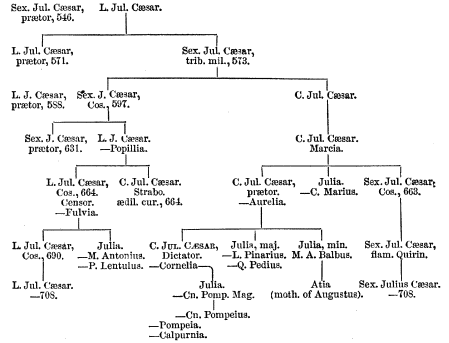
The family of the Julii was very ancient, and we find personages bearing this name from the third century of Rome. The first of whom history makes mention was C. Julius Julus, consul in 265. There were other consuls of the same family in 272, 281, 307, 324; consular tribunes in 330, 351, 362, 367; and a dictator, C. Julius Julus, in 402; but their filiation is little known. The genealogy of Cæsar begins in a direct line only from Sextus Julius Cæsar, prætor in 546. We borrow the genealogy of the family of the Julii from the History of Rome by Families, by the learned professor W. Drumann (Vol. III., page 120; Kœnigsberg, 1837), introducing one variation only, explained in Note (4) of page 290.

The opinion most accredited with the ancients, on the origin of the name of Cæsar, was that Julius slew an elephant in a fight. In the Punic tongue cæsar signifies “an elephant.” The medals of Cæsar, as grand pontiff, confirm this hypothesis; on the reverse is an elephant crushing a serpent beneath its feet. (Cohen, Consular Medals, plate xx. 10.)—We know that some symbols on the Roman medals are a species of canting heraldry. Pliny gives another etymology of the name of Cæsar: “Primusque Cæsarum a cæso matris utero dictus, qua de causa et Cæsones appellati.” (Natural History, VII. 9.)—Festus (p. 57) thus expresses himself: “Cæsar a cæsarie dictus est; qui scilicet cum cæsarie natus est;” and page 45: “Cæsariati (comati).”—Finally, Spartianus (Life of Ælius Verus, ii.) sums up in these words the greater part of the etymologies: “Cæsorem vel ab elephante (qui lingua Mauroram cæsar dicitur) in prœlio cæso, cum qui primus sic appellatus est, doctissimi et eruditissimi viri putant dictum; vel quia mortua matre, ventre cæso sit natus; vel quod cum magnis crinibus sit utero parentis effusus; vel quod oculis cæsiis et ultra humanum morem viguerit.” (See Isidore, Origines, IX. iii. 12.—Servius, Commentary on the Æneid, I. 290, and Constantine Manasses, p. 71.)