Volume 5 — CHAPTER I—THE EIGHTEENTH THEBAN DYNASTY—(continued) (continued 2)
M. L. McClure translation
Beyond the Red Sea the mines were actively worked, and even the oases of the Libyan desert took part in the national revival, and buildings rose in their midst of a size proportionate to their slender revenues. Thebes naturally came in for the largest share of the spoils of war. Although her kings had become the rulers of the world, they had not, like the Pharaohs of the XIIth and XIIIth dynasties, forsaken her for some more illustrious city: here they had their ordinary residence as well as their seat of government, hither they returned after each campaign to celebrate their victory, and hither they sent the prisoners and the spoil which they had reserved for their own royal use. In the course of one or two generations Thebes had spread in every direction, and had enclosed within her circuit the neighbouring villages of Ashîrû, the fief of Maiit, and Apît-rîsîfc, the southern Thebes, which lay at the confluence of the Nile with one of the largest of the canals which watered the plain. The monuments in these two new quarters of the town were unworthy of the city of which they now formed part, and Amenôthes III. consequently bestowed much pains on improving them. He entirely rebuilt the sanctuary of Maût, enlarged the sacred lake, and collected within one of the courts of the temple several hundred statues in black granite of the Memphite divinity, the lioness-headed Sokhît, whom he identified with his Theban goddess. The statues were crowded together so closely that they were in actual contact with each other in places, and must have presented something of the appearance of a regiment drawn up in battle array. The succeeding Pharaohs soon came to look upon this temple as a kind of storehouse, whence they might provide themselves with ready-made figures to decorate their buildings either at Thebes or in other royal cities. About a hundred of them, however, still remain, most of them without feet, arms, or head; some over-turned on the ground, others considerably out of the perpendicular, from the earth having given way beneath them, and a small number only still perfect and in situ.
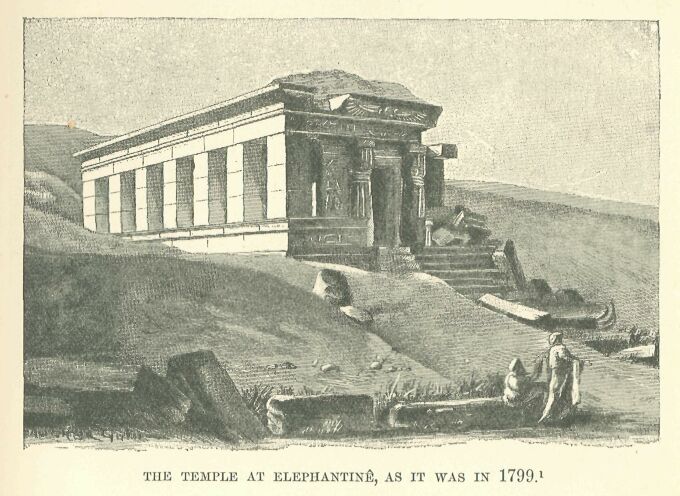
Drawn by Faucher-Gudin, from the Description de l’Egypte, Ant., vol. i p. 35. A good restoration of it, made from the statements in the Description, is to be found in Pekrot-Cuipiez, Histoire de l’Art dans l’Antiquité, vol. i. pp. 402, 403.
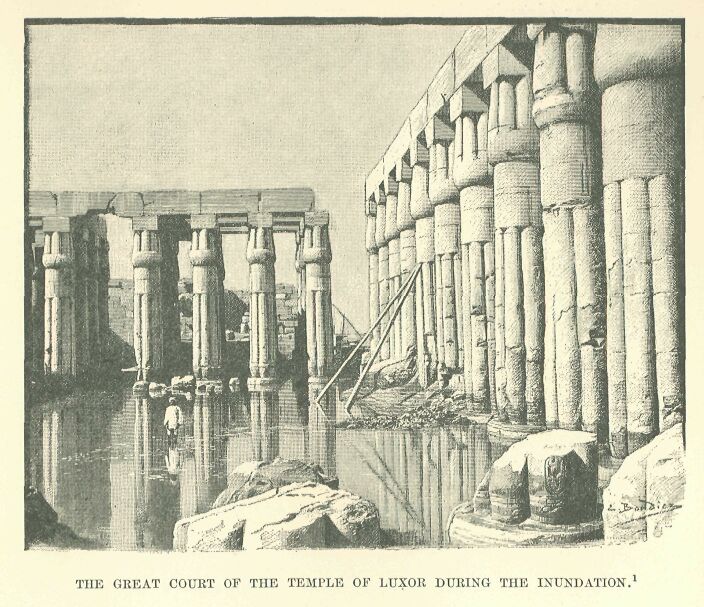
Drawn by Boudier, from a photograph by Beato.
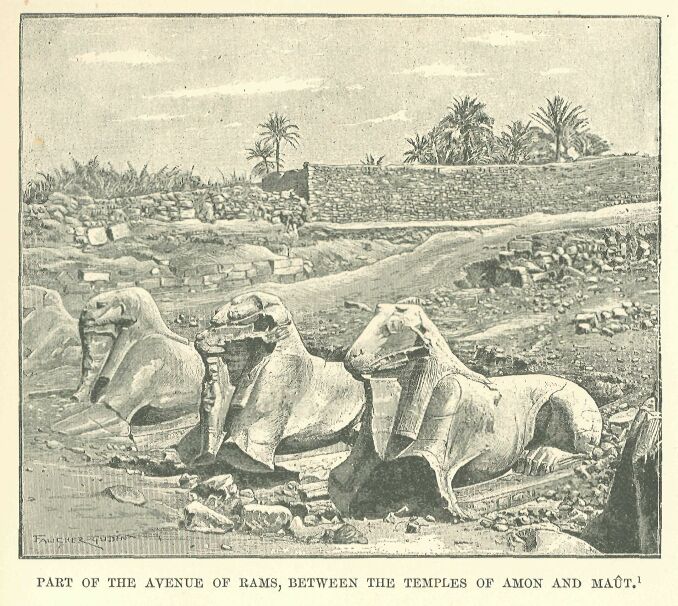
Drawn by Faucher-Gudin, from a photograph by Beato.
At Luxor Amenôthes demolished the small temple with which the sovereigns of the XIIth and XIIIth dynasties had been satisfied, and replaced it by a structure which is still one of the finest yet remaining of the times of the Pharaohs. The naos rose sheer above the waters of the Nile, indeed its cornices projected over the river, and a staircase at the south side allowed the priests and devotees to embark directly from the rear of the building. The sanctuary was a single chamber, with an opening on its side, but so completely shut out from the daylight by the long dark hall at whose extremity it was placed as to be in perpetual obscurity. It was flanked by narrow, dimly lightly chambers, and was approached through a pronaos with four rows of columns, a vast court surrounded with porticoes occupying the foreground. At the present time the thick walls which enclosed the entire building are nearly level with the ground, half the ceilings have crumbled away, air and light penetrate into every nook, and during the inundation the water flowing into the courts, transformed them until recently into lakes, whither the flocks and herds of the village resorted in the heat of the day to bathe or quench their thirst. Pictures of mysterious events never meant for the public gaze now display their secrets in the light of the sun, and reveal to the eyes of the profane the supernatural events which preceded the birth of the king. On the northern side an avenue of sphinxes and crio-sphinxes led to the gates of old Thebes. At present most of these creatures are buried under the ruins of the modern town, or covered by the earth which overlies the ancient road; but a few are still visible, broken and shapeless from barbarous usage, and hardly retaining any traces of the inscriptions in which Amenôthes claimed them boastingly as his work.
Drawn by Boudier, from a photograph by Beato.
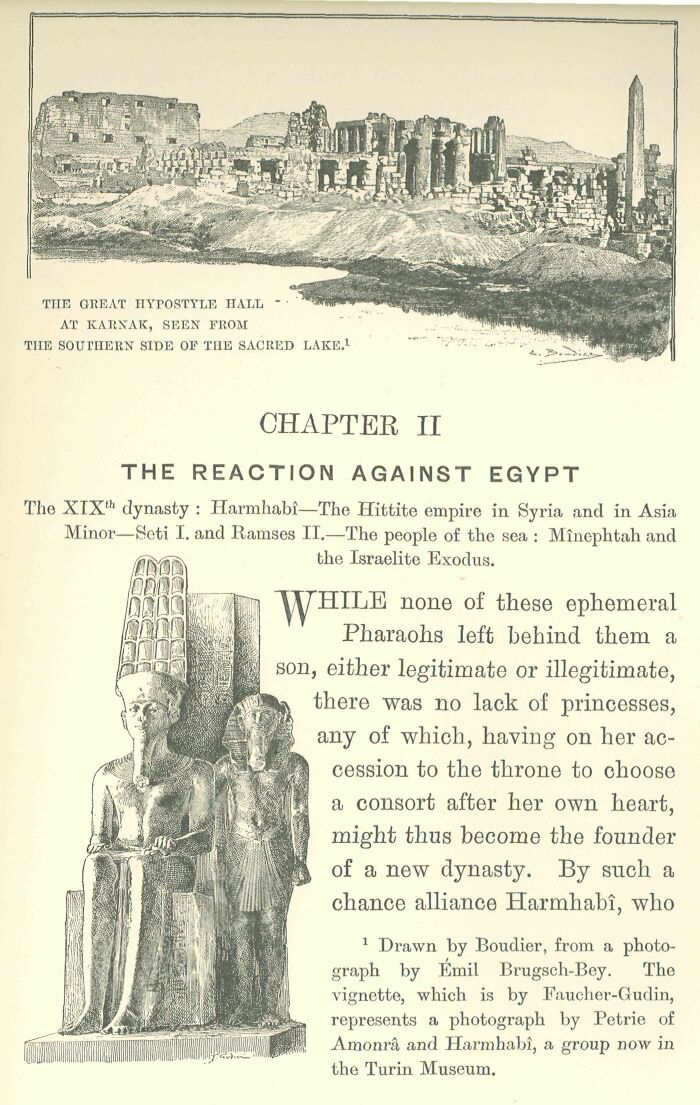
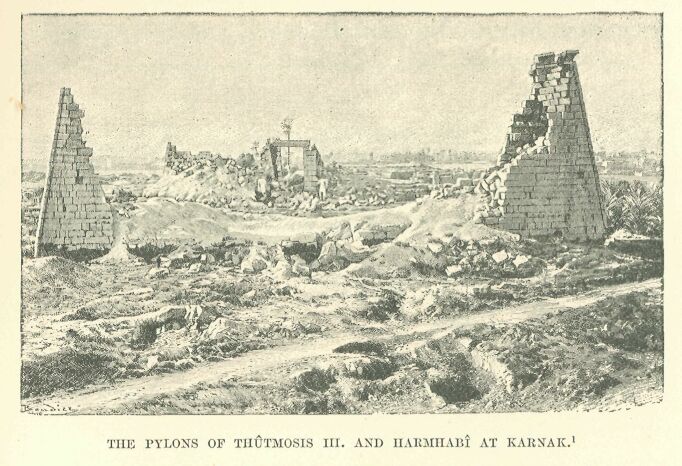
Triumphal processions passing along this route from Luxor to Karnak would at length reach the great court before the temple of Amon, or, by turning a little to the right after passing the temple of Maût, would arrive in front of the southern façade, near the two gilded obelisks whose splendour once rejoiced the heart of the famous Hâtshopsîtû. Thûtmosis III. was also determined on his part to spare no expense to make the temple of his god of proportions suitable to the patron of so vast an empire. Not only did he complete those portions which his predecessors had merely sketched out, but on the south side towards Ashîrû he also built a long row of pylons, now half ruined, on which he engraved, according to custom, the list of nations and cities which he had subdued in Asia and Africa. To the east of the temple he rebuilt some ancient structures, the largest of which served as a halting-place for processions, and he enclosed the whole with a stone rampart. The outline of the sacred lake, on which the mystic boats were launched on the nights of festivals, was also made more symmetrical, and its margin edged with masonry.
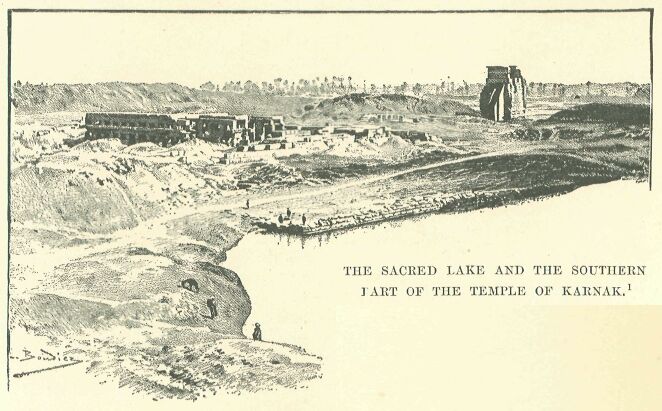
Drawn by Boucher, from a photograph by Boato: the building near the centre of the picture is the covered walk constructed by Thûtmosis III.
By these alterations the harmonious proportion between the main buildings and the façade had been destroyed, and the exterior wall was now too wide for the pylon at the entrance. Amenôthes III. remedied this defect by erecting in front a fourth pylon, which was loftier, larger, and in all respects more worthy to stand before the enlarged temple. Its walls were partially covered with battle-scenes, which informed all beholders of the glory of the conqueror.*
* Portions of the military bas-reliefs which covered the exterior face of the pylon are still to be seen through the gaps in the wall at the end of the great Hall of Pillars built by Seti I. and Ramses II.
Progress had been no less marked on the left bank of the river. As long as Thebes had been merely a small provincial town, its cemeteries had covered but a moderate area, including the sandy plain and low mounds opposite Karnak and the valley of Deîr el-Baharî beyond; but now that the city had more than doubled its extent, the space required for the dead was proportionately greater. The tombs of private persons began to spread towards the south, and soon reached the slopes of the Assassîf, the hill of Sheikh-Abd-el-Qurnah and the district of Qûrnet-Mûrraî—in fact, all that part which the people of the country called the “Brow” of Thebes. On the borders of the cultivated land a row of chapels and mastabas with pyramidal roofs sheltered the remains of the princes and princesses of the royal family. The Pharaohs themselves were buried either separately under their respective brick pyramids or in groups in a temple, as was the case with the first three Thûtmosis and Hâtshopsîtû at Deîr el-Baharî. Amenôthes II. and Thûtmosis IV. could doubtless have found room in this crowded necropolis,* although the space was becoming limited, but the pride of the Pharaohs began to rebel against this promiscuous burial side by side with their subjects. Amenôthes III. sought for a site, therefore, where he would have ample room to display his magnificence, far from the vulgar crowd, and found what he desired at the farther end of the valley which opens out behind the village of Qurnah. Here, an hour’s journey from the bank of the Nile, he cut for himself a magnificent rock-tomb with galleries, halls, and deep pits, the walls being decorated with representations of the Voyage of the Sun through the regions which he traverses during the twelve hours of his nocturnal course.
* The generally received opinion is that these sovereigns of the XVIIIth dynasty were buried in the Bibân el-Molûk, but I have made several examinations of this valley, and cannot think that this was the case. On the contrary, the scattered notices in the fragments of papyrus preserved at Turin seem to me to indicate that Amenôthes II. and Thûtmosis IV. must have been buried in the neighbourhood of the Assassîf or of Deîr el-Baharî.
A sarcophagus of red granite received his mummy, and Ushabti’s of extraordinary dimensions and admirable workmanship mounted guard around him, so as to release him from the corvée in the fields of Ialû. The chapel usually attached to such tombs is not to be found in the neighbourhood. As the road to the funeral valley was a difficult one, and as it would be unreasonable to condemn an entire priesthood to live in solitude, the king decided to separate the component parts which had hitherto been united in every tomb since the Memphite period, and to place the vault for the mummy and the passages leading to it some distance away in the mountains, while the necessary buildings for the cultus of the statue and the accommodation of the priests were transferred to the plain, and were built at the southern extremity of the lands which were at that time held by private persons. The divine character of Amenôthes, ascribed to him on account of his solar origin and the co-operation of Amon-Râ at his birth, was, owing to this separation of the funerary constituents, brought into further prominence. When once the body which he had animated while on earth was removed and hidden from sight, the people soon became accustomed to think only of his Double enthroned in the recesses of the sanctuary: seeing him receive there the same honours as the gods themselves, they came naturally to regard him as a deity himself.
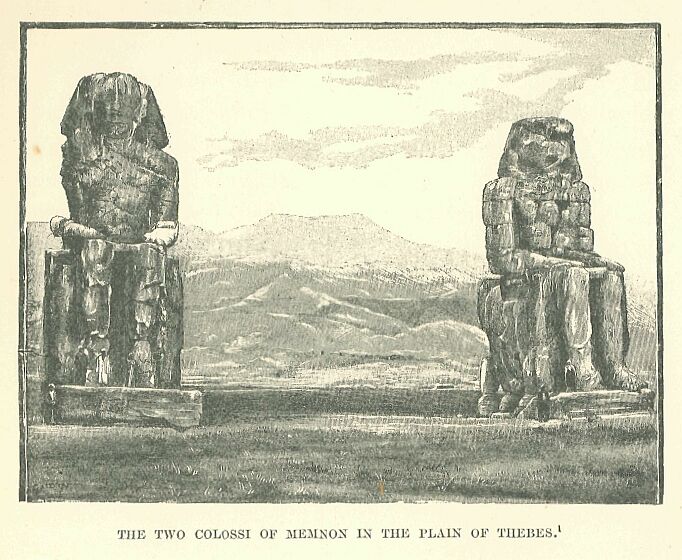
Drawn by Faucher-Gudin, from a photograph by Beato. The “Vocal Statue of Memon” is that on the right-hand side of the illustration.
The arrangement of his temple differed in no way from those in which Amon, Maût, and Montû were worshipped, while it surpassed in size and splendour most of the sanctuaries dedicated to the patron gods of the chief towns of the nomes. It contained, moreover, colossal statues, objects which are never found associated with the heavenly gods. Several of these figures have been broken to pieces, and only a few scattered fragments of them remain, but two of them still maintain their positions on each side of the entrance, with their faces towards the east. They are each formed of a single block of red breccia from Syenê,* and are fifty-three feet high, but the more northerly one was shattered in the earthquake which completed the ruin of Thebes in the year 27 B.C. The upper part toppled over with the shock, and was dashed to pieces on the floor of the court, while the lower half remained in its place. Soon after the disaster it began to be rumoured that sounds like those produced by the breaking of a harp-string proceeded from the pedestal at sunrise, whereupon travellers flocked to witness the miracle, and legend soon began to take possession of the giant who spoke in this marvellous way. In vain did the Egyptians of the neighbourhood declare that the statue represented the Pharaoh Amenôthes; the Greeks refused to believe them, and forthwith recognised in the colossus an image of Memnon the Ethiopian, son of Tithonus and Aurora, slain by their own Achilles beneath the walls of Troy—maintaining that the music heard every morning was the clear and harmonious voice of the hero saluting his mother.
* It is often asserted that they are made of rose granite, but Jollois and Devilliers describe them as being of “a species of sandstone breccia, composed of a mass of agate flint, conglomerated together by a remarkably hard cement. This material, being very dense and of a heterogeneous composition, presents to the sculptor perhaps greater difficulties than even granite.”
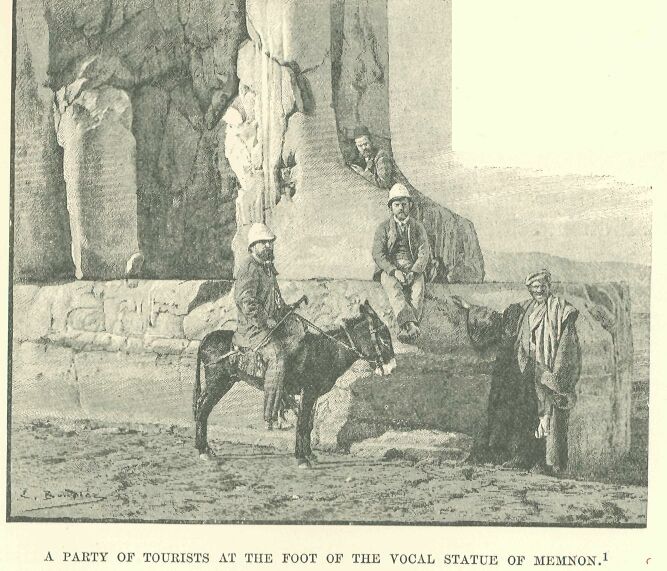
Towards the middle of the second century of our era, Hadrian undertook a journey to Upper Egypt, and heard the wonderful song; sixty years later, Septimus Severus restored the statue by the employment of courses of stones, which were so arranged as to form a rough representation of a human head and shoulders. His piety, however, was not rewarded as he expected, for Memnon became silent, and his oracle fell into oblivion. The temple no longer exists, and a few ridges alone mark the spot where it rose; but the two colossi remain at their post, in the same condition in which they were left by the Roman Cæsar: the features are quite obliterated, and the legs and the supporting female figures on either side are scored all over with Greek and Latin inscriptions expressing the appreciation of ancient tourists. Although the statues tower high above the fields of corn and bersîm which surround them, our first view of them, owing to the scale of proportion observed in their construction, so different from that to which we are accustomed, gives us the impression that they are smaller than they really are, and it is only when we stand close to one of them and notice the insignificant appearance of the crowd of sightseers clustered on its pedestal that we realize the immensity of the colossi.
The descendants of Ahmosis had by their energy won for Thebes not only the supremacy over the peoples of Egypt and of the known world, but had also secured for the Theban deities pre-eminence over all their rivals. The booty collected both in Syria and Ethiopia went to enrich the god Amon as much as it did the kings themselves; every victory brought him the tenth part of the spoil gathered on the field of battle, of the tribute levied on vassals, and of the prisoners taken as slaves. When Thûtmosis IIL, after having reduced Megiddo, organised a systematic plundering of the surrounding country, it was for the benefit of Amon-Eâ that he reaped the fields and sent their harvest into Egypt; if during his journeys he collected useful plants or rare animals, it was that he might dispose of them in the groves or gardens of Amon as well as in his own, and he never retained for his personal use the whole of what he won by arms, but always reserved some portion for the sacred treasury.
Drawn by Boudier, from a photograph by Insinger.
His successors acted in a similar manner, and in the reigns of Amenôthes II., Thût-mosis IV., and Amenôthes III., the patrimony of the Theban priesthood continued to increase. The Pharaohs, perpetually called upon as they were to recompense one or other of their servants, were never able to retain for long their share of the spoils of war. Gold and silver, lands, jewels, and slaves passed as quickly out of their hands as they had fallen into them, and although then fortune was continually having additions made to it in every fresh campaign, yet the increase was rarely in proportion to the trouble expended. The god, on the contrary, received what he got for all time, and gave back nothing in return: fresh accumulations of precious metals were continually being added to his store, his meadows were enriched by the addition of vineyards, and with his palm forests he combined fish-ponds full of fish; he added farms and villages to those he already possessed, and each reign saw the list of his possessions increase. He had his own labourers, his own tradespeople, his own fishermen, soldiers, and scribes, and, presiding over all these, a learned hierarchy of divines, priests, and prophets, who administered everything. This immense domain, which was a kind of State within the State, was ruled over by a single high priest, chosen by the sovereign from among the prophets. He was the irresponsible head of it, and his spiritual ambition had increased step by step with the extension of his material resources. As the human Pharaoh showed himself entitled to homage from the lords of the earth, the priests came at length to the conclusion that Amon had a right to the allegiance of the lords of heaven, and that he was the Supreme Being, in respect of whom the others were of little or no account, and as he was the only god who was everywhere victorious, he came at length to be regarded by them as the only god in existence. It was impossible that the kings could see this rapid development of sacerdotal power without anxiety, and with all their devotion to the patron of their city, solicitude for their own authority compelled them to seek elsewhere for another divinity, whose influence might in some degree counterbalance that of Amon. The only one who could vie with him at Thebes, either for the antiquity of his worship or for the rank which he occupied in the public esteem, was the Sun-lord of Heliopolis, head of the first Ennead. Thûtmosis IV. owed his crown to him, and ‘displayed his gratitude in clearing away the sand from the Sphinx, in which the spirit of Harmakhis was considered to dwell; and Amenôthes III., although claiming to be the son of Amon himself, inherited the disposition shown by Thûtmosis in favour of the Heliopolitan religions, but instead of attaching himself to the forms most venerated by theologians, he bestowed his affection on a more popular deity—Atonû, the fiery disk. He may have been influenced in his choice by private reasons. Like his predecessors, he had taken, while still very young, wives from among his own family, but neither these reasonable ties, nor his numerous diplomatic alliances with foreign princesses, were enough for him. From the very beginning of his reign he had loved a maiden who was not of the blood of the Pharaohs, Tîi, the daughter of Iûîa and his wife Tûîa.*
* For the last thirty years Queen Tîi has been the subject of many hypotheses and of much confusion. The scarabasi engraved under Amenôthes III. say explicitly that she was the daughter of two personages, Iûîa and Tûîa, but these names are not accompanied by any of the signs which are characteristic of foreign names, and were considered Egyptian by contemporaries. Hincks was the first who seems to have believed her to be a Syrian; he compares her father’s name with that of Levi, and attributes the religious revolution which followed to the influence of her foreign education. This theory has continued to predominate; some prefer a Libyan origin to the Asiatic one, and latterly there has been an attempt to recognise in Tîi one of the princesses of Mitanni mentioned in the correspondence of Tel el-Amarna. As long ago as 1877, I showed that Tîi was an Egyptian of middle rank, probably of Heliopolitan origin.
Connexions of this kind had been frequently formed by his ancestors, but the Egyptian women of inferior rank whom they had brought into their harems had always remained in the background, and if the sons of these concubines were ever fortunate enough to come to the throne, it was in default of heirs of pure blood. Amenôthes III. married Tîi, gave her for her dowry the town of Zâlû in Lower Egypt, and raised her to the position of queen, in spite of her low extraction. She busied herself in the affairs of State, took precedence of the princesses of the solar family, and appeared at her husband’s side in public ceremonies, and was so figured on the monuments. If, as there is reason to believe, she was born near Heliopolis, it is easy to understand how her influence may have led Amenôthes to pay special honour to a Heliopolitan divinity. He had built, at an early period of his reign, a sanctuary to Atonû at Memphis, and in the Xth year he constructed for him a chapel at Thebes itself,* to the south of the last pylon of ïhûtmosis III., and endowed this deity with property at the expense of Anion.
* This temple seems to have been raised on the site of the building which is usually attributed to Amenôthes II. and Amenôthes III. The blocks bearing the name of Amenôthes II. had been used previously, like most of those which bear the cartouches of Amenôthes III. The temple of Atonû, which was demolished by Harmhabî or one of the Ramses, was subsequently rebuilt with the remains of earlier edifices, and dedicated to Amon.
He had several sons;* but the one who succeeded him, and who, like him, was named Amenôthes, was the most paradoxical of all the Egyptian sovereigns of ancient times.**
* One of them, Thûtmosis, was high priest of Phtah, and we possess several monuments erected by him in the temple of Memphis; another, Tûtonkhamon, subsequently became king. He also had several daughters by Tîi—Sîtamon. ** The absence of any cartouches of Amenôthes IV. or his successors in the table of Abydos prevented Champollion and Rosellini from classifying these sovereigns with any precision. Nestor L’hôte tried to recognise in the first of them, whom he called Bakhen-Balchnan, a king belonging to the very ancient dynasties, perhaps the Hyksôs Apakhnan, but Lepsius and Hincks showed that he must be placed between Amenôthes III. and Harmhabî, that he was first called Amenôthes like his father, but that he afterwards took the name of Baknaten, which is now read Khûnaten or Khûniaton. His singular aspect made it difficult to decide at first whether a man or a woman was represented. Mariette, while pronouncing him to be a man, thought that he had perhaps been taken prisoner in the Sudan and mutilated, which would have explained his effeminate appearance, almost like that of an eunuch. Recent attempts have been made to prove that Amenôthes IV. and Khûniaton were two distinct persons, or that Khûniaton was a queen; but they have hitherto been rejected by Egyptologists.
He made up for the inferiority of his birth on account of the plebeian origin of his mother Tîî,* by his marriage with Nofrîtîti, a princess of the pure solar race.** Tîi, long accustomed to the management of affairs, exerted her influence over him even more than she had done over her husband. Without officially assuming the rank, she certainly for several years possessed the power, of regent, and gave a definite Oriental impress to her son’s religious policy. No outward changes were made at first; Amenôthes, although showing his preference for Heliopolis by inscribing in his protocol the title of prophet of Harmakhis, which he may, however, have borne before his accession, maintained his residence at Thebes, as his father had done before him, continued to sacrifice to the Theban divinities, and to follow the ancient paths and the conventional practices.***
* The filiation of Amenôthes IV. and Tîi has given rise to more than one controversy. The Egyptian texts do not define it explicitly, and the title borne by Tîi has been considered by some to prove that Amenôthes IV. was her son, and by others that she was the mother of Queen Nofrîtîti. The Tel el-Amarna correspondence solves the question, however, as it gives a letter from Dushratta to Khûniaton, in which Tîi is called “thy mother.” ** Nofrîtîti, the wife of Amenôthes IV., like all the princesses of that time, has been supposed to be of Syrian origin, and to have changed her name on her arrival in Egypt. The place which she holds beside her husband is the same as that which belongs to legitimate queens, like Nofritari, Ahmosis, and Hâtshopsîtû, and the example of these princesses is enough to show us what was her real position; she was most probably a daughter of one of the princesses of the solar blood, perhaps of one of the sisters of Amenôthes III., and Amenôthes IV. married her so as to obtain through her the rights which were wanting to him through his mother Tîi. *** The tomb of Ramses, governor of Thebes and priest of Mâît, shows us in one part of it the king, still faithful to his name of Amenôthes, paying homage to the god Amon, lord of Karnak, while everywhere else the worship of Atonû predominates. The cartouches on the tomb of Pari, read by Bouriant Akhopîrûrî, and by Scheil more correctly Nofirkhopîrûrî, seem to me to represent a transitional form of the protocol of Amenôthes IV., and not the name of a new Pharaoh; the inscription in which they are to be found bears the date of his third year.
Drawn by Faucher-Gudin, from a photograph of the scarabaeus preserved at Gîzeh.
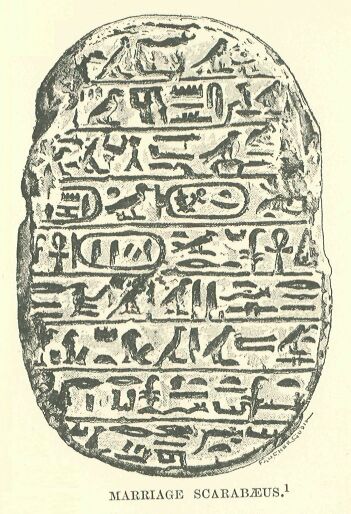
He either built a temple to the Theban god, or enlarged the one which his father had constructed at Karnak, and even opened new quarries at Syene and Silsileh for providing granite and sandstone for the adornment of this monument. His devotion to the invincible Disk, however, soon began to assert itself, and rendered more and more irksome to him the religious observances which he had constrained himself to follow. There was nothing and no one to hinder him from giving free course to his inclinations, and the nobles and priests were too well trained in obedience to venture to censure anything he might do, even were it to result in putting the whole population into motion, from Elephantine to the sea-coast, to prepare for the intruded deity a dwelling which should eclipse in magnificence the splendour of the great temple. A few of those around him had become converted of their own accord to his favourite worship, but these formed a very small minority. Thebes had belonged to Amon so long that the king could never hope to bring it to regard Atonû as anything but a being of inferior rank. Each city belonged to some god, to whom was attributed its origin, its development, and its prosperity, and whom it could not forsake without renouncing its very existence. If Thebes became separated from Amon it would be Thebes no longer, and of this Amenôthes was so well aware that he never attempted to induce it to renounce its patron. His residence among surroundings which he detested at length became so intolerable, that he resolved to leave the place and create a new capital elsewhere. The choice of a new abode would have presented no difficulty to him had he been able to make up his mind to relegate Atonû to the second rank of divinities; Memphis, Heracleopolis, Siût, Khmûnû, and, in fact, all the towns of the valley would have deemed themselves fortunate in securing the inheritance of their rival, but not one of them would be false to its convictions or accept the degradation of its own divine founder, whether Phtah, Harshafîtû, Anubis, or Thot. A newly promoted god demanded a new city; Amenôthes, therefore, made selection of a broad plain extending on the right bank of the Nile, in the eastern part of the Hermopolitan nome, to which he removed with all his court about the fourth or fifth year of his reign.*
* The last date with the name of Amenôthes is that of the year V., on a papyrus from the Payilm; elsewhere we find from the year VI. the name of Khûniaton, by the side of monuments with the cartouche of Amenôthes; we may conclude from this that the foundation of the town dates from the year IV. or V. at the latest, when the prince, having renounced the worship of Amon, left Thebes that he might be able to celebrate freely that of Atonû.
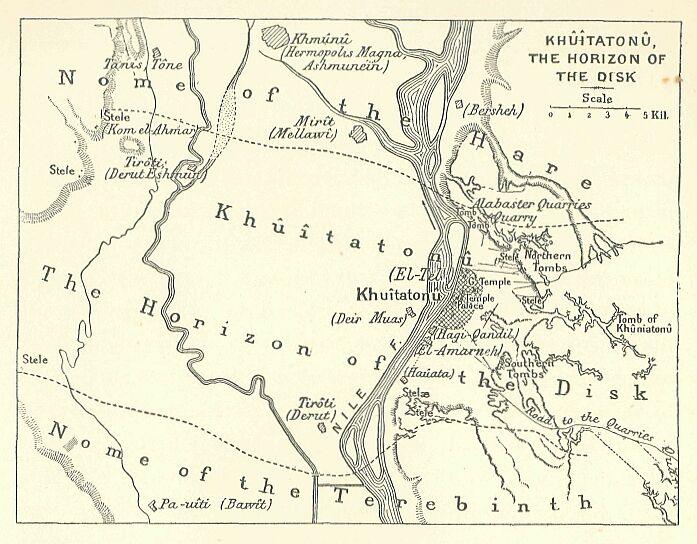
He found here several obscure villages without any historical or religious traditions, and but thinly populated; Amenôthes chose one of them, the Et-Tel of the present day, and built there a palace for himself and a temple for his god. The temple, like that of Eâ at Heliopolis, was named Haît-Banbonû, the Mansion of the Obelisk. It covered an immense area, of which the sanctuary, however, occupied an inconsiderable part; it was flanked by brick storehouses, and the whole was surrounded by a thick wall. The remains show that the temple was built of white limestone, of fine quality, but that it was almost devoid of ornament, for there was no time to cover it with the usual decorations.*
* The opinion of Brugsch, that the arrangement of the various parts differed from that of other temples, and was the effect of foreign influence, has not been borne out by the excavations of Prof. Pétrie, the little which he has brought to light being entirely of Egyptian character. The temple is represented on the tomb of the high priest Mariri.
The palace was built of brick; it was approached by a colossal gateway, and contained vast halls, interspersed with small apartments for the accommodation of the household, and storehouses for the necessary provisions, besides gardens which had been hastily planted with rare shrubs and sycamores. Fragments of furniture and of the roughest of the utensils contained in the different chambers are still unearthed from among the heaps of rubbish, and the cellars especially are full of potsherds and cracked jars, on which we can still see written an indication of the reign and the year when the wine they once contained was made. Altars of massive masonry rose in the midst of the courts, on which the king or one of his ministers heaped offerings and burnt incense morning, noon, and evening, in honour of the three decisive moments in the life of Atonû.*
* Naville discovered at Deîr el-Baharî a similar altar, nearly intact. No other example was before known in any of the ruined towns or temples, and no one had any idea of the dimensions to which these altars, attained.
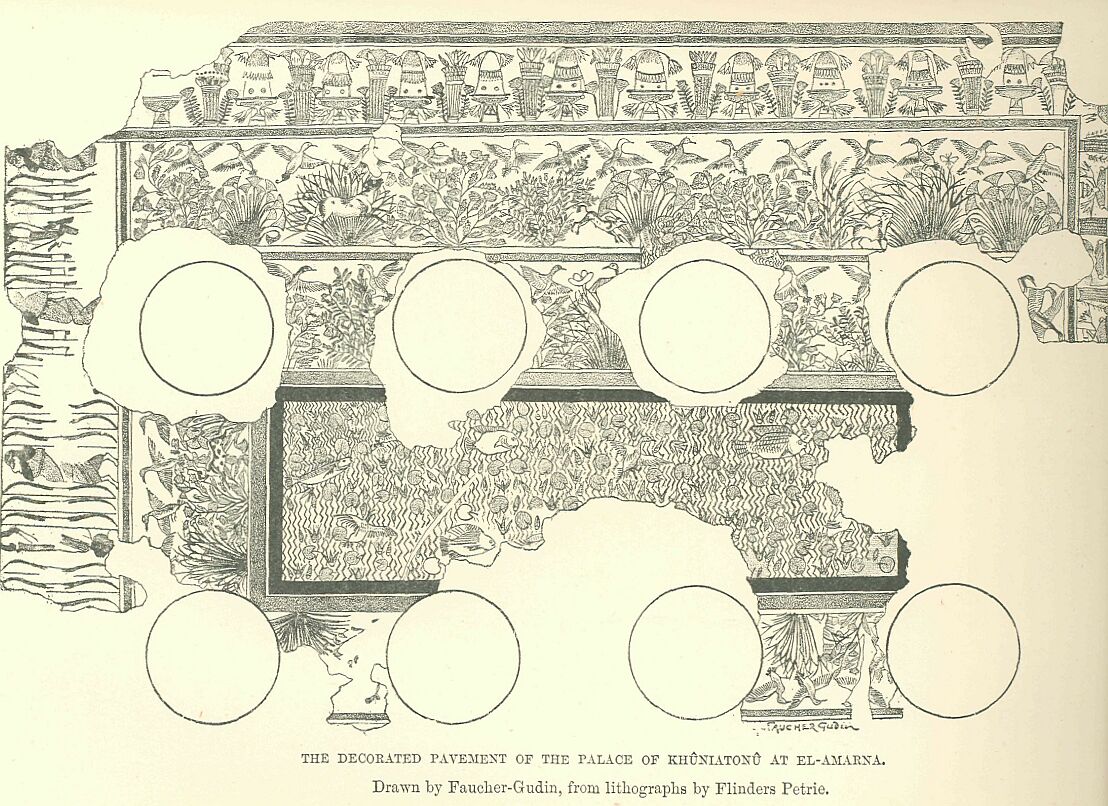
A few painted and gilded columns supported the roofs of the principal apartments in which the Pharaoh held his audiences, but elsewhere the walls and pillars were coated with cream-coloured stucco or whitewash, on which scenes of private life were depicted in colours. The pavement, like the walls, was also decorated. In one of the halls which seems to have belonged to the harem, there is still to be seen distinctly the picture of a rectangular piece of water containing fish and lotus-flowers in full bloom; the edge is adorned with water-plants and flowering shrubs, among which birds fly and calves graze and gambol; on the right and left were depicted rows of stands laden with fruit, while at each end of the room were seen the grinning faces of a gang of negro and Syrian prisoners, separated from each other by gigantic arches. The tone of colouring is bright and cheerful, and the animals are treated with great freedom and facility. The Pharaoh, had collected about him several of the best artists then to be found at Thebes, placing them under the direction of Baûki, the chief of the corporation of sculptors,* and probably others subsequently joined these from provincial studios.
* Baûki belonged to a family of artists, and his father Mani had filled before him the post of chief of the sculptors. The part played by these personages was first defined by Brugsch, with perhaps some exaggeration of their artistic merit and originality of talent.
Work for them was not lacking, for houses had to be built for all the courtiers and government officials who had been obliged to follow the king, and in a few years a large town had sprung up, which was called Khûîtatonû, or the “Horizon of the Disk.” It was built on a regular plan, with straight streets and open spaces, and divided into two separate quarters, interspersed with orchards and shady trellises. Workmen soon began to flock to the new city—metal-founders, glass-founders, weavers; in fine, all who followed any trade indispensable to the luxury of a capital. The king appropriated a territory for it from the ancient nome of the Hare, thus compelling the god Thot to contribute to the fortune of Atonû; he fixed its limits by means of stelæ placed in the mountains, from Gebel-Tûnah to Deshlûît on the west, and from Sheikh-Said to El-Hauata on the eastern bank;* it was a new nome improvised for the divine parvenu.
* We know at present of fourteen of these stelæ. A certain number must still remain to be discovered on both banks of the Nile.
Atonû was one of the forms of the Sun, and perhaps the most material one of all those devised by the Egyptians. He was defined as “the good god who rejoices in truth, the lord of the solar course, the lord of the disk, the lord of heaven, the lord of earth, the living disk which lights up the two worlds, the living Harmakhis who rises on the horizon bearing his name of Shû, which is disk, the eternal infuser of life.” His priests exercised the same functions as those of Heliopolis, and his high priest was called “Oîrimaû,” like the high priest of Râ in Aunû. This functionary was a certain Marirl, upon whom the king showered his favours, and he was for some time the chief authority in the State after the Pharaoh himself. Atonû was represented sometimes by the ordinary figure of Horus,* sometimes by the solar disk, but a disk whose rays were prolonged towards the earth, like so many arms ready to lay hold with their little hands of the offerings of the faithful, or to distribute to mortals the crux ansata, the symbol of life. The other gods, except Amon, were sharers with humanity in his benefits. Atonû proscribed him, and tolerated him only at Thebes; he required, moreover, that the name of Amon should be effaced wherever it occurred, but he respected Râ and Horus and Harmakhis—all, in fact, but Amon: he was content with being regarded as their king, and he strove rather to become their chief than their destroyer.**
* It was probably this form of Horus which had, in the temple at Thebes, the statue called “the red image of Atonû in Paatoml.” ** Prisse d’Avennes has found at Karnak, on fragments of the temple, the names of other divinities than Atonû worshipped by Khûniatonû.
His nature, moreover, had nothing in it of the mysterious or ambiguous; he was the glorious torch which gave light to humanity, and which was seen every day to flame in the heavens without ever losing its brilliance or becoming weaker. When he hides himself “the world rests in darkness, like those dead who lie in their rock-tombs, with their heads swathed, their nostrils stuffed up, their eyes sightless, and whose whole property might be stolen from them, even that which they have under their head, without their knowing it; the lion issues from his lair, the serpent roams ready to bite, it is as obscure as in a dark room, the earth is silent whilst he who creates everything dwells in his horizon.” He has hardly arisen when “Egypt becomes festal, one awakens, one rises on one’s feet; when thou hast caused men to clothe themselves, they adore thee with outstretched hands, and the whole earth attends to its work, the animals betake themselves to their herbage, trees and green crops abound, birds fly to their marshy thickets with wings outstretched in adoration of thy double, the cattle skip, all the birds which were in their nests shake themselves when thou risest for them; the boats come and go, for every way is open at thy appearance, the fish of the river leap before thee as soon as thy rays descend upon the ocean.” It is not without reason that all living things thus rejoice at his advent; all of them owe their existence to him, for “he creates the female germ, he gives virility to men, and furnishes life to the infant in its mother’s womb; he calms and stills its weeping, he nourishes it in the maternal womb, giving forth the breathings which animate all that he creates, and when the infant escapes from the womb on the day of its birth, thou openest his mouth for speech, and thou satisfiest his necessities. When the chick is in the egg, a cackle in a stone, thou givest to it air while within to keep it alive; when thou hast caused it to be developed in the egg to the point of being able to break it, it goes forth proclaiming its existence by its cackling, and walks on its feet from the moment of its leaving the egg.” Atonû presides over the universe and arranges within it the lot of human beings, both Egyptians and foreigners. The celestial Nile springs up in Hades far away in the north; he makes its current run down to earth, and spreads its waters over the fields during the inundation in order to nourish his creatures. He rules the seasons, winter and summer; he constructed the far-off sky in order to display himself therein, and to look down upon his works below. From the moment that he reveals himself there, “cities, towns, tribes, routes, rivers—all eyes are lifted to him, for he is the disk of the day upon the earth.” * The sanctuary in which he is invoked contains only his divine shadow;** for he himself never leaves the firmament.
* These extracts are taken from the hymns of Tel el-Amarna. ** In one of the tombs at Tel el-Amarna the king is depicted leading his mother Tîi to the temple of Atonû in order to see “the Shadow of Râ,” and it was thought with some reason that “the Shadow of Râ” was one of the names of the temple. I think that this designation applied also to the statue or symbol of the god; the shadow of a god was attached to the statue in the same manner as the “double,” and transformed it into an animated body.
His worship assumes none of the severe and gloomy forms of the Theban cults: songs resound therein, and hymns accompanied by the harp or flute; bread, cakes, vegetables, fruits, and flowers are associated with his rites, and only on very rare occasions one of those bloody sacrifices in which the other gods delight. The king made himself supreme pontiff of Atonu, and took precedence of the high priest. He himself celebrated the rites at the altar of the god, and we see him there standing erect, his hands outstretched, offering incense and invoking blessings from on high.* Like the Caliph Hakim of a later age, he formed a school to propagate his new doctrines, and preached them before his courtiers: if they wished to please him, they had to accept his teaching, and show that they had profited by it. The renunciation of the traditional religious observances of the solar house involved also the rejection of such personal names as implied an ardent devotion to the banished god; in place of Amenôthes, “he to whom Amon is united,” the king assumed after a time the name of Khûniatonû, “the Glory of the Disk,” and all the members of his family, as well as his adherents at court, whose appellations involved the name of the same god, soon followed his example. The proscription of Amon extended to inscriptions, so that while his name or figure, wherever either could be got at, was chiselled out, the vulture, the emblem of Mût, which expressed the idea of mother, was also avoided.**
* The altar on which the king stands upright is one of those cubes of masonry of which Naville discovered such a fine example in the temple of Hâtshopsîtû at Deîr el-Baharî. ** We find, however, some instances where the draughtsman, either from custom or design, had used the vulture to express the word mailt, “the mother,” without troubling himself to think whether it answered to the name of the goddess.
The king would have nothing about him to suggest to eye or ear the remembrance of the gods or doctrines of Thebes. It would consequently have been fatal to them and their pretensions to the primacy of Egypt if the reign of the young king had continued as long as might naturally have been expected. After having been for nearly two centuries almost the national head of Africa, Amon was degraded by a single blow to the secondary rank and languishing existence in which he had lived before the expulsion of the Hyksôs. He had surrendered his sceptre as king of heaven and earth, not to any of his rivals who in old times had enjoyed the highest rank, but to an individual of a lower order, a sort of demigod, while he himself had thus become merely a local deity, confined to the corner of the Said in which he had had his origin. There was not even left to him the peaceful possession of this restricted domain, for he was obliged to act as host to the enemy who had deposed him: the temple of Atonû was erected at the door of his own sanctuary, and without leaving their courts the priests of Amon could hear at the hours of worship the chants intoned by hundreds of heretics in the temple of the Disk. Amon’s priests saw, moreover, the royal gifts flowing into other treasuries, and the gold of Syria and Ethiopia no longer came into their hands. Should they stifle their complaints, and bow to this insulting oppression, or should they raise a protest against the action which had condemned them to obscurity and a restricted existence? If they had given indications of resistance, they would have been obliged to submit to prompt repression, but we see no sign of this. The bulk of the people—clerical as well as lay—accepted the deposition with complacency, and the nobles hastened to offer their adherence to that which afterwards became the official confession of faith of the Lord King.* The lord of Thebes itself, a certain Ramses, bowed his head to the new cult, and the bas-reliefs of his tomb display to our eyes the proofs of his apostasy: on the right-hand side Amon is the only subject of his devotion, while on the left he declares himself an adherent of Atonû. Religious formularies, divine appellations, the representations of the costume, expression, and demeanour of the figures are at issue with each other in the scenes on the two sides of the door, and if we were to trust to appearances only, one would think that the two pictures belonged to two separate reigns, and were concerned with two individuals strangers to each other.**
* The political character of this reaction against the growing power of the high priests and the town of Amon was pointed out for the first time by Masporo in 1878. Ed. Meyer and Tiele blond with the political idea a monotheistic conception which does not seem to me to be fully justified, at least at present, by anything in the materials we possess. ** His tomb was discovered in 1878 by Villiers-Stuart.
The rupture between the past and the present was so complete, in fact, that the sovereign was obliged to change, if not his face and expression, at least the mode in which they were represented.
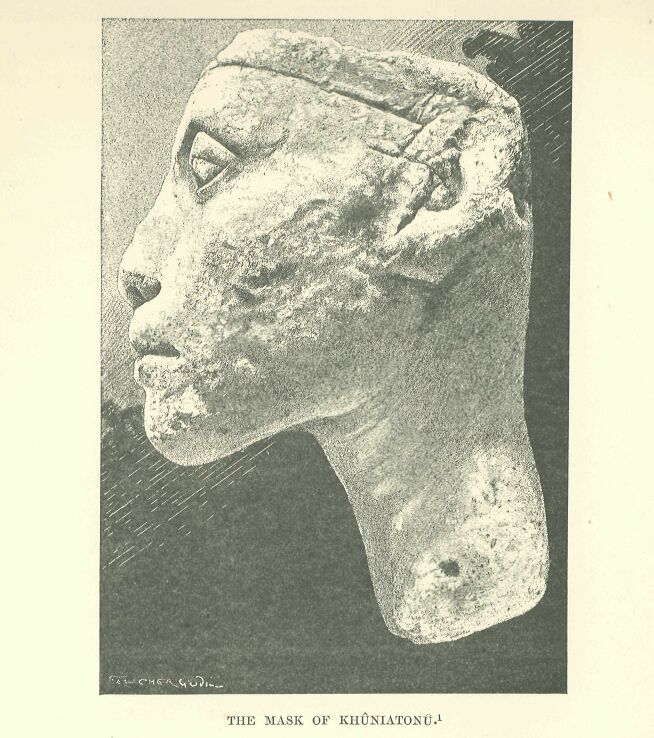
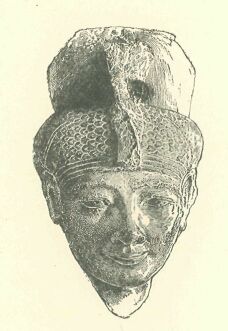
Drawn by Faucher-Gudin, from a photograph by Petrie. Petrie thinks that the monument discovered by him, which is of fine plaster, is a cast of the dead king, executed possibly to enable the sculptors to make Ushabtu, “Respondents,” for him.
Drawn by Faucher-Gudin, from a drawing by Petrie.
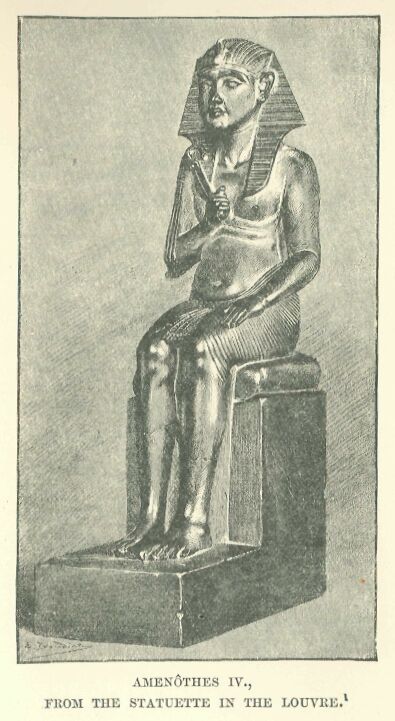
The name and personality of an Egyptian were so closely allied that interference with one implied interference with the other. Khûniatonû could not continue to be such as he was when Amenôthes, and, in fact, their respective portraits differ from each other to that degree that there is some doubt at moments as to their identity. Amenôthes is hardly to be distinguished from his father: he has the same regular and somewhat heavy features, the same idealised body and conventional shape as those which we find in the orthodox Pharaohs. Khûniatonû affects a long and narrow head, conical at the top, with a retreating forehead, a large aquiline and pointed nose, a small mouth, an enormous chin projecting in front, the whole being supported by a long, thin neck.
His shoulders are narrow, with little display of muscle, but his breasts are so full, his abdomen so prominent, and his hips so large, that one would think they belonged to a woman. Etiquette required the attendants upon the king, and those who aspired to his favour, to be portrayed in the bas-reliefs of temples or tombs in all points, both as regards face and demeanour, like the king himself. Hence it is that the majority of his contemporaries, after having borne the likeness of Amenôthes, came to adopt, without a break, that of Khûniatonû. The scenes at Tel el-Amarna contain, therefore, nothing but angular profiles, pointed skulls, ample breasts, flowing figures, and swelling stomachs. The outline of these is one that lends itself readily to caricature, and the artists have exaggerated the various details with the intention, it may be, of rendering the representations grotesque. There was nothing ridiculous, however, in the king, their model, and several of his statues attribute to him a languid, almost valetudinarian grace, which is by no means lacking in dignity.
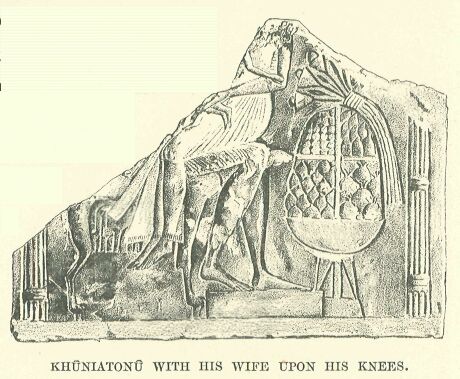
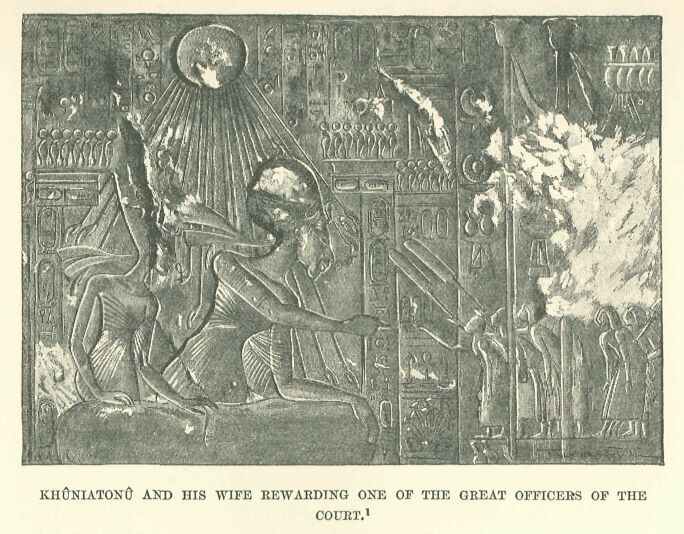
He was a good and affectionate man, and was passionately fond of his wife, Nofrîtîti, associating her with himself in his sovereign acts. If he set out to visit the temple, she followed him in a chariot; if he was about to reward one of his faithful subjects, she stood beside him and helped to distribute the golden necklaces. She joined him in his prayers to the Solar Disk; she ministered to him in domestic life, when, having broken away from the worries of his public duties, he sought relaxation in his harem; and their union was so tender, that we find her on one occasion, at least, seated in a coaxing attitude on her husband’s knees—a unique instance of such affection among all the representations on the monuments of Egypt.
Drawn by Faucher-Gudin, from a photograph by Insinger.
They had six daughters, whom they brought up to live with them on terms of the closest intimacy: they accompanied their father and mother everywhere, and are exhibited as playing around the throne while their parents are engaged in performing the duties of their office. The gentleness and gaiety of the king were reflected in the life of his subjects: all the scenes which they have left us consist entirely of processions, cavalcades, banquets, and entertainments. Khûniatonû was prodigal in the gifts of gold and the eulogies which he bestowed on Marirî, the chief priest: the people dance around him while he is receiving from the king the just recompense of his activity. When Hûîa, who came back from Syria in the XIIth year of the king’s reign, brought solemnly before him the tribute he had collected, the king, borne in his jolting palanquin on the shoulders of his officers, proceeded to the temple to return thanks to his god, to the accompaniment of chants and the waving of the great fans. When the divine father Aï had married the governess of one of the king’s daughters, the whole city gave itself up to enjoyment, and wine flowed freely during the wedding feast. Notwithstanding the frequent festivals, the king found time to watch jealously over the ordinary progress of government and foreign affairs. The architects, too, were not allowed to stand idle, and without taking into account the repairs of existing buildings, had plenty to do in constructing edifices in honour of Atonû in the principal towns of the Nile valley, at Memphis, Heliopolis, Hermopolis, Hermonthis, and in the Fayûm. The provinces in Ethiopia remained practically in the same condition as in the time of Amenôthes III.;* Kûsh was pacified, notwithstanding the raids which the tribes of the desert were accustomed to make from time to time, only to receive on each occasion rigorous chastisement from the king’s viceroy.
* The name and the figure of Khûniatonû are met with on the gate of the temple of Soleb, and he received in his XIIth year the tributes of Kûsh, as well as those of Syria.
The sudden degradation of Amon had not brought about any coldness between the Pharaoh and his princely allies in Asia. The aged Amenôthes had, towards the end of his reign, asked the hand of Dushratta’s daughter in marriage, and the Mitannian king, highly flattered by the request, saw his opportunity and took advantage of it in the interest of his treasury. He discussed the amount of the dowry, demanded a considerable sum of gold, and when the affair had been finally arranged to his satisfaction, he despatched the princess to the banks of the Nile. On her arrival she found her affianced husband was dead, or, at all events, dying. Amenôthes IV., however, stepped into his father’s place, and inherited his bride with his crown.
Drawn by Faucher-Gudin, from a photograph by Insinger.
The new king’s relations with other foreign princes were no less friendly; the chief of the Khâti (Hittites) complimented him on his accession, the King of Alasia wrote to him to express his earnest desire for a continuance of peace between the two states. Burnaburiash of Babylon had, it is true, hoped to obtain an Egyptian princess in marriage for his son, and being disappointed, had endeavoured to pick a quarrel over the value of the presents which had been sent him, together with the notice of the accession of the new sovereign. But his kingdom lay too far away to make his ill-will of much consequence, and his complaints passed unheeded. In Coele-Syria and Phoenicia the situation remained unchanged. The vassal cities were in a perpetual state of disturbance, though not more so than in the past. Azîru, son of Abdashirti, chief of the country of the Amorites, had always, even during the lifetime of Amenôthes III., been the most turbulent of vassals. The smaller states of the Orontes and of the coast about Arvad had been laid waste by his repeated incursions and troubled by his intrigues. He had taken and pillaged twenty towns, among which were Simyra, Sini, Irqata, and Qodshû, and he was already threatening Byblos, Berytus, and Sidon. It was useless to complain of him, for he always managed to exculpate himself to the royal messengers. Khaî, Dûdû, Amenemaûpît had in turn all pronounced him innocent. Pharaoh himself, after citing him to appear in Egypt to give an explanation of his conduct, had allowed himself to be won over by his fair speaking, and had dismissed him uncondemned. Other princes, who lacked his cleverness and power, tried to imitate him, and from north to south the whole of Syria could only be compared to some great arena, in which fighting was continually carried on between one tribe or town and another—Tyre against Sidon, Sidon against Byblos, Jerusalem against Lachish. All of them appealed to Khûniatonû, and endeavoured to enlist him on their side. Their despatches arrived by scores, and the perusal of them at the present day would lead us to imagine that Egypt had all but lost her supremacy. The Egyptian ministers, however, were entirely unmoved by them, and continued to refuse material support to any of the numerous rivals, except in a few rare cases, where a too prolonged indifference would have provoked an open revolt in some part of the country.
Khûniatonû died young, about the XVIIIth year of his reign.* He was buried in the depths of a ravine in the mountain-side to the east of the town, and his tomb remained unknown till within the last few years. Although one of his daughters who died before her father had been interred there, the place seems to have been entirely unprepared for the reception of the king’s body. The funeral chamber and the passages are scarcely even rough-hewn, and the reception halls show a mere commencement of decoration.** The other tombs of the locality are divided into two groups, separated by the ravine reserved for the burying-place of the royal house. The noble families possessed each their own tomb on the slopes of the hillside; the common people were laid to rest in pits lower down, almost on the level of the plain. The cutting and decoration of all these tombs had been entrusted to a company of contractors, who had executed them according to two or three stereotyped plans, without any variation, except in size. Nearly all the walls are bare, or present but few inscriptions; those tombs only are completed whose occupants died before the Pharaoh.
* The length of Khûniatonû’s reign was fixed by Griffith with almost absolute certainty by means of the dates written in ink on the jars of wine and preserves found in the ruins of the palace. ** The tomb has been found, as I anticipated, in the ravine which separates the northern after the southern group of burying-places. The Arabs opened it in 1891, and Grébaut has since completely excavated it. The scenes depicted in it are connected with the death and funeral of the Princess Mâqîtatonû.
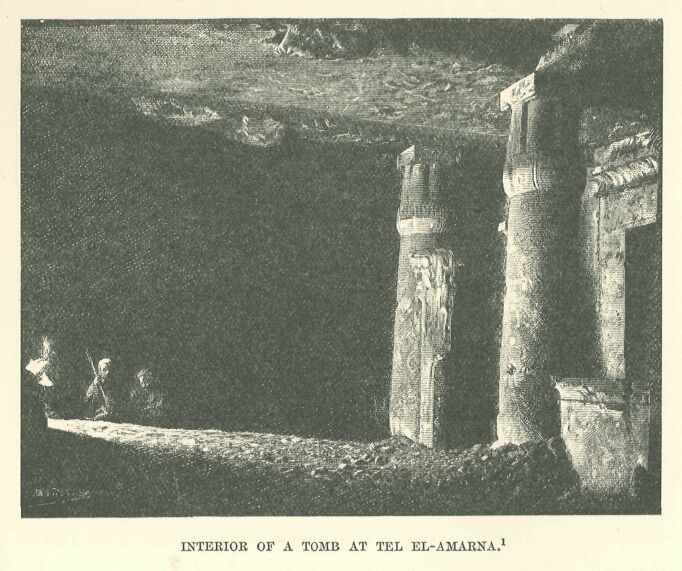
Drawn by Boudier, after a photograph by Insinger.
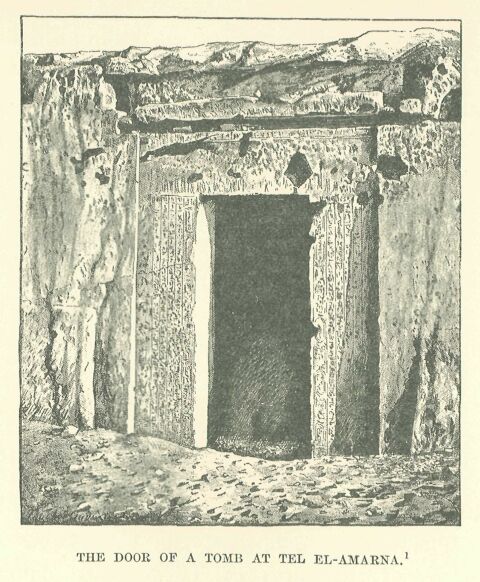
The façades of the tombs are cut in the rock, and contain, for the most part, but one door, the jambs of which are covered on both sides by several lines of hieroglyphs; and it is just possible to distinguish traces of the adoration of the radiant Disk on the lintels, together with the cartouches containing the names of the king and god. The chapel is a large rectangular chamber, from one end of which opens the inclined passage leading to the coffin. The roof is sometimes supported by columns, having capitals decorated with designs of flowers or of geese hung from the abacus by their feet with their heads turned upwards.
The religious teaching at Tel el-Amarna presents no difference in the main from that which prevailed in other parts of Egypt.* The Double of Osiris was supposed to reside in the tomb, or else to take wing to heaven and embark with Atonû, as elsewhere he would embark with Eâ. The same funerary furniture is needed for the deceased as in other local cults—ornaments of vitreous paste, amulets, and Ushabtiu, or “Respondents,” to labour for the dead man in the fields of Ialû. Those of Khûniatonû were, like those of Amenôthes III., actual statuettes in granite of admirable workmanship. The dead who reached the divine abode, retained the same rank in life that they had possessed here below, and in order to ensure the enjoyment of it, they related, or caused to be depicted in their tombs, the events of their earthly career.
* The peculiar treatment of the two extremities of the sign for the sky, which surmounts the great scene on the tomb of Ahmosis, shows that there had been no change in the ideas concerning the two horizons or the divine tree found in them: the aspirations for the soul of Marirî, the high priest of Atonû, or for that of the sculptor Baûkû, are the same as those usually found, and the formula on the funerary stelae differs only in the name of the god from that on the ordinary stelae of the same kind.
A citizen of Khûîtatonû would naturally represent the manners and customs of his native town, and this would account for the local colouring of the scenes in which we see him taking part.
They bear no resemblance to the traditional pictures of the buildings and gardens of Thebes with which we are familiar; we have instead the palaces, colonnades, and pylons of the rising city, its courts planted with sycomores, its treasuries, and its storehouses. The sun’s disk hovers above and darts its prehensile rays over every object; its hands present the crux ansata to the nostrils of the various members of the family, they touch caressingly the queen and her daughters, they handle the offerings of bread and cakes, they extend even into the government warehouses to pilfer or to bless. Throughout all these scenes Khûniatonû and the ladies of his harem seem to be ubiquitous: here he visits one of the officers, there he repairs to the temple for the dedication of its sanctuary. His chariot, followed at a little distance by that of the princesses, makes its way peaceably through the streets. The police of the city and the soldiers of the guard, whether Egyptians or foreigners, run before him and clear a path among the crowd, the high priest Marirî stands at the gate to receive him, and the ceremony is brought to a close by a distribution of gold necklaces or rings, while the populace dance with delight before the sovereign. Meantime the slaves have cooked the repast, the dancers and musicians within their chambers have rehearsed for the evening’s festival, and the inmates of the house carry on animated dialogues during their meal. The style and the technique of these wall-paintings differ in no way from those in the necropolis of the preceding period, and there can be no doubt that the artists who decorated these monuments were trained in the schools of Thebes. Their drawing is often very refined, and there is great freedom in their composition; the perspective of some of the bas-reliefs almost comes up to our own, and the movement of animated crowds is indicated with perfect accuracy. It is, however, not safe to conclude from these examples that the artists who executed them would have developed Egyptian art in a new direction, had not subsequent events caused a reaction against the worship of Atonû and his followers.
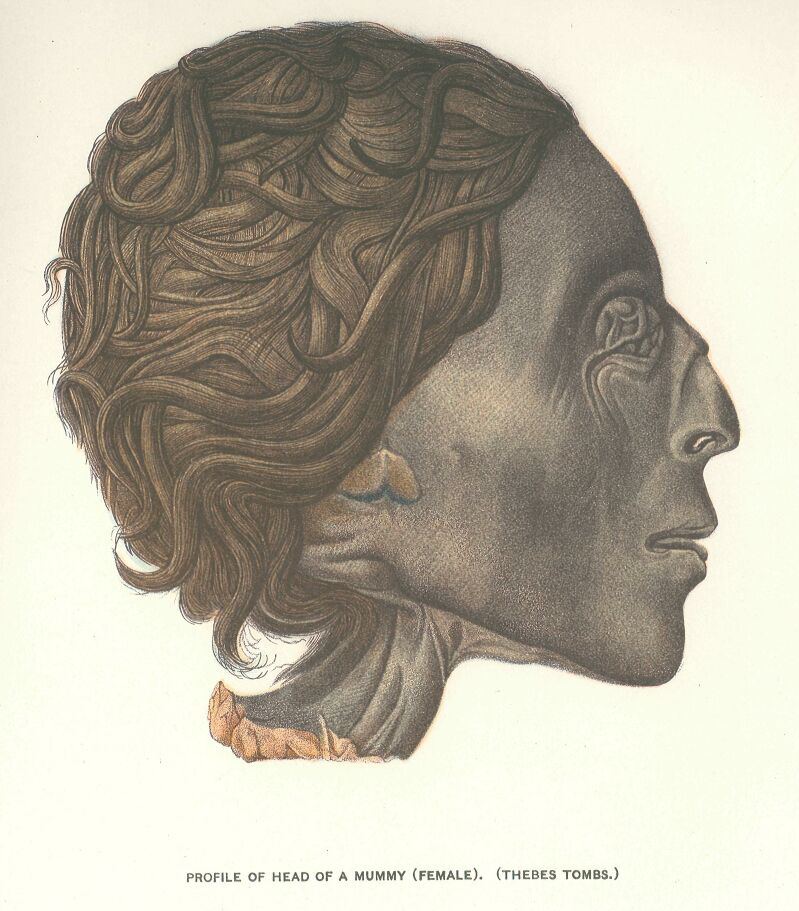
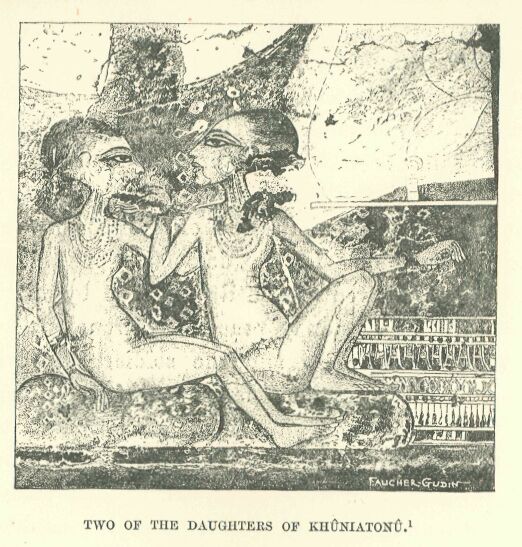
Drawn by Faucher-Gudin, from a photograph by Petrie.
Although the tombs in which they worked differ from the generality of Egyptian burying-places, their originality does not arise from any effort, either conscious or otherwise, to break through the ordinary routine of the art of the time; it is rather the result of the extraordinary appearance of the sovereign whose features they were called on to portray, and the novelty of several of the subjects which they had to treat. That artist among them who first gave concrete form to the ideas circulated by the priests of Atonû, and drew the model cartoons, evidently possessed a master-hand, and was endowed with undeniable originality and power. No other Egyptian draughtsman ever expressed a child’s grace as he did, and the portraits which he sketched of the daughters of Khûniatonû playing undressed at their mother’s side, are examples of a reserved and delicate grace. But these models, when once composed and finished even to the smallest details, were entrusted for execution to workmen of mediocre powers, who were recruited not only from Thebes, but from the neighbouring cities of Hermopolis and Siût. These estimable people, with a praiseworthy patience, traced bit by bit the cartoons confided to them, omitting or adding individuals or groups according to the extent of the wall-space they had to cover, or to the number of relatives and servants whom the proprietor of the tomb desired should share in his future happiness. The style of these draughtsmen betrays the influence of the second-rate schools in which they had learned their craft, and the clumsiness of their work would often repel us, were it not that the interest of the episodes portrayed redeems it in the eyes of the Egyptologist.
Khûniatonû left no son to succeed him; two of his sons-in-law successively occupied the throne—Sâakerî, who had married his eldest daughter Marîtatonû, and Tûtankhamon, the husband of Ankhnasaton. The first had been associated in the sovereignty by his father-in-law;* he showed himself a zealous partisan of the “Disk,” and he continued to reside in the new capital during the few years of his sole reign.** The second son-in-law was a son of Amenôthes III., probably by a concubine. He returned to the religion of Amon, and his wife, abjuring the creed of her father, changed her name from Ankhnasaton to that of Ankhnasamon. Her husband abandoned Khûitatonû*** at the end of two or three years, and after his departure the town fell into decadence as quickly as it had arisen. The streets were unfrequented, the palaces and temples stood empty, the tombs remained unfinished and unoccupied, and its patron god returned to his former state, and was relegated to the third or fourth rank in the Egyptian Pantheon.
* He and his wife are represented by the side of Khûniatonû, with the protocol and the attributes of royalty. Pétrie assigns to this double reign those minor objects on which the king’s prenomen Ankhkhopîrûri is followed by the epithet beloved of Uânirâ, which formed part of the name of Khûniatonû. ** Pétrie thinks, on the testimony of the lists of Manetho, which give twelve years to Akenkheres, daughter of Horos, that Sâakerî reigned twelve years, and only two or three years as sole monarch without his father-in-law. I think these two or three years a probable maximum length of his reign, whatever may be the value we should here assign to the lists of Manetho. *** Pétrie, judging from the number of minor objects which he has found in his excavations at Tel el-Amarna, believes that he can fix the length of Tûtankhamon’s sojourn at Khûîtatonû at six years, and that of his whole reign at nine years.
The town struggled for a short time against its adverse fate, which was no doubt retarded owing to the various industries founded in it by Khûniatonû, the manufactories of enamel and coloured glass requiring the presence of many workmen; but the latter emigrated ere long to Thebes or the neighbouring city of Hermopolis, and the “Horizon of Atonû” disappeared from the list of nomes, leaving of what might have been the capital of the Egyptian empire, merely a mound of crumbling bricks with two or three fellahîn villages scattered on the eastern bank of the Nile.*
* Pétrie thinks that the temples and palaces were systematically destroyed by Harmhabî, and the ruins used by him in the buildings which he erected at different places in Egypt. But there is no need for this theory: the beauty of the limestone which Khûniatonû had used sufficiently accounts for the rapid disappearance of the deserted edifices.
Thebes, whose influence and population had meanwhile never lessened, resumed her supremacy undisturbed. If, out of respect for the past, Tûtankhamon continued the decoration of the temple of Atonû at Karnak, he placed in every other locality the name and figure of Amon; a little stucco spread over the parts which had been mutilated, enabled the outlines to be restored to their original purity, and the alteration was rendered invisible by a few coats of colour. Tûtankhamon was succeeded by the divine father Aï, whom Khûniatonû had assigned as husband to one of his relatives named Tîi, so called after the widow of Amenôthes III. Aï laboured no less diligently than his predecessor to keep up the traditions which had been temporarily interrupted. He had been a faithful worshipper of the Disk, and had given orders for the construction of two funerary chapels for himself in the mountain-side above Tel el-Amarna, the paintings in which indicate a complete adherence to the faith of the reigning king. But on becoming Pharaoh, he was proportionally zealous in his submission to the gods of Thebes, and in order to mark more fully his return to the ancient belief, he chose for his royal burying-place a site close to that in which rested the body of Amenôthes III.*
* The first tomb seems to have been dug before his marriage, at the time when he had no definite ambitions; the second was prepared for him and his wife Tîi.
His sarcophagus, a large oblong of carved rose granite, still lies open and broken on the spot.
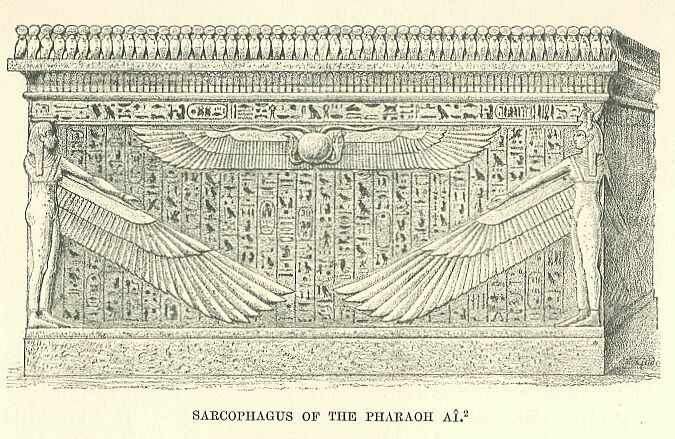
Drawn by Faucher-Gudin, after the drawing of Prisse d’Avenues.
Figures of goddesses stand at the four angles and extend their winged arms along its sides, as if to embrace the mummy of the sovereign. Tûtankhamon and Aï were obeyed from one end of Egypt to the other, from Napata to the shores of the Mediterranean. The peoples of Syria raised no disturbances during their reigns, and paid their accustomed tribute regularly;* if their rule was short, it was at least happy. It would appear, however, that after their deaths, troubles arose in the state. The lists of Manetho give two or three princes—Râthôtis, Khebres, and Akherres—whose names are not found on the monuments.** It is possible that we ought not to regard them as historical personages, but merely as heroes of popular romance, of the same type as those introduced so freely into the history of the preceding dynasties by the chroniclers of the Saite and Greek periods. They were, perhaps, merely short-lived pretenders who were overthrown one by the other before either had succeeded in establishing himself on the seat of Horus. Be that as it may, the XVIIIth dynasty drew to its close amid strife and quarreling, without our being able to discover the cause of its overthrow, or the name of the last of its sovereigns.***
* Tûtankhamon receives the tribute of the Kûshites as well as that of the Syrians; Aï is represented at Shataûi in Nubia as accompanied by Paûîrû, the prince of Kûsh. ** Wiedemann has collected six royal names which, with much hesitation, he places about this time. *** The list of kings who make up the XVIIIth dynasty can be established with certainty, with the exception of the order of the three last sovereigns who succeed Khûniatonû. It is here given in its authentic form, as the monuments have permitted us to reconstruct it, and in its Greek form as it is found in the lists of Manetho:
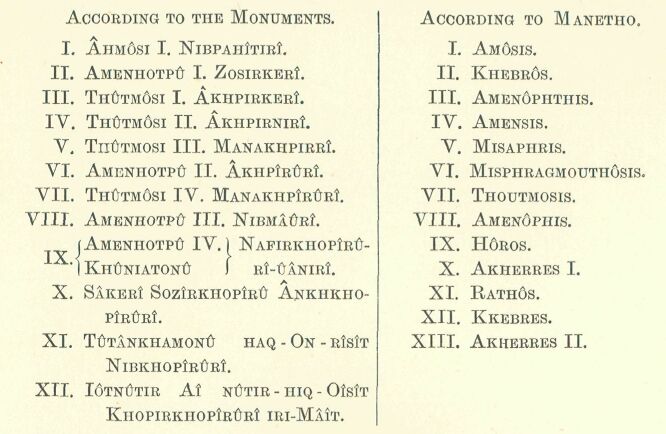
Manetho’s list, as we have it, is a very ill-made extract, wherein the official kings are mixed up with the legitimate queens, as well as, at least towards the end, with persons of doubtful authenticity. Several kings, between Khûniatonû and Harmhabi, are sometimes added at the end of the list; some of these I think, belonged to previous dynasties, e.g. Teti to the VIth, Râhotpû to the XVIIth; several are heroes of romance, as Mernebphtah or Merkhopirphtah, while the names of the others are either variants from the cartouche names of known princes, or else are nicknames, such as was Sesû, Sestûrî for Ramses II. Dr. Mahler believes that he can fix, within a few days, the date of the kings of whom the list is composed, from Ahmosis I. to Aî. I hold to the approximate date which I have given in vol. iv. p. 153 of this History, and I give the years 1600 to 1350 as the period of the dynasty, with a possible error of about fifty years, more or less.
Scarcely half a century had elapsed between the moment when the XVIII’s dynasty reached the height of its power under Amenôthes III. and that of its downfall. It is impossible to introduce with impunity changes of any kind into the constitution or working of so complicated a machine as an empire founded on conquest. When the parts of the mechanism have been once put together and set in motion, and have become accustomed to work harmoniously at a proper pace, interference with it must not be attempted except to replace such parts as are broken or worn out, by others exactly like them. To make alterations while the machine is in motion, or to introduce new combinations, however ingenious, into any part of the original plan, might produce an accident or a breakage of the gearing when perhaps it would be least expected. When the devout Khûniatonû exchanged one city and one god for another, he thought that he was merely transposing equivalents, and that the safety of the commonwealth was not concerned in the operation. Whether it was Amon or Atonu who presided over the destinies of his people, or whether Thebes or Tel el-Amarna were the centre of impulse, was, in his opinion, merely a question of internal arrangement which could not affect the economy of the whole. But events soon showed that he was mistaken in his calculations. It is probable that if, on the expulsion of the Hyksôs, the earlier princes of the dynasty had attempted an alteration in the national religion, or had moved the capital to any other city they might select, the remainder of the kingdom would not have been affected by the change. But after several centuries of faithful adherence to Amon in his city of Thebes, the governing power would find it no easy matter to accomplish such a resolution. During three centuries the dynasty had become wedded to the city and to its patron deity, and the locality had become so closely associated with the dynasty, that any blow aimed at the god could not fail to destroy the dynasty with it; indeed, had the experiment of Khûniatonû been prolonged beyond a few years, it might have entailed the ruin of the whole country. All who came into contact with Egypt, or were under her rule, whether Asiatics or Africans, were quick to detect any change in her administration, and to remark a falling away from the traditional systems of the times of Thûtmosis III. and Amenothes II. The successors of the heretic king had the sense to perceive at once the first symptoms of disorder, and to refrain from persevering in his errors; but however quick they were to undo his work, they could not foresee its serious consequences. His immediate followers were powerless to maintain their dynasty, and their posterity had to make way for a family who had not incurred the hatred of Amon, or rather that of his priests. If those who followed them were able by their tact and energy to set Egypt on her feet again, they were at the same time unable to restore her former prosperity or her boundless confidence in herself.
THE REACTION AGAINST EGYPT
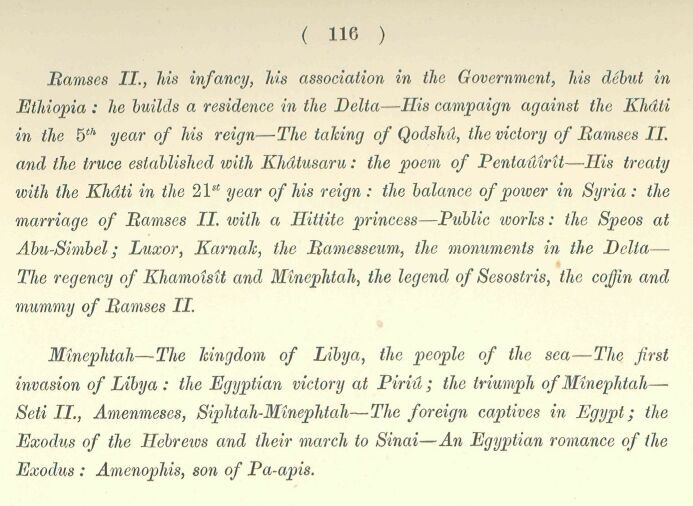
THE XIth DYNASTY: HARMHABΗTHE HITTITE EMPIRE IN SYRIA AND IN ASIA MINOR—SETI I. AND RAMSES II.—THE PEOPLE OF THE SEA: MÎNEPHTAH AND THE ISRAELITE EXODUS.
The birth and antecedents of Harmhabî, his youth, his enthronement—The final triumph of Amon and his priests—Harmhabî infuses order into the government: his wars against the Ethiopians and Asiatics—The Khâti, their civilization, religion; their political and military constitution; the extension of their empire towards the north—The countries and populations of Asia Minor; commercial routes between the Euphrates and the Ægean Sea—The treaty concluded between Harmhabî and Sapalulu.
Ramses I. and the uncertainties as to his origin—Seti I. and the campaign against Syria in the 1st year of his reign; the re-establishment of the Egyptian empire—Working of the gold-mines at Etaï—The monuments constructed by Seti I. in Nubia, at Karnak, Luxor, and Abydos—The valley of the kings and tomb of Seti I. at Thebes.
Ramses II., his infancy, his association in the Government, his début in Ethiopia: he builds a residence in the Delta—His campaign against the Khâti in the 5th year of his reign—The talcing of Qodshu, the victory of Ramses II. and the truce established with Khâtusaru: the poem of Pentaûîrît—His treaty with the Khâti in the 21st year of his reign: the balance of power in Syria: the marriage of Ramses II. with a Hittite princess—Public works: the Speos at Abu-Simbel; Luxor, Karnak, the Eamesseum, the monuments in the Delta—The regency of Khamoîsît and Mînephtah, the legend of Sesostris, the coffin and mummy of Ramses II.
Minephtah—The kingdom of Libya, the people of the sea—The first invasion of Libya: the Egyptian victory at Piriû; the triumph of Minephtah—Seti II., Amenmeses, Siphtah-Minephtah—The foreign captives in Egypt; the Exodus of the Hebrews and their march to Sinai—An Egyptian romance of the Exodus: Amenophis, son of Pa-apis.