Note 4 — PART I. The instrument.
John Matthews translation
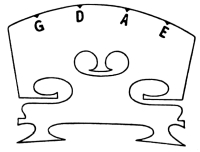
The quality of the wood in a bridge,—whether hard or soft—and its thickness (according to Otto, its weight), materially affect the tone of a violin. Bridges as supplied by dealers are usually almost twice the proper thickness, to allow for rubbing down with sandpaper. The best bridges are the genuine “Aubert” (with the name stamped inside an oval); those with large and decided reddish markings showing hardness of grain, and the less distinct markings a softer quality. When fitting a violin, a few of each should be tried, first cutting the feet to the approximate slope with a sharp penknife, then with a small piece of fine (No. 0.) glass paper held steadily between the ff holes, rub the bridge to and fro over the glass paper between the notches of the ff holes, until, on removing the glass paper it is seen to fit perfectly, standing upright when the instrument is level. The sketch shows the amount of slope to be made on the E side; the distances for the notches to receive the strings, and the amount to which the feet must be thinned in an ordinary full sized instrument. The height of the bridge is dependent, (for convenience of stopping), upon the height of the fingerboard. A high bridge gives more power, but often the quality of tone is not so good. The E string being harder to press down (by reason of its greater tension) is kept a little nearer the fingerboard than the others. From the end of the fingerboard, the E string should be about this distance

the G

On ½ size and ¾ size instruments for children these distances must be reduced about one-third. Tr.