Note 5 — The one abandoned for eating the flipper of a hair seal
Reading edition
It is difficult to follow the old man’s descriptions, but the accompanying diagram shows how my interpreter illustrated the construction of this fish trap to me.
The trap is seen to be triangular with the apex pointing upstream. The two sides of the triangle next this apex form the trap proper or gī′g·awai (a). The third side is flush with a weir running to the bank of the stream on either side, the two parts of which are called the x̣ia′-i (b) or “wings.” Entrance to the trap is given between two slanting sections called the gīgwᴀ′ñgīda (c), which are far apart at the lower end, but almost come together at the upper. The remaining sections on either side of the gīgwᴀ′ñgīda which close the trap are called łg̣aiyî′ñgadadji (d), were made one fathom higher than the other parts, and were painted on the upper section on the side downstream. In construction, posts were driven into the stream bed along these lines and horizontal pieces laid between and secured with cedar limbs. The salmon in their course upstream were led along by the “wings” to the opening between the łg̣aiyî′ñgadadji, forced their way through the apex into the space above, and were unable to get farther or to return.
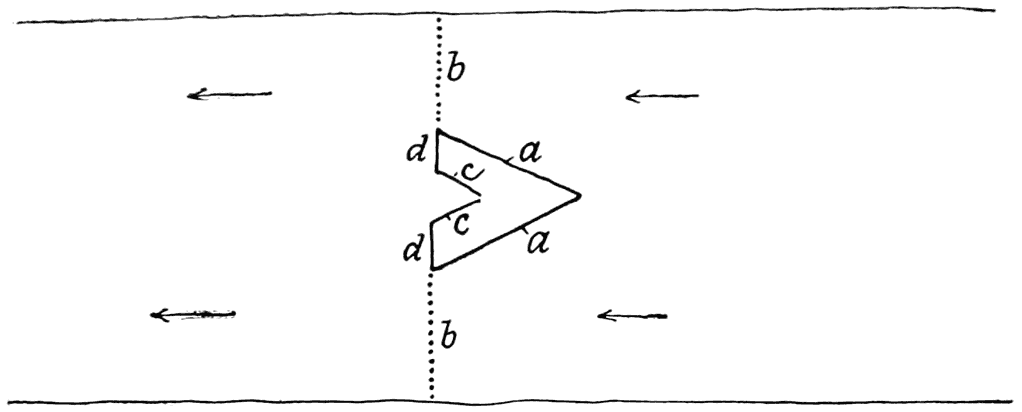
Fig. 2.—Plan of large salmon trap.
↑