Note 2 — STORIES ACCOMPANIED BY TEXTS
Reading edition
The construction of these deadfalls was described to me as follows: The hadjigā′ñwa-i (a, fig. 1) are four posts, two on each side of a bear trail. These are fastened together in pairs by the kiutꜝa′skꜝî (b). Between them lies a timber called the qꜝatᴀ′nłanu (c), while the deadfall proper consists of a timber called sî′txasqꜝa′gida (d) hung above this at one end and weighted at the other end, which rests upon the ground. The suspended end is held by a loop (łqꜝō′ya-i), which passes over a short stick, the x̣ā′ña (e), which is supported in its turn by one of the kiutꜝa′skꜝî. A rope is fastened to the inner end of this x̣ā′ña and carried down to the notch in another stick called sqaołg̣ai′wa-i (f), which is fastened to a stake at one side of the bear trail. Other cords, qa-ī′tu (g), are then fastened between the two front posts and carried down to this loop. The bear, coming against these latter, in its endeavors to get through pulls the loop (h) out of the notch in the sqaołg̣ai′wa-i. This in turn releases the x̣ā′ña, allowing the sî′txasqꜝa′gida to fall upon the animal’s back.
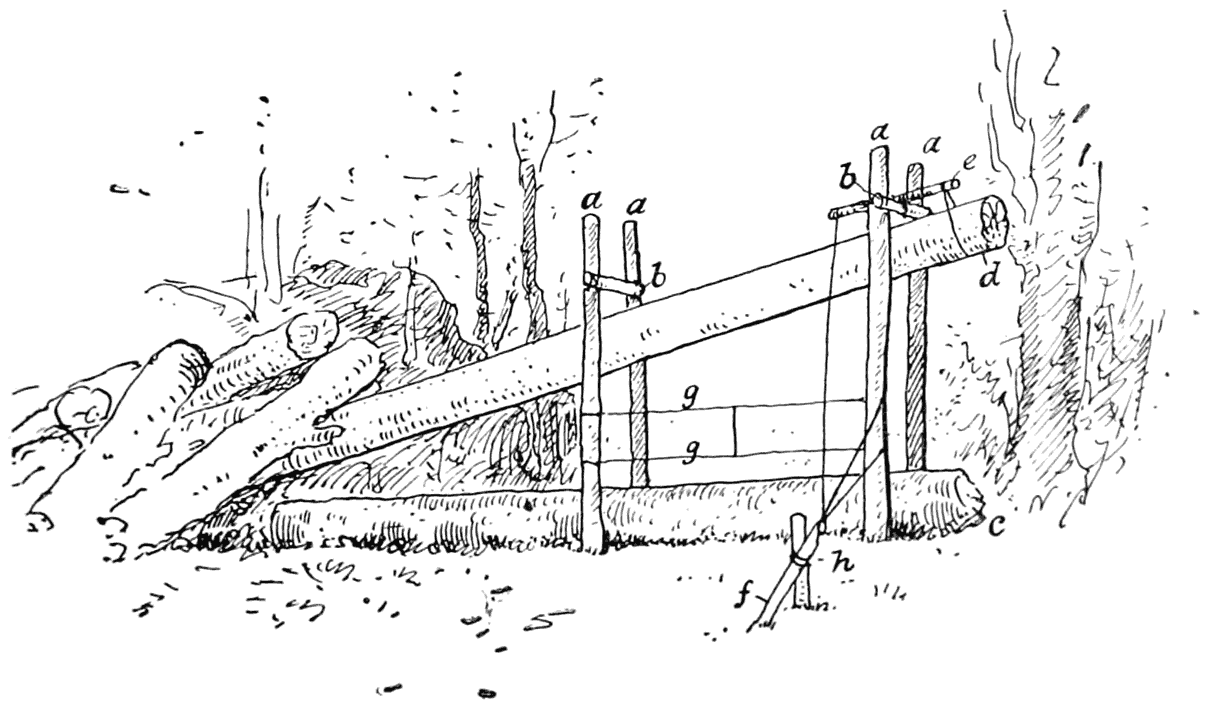
Fig. 1.—Diagram of bear deadfall.
↑