Editorial note — INDEX.
Reading edition
Typographical errors are shown in the text with mouse-hover popups. In the Index, missing commas within or before entries were silently supplied. Differences in punctuation or hyphenization between the Table of Contents, Index, or List of Illustrations, and the item itself, are not noted. Irregularities that are specific to an individual article are noted at the beginning of the article.
For this e-text, Plates were rescaled to 25% by pixel count, while most Figures were rescaled to 33%. The original is strongly sepia-toned, so the distinction between color and grayscale reflects the transcriber’s judgement rather than a clear difference in the original.
The article on Sign Language includes a number of full- or half-length drawings of named or namable sources. On the principle of “Good informants make good anthropology”, a few of them are shown here.
The writer’s favorite source, illustrated as “Shoshoni and Banak I”. Identified in the article as Tendoy (The Climber), one of “a delegation of Shoshoni and Banak chiefs from Idaho, who visited Washington during the months of April and May, 1880”. Here shown in Figure 310, sign for many.
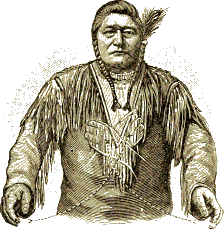
Huerito (Little Blonde), source “Apache I”, one of “a delegation of Apache chiefs from Tierra Amarilla, New Mexico, who were brought to Washington in the months of March and April, 1880”. Here shown in Figure 304, sign for who are you?
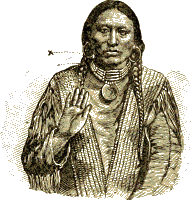
Tce-caq´-a-daq-a-qic (Lean Wolf), source “Hidatsa I”, identified as “chief of the Hidatsa ... at Washington with a delegation of Sioux Indians, in June, 1880”. Here shown in Figure 331, sign for friend.
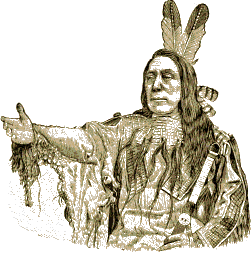
Ta-taⁿ´ka Wa-kaⁿ (Medicine Bull), source “Dakota VIII”, one of “a delegation of Lower Brulé Dakotas, while at Washington during the winter of 1880-’81”. Here shown in Figure 316, sign for hear.
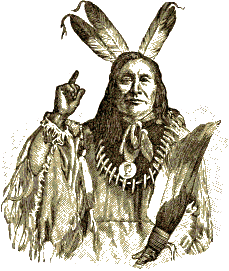
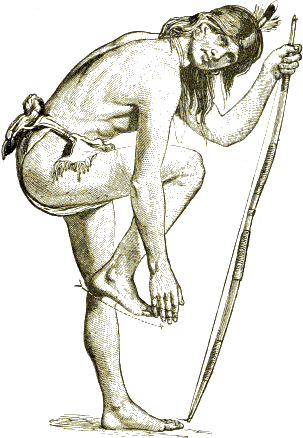
Na´tci, source “Pai-Ute I”. Identified in the text as “a Pai-Ute chief, who was one of a delegation of that tribe to Washington in January, 1880”, though these drawings were probably not made in Washington in January. Here shown in Figure 245, sign for chief. The name of Na´tci’s father, mentioned in the introduction to Na´tci’s Narrative, is more often spelled Winnemucca.
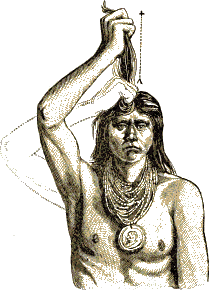
The subject of this illustration could not be identified; he may simply be Na´tci (above) from a different angle. He is shown here in Figure 286, Blackfoot (tribal sign).