PART III. GRAPHIC SYSTEMS AND LITERATURE.
Reading edition
INTRODUCTORY.
The intellectual development of a nation attains its fullest expression in language, oral or written. This “divine art” as Plato calls it, claims therefore from the student of man in the aggregate a prolonged attention and the most painstaking analysis. Too frequently one hears among anthropologists the claims of linguistics decried, and the many blunders and over-hasty generalizations of philologists quoted as good reasons for the neglect or distrust of their branch.
The real reason of this attitude I believe to be not so much the mistakes of the linguists, as a strong aversion which I have noticed in many distinguished teachers of physical science to the study of language and the philosophy of expression. The subject is difficult and distasteful to them. Having no aptitude for it, nor real acquaintance with it, they condemn it as of small value and of doubtful results. I have never known a scientific man who was really a well-read philologist who thus under-estimated the 194position of linguistics in the scheme of anthropology; but I have known many who, not having such thorough knowledge, depreciated its value in others.
The third and fourth parts of this volume are devoted to language, the third as it appears especially in its written forms, the fourth particularly to the profounder questions of linguistic philosophy. Here again I shall be found in opposition to the majority who have written on these subjects. The claim I make for the largely phonetic character of the Mexican and Maya hieroglyphs is not generally accepted; and the poetical spirit which I argue exists in many productions of the aboriginal muse will not be favored by those who deny the higher sentiments of humanity to uncivilized man.
I have endeavored by frequent illustration, and reference to the best sources of information, to put the reader in the position to judge for himself; and I shall feel highly gratified if he is prompted to such investigations by what I may say, whether his final conclusions agree with mine or not.
195
THE PHONETIC ELEMENTS IN THE GRAPHIC SYSTEMS OF THE MAYAS AND MEXICANS.[201]
All who have read the wonderful story of the Spanish conquest of Mexico and Central America will remember that the European invaders came upon various nations who were well acquainted with some method of writing, who were skilled in the manufacture of parchment and paper, and who filled thousands of volumes formed of these materials with the records of their history, the theories of their sciences, and the traditions of their theologies. Aiming at greater permanence than these perishable materials would offer, they also inscribed on plinths of stone, on slabs of hard wood, and on terra cotta tablets, the designs and figures which in the system they adopted served to convey the ideas they wished to transmit to posterity.
In spite of the deliberate and wholesale destruction of these records at the conquest, and their complete neglect for centuries afterwards, there still remain enough, were they collected, to form a respectably large Corpus Inscriptionum Americanarum. Within the present century many Mexican and Maya MSS. have for the first time been published, and 196the inscriptions on the temples of southern Mexico and Yucatan have been brought to the tables of students by photography and casts, methods which permit no doubt as to their faithfulness.
Nor have there been lacking diligent students who have availed themselves of these facilities to search for the lost key to these mysterious records. It is a pleasure to mention the names of Thomas and Holden in the United States, of De Rosny, Aubin and de Charencey in France, of Förstemann, Seler and Schellhas in Germany, of Ramirez and Orozco in Mexico. But it must frankly be confessed that the results obtained have been inadequate and unsatisfactory. We have not yet passed the threshold of investigation.
The question which forces itself upon our attention as demanding a reply at the very outset, is whether the Aztec and Maya systems of writing were or were not, in whole or in part, phonetic systems? Did they appeal, in the first instance, to the meaning of the word, or to the sound of the word? If to the latter—if, in other words, they were phonetic, or even partially phonetic—then it is vain to attempt any interpretation of these records without a preliminary study of the languages of the nations who were the writers. These languages must moreover be studied in the form in which they were spoken at the period of the conquest, and the course of native thought as expressed in the primitive grammatical structure must be understood and taken into account. I hasten to add that we have abundant materials for such studies.
This essential preliminary question, as to the extent of the phonetic element in the Mexican and Maya systems of writing, 197is that which I propose to put at present, and to answer it, so far as may be. Hitherto, the greatest diversity of opinion about it has prevailed. Some able writers, such as Valentini and Holden, have questioned the existence of any phonetic elements; but most have been willing to concede that there are such present, though their quantity and quality are by no means clearly defined.
We may assume that both systems under consideration are partly ideographic. Every system of phonetic writing introduces ideograms to some extent, our own among the number. The question is, to what extent?
But before we are prepared to answer this question about the extent of the phonetic element, we must seek to ascertain its character. We are all aware that a phonetic symbol may express the sound either of a whole word of several syllables, or of a single syllable, or of a simple acoustic element. Again, a single phonetic symbol may express several quite diverse sounds, as is familiarly exemplified in the first letter of the English alphabet, which represents three very different sounds; and, on the other hand, we may find three, four or more symbols, no wise alike in form or origin, bearing one and the same phonetic value, a fact especially familiar to Egyptologists.
We must further bear in mind that the arrangement to the eye of phonetic symbols is altogether arbitrary. Because a prefix is pronounced first in the order of time and a suffix last, it by no means follows that the order in space of their corresponding symbols shall bear any analogous relation. The idea awakened by the sound of the word is a whole, and one; and so that this sound is represented, the disposition of 198its component parts is, philosophically speaking, indifferent. When it is remembered that in most American languages, and notably in the Mexican or Nahuatl, there is a tendency to consolidate each phrase into a single word, the importance of this consideration is greatly increased.
As the position of the phonetic parts of the phrase-word may thus be disregarded, yet more indifferent is the order of sequence of the symbols. There is no a priori reason why this should be from left to right as in English, or from right to left as in Hebrew; alternately, as in the Boustrophedon of the Greek; or from top to bottom, as in Chinese.
In such an examination as the present one, we must rid our minds of the expectation of finding the phonetic elements in some familiar form, and simply ask whether they are to be found in any form.
We are not without a trustworthy guide in this quest. It is agreed among those who have most carefully studied the subject that there is but one path by which the human mind could have originally proceeded from picture-writing or thought-writing to phonetic or sound-writing. This was through the existence of homophones and homoiophones in a language, of words with the same or similar sounds, but with diverse significations. The deliberate analysis of a language back to its phonetic elements, and the construction upon those of a series of symbols, as was accomplished for the Cherokee by the half-breed Sequoyah, has ever been the product of culture, not a process of primitive evolution.
In this primitive process the sounds which were most frequently repeated, or were otherwise most prominent to the 199ear, would be those first represented by a figure; and the same figure would come to be employed as an equivalent for this sound and others closely akin to it, even when they had other connections and bore other significations. Hence affixes, suffixes, and monosyllabic words, are those to which we must look as offering the earliest evidences of a connection of figure with sound.
According to the theory here very briefly indicated, I shall examine the Maya and Nahuatl systems of writing, to ascertain if they present any phonetic elements, and of what nature these are.
Turning first to the Maya, I may in passing refer to the disappointment which resulted from the publication of Landa’s alphabet by the Abbé Brasseur in 1864. Here was what seemed a complete phonetic alphabet, which should at once unlock the mysteries of the inscriptions on the temples of Yucatan and Chiapas, and enable us to interpret the script of the Dresden and other Codices. Experience proved the utter fallacy of any such hope. His work is no key to the Maya script; but it does indicate that the Maya scribes were able to assign a character to a sound, even a sound so meaningless as that of a single letter.
The failure of the Landa alphabet left many scholars total skeptics as to the phonetic values of any of the Maya characters. To name a conspicuous and recent example, Prof. Leon de Rosny, in his edition of the Codex Cortesianus, published in 1883, appends a Vocabulary of the hieratic signs as far as known; but does not include among them any phonetic signs other than Landa’s.
But if we turn to the most recent and closest students of 200these records, we find among them a consensus of opinion that a certain degree, though a small degree, of phoneticism must be accepted. Thus our own able representative in this branch, Prof. Cyrus Thomas, announced in 1882, in his Study of the MS. Troano,[202] that several of the day and month characters are, beyond doubt, occasionally phonetic.
Prof. Förstemann, of Dresden, whose work on the Dresden Codex has appeared quite recently, announces his conclusion that the Maya script is essentially ideographic;[203] but immediately adds that the numerous small figures attached to the main sign are to be considered phonetic, and no matter in what local relation they may stand to this sign, they are to be regarded either as prefixes or suffixes of the word. He does not attempt to work out their possible meaning, but, as he says, leaves that to the future.
Almost identical is the conclusion of Dr. Schellhas, whose essay on the Dresden Codex[204] is a most meritorious study. His final decision is in these words: “The Maya writing is ideographic in principle, and probably avails itself, in order to complete its ideographic hieroglyphs, of a number of fixed phonetic signs.”
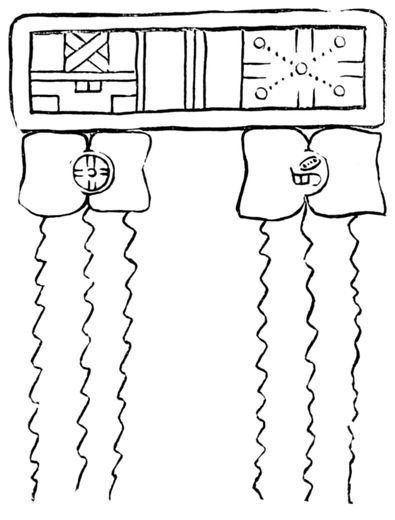
Fig. 1.—The Maya Hieroglyph of the Firmament.
Some of these signs have been so carefully scrutinized that their phonetic value may be considered to have been determined with reasonable certainty. An interesting example is shown in Fig. 1, for the analysis of which we are indebted to Dr. Schellhas. The quadrilateral figure at the top represents the firmament. One of the squares into which it is 201divided portrays the sky in the day time, the other, the starry sky at night. Beneath each are white and black objects, signifying the clouds, from which falling rain is indicated by long zigzag lines. Between the clouds on the left of the figure is the well-known ideogram of the sun, on the right that of the moon. In the Maya language the sun is called kin, the moon u, and these figures are found elsewhere, not indicating these celestial bodies, but merely the phonetic values, the one of the syllable kin, the other of the letter u. The two signs given in Landa’s alphabet for the letter u are really one, separated in transcription, and a variant of the figure for the moon with the wavy line beneath it. The word u in Maya is the possessive adjective of the 202third person, and as such is employed in conjugating verbs, the Maya verbal being really a possessive.
A very common terminal syllable in Maya is il. It is called by grammarians “the determinative ending,” and is employed to indicate the genitive and ablative relations. Dr. Schellhas considers that this is represented by the signs affixed to the main hieroglyphs shown on Fig. 2.[205]
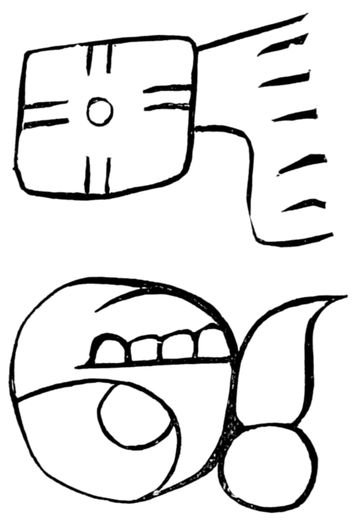
Fig. 2.—Maya Phonetic Terminals.
The upper figure he reads kinil, the lower cim-il. The two signs are the title to a picture in the Codex Troano representing a storm with destruction of human life. The two words kin-il cim-il maybe translated “At the time of the killing.” The syllable cim is expressed in several 203variants in the Codices, examples of two of which, from the Dresden Codex, are presented in Fig. 3.
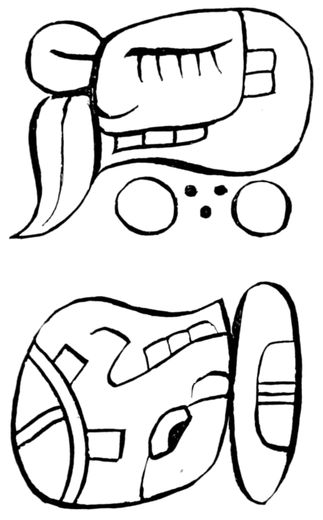
Fig. 3.—Maya Phonetic Terminals.
The signs for the four cardinal points appear to be expressed phonetically. They are represented in Figs. 4 and 5. The words are for North, xaman, East, lakin, South, nohil, West, chikin. Of these the syllable kin appears in lakin and chikin, and is represented as above described. The word for North has not been analyzed; that for South has been translated by Prof. Londe Rosny as ma ya, the word ma meaning hands or arms, the lower as either a fruit or the masculine sign, in either case the phonetic value being alone intended. Both the name and the etymology are, however, doubtful, resting upon late and imperfect authorities.
204By pursuing the plan here indicated, that is, by assuming that a figure whose representative value is known, has also a merely phonetic value in other combinations, a certain number of phonetic elements of the Maya tongue have been identified. Prof. Cyrus Thomas, in an article published in one of our prominent journals, states that he has “interpreted satisfactorily to himself twelve or fifteen compound characters which appear to be phonetic.”[206]
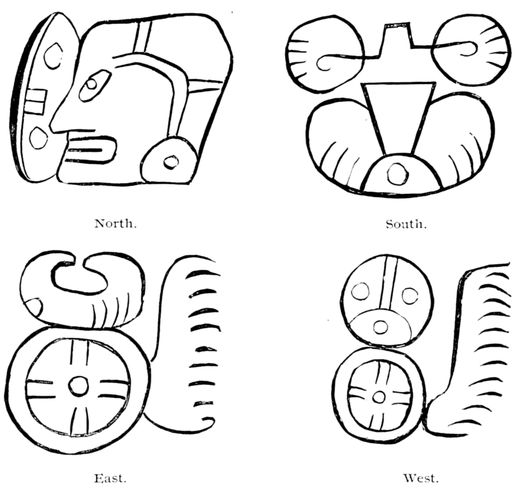
Figs. 4 and 5.—Signs of the Cardinal Points in Maya.
It is obvious, however, that small progress has been made in this direction compared to the labor expended. By far 205the greater number of the fixed symbols of the Maya are yet undeciphered. It is acknowledged by all recent students that they cannot be representative, as they recur too frequently. To explain them, there is but one sure course, and that is, by a close analysis of the Maya language to get at the relations of ideas in the native mind as expressed in their own phonetic system.
When we turn to the Mexican system of writing, much more definite and extensive information as to its phonetic elements awaits us. It is possible that at bottom it has really no higher phonetic character, but several facts have combined to give us a better understanding of its structure. In the first place, more examples of it have been preserved, some of these with more or less accurate translations. Again, the earlier writers, those whom we look upon as our historical authorities, have been more explicit and ample in their description of Mexican native literature than of that of Yucatan. Finally, and most important, the Mexican language, the Nahuatl, was studied at an early date, and with surprising thoroughness, by the Catholic priests. Within a generation after the conquest they had completed a quite accurate analysis of its grammatical structure, and had printed a Nahuatl-Spanish dictionary containing more words than are to be found in any English dictionary for a century later.
These intelligent missionaries acquainted themselves with the principles of the Mexican script, and to a limited extent made use of it in their religious instructions, as did also the Spanish scriveners in their legal documents in transactions with the natives. They found the native phonetic writing partly syllabic and partly alphabetic; and it was easy for the 206priests to devise a wholly alphabetic script on the same plan. An interesting example of this is preserved in the work of Valades, entitled Rhetorica Christiana, written about 1570. Familiar objects are represented, chiefly of European introduction. Each has the phonetic value only of the first letter of its Nahuatl name. The plan is extremely simple, and indeed the forms and names of the Hebrew letters seem to indicate that they arose in the same way. Applying it to English, we should spell the word cat by a picture of a chair, of an axe, and of a table, each of these being the recognized symbol of its first phonetic element or initial letter. Often any one of several objects whose names begin with the same letter could be used, at choice. This is also illustrated in Valades’ alphabet, where, for instance, the letter E is represented by four different objects.
As I have observed, the native genius had not arrived at a complete analysis of the phonetic elements of the language; but it was distinctly progressing in that direction. Of the five vowels and fourteen consonants which make up the Nahuatl alphabet, three vowels certainly, and probably three consonants, had reached the stage where they were often expressed as simple letters by the method above described. The vowels were a, for which the sign was atl, water; e represented by a bean, etl; and o by a footprint, or path, otli; the consonants were p, represented either by a flag, pan, or a mat, petl; t, by a stone, tetl, or lips, tentli; and z, by a lancet, zo. These are, however, exceptions. Most of the Nahuatl phonetics were syllabic, sometimes one, sometimes two syllables of the name of the object being employed. When the whole name of an object or most of it was used as 207a phonetic value, the script remains truly phonetic, but becomes of the nature of a rebus, and this is the character of most of the phonetic Mexican writing.
Every one is familiar with the principle of the rebus. It is where a phrase is represented by pictures of objects whose names bear some resemblance in sound to the words employed. A stock example is that of the gallant who to testify his devotion to the lady of his heart, whose name was Rose Hill, had embroidered on his gown the pictures of a rose, a hill, an eye, a loaf of bread, and a well, which was to be interpreted, “Rose Hill I love well.”
In medieval heraldry this system was in extensive use. Armorial bearings were selected, the names of the elements of which expressed that of the family who bore them. Thus Pope Adrian IV, whose name was Nicolas Breakespeare, carried the device of a spear with a broken shaft; the Boltons of England wear arms representing a cask or tun pierced by a cross-bow shaft or bolt; etc. Such arms were called canting arms, the term being derived from the Latin cantare, to sing or chant, the arms themselves chanting or announcing the family surname.
We have, so far as I am aware, no scientific term to express this manner of phonetic writing, and I propose for it therefore the adjective ikonomatic, from the Greek eikon, a figure or image, and onoma (genitive, onomatos) name,—a writing by means of the names of the figures or images represented. The corresponding noun would be ikonomatography. It differs radically from picture-writing (Bilderschrift,) for although it is composed of pictures, these were 208used solely with reference to the sound of their names, not their objective significance.
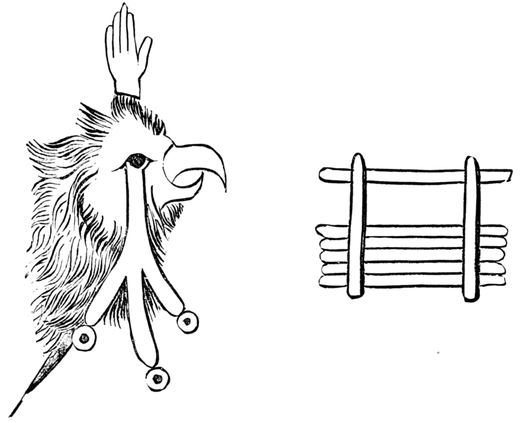
Fig. 6.—Mexican Phonetic Hieroglyphics of the name of Montezuma.
The Mexicans, in their phonetic writing, were never far removed from this ikonomatic stage of development. They combined, however, with it certain clearly defined monosyllabic signs, and the separate alphabetic elements which I have already noted. An examination of the MSS. proves that there was no special disposition of the parts of a word. In other words, they might be arranged from right to left or from left to right, from below upwards or from above downwards; or the one may be placed within the other. It will easily be seen that this greatly increases the difficulty of deciphering these figures.
209As illustrations of the phoneticism of Mexican writing I show two compounds, quoted by M. Aubin in his well-known essay on the subject. The first is a proper noun, that of the emperor Montezuma (Fig. 6). It should be read from right to left. The picture at the right represents a mouse trap, in Nahuatl, montli, with the phonetic value mo, or mon; the head of the eagle has the value quauh, from quauhtli; it is transfixed with a lancet, zo; and surmounted with a hand, maitl, whose phonetic value is ma; and these values combined give mo-quauh-zo-ma.
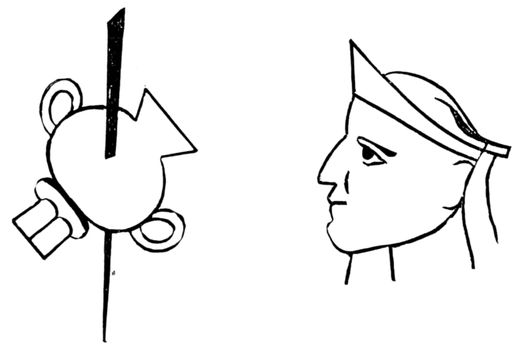
Fig. 7.—Mexican Phonetic Hieroglyphics of the name of a Serpent.
The second example is a common noun, the name of a serpent tecuhtlacozauhqui (Fig. 7). It is also read from right to left; the head with the peculiar band and frontal ornament is that of one of the noble class, tecuhtli; at the base of the left figure is a familiar sign for tla, and represents two teeth, tlantli; they are surmounted by a jar, comitl with the value co; and this in turn is pierced by a lancet, which here 210has only its alphabetic value z. The remainder of the word was not expressed in the writing, the above signs being deemed sufficient to convey the idea to the reader.
In presenting these examples I do not bring forward anything new. They are from an essay which has been in print nearly forty years.[207] Many other examples are to be seen in the great work of Lord Kingsborough, and later in publications in the city of Mexico. The learned Ramirez undertook a dictionary of Nahuatl hieroglyphics which has in part been published; Orozco y Berra in his “History of Ancient Mexico” gathered a great many facts illustrative of the phonetic character of the Mexican script; and within a year Dr. Peñafiel has issued a quarto of considerable size giving ancient local Mexican names with their phonetic representations.[208]
211With these aids at command, why has not our progress in the interpretation of the ancient records on stone and paper been more rapid? Why do we stand now almost at the same point as in 1850?
There can be but one answer, and that will immediately suggest itself from the nature of the phoneticism in the Mexican writing. What I have called the ikonomatic system of writing can be elucidated only by one who has a wide command of the vocabulary of the language. Consider, for a moment, the difficulty which we experience, with all our knowledge of our native tongue, in solving one of the rebuses which appear in the puzzle columns of periodicals for children; or in interpreting the canting arms in armorial bearings. Not only must we recall the various names of the objects represented, and select from them such as the sense of the context requires, but we must make allowance for extensive omissions, as in one of the examples above quoted (Fig. 7), and for mere similarities of sound, often quite remote, as well as for the abbreviations and conventionalisms of practiced scribes, familiar with their subject and with this method of writing the sounds of their language.
Such difficulties as these can only be overcome by long-continued application to the tongues themselves, and by acquainting one’s self intimately with the forms, the methods, and the variations of this truly puzzling graphic system. Every identification is solving an enigma; but once solved, each illustrates the method, confirms its accuracy, and facilitates the learner’s progress, and at the same time stimulates him with the joyous sense of difficulties conquered, and with the vision of discovered truth illuminating his onward path.
212Although, as I have stated, the general principles of this method were pointed out forty years ago, the prevailing ignorance of the Nahuatl language has prevented any one from successfully deciphering the Mexican script. This ignorance has had even a worse effect. Men who did not know a dozen words of Nahuatl, who were unable to construe a single sentence in the language, have taken upon themselves to condemn Aubin’s explanations as visionary and untrue, and to deny wholly the phonetic elements of the Mexican writing. Lacking the essential condition of testing the accuracy of the statement, they have presumed blankly to condemn it!
213
THE IKONOMATIC METHOD OF PHONETIC WRITING.[209]
All methods of recording ideas have been divided into two classes, Thought Writing and Sound Writing.
The first, simplest and oldest is Thought Writing. This in turn is subdivided into two forms, Ikonographic and Symbolic Writing. The former is also known as Imitative, Representative or Picture Writing. The object to be held in memory is represented by its picture, drawn with such skill, or lack of skill, as the writer may possess. In Symbolic Writing, a single characteristic part or trait serves to represent the whole object; thus, the track of an animal will stand for the animal itself; a representation of the peculiar round impression of the wolf’s foot, or the three-lined track of the wild turkey, being amply sufficient to designate these creatures. Even the rudest savages practice both these forms of writing, and make use of them to scratch on rocks, and paint on bark and hides, the record of their deeds.
It will be observed that Thought Writing has no reference to spoken language; neither the picture of a wolf, nor the representation of his footprint, conveys the slightest 214notion of the sound of the word wolf. How was the enormous leap made from the thought to the sound—in other words, from an ideographic to a phonetic method of writing?
This question has received considerable attention from scholars with reference to the development of the two most important alphabets of the world, the Egyptian and the Chinese. Both these began as simple picture writing, and both progressed to almost complete phoneticism. In both cases, however, the earliest steps are lost, and can be retraced only by indications remaining after a high degree of phonetic power had been reached. On the other hand, in the Mexican and probably in the Maya hieroglyphics, we find a method of writing which is intermediate between the two great classes I have mentioned, and which illustrates in a striking manner the phases through which both the Egyptian and Semitic alphabets passed somewhat before the dawn of history.
To this method, which stands midway between the ikonographic and the alphabetic methods of writing, I have given the name ikonomatic, derived from the Greek εικων-ονος, an image, a figure; ονομα-ατος, a name. That which the figure or picture refers to is not the object represented, but the name of that object—a sound, not a thing. But it does not refer to that sound as the name of the object, but precisely the contrary—it is the sound of the name of some other object or idea. Many ideas have no objective representation, and others are much more simply expressed by the use of figures whose names are familiar and of similar sound. Thus, to give a simple example, the infinitive “to hide” could be written by a figure 2, and the picture of a skin or 215hide. It is this plan on which those familiar puzzles are constructed which are called rebuses, and none other than this which served to bridge over the wide gap between Thought and Sound writing. It is, however, not correct to say that it is a writing by things, “rebus;” but it is by the names of things, and hence I have coined the word ikonomatic, to express this clearly.
I shall select several illustrations from two widely diverse sources, the one the hieroglyphs of Egypt, the other the heraldry of the Middle Ages, and from these more familiar fields obtain some hints of service in unraveling the intricacies of the Mexican and Maya scrolls.
The general principle which underlies “ikonomatic writing” is the presence in a language of words of different meaning but with the same or similar sounds; that is, of homophonous words. The figure which represents one of these is used phonetically to signify the other. There are homophones in all languages; but they abound in some more than in others. For obvious reasons, they are more abundant in languages which tend toward monosyllabism, such as the Chinese and the Maya, and in a less degree the ancient Coptic. In these it is no uncommon occurrence to find four or five quite different meanings to the same word; that is, the same sound has served as the radical for that many different names of diverse objects. The picture of any of these objects would, to the speaker of the language, recall a sound which would have all these significations, and could be employed indifferently for any of them. This circle of meanings would be still more widely extended when mere similarity, not strict identity, was aimed at.
216Such was plainly the origin of phoneticism in the Egyptian hieroglyphic inscriptions. Take the word nefer. Its most common concrete signification was “a lute,” and in the picture writing proper the lute is represented by its figure. But nefer had several other significations in Coptic. It meant, a colt, a conscript soldier, a door, and the adjective good. The picture of the lute therefore was used to signify every one of these.
It will be observed that this is an example of a pure ikonograph—the picture is that of the object in full, a lute; but precisely in the same way the second class of figures in picture writing, those which are wholly symbolic, may be employed. This, too, finds ample illustration in the Egyptian hieroglyphics. Instead of the picture of a house, the figure of a square was employed, with one side incomplete. Phonetically, this conveyed the sound per, which means house, and several other things.
It will readily be seen that where a figure represents a number of homophonous words, considerable confusion may result from the difficulty of ascertaining which of these is intended. To meet this, we find both in Egyptian and Chinese writing series of signs which are written but not pronounced, called “determinatives.” These indicate the class to which a word has reference. They are ideographic, and of fixed meaning. Thus, after the word nefer, when used for conscript, the determinative is the picture of a man, etc.[210]
217There is little doubt but that all the Egyptian syllabic and alphabetic writing was derived from this early phase, where the governing principle was that of the rebus. At the date of the earliest inscriptions, most of the phonetics were monosyllabic; but in several instances, as nefer, above given, neter, which represents a banner, and by homophony, a god, and others, the full disyllabic name was preserved to the latest times. The monosyllabic signs were derived from the initial and the accented syllables of the homophones; and the alphabet, so-called, but never recognized as such, by the Egyptians, either from monoliteral words, or from initial sounds. At no period of ancient Egyptian history was one sound constantly represented by one sign. In the so-called Egyptian alphabet, there are four quite different signs for the M, four for the T, three for the N, and so on. This is obviously owing to the independent derivation of these phonetic elements from different figures employed ikonomatically.
There are other peculiarities in the Egyptian script, which are to be explained by the same historic reason. For instance, certain phonetic signs can be used only in definite combinations; others must be assigned fixed positions, as at the beginning or at the end of a group; and, in other cases, two or more different signs, with the same phonetic value, follow one another, the scribe thinking that if the reader was not acquainted with one, he would be with the other. I note these peculiarities, because they may be expected to recur in 218other systems of ikonomatic writing, and may serve as hints in interpreting them.
Evidently, one of the earliest stimuli to the development of phonetics was the wish to record proper names, which in themselves had no definite signification, such as those drawn from a foreign language, or those which had lost through time their original sense. In savage conditions every proper name is significant; but in conditions of social life, as developed as that of the Egyptians of the earlier dynasties, and as that of the Mayas and Mexicans in the New World, there are found many names without meaning in the current tongue. These could not be represented by any mode of picture writing. To be recorded at all, they must be written phonetically; and to accomplish this the most obvious plan was to select objects whose names had a similar sound, and by portraying the latter, represent to the ear the former. The Greek names, Alexander and Alexandria, occurring on the Rosetta Stone, were wholly meaningless to the Egyptian ear; but their scribes succeeded in expressing them very nearly by a series of signs which in origin are rebuses.
This inception of the ikonomatic method, in the effort to express phonetically proper names, is admirably illustrated in mediæval heraldry. Very early in the history of armorial bearings, we find a class of scutal devices called in Latin arma cantantia, in English canting arms, in French armes parlantes. The English term canting is from the Latin cantare, in its later sense of chanting or announcing. Armorial bearings of this character present charges, the names of which resemble more or less closely in sound the proper names of the family who carry them.
219Some writers on heraldry have asserted that bearings of this character should be considered as what are known as assumptive arms, those which have been assumed by families, without just title. Excellent authorities, however, such as Woodham and Lower, have shown that these devices were frequent in the remotest ages of heraldry.[211] For instance, in the earliest English Roll of Arms extant, recorded in the reign of the third Henry, about the year 1240, nine such charges occur, and still more in the Rolls of the time of Edward the Second. They are also abundant in the heraldry of Spain, of Italy and of Sweden; and analogous examples have been adduced from ancient Rome. In fact, the plan is so obvious that instances could be quoted from every quarter of the globe. In later centuries, such punning allusions to proper names became unpopular in heraldry, and are now considered in bad taste.
To illustrate their character, I will mention a few which are of ancient date. The well-known English family of Dobells carry a hart passant, and three bells argent, thus expressing very accurately their name, doe-bells. The equally ancient family of Boltons carry a device representing a cask or tun, transfixed by a cross-bow or bolt. Few canting arms, however, are so perfect as these. The Swinburnes, who are among those mentioned on the Roll of 1240, already referred to, bear three boar-heads, symbolical of swine; the Boleynes carry three bulls’ heads, which reminds us of Cardinal Wolsey’s pronunciation of the name in Shakespeare’s Henry VIII, Bullen:
220“Anne Bullen? No; I’ll no Anne Bullens for him;
There’s more in’t than fair visage.—Bullen!
No, we’ll no Bullens.”—King Henry VIII, Act III.
Not rarely the antiquity of such bearings is evidenced by the loss of the allusion in the current language, and recourse must be had to ancient and obsolete words to appreciate it. The English Harrisons display in their shield a hedge-hog, which is to be explained by the French hérisson, and testifies to their Norman origin. The Sykes of the north of England show a fountain in their shield, whose significance is first ascertained on learning that in the Northumbrian dialect syke means a flowing spring or stream. The celebrated fleurs-de-lys of the royal house of France are traced back to the first Louis, whose name was pronounced Loys, and from the similarity of this to the common name of the flower, the latter was adopted as the charge on his shield.
Hundreds of such examples could be adduced, and the task of examining and analyzing them would not be an altogether vain one, as the principles upon which they were applied are the same which control the development of ikonomatic writing wherever we find it. But I pass from the consideration of these facts of general knowledge to the less known and much misunderstood forms of this writing which are presented in American archæology.
These are best exemplified in the so-called Mexican picture writing. For many years scholars have been divided in opinion whether this was purely ikonographic or partly phonetic. About forty years ago M. Aubin wrote an essay maintaining that it is chiefly phonetic, and laid down rules for its interpretation on this theory. But neither he nor any 221who undertook to apply his teachings succeeded in offering any acceptable renderings of the Aztec Codices. I am persuaded, however, that the cause of this failure lay, not in the theory of Aubin, but in the two facts, first, that not one of the students who approached this subject was well grounded in the Nahuatl language; and, secondly, that the principles of the interpretation of ikonomatic writing have never been carefully defined, and are extremely difficult, ambiguous and obscure, enough so to discourage any one not specially gifted in the solution of enigmas. At first, every identification is as puzzling as the effort to decipher an artificial rebus.
There are, indeed, some able scholars who still deny that any such phoneticism is to be found in Mexican pictography. To convince such of their error, and to illustrate the methods employed by these native American scribes, I will present and analyze several typical examples from Aztec manuscripts.
Beginning with proper names drawn from other languages, we find that the Nahuas had a number of such, which, of course, had no meaning in their own tongue. One of their documents speaks of the town of the Huastecas, called by that tribe Tamuch, which means in their tongue “near the scorpions,” and by the Aztecs, in imitation, Tamuoc.[212] As the Huasteca is a Maya dialect, totally distinct from the Nahuatl, this word had no sense to the ears of 222the Aztecs. To convey its sound, they portrayed a man holding in his hands a measuring stick, and in the act of measuring. Now, in Nahuatl, the verb “to measure” is tamachina; the measuring stick is octocatl; and to make the latter plainer, several foot-prints, xoctli, are painted upon the measuring stick, giving an example of the repetition of the sound, such as we have already seen was common among the Egyptian scribes.
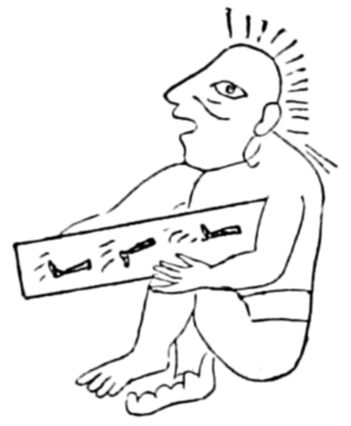
Fig. 1.—Tamuoc.
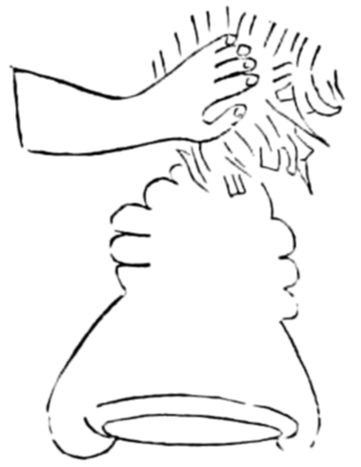
Fig. 2.—Mapachtepec.
In another class of proper names, in their own tongue, although they had a meaning in the Nahuatl, the scribe preferred to express them by ikonomatic instead of ikonographic devices. Thus, Mapachtepec, means literally, “badger hill,” or “badger town,” but in place of depicting a badger, the native writer made a drawing of a hand grasping 223a bunch of Spanish moss, the Tillandsia usneoides. The hand or arm in Nahuatl is maitl, the moss pachtli; and taking the first syllables of these two words we obtain ma pach: the word tepec, locative form of tepetl, hill or village, is expressed by the usual conventional ideographic or determinative sign.
In other names, the relative positions of the objects are significant, reminding us of the rebus of a well-known town in Massachusetts, celebrated for its educational institutions:
&
Mass.
which is to be read, “Andover, Massachusetts;” so in the Aztec scrolls, we have itzmiquilpan represented by an obsidian knife, itztli, and an edible plant, quilitl, which are placed above or over (pan), the sign for cultivated land, milli, thus giving all the elements of the name, the last syllable by position only.
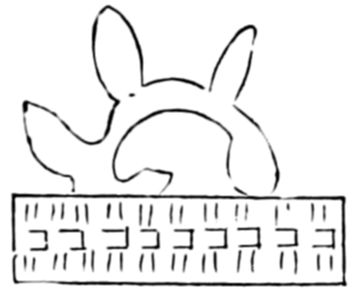
Fig. 3.—Itzmiquilpan.
In one respect I believe the ikonomatic writing of the Mexicans is peculiar; that is, in the phonetic value which it assigns to colors. Like the Egyptian, it is polychromatic, but, so far as I know, the Egyptian polychromes never had a phonetic value; they were, in a general way, used by that people as determinatives, from some supposed similarity of hue; thus green indicates a vegetable substance or bronze, 224yellow, certain woods and some animals, and so on. In heraldry the colors are very important and have well-defined significations, but very seldom, if ever, phonetic ones. Quite the contrary is the case with the Mexican script. It presents abundant instances where the color of the object as portrayed is an integral phonetic element of the sound designed to be conveyed.
To quote examples, the Nahuatl word for yellow is cuztic or coztic, and when the hieroglyphics express phonetically such proper names as Acozpa, Cozamaloapan, Cozhuipilcan, etc., the monosyllable coz is expressed solely by the yellow color which the scribe lays upon his picture. Again, the name Xiuhuacan, “the place of grass,” is represented by a circle colored pale blue, xiuhtic. The name of this tint supplies the phonetic desired. The name of the village Tlapan is conveyed by a circle, whose interior is painted red, tlapalli, containing the mark of a human foot-print. Such examples are sufficient to prove that in undertaking to decipher the Mexican writing we must regard the color as well as the figure, and be prepared to allow to each a definite phonetic value.
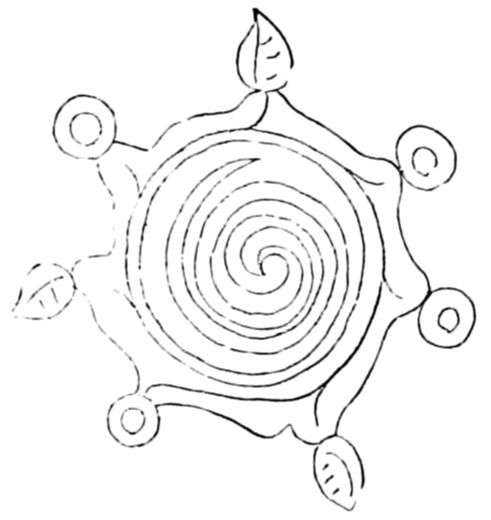
Fig. 4.—Acozpa. (A yellow center surrounded by water drops, atl, a.)
225
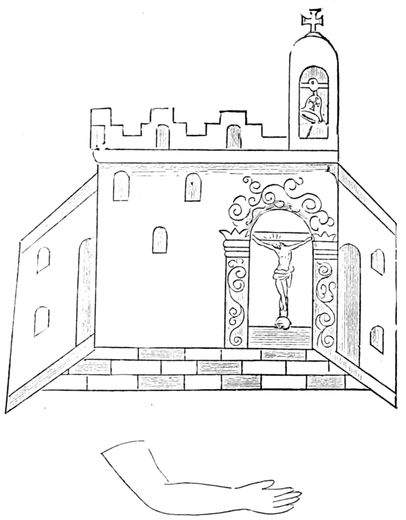
Fig. 5.—Tlamapa.
It must not be understood that all the Aztec writing is made up of phonetic symbols. This is far from being the case. We discover among the hundreds of curious figures which it presents, determinatives, as in the Egyptian inscriptions, and numerous ideograms. Sometimes the ideogram is associated with the phonetic symbol, acting as a sort of determinative to the latter. An interesting example of this is given at the beginning of the “Manuscrito Hieratico,” 226recently published by the Spanish government.[213] It is the more valuable as an example, as the picture writing is translated into Nahuatl and written in Spanish characters. The date of the document, 1526, leaves no doubt that it is in the same style as the ancient Codices. The page is headed with the picture of a church edifice; underneath is the outline of a human arm, and the legend in Nahuatl is:
In Altepetl y Santa Cruz Tlamapa.
These words mean, “the town of Santa Cruz Tlamapa.” The name “tlamapa” means “on the hill-side,” and doubtless originally referred to the position in which the village was situated. But the prefix “tlama” usually signifies, “to do something with the arms or hands,” derived from maitl, hand or arm. Hence, the figure of the extended arm gives this disyllable, tlama, which was sufficient to recall the name of the town.
The Aztecs by no means confined the ikonomatic system to proper names. They composed in it words, sentences, and treatises on various subjects. In proportion as it is applied to these connected and lengthy compositions, its processes become more recondite, curious and difficult of interpretation. Without a knowledge of the spoken language considerably more than rudimentary, it would be hopeless for the student to attempt to solve the enigmas which he meets at every step. Yet every well-directed effort will convince him that he is on the right track, and he will constantly 227be cheered and stimulated to further endeavor by the victories he will win day by day.
The analogy which is presented in so many particulars between Mexican and Maya civilization would lead us to infer that the Maya writing, of which we have a number of examples well preserved, should be unlocked by the same key which has been successfully applied to the Aztec Codices. The latest writers on the Maya manuscripts, while agreeing that they are in part, at least, in phonetic characters, consider them mostly ideographic. But it is to be noted that not one of these writers had any practical acquaintance with the sounds of the Maya language, and scarcely any with its vocabulary. From this it is evident that even were these codices in ikonomatic writing, such investigators could make very little progress in deciphering them, and might readily come to the conclusion that the figures are not phonetic in any sense. Precisely the same position was taken by a number of students of Egyptian antiquity long after the announcement of the discovery of Champollion; and even within a few years works have been printed denying all phoneticism to the Nilotic inscriptions.
What induces me to believe that much of the Maya script is of the nature of the Mexican is the endeavor, undertaken for a very different purpose, of Professor Valentini to explain the origin of the so-called Maya alphabet, preserved by Bishop Landa, and printed in the editions of his celebrated “Description of Yucatan.”[214] Professor Valentini 228shows by arguments and illustrations, which I think are in the main correct, that when the natives were asked to represent the sounds of the Spanish letters in their method of writing, they selected objects to depict, whose names, or initial sounds, or first syllables, were the same, or akin, to the sounds of the Spanish vowel or consonant heard by them. Sometimes they would give several words, with their corresponding pictures, for the same sound; just as I have shown was the custom of the ancient Egyptians. Thus, for the sound b they drew a foot-print, which in their tongue was called be; for the sound a an obsidian knife, in Maya, ach, etc. Valentini thinks also that the letter e was delineated by black spots, in Maya eek, meaning black, which, if proved by further research, would show that the Mayas, like the Mexicans, attributed phonetic values to the colors they employed in their painted scrolls.
Outside of the two nations mentioned, the natives of the American continent made little advance toward a phonetic system. We have no positive evidence that even the cultivated Tarascas and Zapotecs had anything better than ikonographs; and of the Quiches and Cakchiquels, both near relatives of the Mayas, we only know that they had a written literature of considerable extent, but of the plan by which it was preserved we have only obscure hints. Next to these we should probably place the Chipeway pictography, as preserved on their meda sticks, bark records, and adjidjiatig or grave-posts. I have examined a number of specimens of these, but have failed to find any evidence that the characters refer to sounds in the language; however, I might not consider it improbable that further researches 229might disclose some germs of the ikonomatic method of writing even in these primitive examples of the desire of the human intellect to perpetuate its acquisitions, and hand them down to generations yet unborn.
230
THE WRITING AND RECORDS OF THE ANCIENT MAYAS.[215]
1.—Introductory.
One of the ablest living ethnologists has classified the means of recording knowledge under two general headings—Thought-writing and Sound-writing.[216] The former is again divided into two forms, the first and earliest of which is by pictures, the second by picture-writing.
The superiority of picture-writing over the mere depicting of an occurrence is that it analyzes the thought and expresses separately its component parts, whereas the picture presents it as a whole. The representations familiar among the North American Indians are usually only pictures, while most of the records of the Aztec communities are in picture-writing.
The genealogical development of Sound-writing begins by the substitution of the sign of one idea for that of another whose sound is nearly or quite the same. Such was the early graphic system of Egypt, and such substantially to-day 231is that of the Chinese. Above stands syllabic writing, this as that of the Japanese, and the semi-syllabic signs of the old Semitic alphabet; while, as the perfected result of these various attempts, we reach at last the invention of a true alphabet, in which a definite figure corresponds to a definite elementary sound.
It is a primary question in American archæology, How far did the most cultivated nations of the western continent ascend this scale of graphic development? This question is as yet unanswered. All agree, however, that the highest evolution took place among the Nahuatl-speaking tribes of Mexico and the Maya race of Yucatan.
I do not go too far in saying that it is proved that the Aztecs used to a certain extent a phonetic system of writing, one in which the figures refer not to the thought, but to the sound of the thought as expressed in spoken language. This has been demonstrated by the researches of M. Aubin, and, of late, by the studies of Señor Orozco y Berra.[217]
Two evolutionary steps can be distinguished in the Aztec writing. In the earlier the plan is that of the rebus in combination with ideograms, which latter are nothing more than the elements of picture-writing. Examples of this plan are the familiar “tribute rolls” and the names of towns and kings, as shown in several of the codices published by Lord Kingsborough. The second step is where a conventional image is employed to represent the sound of its first 232syllable. This advances actually to the level of the syllabic alphabet; but it is doubtful if there are any Aztec records entirely, or even largely, in this form of writing. They had only reached the commencement of its development.
The graphic system of the Mayas of Yucatan was very different from that of the Aztecs. No one at all familiar with the two could fail at once to distinguish between the manuscripts of the two nations. They are plainly independent developments.
We know much more about the ancient civilization of Mexico than of Yucatan; we have many more Aztec than Maya manuscripts, and hence we are more at a loss to speak with positiveness about the Maya system of writing than about the Mexican. We must depend on the brief and unsatisfactory statements of the early Spanish writers, and on what little modern research has accomplished, for means to form a correct opinion; and there is at present a justifiable discrepancy of opinion about it among those who have given the subject most attention.
2.—Descriptions by Spanish Writers.
The earliest exploration of the coast of Yucatan was that of Francisco Hernandez de Cordova, in 1517. The year following a second expedition, under Juan de Grijalva, visited a number of points between the island of Cozumel and the Bahia de Terminos.
Several accounts of Grijalva’s voyage have been preserved, but they make no distinct reference to the method of writing they found in use. Some native books were obtained, however, 233probably from the Mayas, and were sent to Spain, where they were seen by the historian Peter Martyr. He describes them in general terms, and compares the characters in which they were written to the Egyptian hieroglyphics, some of which he had seen in Rome. He supposes that they contain the laws and ceremonies of the people, astronomical calculations, the deeds of their kings, and other events of their history. He also speaks in commendation of the neatness of their general appearance, the skill with which the drawing and painting were carried out. He further mentions that the natives used this method of writing or drawing in the affairs of common life.[218]
Although Yucatan became thus early known to the Spaniards, it was not until 1541 that a permanent settlement was effected, in which year Francisco de Montejo, the younger, advanced into the central province of Ceh Pech, and established a city on the site of the ancient town called Ichcanziho, which means “the five (temples) of many oracles (or serpents),” to which he gave the name Mérida, on account of the magnificent ancient edifices he found there.
Previous to this date, however, in 1534, Father Jacobo de Testera, with four other missionaries, proceeded from Tabasco up the west coast to the neighborhood of the Bay of Campeachy. They were received amicably by the natives, and instructed them in the articles of the Christian faith. They also obtained from the chiefs a submission to the King of Spain; and I mention this early missionary expedition for the fact stated that each chief signed this act of submission “with a certain mark, like an autograph.” This document 234was subsequently taken to Spain by the celebrated Bishop Las Casas.[219] It is clear from the account that some definite form of signature was at that time in use among the chiefs.
It might be objected that these signatures were nothing more than rude totem marks, such as were found even among the hunting tribes of the Northern Mississippi Valley. But Las Casas himself, in whose possession the documents were, here comes to our aid to refute this opinion. He was familiar with the picture-writing of Mexico, and recognized in the hieroglyphics of the Mayas something different and superior. He says expressly that these had inscriptions, writings, in certain characters, the like of which were found nowhere else.[220]
One of the early visitors to Yucatan after the conquest was the Pope’s commissary-general, Father Alonzo Ponce, who was there in 1588. Many natives who had grown to adult years in heathenism must have been living then. He makes the following interesting observation:
“The natives of Yucatan are, among all the inhabitants of New Spain, especially deserving of praise for three things: First, that before the Spaniards came they made use of characters and letters, with which they wrote out their histories, their ceremonies, the order of sacrifices to their idols, and their calendars, in books made of bark of a certain tree. 235These were on very long strips, a quarter or a third (of a yard) in width, doubled and folded, so that they resembled a bound book in quarto, a little larger or smaller. These letters and characters were understood only by the priests of the idols (who in that language are called Ahkins) and a few principal natives. Afterwards some of our friars learned to understand and read them, and even wrote them.”[221]
The interesting fact here stated, that some of the early missionaries not only learned to read these characters, but employed them to instruct the Indians, has been authenticated by a recent discovery of a devotional work written in this way.
The earliest historian of Yucatan is Fr. Bernardo de Lizana.[222] But I do not know of a single complete copy of his work, and only one imperfect copy, which is, or was, in the city of Mexico, from which the Abbé Brasseur (de Bourbourg) copied and republished a few chapters. Lizana was himself not much of an antiquary, but he had in his hands the manuscripts left by Father Alonso de Solana, who came to Yucatan in 1565, and remained there til his death, in 1599. Solana was an able man, acquiring thoroughly the Maya tongue, and left in his writings many notes on the antiquities of the country.[223] Therefore we may put 236considerable confidence in what Lizana writes on these matters.
The reference which I find in his work to the Maya writings is as follows:
“The most celebrated and revered sanctuary in this land, and that to which they resorted from all parts, was this town and temples of Ytzamal, as they are now called; and that it was founded in most ancient times, and that it is still known who did found it, will be set forth in the next chapter.
“III. The history and the authorities which we can cite are certain ancient characters, scarcely understood by many, and explained by some old Indians, sons of the priests of their gods, who alone knew how to read and expound them, and who were believed in and revered as much as the gods themselves, etc.[224]”
We have here the positive statement that these hieroglyphic inscriptions were used by the priests for recording their national history, and that by means of them they preserved the recollection of events which took place in a very remote past.
Another valuable early witness, who testifies to the same effect, is the Dr. Don Pedro Sanchez de Aguilar, who was cura of Valladolid, in Yucatan, in 1596, and, later, dean of the chapter of the cathedral at Merida. His book, too, is extremely scarce, and I have never seen a copy; but I have 237copious extracts from it, made by the late Dr. C. Hermann Berendt from a copy in Yucatan. Aguilar writes of the Mayas:
“They had books made from the bark of trees, coated with a white and durable varnish. They were ten or twelve yards long, and were gathered together in folds, like a palm leaf. On these they painted in colors the reckoning of their years, wars, pestilences, hurricanes, inundations, famines, and other events. From one of these books, which I myself took from some of these idolaters, I saw and learned that to one pestilence they gave the name Mayacimil, and to another Ocnakuchil, which mean ‘sudden deaths’ and ‘times when the crows enter the houses to eat the corpses.’ And the inundation they called Hunyecil, the submersion of trees.”[225]
The writer leaves it uncertain whether he learned these words directly from the characters of the book or through the explanations of some native.
It has sometimes been said that the early Spanish writers drew a broad line between the picture-writing that they found in America and an alphabetic script. This may be true of other parts, but is not so of Yucatan. These signs, or some of them, are repeatedly referred to as “letters,” letras.
This is pointedly the case with Father Gabriel de San Buenaventura, a French Franciscan who served in Yucatan about 1670–'80. He published one of the earliest grammars of the language, and also composed a dictionary in three 238large volumes, which was not printed. Father Beltran de Santa Rosa quotes from it an interesting tradition preserved by Buenaventura, that among the inventions of the mythical hero-god of the natives, Itzamna or Kinich ahau, was that of “the letters of the Maya language,” with which letters they wrote their books.[226] Itzamna, of course, dates back to a misty antiquity, but the legend is of value, as showing that the characters used by the natives did, in the opinion of the early missionaries, deserve the name of letters.
Father Diego Lopez Cogolludo is the best-known historian of Yucatan. He lived about the middle of the seventeenth century, and says himself that at that time there was little more to be learned about the antiquities of the race. He adds, therefore, substantially nothing to our knowledge of the subject, although he repeats, with positiveness, the statement that the natives “had characters by which they could understand each other in writing, such as those yet seen in great numbers on the ruins of their buildings.”[227]
This is not very full. Yet we know to a certainty that there were quantities of these manuscripts in use in Yucatan for a generation after Cogolludo wrote. To be sure, those in the Christianized districts had been destroyed, wherever the priests could lay their hands on them; but in the southern part of the peninsula, on the islands of Lake Peten and 239adjoining territory, the powerful chief, Canek, ruled a large independent tribe of Itzas. They had removed from the northern provinces of the peninsula somewhere about 1450, probably in consequence of the wars which followed the dissolution of the confederacy whose capital was the ancient city of Mayapan.
Their language was pure Maya, and they had brought with them in their migration, as one of their greatest treasures, the sacred books which contained their ancient history, their calendar and ritual, and the prophecies of their future fate. In the year 1697 they were attacked by the Spaniards, under General Don Martin de Ursua; their capital, on the island of Flores, in Lake Peten, taken by storm; great numbers of them slaughtered or driven into the lake to drown, and the twenty-one temples which were on the island razed to the ground.
A minute and trustworthy account of these events has been given by Don Juan de Villagutierre Soto-Mayor, in the course of which occur several references to the sacred books, which he calls Analtés.
The king Canek, he tells us, in reading in his Analtés, had found notices of the northern provinces of Yucatan and of the fact that his predecessors had come thence, and had communicated these narratives to his chiefs.[228]
These books are described as showing “certain characters and figures, painted on certain barks of trees, each leaf or 240tablet about a quarter (of a yard) wide, and of the thickness of a piece of eight, folded at one edge and the other in the manner of a screen, called by them Analtehes.”[229]
When the island of Flores was captured these books were found stored in the house of the king Canek, containing the account of all that had happened to the tribe.[230] What disposition was made of them we are not informed.
I have reserved until now a discussion of the description of the Maya writing presented in the well-known work of Diego de Landa, the second bishop of Yucatan. Landa arrived in the province in August, 1549, and died in April, 1579, having passed most of the intervening thirty years there in the discharge of his religious duties. He became well acquainted with the language, which, for that matter, is a comparatively easy one, and though harsh, illiberal, and bitterly fanatic, he paid a certain amount of attention to the arts, religion, and history of the ancient inhabitants.
The notes that he made were copied after his death and reached Spain, where they are now preserved in the library of the Royal Academy of History, Madrid. In 1864 they were published at Paris, with a French translation, by the Abbé Brasseur (de Bourbourg).
Of all writers Landa comes the nearest telling us how the Mayas used their system of writing; but, unfortunately, he also is so superficial and obscure that his words have given rise to very erroneous theories. His description runs as follows:
241“This people also used certain characters or letters, with which they wrote in their books their ancient matters and their sciences, and with them (i. e., with their characters or letters), and figures (i. e., drawings or pictures), and some signs in the figures, they understood their matters, and could explain them and teach them. We found great numbers in these letters, but as they contained nothing that did not savor of superstition and lies of the devil, we burnt them all, at which the natives grieved most keenly and were greatly pained.
“I will give here an a, b, c, as their clumsiness does not allow more, because they use one character for all the aspirations of the letters, and for marking the parts another, and thus it could go on in infinitum, as may be seen in the following example. Le means a noose and to hunt with one; to write in their characters, after we had made them understand that there are two letters, they wrote it with three, giving to the aspiration of the l the vowel é, which it carries before it; and in this they are not wrong so to use it, if they wish to, in their curious manner. After this they add to the end the compound part.”[231]
I need not pursue the quotation. The above words show clearly that the natives did not in their method of writing analyze a word to its primitive phonetic elements. “This,” said the bishop, “we had to do for them.” Therefore they did not have an alphabet in the sense of the word as we use it.
On the other hand, it is equally clear, from his words and examples, that they had figures which represented sounds, 242and that they combined these and added a determinative or an ideogram to represent words or phrases.
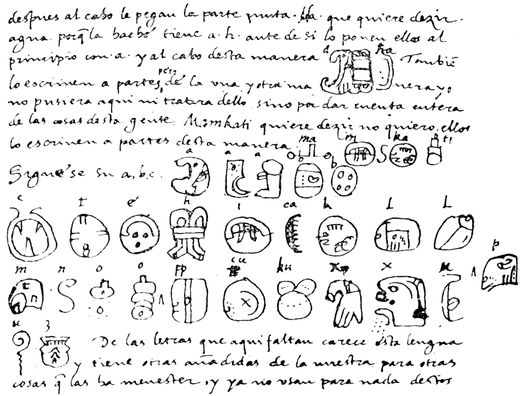
Fig. 1.—Fac Simile of Landa’s Manuscript.
The alphabet which he inserts has been engraved and printed several times, but nowhere with the fidelity desirable for so important a monument in American archæology. For that reason I insert a photographic reproduction of it from the original MS. in the library of the Academia de la Historia of Madrid.
A comparison of this with the alphabet as given in Brasseur’s edition of Landa discloses several variations of importance. 243Thus the Abbé places the first form of the letter C horizontally instead of upright. Again in the MS., the two figures for the letter U stand, the first at the end of one line, the second at the beginning of the next. From their strong analogy with the sign of the sky at night, I am of opinion that they belong together as members of one composite sign, not separately as Brasseur gives them.
Both in it and in the inscriptions, manuscripts, and paintings the forms of the letters are rounded, and a row of them presents the outlines of a number of pebbles cut in two. Hence the system of writing has been called “calculiform,” from calculus, a pebble. The expression has been criticised, but I agree with Dr. Förstemann in thinking it a very appropriate one. It was suggested, I believe, by the Abbé Brasseur (de Bourbourg).
This alphabet of course, can not be used as the Latin a, b, c. It is surprising that any scholar should have ever thought so. It would be an exception, even a contradiction, to the history of the evolution of human intelligence, to find such an alphabet among nations of the stage of cultivation of the Mayas or Aztecs.
The severest criticism which Landa’s figures have met has been from Dr. Phillip J. J. Valentini. He discovered that many of the sounds of the Spanish alphabet were represented by signs or pictures of objects whose names in the Maya begin with that sound. Thus he supposes that Landa asked an Indian to write in the native character the Spanish letter a, and the Indian drew an obsidian knife, which, says Dr. Valentini, is in the Maya ach; in other words, it begins with the vowel a. So for the sound ki, the Indian gave the sign of the day named kinich.
244Such is Dr. Valentini’s theory of the formation of Landa’s alphabet; and not satisfied with lashing with considerable sharpness those who have endeavored by its aid to decipher the manuscripts and mural inscriptions, he goes so far as to term it “a Spanish fabrication.”
I shall not enter into a close examination of Dr. Valentini’s supposed identification of these figures. It is evident that it has been done by running over the Maya dictionary to find some word beginning with the letter under criticism, the figurative representation of which word might bear some resemblance to Landa’s letter. When the Maya fails, such a word is sought for in the Kiche or other dialect of the stock; and the resemblances of the pictures to the supposed originals are sometimes greatly strained.
But I pass by these dubious methods of criticism, as well as several lexicographic objections which might be raised. I believe, indeed, that Dr. Valentini is not wrong in a number of his identifications. But the conclusion I draw is a different one. Instead of proving that this is picture-writing, it indicates that the Mayas used the second or higher grade of phonetic syllabic writing, which, as I have before observed, has been shown by M. Aubin to have been developed to some extent by the Aztecs in some of their histories and connected compositions (see above, page 231). Therefore the importance and authenticity of Landa’s alphabet are, I think, vindicated by this attempt to treat it as a “fabrication.”[232]
245Landa also gives some interesting details about their books. He writes:
“The sciences that they taught were the reckoning of the years, months, and days, the feasts and ceremonies, the administration of their sacraments, the fatal days and seasons, their methods of divination and prophecies, events about to happen, remedies for diseases, their ancient history, together with the art of reading and writing their books with characters which were written, and pictures which represented the things written.
“They wrote their books on a large sheet doubled into folds, which was afterwards inclosed between two boards, which they decorated handsomely. They were written from side to side in columns, as they were folded. They manufactured this paper from the root of a tree and gave it a white surface on which one could write. Some of the principal nobles cultivated these sciences out of a taste for them, and although they did not make public use of them, as did the priests, yet they were the more highly esteemed for this knowledge.”[233]
From the above extracts from Spanish writers we may infer that—
1. The Maya graphic system was recognized from the first to be distinct from the Mexican.
2. It was a hieroglyphic system, known only to the priests and a few nobles.
2463. It was employed for a variety of purposes, prominent among which was the preservation of their history and calendar.
4. It was a composite system, containing pictures (figuras), ideograms (caracteres), and phonetic signs (letras).
3.—References from Native Sources.
We might reasonably expect that the Maya language should contain terms relating to their books and writings which would throw light on their methods. So, no doubt, it did. But it was a part of the narrow and crushing policy of the missionaries not only to destroy everything that related to the times of heathendom, but even to drop all words which referred to ancient usages. Hence the dictionaries are more sterile in this respect than we might have supposed.
The verb “to write” is dzib, which like the Greek γράφειν, meant also to draw and to paint. From this are derived the terms dziban, something written; dzibal, a signature, etc.
Another word, meaning to write, or to paint in black, is zabac. As a noun, this was in ancient times applied to a black fluid extracted from the zabacche, a species of tree, and used for dyeing and painting. In the sense of “to write,” zabac is no longer found in the language, and instead of its old meaning, it now refers to ordinary ink.
The word for letter or character is uooh. This is a primitive root found with the same or a closely allied meaning in other branches of this linguistic stock, as, for instance, in the Kiché and Cakchiquel. As a verb, pret. uooth, fut. uooté, it 247also means to form letters, to write; and from the passive form, uoohal, we have the participial noun, uoohan, something written, a manuscript.
The ordinary word for book, paper, or letter, is huun, in which the aspirate is almost mute, and is dropped in the forms denoting possession, as u uun, my book, yuunil Dios, the book of God, il being the so-called “determinative” ending. It occurs to me as not unlikely that uun, book, is a syncopated form of uoohan, something written, given above. To read a book is xochun, literally to count a book.
According to Villagutierre Soto-Mayor, the name of the sacred books of the Itzas was analté. In the printed Diccionario de la Lengua Maya, by Don Juan Pio Perez, this is spelled anahté, which seems to be a later form.
The term is not found in several early Maya dictionaries in my possession, of dates previous to 1700. The Abbé Brasseur indeed, in a note to Landa, explains it to mean “a book of wood,” but it can have no such signification. Perhaps it should read hunilté, this being composed of hunil, the “determinative” form of huun, a book, and the termination té, which added to nouns, gives them a specific sense, e. g. amayté, a square figure, from amay, an angle; tzucublé, a province, from tzuc, a portion separated from the rest. It would mean especially the sacred or national books.
The particular class of books which were occupied with the calendar and the ritual were called tzolanté, which is a participial noun from the verb tzol, passive tzolal, to set in order, to arrange, with the suffix té. By these books were set in order and arranged the various festivals and fasts.
When the conquest was an accomplished fact and the 248priests had got the upper hand, the natives did not dare use their ancient characters. They exposed themselves to the suspicion of heresy and the risk of being burnt alive, as more than once happened. But their strong passion for literature remained, and they gratified it as far as they dared by writing in their own tongue with the Spanish alphabet volumes whose contents are very similar to those described by Landa.
A number of these are still in existence, and offer an interesting field for antiquarian and linguistic study. Although, as I say, they are no longer in the Maya letters, they contain quite a number of ideograms, as the signs of the days and the months, and occasional cartouches and paintings, which show that they were made to resemble the ancient manuscripts as closely as possible.
They also contain not infrequent references to the “writing” of the ancients, and what are alleged to be extracts from the old records, chiefly of a mystic character. The same terms are employed in speaking of the ancient graphic system as of the present one. Thus in one of them, known as “The Book of Chilan Balam of Chumayel,” occurs this phrase: Bay dzibanil tumenel Evangelistas yetel profeta Balam—“as it was written by the Evangelists, and also by the prophet Balam,” this Balam being one of their own celebrated ancient seers.
Among the predictions preserved from a time anterior to the Conquest, there are occasional references to their books and their contents. I quote, as an example, a short prophecy attributed to Ahkul Chel, “priest of the idols.” It is found in several of the oldest Maya manuscripts, and is in all probability 249authentic, as it contains nothing which would lead us to suppose that it was one of the “pious frauds” of the missionaries.
“Enhi cibte katune yume, maixtan à naaté;
Uatac u talel, mac bin ca ɔabac tu coɔ pop;
Katune yume bin uluc, holom uil tucal ya;
Tali ti xaman, tali ti chikine; ahkinob uil yane yume;
Mac to ahkin, mac to ahbobat, bin alic u than uoohe;
Yhcil Bolon Ahau, maixtan à naaté?”
“The lord of the cycle has been written down, but ye will not understand;
“He has come, who will give the enrolling of the years;
“The lord of the cycle will arrive, he will come on account of his love;
“He came from the north, from the west. There are priests, there are fathers,
“But what priest, what prophet, shall explain the words of the books,
“In the Ninth Ahau, which ye will not understand?”[234]
250From this designedly obscure chant we perceive that the ancient priests inscribed their predictions in books, which were afterward explained to the people. The expression bin alic u than uoohe—literally, “he will speak the words of the letters”—seems to point to a phonetic writing, but as it may be used in a figurative sense, I shall not lay stress on it.[235]
4.—The Existing Codices.
The word Codex ought to be confined, in American archæology, to manuscripts in the original writing of the natives. Some writers have spoken of the “Codex Chimalpopoca,” the “Codex Zumarraga,” and the “Codex Perez,” which are nothing more than manuscripts either in the native or Spanish tongues written with the Latin alphabet.
Of the Maya Codices known, only four have been published, which I will mention in the order of their appearance.
The Dresden Codex.—This is an important Maya manuscript preserved in the Royal Library at Dresden. How or when it came to Europe is not known. It was obtained from some unknown person in Vienna in 1739.
This Codex corresponds in size, appearance, and manner of folding to the descriptions of the Maya books which I have presented above from Spanish sources. It has thirty-nine leaves, thirty-five of which are colored and inscribed on 251both sides, and four on one side only, so that there are only seventy-four pages of matter. The total length of the sheet is 3.5 meters, and the height of each page is 0.295 meter, the width 0.085 meter.
The first publication of any portion of this Codex was by Alexander von Humboldt, who had five pages of it copied for his work, Vues des Cordillères et Monumens des Peuples Indigenes de l’Amérique, issued at Paris in 1813 (not 1810, as the title-page has it). It was next very carefully copied in full by the Italian artist, Agostino Aglio, for the third volume of Lord Kingsborough’s great work on Mexican Antiquities, the first volume of which appeared in 1831.
From Kingsborough’s work a few pages of the Codex have been from time to time republished in other books, which call for no special mention; and two pages were copied from the original in Wuttke’s Geschichte der Schrift, Leipzig, 1872.
Finally, in 1880, the whole was very admirably chromo-photographed by A. Naumaun’s establishment at Leipzig, to the number of fifty copies, forty of which were placed on sale. It is the first work which was ever published in chromo-photography, and has, therefore, a high scientific as well as antiquarian interest.
The editor was Dr. E. Förstemann, aulic counselor and librarian-in-chief of the Royal Library. He wrote an introduction (17 pp. 4to.) giving a history of the manuscript, and bibliographical and other notes upon it of much value. One opinion he defends must not be passed by in silence. It is that the Dresden Codex is not one, but parts of two original manuscripts written by different hands.
252It appears that it has always been in two unequal fragments, which all previous writers have attributed to an accidental injury to the original. Dr. Förstemann gives a number of reasons for believing that this is not the correct explanation, but that we have here portions of two different books, having general similarity but also many points of diversity.
This separation led to an erroneous (or perhaps erroneous) sequence of the pages in Kingsborough’s edition. The artist Aglio took first one fragment and copied both sides, and then proceeded to the next one; and it is not certain that in either case he begins with the first page in the original order of the book.
The Codex Peresianus, or Codex Mexicanus, No. II, of the Bibliothèque Nationale of Paris.—This fragment—for it is unfortunately nothing more—was discovered in 1859 by Prof. Leon de Rosny among a mass of old papers in the National Library. It consists of eleven leaves, twenty-two pages, each 9 inches long and 5¼ inches wide. The writing is very much defaced, but was evidently of a highly artistic character, probably the most so of any manuscript known. It unquestionably belongs to the Maya manuscripts.
Its origin is unknown. The papers in which it was wrapped bore the name “Perez,” in a Spanish hand of the seventeenth century, and hence the name “Peresianus” was given it. By order of the Minister of Public Instruction, ten photographic copies of this Codex, without reduction, were prepared for the use of scholars. None of them were placed on sale, and so far as I know the only one which has found 253its way to the United States is that in my own library. An ordinary lithographic reproduction was given in the Archives paléographiques de l’Orient et de l’Amérique, tome I. (Paris, 1869–'71).
The Codex Tro, or Troano.—The publication of this valuable Codex we owe to the enthusiasm of the Abbé Brasseur (de Bourbourg). On his return from Yucatan in 1864 he visited Madrid, and found this Manuscript in the possession of Don Juan de Tro y Ortolano, professor of paleography, and himself a descendent of Hernan Cortes. The abbé named it Troano, as a compound of the two names of its owner; but later writers often content themselves by referring to it simply as the Codex Tro.
It consists of thirty-five leaves and seventy pages, each of which is larger than a page of the Dresden Codex, but less than one of the Codex Peresianus. It was published by chromo-lithography at Paris, in 1869, prefaced by a study on the graphic system of the Mayas by the abbé, and an attempt at a translation. The reproduction, which was carried out under the efficient care of M. Leonce Angrand, is extremely accurate.
The Codex Cortesianus.—This Codex, published at Paris, 1883, under the editorship of Professor Leon de Rosny, presents the closest analogy to the Codex Troano, of which, indeed, it probably formed a part. It has forty-two leaves, closely written in the calculiform character. There is no evidence that it was brought to Spain by Cortes, but from a tradition to that effect, it has received its name.
All four of these codices were written on paper manufactured from the leaves of the maguey plant, such as that in 254common use in Mexico. In Maya the maguey is called ci, the varieties being distinguished by various prefixes. It grows luxuriantly in most parts of Yucatan, and although the favorite tipple of the ancient inhabitants was mead, they were not unacquainted with the intoxicating pulque, the liquor from the maguey, if we can judge from their word for a drunkard, ci-vinic (vinic==man). The old writers were probably in error when they spoke of the books being made of the barks of trees; or, at least, they were not all of that material.
The above-mentioned Manuscripts are the only ones which have been published. I shall not enumerate those which are said to exist in private hands. So long as they are withheld from the examination of scientific men they can add nothing to the general stock of knowledge, and as statements about them are not verifiable, it is useless to make any.
In addition to the Manuscripts, we have the mural paintings and inscriptions found at Palenque, Copan, Chichen Itza, and various ruined cities within the boundaries of the Maya-speaking races. There is no mistaking these inscriptions. They are unquestionably of the same character as the Manuscripts, although it is also easy to perceive variations, which are partly owing to the necessary differences in technique between painting and sculpture: partly, no doubt, to the separation of age and time.
Photographs and “squeezes” have reproduced many of these inscriptions with entire fidelity. We can also depend upon the accurate pencil of Catherwood, whose delineations have never been equalled. But the pictures of Waldeck and some other travelers do not deserve any confidence, and should not be quoted in a discussion of the subject.
255
THE BOOKS OF CHILAN BALAM.[236]
Civilization in ancient America rose to its highest level among the Mayas of Yucatan. Not to speak of the architectural monuments which still remain to attest this, we have the evidence of the earliest missionaries to the fact that they alone, of all the natives of the New World, possess a literature written in “letters and characters,” preserved in volumes neatly bound, the paper manufactured from the material derived from fibrous plants, and sized with a durable white varnish.[237]
256A few of these books still remain, preserved to us by accident in the great European libraries; but most of them were destroyed by the monks. Their contents were found to relate chiefly to the pagan ritual, to traditions of the heathen times, to astrological superstitions, and the like. Hence, they were considered deleterious, and were burned wherever discovered.
This annihilation of their sacred books affected the natives most keenly, as we are pointedly informed by Bishop Landa, himself one of the most ruthless of Vandals in this respect.[238] But already some of the more intelligent had learned the Spanish alphabet, and the missionaries had added a sufficient number of signs to it to express with tolerable accuracy the phonetics of the Maya tongue. Relying on their memories, and no doubt aided by some manuscripts secretly preserved, many natives set to work to write out in this new alphabet the contents of their ancient records. Much was added which had been brought in by the Europeans, and much omitted which had become unintelligible or obsolete since the Conquest; while, of course, the different writers, varying in skill and knowledge, produced works of very various merit.
Nevertheless, each of these books bore the same name. 257In whatever village it was written, or by whatever hand, it always was, and to-day still is, called “The Book of Chilan Balam.” To distinguish them apart, the name of the village where a copy was found or written, is added. Probably, in the last century, almost every village had one, which was treasured with superstitious veneration. But the opposition of the padres to this kind of literature, the decay of ancient sympathies, and especially the long war of races, which since 1847 has desolated so much of the peninsula, have destroyed most of them. There remain, however, either portions or descriptions of not less than sixteen of these curious records. They are known from the names of the villages respectively as the Book of Chilan Balam of Nabula, of Chumayel, of Káua, of Mani, of Oxkutzcab, of Ixil, of Tihosuco, of Tixcocob, etc., these being the names of various native towns in the peninsula.
When I add that not a single one of these has ever been printed, or even entirely translated into any European tongue, it will be evident to every archæologist and linguist what a rich and unexplored mine of information about this interesting people they may present. It is my intention in this article merely to touch upon a few salient points to illustrate this, leaving a thorough discussion of their origin and contents to the future editor who will bring them to the knowledge of the learned world.
Turning first to the meaning of the name “Chilan Balam,” it is not difficult to find its derivation. “Chilan,” says Bishop Landa, the second bishop of Yucatan, whose description of the native customs is an invaluable source to us, “was the name of their priests, whose duty it was to 258teach the sciences, to appoint holy days, to treat the sick, to offer sacrifices, and especially to utter the oracles of the gods. They were so highly honored by the people that usually they were carried on litters on the shoulders of the devotees.”[239] Strictly speaking, in Maya “chilan” means “interpreter,” “mouth-piece,” from “chij,” “the mouth,” and in this ordinary sense frequently occurs in other writings. The word, “balam”—literally, “tiger,”—was also applied to a class of priests, and is still in use among the natives of Yucatan as the designation of the protective spirits of fields and towns, as I have shown at length in a previous study of the word as it occurs in the native myths of Guatemala.[240] “Chilan Balam,” therefore, is not a proper name, but a title, and in ancient times designated the priest who announced the will of the gods and explained the sacred oracles. This accounts for the universality of the name and the sacredness of its associations.
The dates of the books which have come down to us are various. One of them, “The Book of Chilan Balam of Mani,” was undoubtedly composed not later than 1595, as is proved by internal evidence. Various passages in the 259works of Landa, Lizana, Sanchez Aguilar and Cogolludo—all early historians of Yucatan—prove that many of these native manuscripts existed in the sixteenth century. Several rescripts date from the seventeenth century,—most from the latter half of the eighteenth.
The names of the writers are generally not given, probably because the books, as we have them, are all copies of older manuscripts, with merely the occasional addition of current items of note by the copyist; as, for instance, a malignant epidemic which prevailed in the peninsula in 1673 is mentioned as a present occurrence by the copyist of “The Book of Chilan Balam of Nabula.”
I come now to the contents of these curious works. What they contain may conveniently be classified under four headings:
Astrological and prophetic matters;
Ancient chronology and history;
Medical recipes and directions;
Later history and Christian teachings.
The last-mentioned consist of translations of the “Doctrina,” Bible stories, narratives of events after the Conquest, etc., which I shall dismiss as of least interest.
The astrology appears partly to be reminiscences of that of their ancient heathendom, partly that borrowed from the European almanacs of the century 1550–1650. These, as is well known, were crammed with predictions and divinations. A careful analysis, based on a comparison with the Spanish almanacs of that time, would doubtless reveal how much was taken from them, and it would be fair to presume that the remainder was a survival of ancient native theories.
260But there are not wanting actual prophecies of a much more striking character. These were attributed to the ancient priests and to a date long preceding the advent of Christianity. Some of them have been printed in translations in the “Historias” of Lizana and Cogolludo, and of some the originals were published by the late Abbé Brasseur de Bourbourg, in the second volume of the reports of the “Mission Scientificque au Mexique et dans l’ Amérique Centrale.” Their authenticity has been met with considerable skepticism by Waitz and others, particularly as they seem to predict the arrival of the Christians from the East and the introduction of the worship of the cross.
It appears to me that this incredulity is uncalled for. It is known that at the close of each of their larger divisions of time (the so-called “katuns,”) a “chilan,” or inspired diviner, uttered a prediction of the character of the year or epoch which was about to begin. Like other would-be prophets, he had doubtless learned that it is wiser to predict evil than good, inasmuch as the probabilities of evil in this worried world of ours outweigh those of good; and when the evil comes his words are remembered to his credit, while if, perchance, his gloomy forecasts are not realized, no one will bear him a grudge that he has been at fault. The temper of this people was, moreover, gloomy, and it suited them to hear of threatened danger and destruction by foreign foes. But, alas! for them. The worst that the boding words of the oracle foretold was as nothing to the dire event which overtook them—the destruction of their nation, their temples and their freedom, ’neath the iron heel of the Spanish conqueror. As the wise Gœthe says:
261“Seltsam ist Prophetenlied,
Doch mehr seltsam was geschieht.”
As to the supposed reference to the cross and its worship, it may be remarked that the native word translated “cross” by the missionaries, simply means “a piece of wood set upright,” and may well have had a different and special signification in the old days.
By way of a specimen of these prophecies, I quote one from “The Book of Chilan Balam of Chumayel,” saying at once that for the translation I have depended upon a comparison of the Spanish version of Lizana, who was blindly prejudiced, and that in French of the Abbé Brasseur de Bourbourg, who knew next to nothing about Maya, with the original. It will be easily understood, therefore, that it is rather a paraphrase than a literal rendering. The original is in short, aphoristic sentences, and was, no doubt, chanted with a rude rhythm:
“What time the sun shall brightest shine,
Tearful will be the eyes of the king.
Four ages yet shall be inscribed,
Then shall come the holy priest, the holy god.
With grief I speak what now I see.
Watch well the road, ye dwellers of Itza.
The master of the earth shall come to us.
Thus prophesies Nahau Pech, the seer,
In the days of the fourth age,
At the time of its beginning.”
Such are the obscure and ominous words of the ancient oracle. If the date is authentic, it would be about 1480—the “fourth age” in the Maya system of computing time being 262a period of either twenty or twenty-four years at the close of the fifteenth century.
It is, however, of little importance whether these are accurate copies of the ancient prophecies; they remain, at least, faithful imitations of them, composed in the same spirit and form which the native priests were wont to employ. A number are given much longer than the above, and containing various curious references to ancient usages.
Another value they have in common with all the rest of the text of these books, and it is one which will be properly appreciated by any student of languages. They are, by common consent of all competent authorities, the genuine productions of native minds, cast in the idiomatic forms of the native tongue by those born to its use. No matter how fluent a foreigner becomes in a language not his own, he can never use it as does one who has been familiar with it from childhood. This general maxim is ten-fold true when we apply it to a European learning an American language. The flow of thought, as exhibited in these two linguistic families, is in such different directions that no amount of practice can render one equally accurate in both. Hence the importance of studying a tongue as it is employed by natives; and hence the very high estimate I place on these “Books of Chilan Balam” as linguistic material—an estimate much increased by the great rarity of independent compositions in their own tongues by members of the native races of this continent.
I now approach what I consider the peculiar value of these records, apart from the linguistic mould in which they are cast; and that is the light they throw upon the chronological system and ancient history of the Mayas. To a limited 263extent, this has already been brought before the public. The late Don Pio Perez gave to Mr. Stephens, when in Yucatan, an essay on the method of computing time among the ancient Mayas, and also a brief synopsis of Maya history, apparently going back to the third or fourth century of the Christian era. Both were published by Mr. Stephens in the appendix to his “Travels in Yucatan,” and have appeared repeatedly since in English, Spanish and French.[241] They have, up to the present, constituted almost our sole sources of information on these interesting points. Don Pio Perez was rather vague as to whence he derived his knowledge. He refers to “ancient manuscripts,” “old authorities,” and the like; but, as the Abbé Brasseur de Bourbourg justly complains, he rarely quotes their words, and gives no descriptions as to what they were or how he gained access to them.[242] In fact, the whole of Señor Perez’s information was derived from these “Books of Chilan Balam;” and without wishing at all to detract from his reputation as an antiquary and a Maya scholar, I am obliged to say that he has dealt with them as scholars so often do with their authorities; that is, having framed his theories, he quoted what he found in their favor and neglected to refer to what he observed was against them.