Note 7 — BIBLIOGRAPHY.
Reading edition
The Translator of the following little treatise deems it necessary to say a few words as to the object of its publication. It is given to the world, neither with a view to advocate Scepticism, nor to spread Infidelity, but simply to vindicate the right of private judgment. No human being is in a position to look into the heart, or to decide correctly as to the creed or conduct of his fellow mortals; and the attributes of the Deity are so far beyond the grasp of limited reason, that man must become a God himself before he can comprehend them. Such being the case, surely all harsh censure of each other’s opinions and actions ought to be abandoned; and every one should so train himself as to be enabled to declare with the humane and manly philosopher
“Homo sum, nihil humani me alienum puto.”
Dundee, September 1844.
The Vale production is evidently translated from an edition derived from the Latin manuscript which is the basis of the translation given in this volume. The variations in the text of each not being important, but simply due to the different modes of expression of the translators—the ideas conveyed being the same.
The Treatise in Vale’s edition concludes with the following:
“Happy the man who, studying Nature’s laws,
Through known effects can trace the secret cause;
His mind possessing in a quiet state,
Fearless of Fortune, and resigned to Fate.”
—Dryden’s Virgil. Georgics Book II, l. 700.
There is also in the Library of Congress a volume entitled “Traité des Trois Imposteurs.” En Suisse de l’imprimerie philosophique—1793. Boards 3½ × 5¾ inches, containing the Treatise proper 112 pp. Sentimens sur le traite des trois imposteurs, (De la Monnaye) 32 pp. Response a la dissertation de M. de la Monnaye 19 pp. signed J. L. R. L. and dated at Leyden 1 Jan., 1716, to which this note is appended: “This letter is from Sieur Pierre Frederic Arpe, of Kiel, in Holstein, author of the apology of Vanini, printed at Rotterdam in 8o, 1712.” The letter contains the account of the discovery of the original Latin manuscript at Frankfort-on-the-Main, in substance much the same as the translation given in this edition.
In the copy at the Congressional Library, I find the following manuscript notes which may be rendered as follows: “Voltaire doubted the existence of this work, this was in 1767. See his letter to his Highness Monseigneur The Prince of ——. Letter V, Vol. 48 of his works, p. 312.”
See Barbier Dict. des ouv. anon. Nos. 18250, 19060, 21612.
De Tribus Impostoribus. Anon.
L’esprit de Spinosa trad. du latin par Vroes.
In connection with this latter note, and observing the name written at end of the colophon of the manuscript from which the present edition is translated, it is probable that this same Vroese was the author of another translation.
Another remarkable copy is contained in the Library of Congress, the title page of which is displayed as follows:
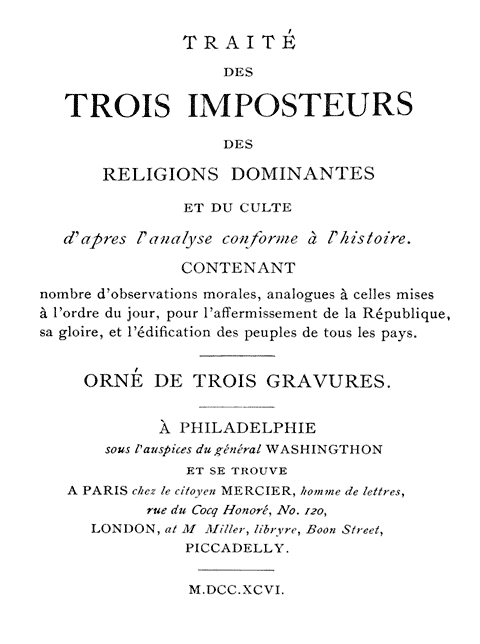
TRAITÉ DES TROIS IMPOSTEURS DES RELIGIONS DOMINANTES ET DU CULTE d’apres l’analyse conforme à l’histoire.
CONTENANT
nombre d’observations morales, analogues à celles mises à l’ordre du jour, pour l’affermissement de la République, sa gloire, et l’édification des peuples de tous les pays.
ORNÉ DE TROIS GRAVURES.
À PHILADELPHIE sous l’auspices du général WASHINGTHON ET SE TROUVE A PARIS chez le citoyen MERCIER, homme de lettres, rue du Cocq Honoré, No. 120, LONDON, at M. Miller, libryre, Boon Street, PICCADELLY.
M.DCC.XCVI.
Note.—This edition has undoubtedly been translated from the original Latin manuscript.—A. N.
Translation. Treatise of the Three Impostors of the governing Religions and worship, after an examination conformable to history, containing a number of moral observations, analogous to those placed in the order of the day for the support of the republic, its glory, and the edification of the people of all countries. Ornamented with three engravings. At Philadelphia under the auspices of General Washington, and may be found at Paris at the house of Citizen Mercier (Claude Francois Xavier6), man of letters, 120 Cocq Honoré street, and at London at Mr. Miller’s, bookseller, Boon street, Piccadelly, 1796.
On the following page may be found the following:
LE PEUPLE FRANÇAIS RECONNANT L’ÊTRE SUPRÊME L’IMMORTALITÉ DE L’AME ET LA LIBERTÉ DES CULTES
——7
TRAITÉ DES Religions Dominantes8
Chapter I. Concerning God, 6 paragraphs.
Chapter II. Reasons, etc., 11 paragraphs. ,,
Chapter III. Religious, 9 paragraphs. ,,
“Les prêtres ne sont pas ce qu’un vain peuple pense
Notre crédulité fait toute leur science.”
Priests are not what vain people think,
Our credulity makes all their science.
Chapter IV. Moses, 2 paragraphs.
Chapter V. Jesus Christ, 10 paragraphs. ,,
Paragraph 2. Politics; paragraph 6. Morals.
Chapter VI. Mahomet, 2 paragraphs.
Chapter VII. Evident Truths, 6 paragraphs. ,,
Chapter VIII. The Soul, 7 paragraphs. ,,
Chapter IX. Demons, 7 paragraphs. ,,
Facing page twenty-seven is a medallion copper plate of Moses, around which are these words (translated): “Moses saw God in the burning bush,” and beneath the following from Voltaire’s Pucelle (translated):
Alone on the summit of the mysterious mount
As he desired, he closed his fortieth year.
Then suddenly he appeared upon the plain
With buck’s horns9 shining on his forehead.
Which brilliant miracle in the mind of the philosopher
Created a prompt effect.”
In a note to par. II. occur the following lines which translated read:
“How many changes a revolution makes:
Heaven has brought us forth in happy time
To see the world——Here the weak Italian
Is frightened at the sight of a stole:
The proud Frenchman astonished at nothing
Boldly goes to defy the Pope at his capital
And the grand Turk in turban, like a good Christian,
Recites the prayers of his faith
And prays to God for the pagan Arab,
Having no thought of any kind of expedient
Nor means to destroy altars and idol worship.
The Supreme Being his only and sole support,
Does not exact for offering a single coin
From any sect, from Jew nor plebeian:
What need has He of Temple or archbishop?
The heart of the just and the general good
Shines like a brilliant sun on the halo of glory.”
Then follows a “Bouquet for the Pope”:
“Thou whom flatterers have invested with a vain title,
Shalt thou at this late day become the arbiter of Europe?
Charitable pontiff, and friend of humanity,
Having so many sovereigns as fathers of families,
The successors of Christ, in the midst of the sanctuary
Have they not placed unblushingly, incest and adultery?
Be this the last of imposture and thy last sigh.
Do thyself more honor, esteem and pleasure,
Than all the monuments erected to the glory
Of thy predecessors in the temple of memory.
Let them read on thy tomb ‘he was worthy of love,
The father of the Church and oracle of the day.’”
On the following page is a copper plate profile portrait of Pius VI. surrounded by the words “Senatus Populus Que Romanus.” At the side Principis Ecclesiae dotes vis Cernere Magni. (Senate and People of Rome—Prince of the Church endowed with power and great wisdom.) Beneath:
“The talents of the learned and the virtues of the wise,
A noble and beneficent manner with which all are charmed,
Depict much better than this image
The true portrait of Pius VI.”
Facing page fifty-one is a copper plate portrait of Mahomet, and beneath this tribute:
“Know you not yet, weak and superb man,
That the humble insect hidden beneath a leaf
And the imperious eagle who flies to heaven’s dome,
Amount to nothing in the eyes of the Eternal.
All men are equal: not birth but virtue
Distinguishes them apart.”
Then there are inserted a number of verses, some of the titles reading:
“Homage to the Supreme Being.”
“Voltaire Admitted to Heaven.”
“Homage to the Eternal Father.”
“Bouquet to the Archbishop of Paris.”
“Infinite Mercy—Consolation for Sinners.”
“Lots of Room in Heaven.”
“The Holy Spirit Absent from Heaven,” etc.
Concluding with “A Picture of France at the Time of the Revolution.”
“Nobility without souls, a fanatical clergy.
Frightful tax gatherers gnawing a plucked people.
Faith and customs a prey to designing persons.
A price set upon the head of the Chancellor (Maupeou).
The skeleton of a perfidious Senate.
Not daring to punish a parricidal conspiracy.
O, my country! O, France! Thy miseries
Have even drawn tears from Rome.10
If you have no Republic, and no pure legislators
Like exist in America, to deliver you from the oppression
Of a tyrannous empire of knaves, brigands and robbers;
Like the British cabinet and the skillful Pitt, chief of flatterers,
Who with his magic lantern fascinates even the wise ones.
This clique will soon be seen to fall, if the French become the conquerors
Of this ancient slavery, and show themselves the proud protectors
Of their musical Carmagnole.
In the name of kings and emperors, how much iniquity and horror
Which are recorded in history, cause the reader to shudder with fright.
The entrance of friends in Belgium, to the eyes of those who know,
Is it not an unique epoch?
And this most flattering tie, sustained by a heroic compact,
Will be the desire of all hearts.”
À BOSTON
under the protection of Congress.
Bound in this volume is a pamphlet entitled “La Fable de Christ devoilée.” Paris: Franklin Press. 75 Rue de Clery. 2nd year of the Republic. Also, “Éloge non-funèbre de Jesus et du Christianisme. Printed on the débris of the Bastille, and the funeral pile of the Inquisition. 2nd year of Liberty, and of Christ 1791.”
Another closes the volume: “Lettres Philosophique sur St. Paul: sur sa doctrine, politique, morale, & réligieuse, & sur plusieurs points de la réligion chrétienne considerées politiquement.” (J. P. Brissot de Warville.) Translated from the English by the philosopher de Ferney and found in the portfolio of M. V. his ancient secretary. Neuchatel en Suisse 1783.
Note translated from the edition “En Suisse, de l’imprimerie philosophique,” 1793.
In a response to M. de la Monnoye, who laboriously endeavored to refute the existence of the treatise entitled “The Three Impostors,” and which reply in addition to M. de la Monnoye’s arguments appear in connection with some of the translations of the treatise, occurs the following introduction to the account of the discovery of the original manuscript: “I have by me a more certain means of overturning this dissertation of M. de la Monnoye, when I inform him that I have read this celebrated little work and that I have it in my library. I will give you and the public an account of the manner in which I discovered it, and as it is in my possession I will subjoin a short but faithful description of it.”
Here follows a summary of the contents and the Dissertation, in substance the same as our manuscript; the response concluding as follows:
“Such is the anatomy of this celebrated work. I might have given it in a manner more extended and more minute; but besides that this letter is already too long, I think that enough has been said to give insight into the nature of its contents. A thousand other reasons which you will well enough understand, have prevented me from entering upon it to so great length as I could have done; “Est modus in rebus.”11
“Now although this book were ready to be printed12 with the preface in which I have given its history, and its discovery, with some conjectures as to its origin, and a few remarks which may be placed at its conclusion, yet I do not believe that it will live to see the day when men will be compelled all at once to quit their opinions and their imaginations, as they have quitted their syllogisms, their canons, and their other antiquated modes. As for me I will not expose myself to the Theological stylus13—which I fear as much as Fra-Poula feared the Roman stylus—to afford to a few learned men the pleasure of reading this little treatise; but neither will I be so superstitious, on my death bed, as to cause it to be thrown into the flames, which we are informed was done by Salvius, the Swedish ambassador, at the peace of Munster. Those who come after me may do what seems to them good—they can not disturb me in the tomb. Before I descend to that, I remain with much respect, your most obedient servant,
J. L. R. L.
“Leyden, 1st January, 1716.”
This letter was written by Mr. Pierre Frederick Arpe, of Kiel, in Holstein; the author of an apology for Vanini, printed in octavo at Rotterdam, 1712.
