Editorial note — CHAP. VII
Reading edition
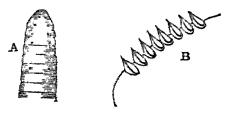
EYES AND TEETH OF THE LAND LEECHES OF CEYLON.
1: Hæmadipsa Ceylanica, Bosc. Blainv. These pests are not, however; confined to Ceylon; they infest the lower ranges of the Himalaya. —HOOKER, vol. i. p. 107; vol. ii. p. 54. THUNBEBG, who records (Travels, vol. iv. p. 232) having seen them in Ceylon, likewise met with them in the forests and slopes of Batavia. MARSDEN (Hist. p. 311) complains of them dropping on travellers in Sumatra. KNORR, found them at Japan; and it is affirmed that they abound in islands farther to the eastward. M. GAY encountered them, in Chili.—MOQUIN-TANDON, (Hirudinèes, p. 211, 346.) It is very doubtful, however, whether all these are to be referred to one species. M. DE BLAINVILLE, under H. Ceylanica, in the Diet, de Scien. Nat. vol. xlvii. p. 271, quotes M. BOSC as authority for the kind which that naturalist describes being "rouges et tachetées;" which is scarcely applicable to the Singhalese species. It is more than probable therefore, considering the period at which M. BOSC wrote, that he obtained his information from travellers to the further east, and has connected with the habitat universally ascribed to them from old KNOX'S work (Part I. chap, vi.) a meagre description, more properly belonging to the land leech of Batavia or Japan, In all likelihood, therefore, there may be a H. Boscii, distinct from the H. Ceylanica. That which is found in Ceylon is round, a little flattened on the inferior surface, largest at the extremity, thence graclimlly tapering forward, and with the anal sucker composed of four rings, and wider in proportion than in other species. It is of a clear brown colour, with a yellow stripe the entire length of each side, and a greenish dorsal one. The body is formed of 100 rings; the eyes, of which there are five pairs, are placed in an arch on the dorsal surface; the first four pairs occupying contiguous rings (thus differing from the water-leeches, which have an unoccupied ring betwixt the third and fourth); the fifth pair are located on the seventh ring, two vacant rings intervening. To Dr. Thwaites, Director of the Botanic Garden at Peradenia, who at my request examined their structure minutely, I am indebted for the following most interesting particulars respecting them. "I have been giving a little time to the examination of the land leech. I find it to have five pairs of ocelli, the first four seated on corresponding segments, and the posterior pair on the seventh segment or ring, the fifth and sixth rings being eyeless (fig. A). The mouth is very retractile, and the aperture is shaped as in ordinary leeches. The serratures of the teeth, or rather the teeth themselves, are very beautiful. Each of the three 'teeth,' or cutting instruments, is principally muscular, the muscular body being very clearly seen. The rounded edge in which the teeth are set appears to be cartilaginous in structure; the teeth are very numerous, (fig. B); but some near the base have a curious appendage, apparently (I have not yet made this out quite satisfactorily) set upon one side. I have not yet been able to detect the anal or sexual pores. The anal sucker seems to be formed of four rings, and on each side above is a sort of crenated flesh-like appendage. The tint of the common species is yellowish-brown or snuff-coloured, streaked with black, with a yellow-greenish dorsal, and another lateral line along its whole length. There is a larger species to be found in this garden with a broad green dorsal fascia; but I have not been able to procure one although I have offered a small reward to any coolie who will bring me one." In a subsequent communication Mr. Thwaites remarks "that the dorsal longitudinal fascia is of the same width as the lateral ones, and differs only in being perhaps slightly more green; the colour of the three fasciæ varies from brownish-yellow to bright green." He likewise states "that the rings which compose the body are just 100, and the teeth 70 to 80 in each set, in a single row, except to one end, where they are in a double row."
2: The Minorite friar, ODORIC of Portenau, writing in A.D. 1320, says that the gem-finders who sought the jewels around Adam's Peak, "take lemons which they peel, anointing themselves with the juice thereof, so that the leeches may not be able to hurt them."—HAKLUYT, Voy. vol. ii. p. 58.
3: DAVY'S Ceylon, p. 104; MARSHALL'S Ceylon, p. 15.