Volume 2 / Part 3 — PART III. (continued 2)
Reading edition
The disease was probably not unknown among the Anglo-Saxons, yet the silence of their laws (the word Leper is not to be found in the index to Thorpe’s Collection) with regard to it, contrasts strongly with the frequent enactments for its prevention in the twelfth and thirteenth centuries both in England and Scotland, and (if we allow the Welsh laws the antiquity which is claimed for them) in the tenth and eleventh centuries in Wales. May not the anomaly be explained by supposing that the disease broke out with new severity about the beginning of the twelfth century?
Scotland.—No trace of leprosy is to be found in Adamnan’s Life of St. Columba, written in the seventh century. But of one of St. Columba’s contemporaries—St. Kentigern of Glasgow, who died about 600—it is related that in that city he cleansed lepers—“mundabat leprosos.” These are the words of his biographer, Joceline of Furnes, who wrote towards the end of the twelfth century.—(Vit. S. Kentigerni, cap. xxxiv.; Pinkert. Vit. Antiq. Sanct. Scotiæ, p. 270.) The same biographer relates that at St. Kentigern’s tomb in Glasgow lepers were cured—“leprosis cutis munditia restituitur.”—(Vit. S. Kentigerni, cap. xliv.; Pinkert. Vit. Antiq. SS. Scot., p. 295.)
So also it is related of St. Boniface of Rosemarky, who appears to have flourished in the beginning of the eighth century, that he cleansed lepers—“leprosos mundabat.” These are the words of the Breviary of Aberdeen (Proprium Sanctorum pro tempore hyemali, fol. lxx.), printed in 1510, but quoting and using older materials.
St. Aelred of Rievaux, who died in 1166, relates that lepers were cleansed at the tomb of St. Ninian at Whithern in Galloway—“ad ejus namque sacratissimum tumulum curantur infirmi, mundantur leprosi.”—(Vit. S. Ninian, cap. xi.) He mentions specially two cases:—
“Visi sunt præterea venire in civitatem viri duo leprosi. Qui præ sumptuosum æstimantes cum lepræ contagio scabiem tangere, quasi delonge poscunt auxilium. Accedentes autem ad fontem, et sanctum arbitrantes quidquid sanctus contigerat Ninianus, lavacio illo se abluendos putarunt.... Mundantur leprosi tactu lavacio, sed meritis Niniani.”—(Vit. S. Niniani, cap. xi. § 4; Pinkert. Vit. Antiq. SS. Scot., pp. 22, 23.)
All these writers—St. Aelred of Rievaux, Joceline of Furnes, and the compiler of the Aberdeen Breviary—wrote so long after the Saints whose miracles they commemorate, that their testimony cannot avail as proof in itself of the existence of leprosy in Scotland in the seventh and eighth centuries. Besides, they speak only in general terms—“leprosos mundabat,”—which may be little or nothing more than a rhetorical flourish. But the passages which have been quoted are at least sufficient to demonstrate that in the twelfth century the existence of leprosy in Scotland from a remote age was a matter of unquestioned belief. Of the general prevalence of the disease on this side of the Tweed in that and the subsequent age, there is abundant evidence elsewhere in the Leges Burgorum and other ancient capitularies of Scotch law.
The canon of the Scotch Church, “De monitionem faciendo leprosis,” printed in the Registrum Episcopatus Aberdonensis, vol. ii. p. 32, and elsewhere, belongs to the thirteenth century, probably to the latter part of that century. If, as seems to be the case, it be merely a diocesan statute, and not a statute for the whole of Scotland, it will only show more forcibly the general prevalence of the disease. The diocese for which it was enacted was apparently Aberdeen, containing at that time about eighty parishes, and the number of lepers must have been great before it could be found necessary to guard against the injury done to the parochial clergy by the withdrawal of the dues and oblations of the inmates of the leper hospitals.
Leprosy in Wales.
The Venedotian Code (the Laws of the Women)—
“Should her husband be leprous, or have fetid breath, or be incapable of marital duties; if on account of one of these three things she leave her husband, she is to have the whole of her property.”—(Ancient Laws and Institutes of Wales, p. 39. Lond. 1841.)
The Dimetian Code (of Women)—
“For three causes, if a woman desert her husband, she is not to lose her agweddi [dowry]; for leprosy, want of connection, and bad breath.”—(Ancient Laws and Institutes of Wales, p. 255.)
The Laws of Howel Dda, according to the Gwentian Code (of Women)—
“For three causes a woman loses not her agweddi, although she may leave her husband; to wit, on account of leprosy, bad breath, and default of connection.”—(Ancient Laws and Institutes of Wales, p. 365.)
These citations are from Aneurin Owen’s translation of the Welsh text of the Welsh laws, published in parallel columns with the Welsh text by the Record Commissioners. These laws are of uncertain date; they are commonly attributed to Howel Dda, but bear interpolations or alterations of much later date. The oldest MSS. of them are of the twelfth century.
I add the passages regarding lepers which occur in the Latin versions of the Welsh Laws, the oldest MSS. of which are of the thirteenth century:—
“Tribus de causis potest femina habere suum egwedy [suam dotem], licet ipsa uirum relinquat; scilicet, si sit leprosus uir; et si habeat fetidum anhelatum; et si cum ea concumbere non possit.”—(Liber Legum Howel Da, lib. ii. cap. xx., sec. xxxi. Ancient Laws and Institutes of Wales, p. 796; Lond. 1841.)
“Tribus de causis habebat femina suum aguedi [suam dotem], licet ipsa virum suum relinquat; id est, si leprosus sit vir; et si fetidum hanelitum habueret; et si cum ea coire non possit.”—(Liber Legum Howel Da, lib. ii. cap. xxiii. sec. xiii. Ancient Laws and Institutes of Wales, p. 827.)
“Leprosi cum seculum dimittunt ebedyw [i.e. heriot seu caulp] dare debent dominis suis.”—(Liber Legum Howel Da, lib. ii. cap. xxii. sec. ix. Ancient Laws and Institutes of Wales, p.797.)
The Dimetian Code (of Murder)—
“If there be a relative of the murderer, or of the murdered, who is an ecclesiastic in holy orders, or in an ecclesiastical community, or leprous, or dumb, or an idiot, such neither pays nor receives any part of galanas” [assythment, or fines for murder].—(Ancient Laws and Institutes of Wales, p. 200.)
The Dimetian Code (Triads)—
“There are three persons, no one of whom, by law, can be a qualified judge; one of them is, a person having a defect, as one who is deaf, or blind, or leprous, or an insane person,” etc. etc.—(Ancient Laws and Institutes of Wales, p. 200.)
The next class of passages is taken from what are called the “Anomalous Welsh Laws,” which, in the state they are now found in, are supposed to be of the sixteenth century:—
“If a person become a surety, and before the termination of the suit he should become leprous, or a monk, or blind, .... he must fulfil his promise while he lives.”—(Ancient Laws and Institutes of Wales, p. 403.)
“There is to be no objection to a pleader, but for having violated his religious profession, and quitting the world, or his becoming a separated leper.”—(Ancient Laws and Institutes of Wales, p. 516.)
“Three sons who are not to have patrimony—The son of a priest, the son of a leper, and the son of a man who had paid his patrimony as blood land. The son of a leper is not to have it, because God has separated him from worldly kin—that is, such son as a leper may have after being adjudged to a lazar-house; and a son a priest shall have after taking priestly orders; and the third has no patrimony, as his father, prior to him, had determined it by law.”—(Ancient Laws and Institutes of Wales, p. 556. See also p. 603.)
“Three persons to whom saraad [fine for insult] is not due—A leper, a natural fool, and an alltud [an alien serf] who is not married to an innate Cymraes: And, nevertheless, there is worth in law attached to each of them, and whoever shall ill-use them and injure them in person and property is subject to a dirwy [fine or punishment].—(Ancient Laws and Institutes of Wales, p. 656.)
“Three persons who are not to be invested with the judicial function—An inefficient person, as one that is deaf, or blind, or maimed, or leprous, or insane, or mute,” etc. etc.—(Ancient Laws and Institutes of Wales, p. 671.)
“A leper cannot be a pleader.”—(Ancient Laws and Institutes of Wales, p. 764.)
The Welsh term for leper is Clafwr, obviously an adaptation of the Latin word.
It should be kept in view that the license which the Welsh laws give to the wife to leave a leprous husband is in direct contradiction to the canon law as declared by Pope Alexander III. to the Archbishop of Canterbury in 1180:—“Mandamus quatenus si qui sunt in provincia tua viri vel mulieres qui lepræ morbum incurrunt, ut uxores viros et viri uxores sequantur, et eis conjugali affectione ministrent, sollicitis exhortationibus inducere non postponas. Si vero ad hoc induci non poterunt, eis arctius injungas ut uterque altero vivente continentiam servet. Quodsi mandatum tuum servare contempserint, vinculo excommunicationis adstringas.”—(Corpus Juris Canonici, vol. ii. col. 656. Edit. 1747.)
The same Pope, in the same year, decreed that lepers might marry:— “Leprosi autem si continere nolunt, et aliquam quæ sibi nubere velit invenerint, liberum est eis ad matrimonium convolare.” He settled another and more delicate point:—“Quodsi virum sive uxorem divino judicio leprosum fieri contigerit, et infirmus a sano carnale debitum exigat, generali præcepto Apostoli, quod exigitur est solvendum: cui præcepto nulla in hoc casu exceptio invenitur.”—(Corpus Juris Canonici, vol. ii. col. 656. Edit. 1747.)
Pope Urban III. found, in 1186, that subsequent leprosy was a sufficient reason why betrothed persons should not be compelled to marry.—(Corpus Juris Canonici, vol. ii. col. 657. Edit. 1747. See also col. 344.)
Nomenclature of the Disease.—The terms “Leprosi” and “Elephantuosi.”
The “MS. History of the Durham Cathedral and Diocese,” referred to in Sir James Simpson’s Paper, Part II. p. 77, was printed in Wharton’s Anglia Sacra in 1691, and more perfectly in the Historiæ Dunelmensis Scriptores Tres, by the Surtees Society in 1839. The passage quoted stands thus (pp. 11, 12):—
“Præterea Hospitale de Schyreburne construxit, et elefantiosos in episcopatu suo circumquaque collectos, ibidem instituit, aptisque eorum usibus habitaculis ampliant; et ne quid sollicitudini caritatis deesset, ad eorum perpetuam sustentationem et nonnullorum susceptionem terras et ecclesias concessit et confirmavit. In geminum creditur esse bonum, quod et pauperum necessitatibus liberrime prospexit, et societatem immundorum a cohabitacione mundorum segregavit.”
“Elephantuosi” is here put as equivalent to “Leprosi.” In the Chronicle of Battle Abbey, written about 1180-1200, some slight distinction seems to be implied between the words. The writer is speaking of the Abbot Walter, who died in 1171:—
“Leprosorum maxime et elephantiosorum ab hominibus ejectioni compatiens, eos non solum non abhorrebat, verumetiam in persona propria eis frequenter ministrans, eorum manus pedesque abluendo fovebat, et intimo caritatis pietatisque affectu blanda oscula imprimebat.”—(Chronicon Monasterii de Bello, p. 135; Lond. 1846. Anglia Christiana.)
But, after all, the two terms may here be used merely rhetorically. There are other instances of such a tautology. Ducange (t. iii. coll. 49, 50), quotes Elephantiæ lepra and “Leprosi enim vere atque Elephantia debent habere.” At the same time he cites from an old Latin-French Glossary, “Elephancia = une maniere de mesclerie.” In the same way some writers distinguish between mesellerie and cordrerie. On the other hand, the Catholicon Anglicum, an Anglo-Latin Dictionary of the year 1483, has “A Lepyr = lepra, elefancia, missella.”—(Promptorium Parvulorum, vol. i. pp. 297, 298. Lond. 1843. Camden Soc.)
Description of a Leper.
Reginald of Durham (sometimes also called Reginald of Coldingham), a Benedictine monk, who wrote before 1195, gives the following description of a leper girl who had been for three years in the hospital at Budele, near Darlington, in the bishopric of Durham:—
“Nempe omnem facierum illius superficiem laceræ putredinis cicatrix nunquam sana totam obduxerat, et falliculis [l. folliculis] crudæ carnis sparsim patentibus et hiulco meatu saniem venenoso meatu rimantibus, horridam cunctis visu reddiderat. Labiorumque ipsius extrema circumquaque marcentia diriguerant, quia particulares quasdam ejus regiones usque ad profunda quædam dimensionum dispendia vis sæva diutini languoris consumendo exederat. His itaque aliisque illius aegritudinus modis corpus ejus dilaceratum periit,” etc.—(Libellus de Vita et Miraculis S. Godrici, p. 456. Lond. 1847. Surtees Soc.)
The leprosy is cured by a miracle at the tomb of S. Godric at Finchale, when the appearance of the face is thus described:—
“tota sana comparuit, omnisque lepræ prioris fœda scabies jam recesserat, labiaque illius sana ac tenua, facies vero tota incontacta ac clara, velut parvuli cujusdam triennis apparebat. Quæ una cum matre sospes domum rediit, quæ illo prius tota lepræ pustulis et sanie contracta pervenit.”
Among other witnesses to the miraculous cure, Ralph Haget, sheriff of Durham,
“dicebat quod facies ejus cutis licet sana, tenera sit et clara, tamen ubi cicatrices ulcerum quondam fuerant illa superficies videtur aliquantulum comparere subrufa; labiorum vero extrema quæ frustris carneis pinis fuerant valliculata, tota sunt plena atque rotunda, sed aliquanto altius prominentia.”
This was confirmed also by Norman the priest of Hailtune, who got the girl into the lepers’ hospital at Badele, near Darlington, and who subsequently showed her to his parishioners in his church.—(Libellus de Vita et Miraculis S. Godrici, pp. 457, 458.)
The same writer, in the same work, gives other descriptions of leprosy. A young shepherd of the north of England “lepra percussus cunctis horrori fuit.” He is miraculously cured—“tumorque omnis cum deformi rubore fugatus abscesserat, novaque coloris insoliti superficies in facie et toto corpore ipsius relucebat; et nulla omnino pustula vel cicatricis macula in ipso residendo comparuit.”—(Lib. de Vit. et Mirac. S. Godrici, p. 431.)
A woman—“diutino tempore toto corpore lepræ fuerat contagio maculisque cum pustulis horrende perfusa ... cunctis horrida et detestenda, nulli pene ad videndum tolerabilis fuerat.”—(Lib. de Vit. et Mirac. S. Godrici, p. 431.)
Rank of the Persons attacked by Leprosy.
In 1203, a piece of land in Sudton in Kent was in dispute in the King’s court between two kinswomen—Mabel, the daughter of William Fitz Fulke, and Avicia, the widow of Warine Fitz Fulke. Among other pleas, it was urged by Avicia, that Mabel had a brother, and that his right to the land must exclude her claim. Mabel answered that her brother was a leper—“E contra dicit Mabilla quod leprosus est.” The judgment is not recorded; but the notice shows two things—(1) The doctrine of the civil death which followed leprosy; (2) The comparatively good condition of the person who in this instance was smitten with leprosy.
The case is recorded in the Placitorum in Domo Capitulari Westmonesteriensi asservatorum Abbreviatio, p. 39. Lond. 1811. Record Commission.
In 1280 it was certified to King Edward I. that Adam of Gangy, brother and heir of Ralph of Gangy, deceased, of the county of Northumberland, holding land of the king in chief, was struck with leprosy (leperia percussus), so that he could not conveniently repair to the king’s presence to pay his homage to the king (quod ad presenciam Regis ad homagium suum Regi faciendum commode accedere non potest). It was therefore ordered that Thomas of Normanville, the elder, should in lieu and turn of the king take the leper’s fealty for his lands.—(Rotulorum Originalium in Curia Scaccarii Abbreviatio, vol. i. p. 33. Lond. 1805.)
Here, again, we see leprosy attacking a person of comparatively high position. But here the disease neither inferred civil death nor excluded the leper from all intercourse with his fellows.
In 1313, Nicholas the Leper (Nicholaus le Lepere) and William the Leper (Willielmus le Lepere) are manucaptors or pledges that John de la Poile, knight of the shire returned for Surrey, will do his duty in Parliament.—(Palgrave’s Parliamentary Writs, vol. ii. pp. 89, 113.)
Here we have a family of note bearing the name of Leper, derived no doubt from the leprosy of an ancestor.
Before 1083 a miraculous cure of leprosy is said to have been effected at the shrine of St. Cuthbert at Durham, on the person of a noble of the south of England—“vir quidam in longinqua Australium Anglorum regione qui multæ nobilitatis gratia inter comprovintiales preditus erat. Hic tam corporis sani virtute gaudebat, quam omni prosperitatis affluentia; et divitiarum gloria cæteros excedebat,” etc. etc.—(Reginaldi Dunelmensis Libellus de Beati Cuthberti Virtutibus, pp. 37-41. Lond. 1835. Surtees Soc.)
The same writer, in another work, relates the cure of three lepers at the tomb of St. Godric of Finchale. One, a male, was a shepherd; the other two were women, apparently of the middle or lower ranks.—(Reginaldi Dunelmensis Libellus de Vita et Miraculis S. Godrici, pp. 430, 431, 455-458. Lond. 1845. Surtees Soc.) The shepherd was a youth (juvenis); one of the women was a girl (puella).
Lepers among the Clergy.
Another illustration of the prevalence of leprosy among the English clergy, alluded to at p. 106, Part III., is supplied by the will of Richard Basy, of Bylburgh, in Yorkshire, in 1393:—“Item lego presbiteris cæcis vel leprosis seu aliter languentibus, qui non valent celebrare circa divinum officium celebrandum, et aliis pauperibus eodem modo languentibus et jacentibus, xl. solidos.”—(Testamenta Eboracensia, vol. i. p. 192. Lond. 1836. Surtees Soc.)
Pope Lucius III. decreed in 1181 that rectors of churches who were struck with leprosy should serve their cures by coadjutors; and Pope Clement III., in 1190, ordained that leprous priests should be removed from their priestly office, but should be supported from the fruits of their benefices.—(Corpus Juris Canonici, vol. ii. coll. 447-448. Edit. 1747.)
Case of King Robert Bruce.
The silence of Wyntoun, Fordun, and our other early Scotch chroniclers, as to the disease of which King Robert Bruce died, may not improbably be explained by their reluctance to associate the heroic monarch with an odious and degrading malady. But the King’s metrical biographer names his disease, or at least its origin; and it would be interesting to know if that disease can be identified with leprosy.
“For a malice him tuk sa sar, That he on na wiss mycht be thar. This malice off enfundeying Begouth; for, through his cald lying, Quhen in his gret myscheiff wes he, Him fell that hard perplexite.”
—(Barbour’s Bruce, pp. 406-407. Dr. Jamieson’s edit. 1820.)
In Mr. Cosmo Innes’ later edition the passage stands thus—
“For ane male es tuk him sa sar That he on na wis mycht be thar. His male es of ane fundying Begouth, for throu his cald lying, Quhen in his gret mischef was he, Him fell that hard perplexite.”
—(Barbour’s Bruce, p. 469. Aberd. 1856. Spalding Club.)
What is “enfundeying,” as Dr. Jamieson calls it, or “ane fundying,” as Mr. Innes makes it? Dr. Jamieson glosses it as “perhaps asthma,” but on what ground I do not see. At the same time I am unable to suggest any interpretation of the term. Can medical nomenclature supply none?
Contagiousness of Leprosy.
To the list of persons (Part III. pp. 133, 134) who tended or even kissed lepers without being smitten with the disease, may be added Walter de Luci, Abbot of Battle, in Sussex, from 1139 to 1171, who often washed and kissed the feet and hands of lepers—eorum manus pedesque abluendo fovebat, et intimo caritatis pietatisque affectu blanda oscula imprimebat.—(Chronicon Monasterii de Bello, p. 135. Lond. 1846. Anglia Christiana.)
The story (Sir James Simpson’s Paper, Part III. p. 134) quoted from Matthew Paris, about the good Queen Maud, is to be found in an earlier writer, St. Aelred of Rievaux, from whose Genealogia Regum Anglorum Matthew Paris, or rather Roger of Wendover, borrowed it. It may be remarked, generally, that late editors have shown that all that part of Matthew Paris’ history which is previous to the year 1235 is really the work of Roger of Wendover. As such it has been reprinted by the English Historical Society.
List of Leper Hospitals.
Oxford, St. Bartholomew.—The date of foundation of this hospital is left blank in the list of British Leper Hospitals, p. 160. It certainly existed before the 24th November 1200, when the lepers of St. Bartholomew of Oxford had letters of protection from King John.—(Rot. Chart. in Turr. Lund. vol. i. p. 99.)
Berington.—On the 20th July 1199 King John confirms to the canons regular of Lantony, among their other possessions, the half of Berington, which had been given to them by the Earl Roger for the procuration of thirteen lepers—“Ex dono Rogeri Comitis aliam dimidietatem de Berington ad procurationem tredecim leprosorum.”—(Rot. Chart. in Turr. Lund. vol. i. p. 7.) “Procuratio” seems to be used here in the sense of necessaria ad victum et vestitum.—(See Ducange, t. v. col. 885.)
Carlisle.—The lepers of Carlisle had letters of protection from King John on 25th February 1201.—(Rot. Chart. in Turr. Lund. vol. i. p. 101.)
Badele, near Darlington, in the county of Durham.—The reception of a leprous girl into the hospital of Badele, about three miles from Darlington, is related by Reginald of Durham in his Libellus de Vita et Miraculis S. Godrici, p. 456. Lond. 1845. (Surtees Soc.) The work was written before 1195.
Canterbury.—The date of foundation of this hospital is left blank in the list of British Leper Hospitals, p. 158. It certainly existed before the death of Archbishop Lanfranc in 1089, for the contemporary historian of Canterbury expressly says it was built by him:—“Ligneas domos in devexo montis latere fabricans, eas ad opus Leprosorum delegavit, viris in istis a fœminarum societate sejunctis.”—(Eadmeri Hist. Novorum, p. 9. Lond. 1623.)
York.—One leper hospital at York is noted in the list of British Leper Hospitals, at p. 161. There were four. The will of Henry of Blythe, painter of York, in 1365, has this bequest:—“Item lego quatuor domibus Leprosorum civitatis Eboracencis equaliter ij solidos dividendos.”—(Testamenta Eboracensia, vol. i. p. 75. Lond. 1836. Surtees Soc.) The will of Master Adam Wigan, rector of St. Saviour’s, York, in 1433, has—“Item lego cuilibet domui quatuor domorum leprosorum iij s. iiij d.”—(Test. Ebor. vol. ii. p. 26. Lond. 1855. Surtees Soc.) The will of Richard Russell, citizen and merchant of York, in 1435, shows that at York, as elsewhere, the leper hospitals were beyond the city walls:—“Et cuilibet leproso in quatuor domibus Leprosorum in suburbiis Ebor., v solidos.”—(Test. Ebor. vol. ii. p. 55.) Again, in the will of William Gyrlyngton, draper of York, in 1444:—“Item lego quatuor domibus Leprosorum in suburbiis Ebor., xx solidos per equales portiones.”—(Test. Ebor. vol. ii. p. 93.) The lepers of York have similar bequests in 1446, in 1454, and 1441.—(Test. Ebor. vol. ii. pp. 115, 182, 187.) I do not observe any legacies to them after 1454.
Beverley.—The leper hospital here, as at York, Canterbury, Glasgow, Stirling, Aberdeen, etc., stood in the suburbs. The will of John Brompton, merchant of Beverley, in 1444, has this legacy—“Item leprosis extra barras boriales Beverlaci ij s. et dimidiam celdram carbonum.”—(Test. Ebor. vol. ii. p. 97.)
Newcastle-upon-Tyne.—The will of Roger Thornton, merchant of Newcastle, in 1429, has this legacy—“Item to the Lepre men of Newcastell, xl s.”—(Northern Wills and Inventories, part i. p. 78. Lond. 1835. Surtees Soc.)
Winchester.—The existence of a leper hospital at Winchester is shown by the will of Martin of Holy Rood, master of the hospital of Sherborn, in 1259 [referred to in Sir James Simpson’s Paper, Part I., p. 36]—“Fratribus Leprosis Wyntonie, ij solidos.”—(Northern Wills and Inventories, part i. p. 10.)
Lynne, Norfolk.—Five leper hospitals at Lynne, in Norfolk, are enumerated in the list of British Leper Hospitals, p. 160. There seem to have been six. Mr. Albert Way, in a note to the Promptorium Parvulorum, vol. i. p. 297, Lond. 1843 (Camden Soc.), cites, from Parkins’ Account of Lynne, in Blomf. Norf. iv. 608, the bequest of Stephen Guybor, in 1432, to every house of lepers about Lynn, “namely, at West Lynn, Cowgate, Herdwyk, Setchehithe, Mawdelyn, and Geywode.” Four of these may be identified with those in the list, p. 160. “West Lynn” and “Cowgate” are the same in both lists; “Mawdelyn” is “St. Mary Magdalene’s;” and “Setchehithe” is “Setch Hithe.”
SIZE OF ORIGINALS.
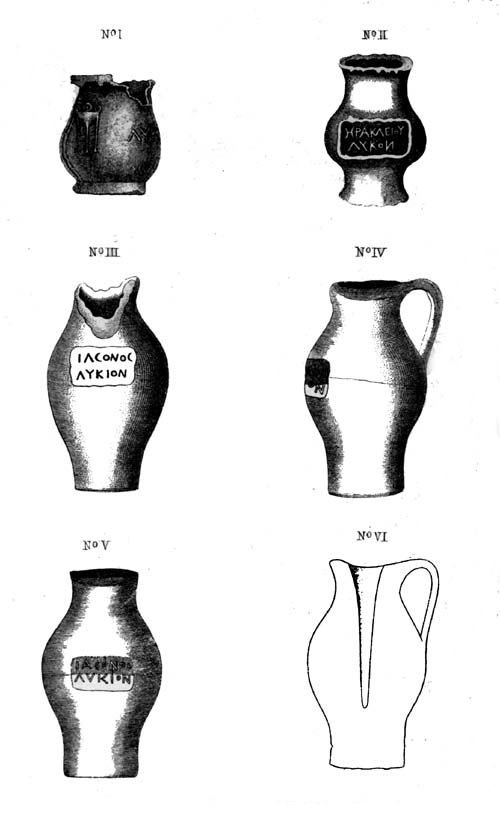
ANCIENT GREEK MEDICINE VASES.