Editorial note — Chaucer. (continued 2)
Reading edition
Neither edition includes a facsimile of the original MS. Readers will have to decide for themselves which differences reflect editorial decisions and which ones are errors in one edition or the other.
Unless otherwise noted, words or letters shown in [brackets] were italicized in the 1865 edition. Other changes are marked in different shades of grey, with mouse-hover popups where appropriate. Within popup text, italics are shown in {braces}, superscripts with leading ^ (caret).
• clear error, almost always corrected from 1876 edition
• changed spelling, including handling of expanded contractions and “&” for “and”
• changed word, including singular/plural alternation and bracketed letters
• added word
• missing word
Not noted:
editorial and typographic differences such as punctuation and capitalization, or the use of boldface type
decorative letterforms, especially final -ll printed with a connecting line
differences that have no exceptions:
• initial v for both u and v (medial u/v is variable)
• you replacing both you and you (“your” is variable)
• prices shown inline as ijs. instead of ijs.
• Sir for Sr
Common differences:
n for u: some readings were obvious errors and have been marked as such
final e added:
which almost always written whiche or whiche; verb ending -eth usually spelled -ethe
emongst(e) spelled emongest(e)
than spelled then
could(e), would(e), should(e) spelled cold(e), wold(e), shold(e)
initial J or j printed as capital I
in plurals or possessives of words ending in two consonants (other than -ll-), where 1865 has simple -s, 1876 has italicized -es
y for i, i for e, aw for au (Chawcer)
The two occurrences of it in 1865 may be errors; 1876 has yt, agreeing with all other occurrences of the word.
several occurrences of the word an are read as one
single o changed to oo: goo, moore, woordes
some Latin quotations have final -e for -æ
words ending -or transcribed as -our
variable word divisions such as as( )well, my( )selfe
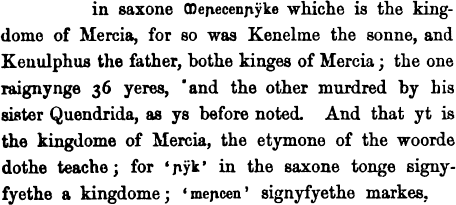
A. In the 1865 text, thorn þ is used for Saxon r ꞃ:
in saxon Meþecenþÿke which is the kingdome of Mercia, for so was Kenelme the sonne, and Kenulphus the father, both kinges of Mercia; the one reignynge 36 yeres, and the other murdred by his sister Quendrida, as ys before noted. And that yt is the kingdome of Mercia, the etymon of the woorde doth teache; for þÿk in the saxon tonge signyfyethe a kingdome; meþcen signyfyethe markes
The 1876 text uses the Saxon letterforms:
Meꞃecenꞃÿke, ꞃÿk, meꞃcen
At the time of preparation (June 2009), Saxon letters had been assigned Unicode values, but font support was extremely limited. Your browser will probably not be able to display the character.
B. Similarly for Greek Χρ (Chi, rho):
placinge ther xþemas (Christmasse) a parte of this tyme of Nowell .... ante xþi (Christi) natalitia viginti aut triginta dies quodam desiderio.
The 1876 text gives only the expanded (Roman script) form of words in Chr-.