Note 6 — Chapter IX · DURATIONS, MOMENTS AND TIME-SYSTEMS
Reading edition
The slab of nature forming a duration is limited in its temporal dimension and unlimited in its spatial dimensions. Thus it represents a finite time and infinite space.
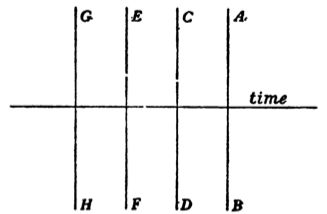
Fig. 7.
For example let the horizontal line represent the time; and assume nature to be spatially one-dimensional, so that an unlimited vertical line in the diagram represents space at an instant.
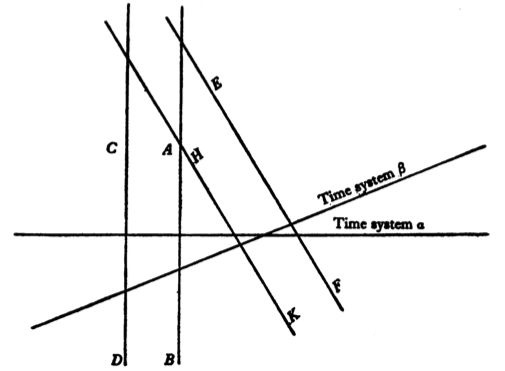
Fig. 8.
Then the area between the unlimited parallel lines and represents a duration. Also the area between and represents another duration which is extended over by the duration bounded by and . But in fig. 7 we have assumed only one time-system, which is the Newtonian hypothesis. Suppose there are many time-systems and consider two such systems and . These are represented by two lines inclined to each other. A duration of time-system is represented by the area between and , and a duration of time-system is represented by the area between and . Two such durations necessarily intersect and also can neither completely extend over the other.
These diagrams are crude illustrations of some properties of durations and are in many respects misleading as the sequel will show.